
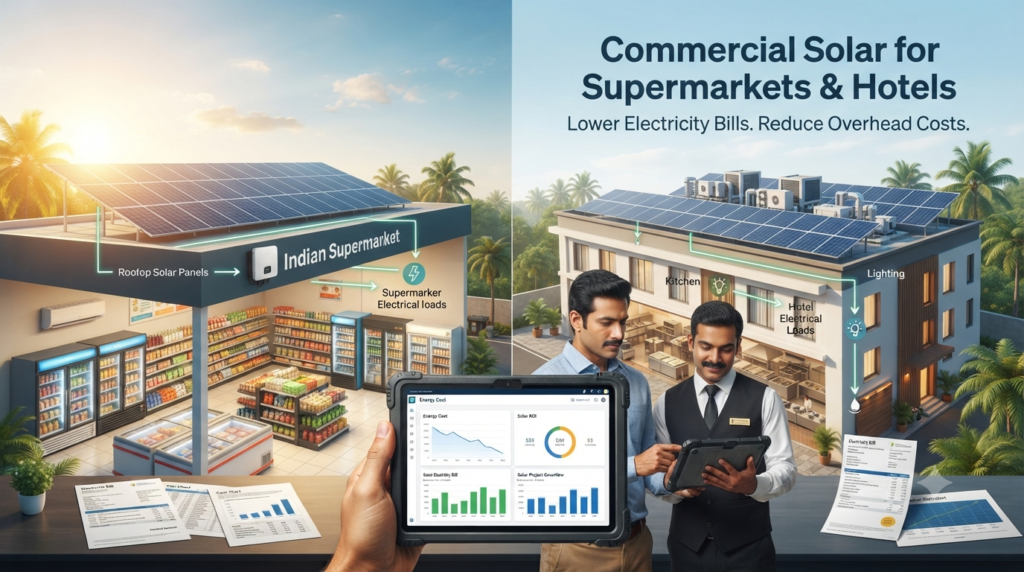
For supermarkets and hotels, electricity is not a small operating expense.
Refrigeration, air conditioning, lighting, elevators, pumps, kitchen equipment, ventilation, water heating and other systems can keep consuming electricity throughout the day.
When electricity tariffs rise, the impact goes directly into the business’s operating expenses and margins.
This is where Commercial Solar for Supermarkets and Hotels can make a meaningful difference.
But there is a common mistake in how businesses evaluate Solar.
They ask:
“How much does a Solar system cost?”
The better question is:
“How much electricity cost can this Solar system offset over its operating life, and what does that do to my total cost of running the business?”
For supermarkets and hotels in Tadepalligudem, West Godavari and across Andhra Pradesh, Solar can be particularly relevant because many of these businesses have significant daytime electricity demand.
Quick Answer: How Does Commercial Solar Reduce Overhead Costs?
Commercial Solar reduces overhead primarily by generating electricity on-site and reducing the amount of power a business needs to purchase from the grid. For supermarkets and hotels, the financial benefit can be significant because refrigeration, air conditioning, lighting, kitchens and other loads can consume substantial electricity. The actual savings depend on electricity consumption, tariff structure, Solar generation, system cost, metering arrangement, financing and operating conditions.
Solar doesn’t eliminate every electricity expense.
It can, however, reduce a significant portion of the energy component of operating costs when properly designed.
Why Electricity Costs Matter So Much for Supermarkets and Hotels
A supermarket may continuously operate:
- Refrigerators
- Freezers
- Display chillers
- Cold rooms
- Air conditioning
- Lighting
- Billing systems
- Elevators
- Water pumps
A hotel may additionally operate:
- Guest-room ACs
- Central HVAC
- Kitchen equipment
- Refrigeration
- Water heaters
- Laundry equipment
- Pumps
- Elevators
- Lighting
- Banquet facilities
These loads create a recurring electricity expense.
Unlike a one-time business expense, electricity is paid month after month.
That makes energy efficiency and Solar particularly interesting from a long-term cost perspective.
Commercial Solar Turns Part of Your Electricity Expense Into an Asset
Without Solar:
Business → Grid → Electricity Bill
With Solar:
Sunlight → Solar Panels → Inverter → Business Loads
The business generates part of its own electricity rather than purchasing all of it from the grid.
This changes the nature of the expenditure.
Instead of spending money exclusively on electricity consumption, the business invests in an energy-generating asset.
The Biggest Benefit: Lower Electricity Purchases
Consider a simplified example.
Suppose a supermarket consumes:
30,000 kWh/month
If Solar supplies:
12,000 kWh/month
then the business potentially needs to purchase only the remaining electricity from the grid, subject to system operation and applicable metering rules.
The financial benefit comes from the value of the Solar electricity that replaces grid electricity.
Solar Is Particularly Attractive When Daytime Consumption Is High
This is one reason supermarkets and hotels can be good candidates.
Solar generation generally occurs during daylight hours.
Supermarkets are often operating during the day.
Hotels may have substantial daytime loads from:
- HVAC
- Kitchen
- Pumps
- Refrigeration
- Common-area lighting
- Laundry
- Water heating
Therefore:
A business that consumes electricity while the Solar system is generating it can often make strong use of self-generated Solar power.
Supermarket Refrigeration: A Major Energy Load
Refrigeration can be one of the most important electricity-consuming systems in a supermarket.
Think about:
- Frozen-food freezers
- Beverage coolers
- Dairy refrigerators
- Meat storage
- Produce refrigeration
- Cold rooms
These systems don’t simply consume power once a day.
They require ongoing operation.
Solar generation during daylight hours can offset part of this demand.
Why Solar Can Be Valuable for Cold-Chain Loads
Refrigeration is a relatively predictable load compared with some other commercial equipment.
That can make Solar energy easier to utilise during the day.
The ideal situation is:
Solar generation ↑
while
Refrigeration demand remains high
This can increase direct Solar self-consumption.
Hotel Air Conditioning: Another Major Opportunity
Hotels can have significant HVAC loads.
Guest rooms, restaurants, lobbies, banquet halls and conference rooms may require cooling.
In Andhra Pradesh’s warm climate, air conditioning can represent a substantial portion of commercial electricity consumption.
Solar can offset part of the daytime AC demand.
Solar + Air Conditioning
Imagine a hotel with high daytime cooling demand.
During sunny hours:
Solar generation increases
and:
AC electricity demand remains high
This creates a natural match.
That doesn’t mean Solar will necessarily run every AC continuously.
The correct Solar capacity should be determined from:
- Load profile
- Maximum demand
- Annual consumption
- Roof area
- Solar resource
- Operating hours
Solar Can Reduce Demand on the Grid
Commercial electricity costs aren’t always simply:
Units × tariff
Businesses can have additional electricity-cost components depending on their tariff category and billing arrangement.
For certain commercial/industrial consumers, maximum demand and other charges can be important.
A Solar system can potentially reduce grid energy consumption and, depending on system design and applicable regulations, influence demand characteristics.
However:
Do not assume Solar automatically eliminates demand charges.
The billing structure needs to be analysed using the business’s actual electricity bills.
Why Businesses Should Analyse 12 Months of Bills
One month’s electricity bill isn’t enough.
Commercial Solar planning should ideally examine:
12 months of consumption
This helps identify:
- Seasonal demand
- Peak electricity usage
- Monthly units
- Demand charges
- Tariff changes
- Operating patterns
For hotels, seasonal occupancy can significantly affect energy consumption.
For supermarkets, refrigeration and HVAC demand may vary with weather and store activity.
Solar Reduces Operating Cost — But Not Every Cost
This distinction matters.
Solar can reduce:
Electricity purchase costs
But it doesn’t automatically reduce:
- Salaries
- Rent
- Food costs
- Property tax
- Insurance
- Maintenance
- Staff expenses
- Loan repayments
Therefore, Solar should be viewed as an energy-cost optimisation strategy, not a universal overhead solution.
Commercial Solar ROI
A basic Solar ROI calculation starts with:
Annual Solar savings
minus
Annual Solar operating costs
compared with
Initial investment
A simple payback estimate can be expressed as:
Solar Project Cost ÷ Annual Net Savings
But a professional feasibility study should go further.
It should consider:
- Financing
- Tariff escalation
- System degradation
- Maintenance
- Inverter replacement
- Taxes/accounting treatment where applicable
- Export value
- Actual operating hours
Example: Supermarket Solar Savings
Consider an illustrative supermarket:
Monthly electricity consumption: 30,000 kWh
Solar generation used to offset consumption: 12,000 kWh/month
Assume an illustrative effective electricity value of:
Rs8/kWh
Then:
12,000 × Rs8 = Rs96,000/month
Potential annual value:
Rs96,000 × 12 = Rs11.52 lakh/year
This is only an illustration, not a guaranteed saving.
Actual savings can differ significantly based on tariff, Solar generation, self-consumption and billing structure.
Example: Hotel Solar Savings
Consider an illustrative hotel:
Monthly consumption: 50,000 kWh
Suppose Solar offsets:
20,000 kWh/month
At an illustrative effective value of:
Rs8/kWh
Potential monthly electricity-cost offset:
20,000 × Rs8 = Rs1.60 lakh
Potential annual value:
Rs19.2 lakh
Again, this is an example for understanding the economics—not a promised return.
Why Self-Consumption Matters
Suppose your Solar system generates:
100 units
If your business immediately uses:
90 units
the economic value of Solar can be high because most generation is directly replacing purchased electricity.
But if the business uses only:
40 units
during generation hours, the treatment and value of the remaining electricity depend on the applicable metering arrangement.
Therefore:
Solar system sizing should be based on the business’s load profile—not simply the available roof area.
Oversizing Solar Can Be a Mistake
A common commercial Solar mistake is:
“We have a huge roof, so let’s fill it with panels.”
That’s not necessarily optimal.
A larger Solar system means:
- Higher capital investment
- More equipment
- Potentially more exported energy
- Greater financing requirement
If additional generation isn’t economically valuable under your applicable billing/metering arrangement, the extra investment may not deliver the expected return.
Solar for Supermarkets: What Should Be Analysed?
Before installation, evaluate:
Refrigeration load
AC load
Lighting load
Store operating hours
Cold-storage requirements
Rooftop area
Transformer capacity
Electricity tariff
Maximum demand
Existing DG usage
Future expansion
This produces a much more realistic Solar business case.
Solar for Hotels: What Should Be Analysed?
Hotels should consider:
- Room occupancy
- HVAC consumption
- Kitchen load
- Laundry
- Water heating
- Refrigeration
- Pumps
- Elevators
- Banquet/event usage
- Restaurant operating hours
- Rooftop availability
A hotel’s electricity consumption can vary dramatically between low-occupancy and peak periods.
Solar Can Reduce DG Dependence — But Don’t Oversell It
Many commercial properties use diesel generators for backup.
Solar can reduce grid electricity purchases during normal operation.
But a conventional grid-tied Solar system does not automatically provide power during a grid outage.
That’s an important technical point.
If backup power is required, the business may need:
- Hybrid inverter
- Battery Energy Storage System
- Appropriate backup architecture
Therefore:
On-grid Solar and backup Solar are not the same thing.
Solar + BESS for Hotels
Hotels with critical loads may consider:
Solar + Battery Energy Storage System
This can potentially provide:
- Backup power
- Load shifting
- Peak management
- Greater energy independence
But BESS adds:
Capital cost + maintenance + battery lifecycle considerations
So it should be financially justified rather than added simply because it sounds technologically advanced.
Solar for Supermarkets With Cold Storage
This is another interesting application.
Cold storage can maintain significant electricity demand throughout the day.
A Solar system can potentially offset part of:
Refrigeration + HVAC + lighting + pumps
However, refrigeration equipment should never be disconnected from necessary backup systems simply to maximise Solar utilisation.
Business continuity comes first.
Commercial Solar and Power Cuts
A standard grid-connected Solar system usually shuts down during a grid outage for safety reasons.
Therefore:
Solar panels alone ≠ blackout protection.
If the supermarket or hotel needs refrigeration, POS systems, elevators, emergency systems or critical equipment to remain operational during outages, a properly engineered backup system is needed.
Solar Can Improve Cost Predictability
Electricity tariffs can change over time.
Solar can help a business generate part of its own electricity.
That can provide some protection against future increases in purchased electricity costs.
It doesn’t eliminate tariff exposure entirely.
But it can reduce the proportion of electricity that must be bought from the grid.
Solar Financing Can Reduce Upfront Pressure
Businesses don’t always need to pay the entire Solar investment upfront.
Potential financing structures include:
- Bank term loans
- Green-energy loans
- Commercial Solar loans
- Vendor-assisted financing
- Lease/PPA structures where available
The right option depends on:
- Business credit profile
- Project size
- Cash flow
- Collateral
- Financing cost
- Ownership preference
Solar Loan vs Cash Purchase
Cash Purchase
Advantages:
- No loan interest
- Immediate ownership
- Lower long-term financing cost
Disadvantages:
- Large upfront capital requirement
- Cash tied up in the energy asset
Solar Loan
Advantages:
- Preserves working capital
- Spreads project cost
- Allows business to invest elsewhere
Disadvantages:
- Interest expense
- EMI/debt servicing
- Financing eligibility requirements
A business should compare total project economics, not just monthly EMI.
Solar Can Improve EBITDA — But Calculate It Correctly
For many businesses, reducing recurring electricity expenditure can improve operating profitability.
If Solar reduces an expense that would otherwise continue every month, the resulting savings can contribute to operating profit.
But the accounting treatment of Solar investment, depreciation, financing and other factors should be evaluated with your accountant/financial advisor.
Don’t publish or assume a specific EBITDA improvement without analysing the company’s accounts.
Solar for Supermarkets With Multiple Branches
If a supermarket chain has:
5 stores
don’t necessarily install the same Solar capacity at every location.
Each location can have different:
- Electricity consumption
- Roof area
- Shading
- Tariff
- Operating hours
- Transformer constraints
A branch-level feasibility study can identify which stores offer the best return.
Solar for Hotel Chains
The same principle applies to hotel groups.
Instead of asking:
“How many kW should every hotel get?”
ask:
“Which properties have the strongest Solar economics?”
Prioritise properties with:
- High electricity consumption
- Large usable roofs
- Strong daytime load
- Good Solar exposure
- High electricity cost
- Long expected occupancy/ownership horizon
Rooftop Space Is an Asset
For supermarkets and hotels, a large rooftop is often underutilised.
Commercial Solar converts part of that space into an electricity-generating asset.
Instead of:
Roof → unused area
you can have:
Roof → Solar generation → lower electricity purchase
The roof itself doesn’t generate revenue directly, but it can help reduce operating expenditure.
Solar Can Also Provide Shade
A properly designed rooftop Solar structure can reduce direct solar radiation reaching the roof surface.
This can potentially reduce heat transfer into the building.
For hotels and supermarkets with large roof areas, this can be a secondary benefit.
However:
Don’t treat roof cooling as the primary Solar ROI calculation.
The primary financial case should still be based on electricity economics.
Solar and Sustainability Branding
Hotels and supermarkets increasingly communicate sustainability efforts to customers.
Commercial Solar can support:
- Renewable energy goals
- Sustainability reporting
- Green branding
- Corporate ESG initiatives
But businesses should avoid vague claims such as:
“100% green hotel”
unless the underlying energy accounting supports that claim.
Use measurable data instead.
Solar Can Strengthen Corporate ESG Positioning
For larger organisations, Solar can contribute to:
- Renewable electricity usage
- Emissions reduction
- Energy-efficiency initiatives
- ESG reporting
This can be useful for companies with formal sustainability objectives.
However:
Solar installation ≠ automatically Net Zero.
Net Zero requires a broader emissions strategy.
Solar for Hotels With EV Charging
Hotels increasingly offer EV charging to guests.
This creates another electricity load.
A Solar system can potentially support daytime EV charging.
The combined strategy can be:
Solar + EV Charger + Hotel Load
But charging demand should be analysed before sizing the Solar system.
Solar for Supermarkets With EV Charging
Supermarkets can also use Solar to support:
- Customer EV charging
- Delivery vehicles
- Staff EV charging
This can create a useful relationship between:
Solar generation + daytime parking + EV charging
Solar carports can also provide shade while generating electricity.
Solar Carports for Hotels and Supermarkets
If rooftop space is limited, businesses can consider Solar carports over:
- Parking areas
- Employee parking
- Customer parking
Benefits can include:
- Solar generation
- Vehicle shade
- Better utilisation of parking space
But structural cost can be higher than a standard rooftop installation.
Commercial Solar Maintenance
Solar isn’t completely maintenance-free.
Businesses should plan for:
- Panel cleaning
- Inverter inspection
- Electrical inspection
- Monitoring
- Cable checks
- Mounting inspection
Dust and bird activity can affect performance.
For commercial installations, preventive maintenance is especially important because even a small percentage loss can translate into meaningful annual revenue/cost impact.
Monitoring Is Essential for Commercial Solar
A supermarket or hotel shouldn’t simply install Solar and forget about it.
Monitor:
Daily generation
Monthly generation
Inverter status
String performance
Abnormal drops
Historical trends
If a 100 kW system suddenly starts producing significantly less electricity, the monitoring system should help identify the issue quickly.
Commercial Solar and Inverter Selection
For larger projects, inverter selection affects:
- System efficiency
- Monitoring
- Reliability
- Maintenance
- Expansion
- Serviceability
Don’t choose an inverter solely because it has the lowest price.
Consider:
Manufacturer support + warranty + service network + efficiency + project suitability
Commercial Solar Warranty
Businesses should document:
Module product warranty
Module performance warranty
Inverter warranty
Mounting structure warranty
Installation/workmanship warranty
Battery warranty, if applicable
A commercial Solar project is a long-term asset.
Warranty documentation should be part of the project handover.
Solar for Supermarkets: Recommended Evaluation Process
Step 1
Collect 12 months of electricity bills.
Step 2
Analyse daytime consumption.
Step 3
Identify refrigeration and HVAC loads.
Step 4
Inspect roof space.
Step 5
Check shading.
Step 6
Determine Solar capacity.
Step 7
Estimate annual generation.
Step 8
Calculate self-consumption.
Step 9
Evaluate financing.
Step 10
Calculate payback and long-term ROI.
Solar for Hotels: Recommended Evaluation Process
Step 1
Analyse electricity bills.
Step 2
Map HVAC consumption.
Step 3
Analyse occupancy patterns.
Step 4
Identify kitchen/laundry loads.
Step 5
Assess rooftop/parking space.
Step 6
Model Solar generation.
Step 7
Calculate self-consumption.
Step 8
Evaluate backup requirements.
Step 9
Compare cash vs financing.
Step 10
Calculate project ROI.
Common Mistakes Businesses Make
Mistake 1: Choosing Solar Based Only on kW
The right project isn’t necessarily the biggest system.
Mistake 2: Ignoring Electricity Tariff Structure
Commercial bills can have multiple components.
Mistake 3: Assuming Solar Eliminates the Entire Bill
Fixed and other charges may remain.
Mistake 4: Ignoring Load Profile
Solar generation happens during daylight.
Mistake 5: Treating On-Grid Solar as Backup
Grid-tied Solar generally doesn’t operate during a grid outage without appropriate backup architecture.
Mistake 6: Choosing the Cheapest EPC
Installation quality affects long-term performance.
Mistake 7: Ignoring Future Expansion
A hotel may add rooms.
A supermarket may add refrigeration.
An EV charging station may be installed later.
Solar planning should consider future loads.
What Is the Best Solar Size for a Supermarket?
There is no universal answer.
It depends on:
- Monthly units
- Daytime consumption
- Roof area
- Maximum demand
- Transformer capacity
- Applicable metering
- Budget
- Future expansion
A proper load and generation study should determine the capacity.
What Is the Best Solar Size for a Hotel?
Again, there is no one-size-fits-all answer.
A small hotel may need a completely different system from a large property with:
- Central AC
- Banquet halls
- Laundry
- Restaurant
- Multiple elevators
The correct approach is to model the hotel’s actual load profile.
Why Tadepalligudem Businesses Should Consider Commercial Solar
Businesses in Tadepalligudem can evaluate Solar particularly when they have:
- Large rooftops
- High daytime electricity usage
- Refrigeration
- AC-heavy operations
- Long business operating hours
Supermarkets and hotels fit several of these characteristics.
The opportunity isn’t simply about installing panels.
It’s about reducing a recurring operating expense.
Commercial Solar in West Godavari
Across West Godavari, commercial properties such as:
- Hotels
- Supermarkets
- Restaurants
- Rice mills
- Cold storages
- Warehouses
- Factories
- Hospitals
can evaluate rooftop Solar as part of their energy-cost strategy.
The financial outcome will vary by property.
A high-quality feasibility study is more valuable than a generic claim such as:
“Solar will save 80% of your electricity bill.”
How to Calculate Your Commercial Solar Opportunity
Start with:
Annual electricity consumption
Then determine:
Daytime consumption
Then estimate:
Solar generation
Then calculate:
Self-consumption
Then determine:
Value of displaced grid electricity
Finally subtract:
Financing + O&M + other relevant costs
That gives you a much more realistic investment picture.
The Strategic Advantage of Commercial Solar
For supermarkets and hotels, Solar isn’t just about environmental branding.
It can become a cost-control strategy.
A business has limited control over:
- Electricity tariffs
- Inflation
- Labour costs
- Input costs
But it can control part of its energy infrastructure.
Investing in Solar can shift some energy expenditure toward a long-term generation asset.
How VMJ Solar Solutions Can Help Businesses in Tadepalligudem
For supermarkets, hotels and other commercial businesses in Tadepalligudem and West Godavari, the right process should start with the numbers.
Electricity Bill Analysis
↓
Load Profile
↓
Roof Assessment
↓
Solar Capacity Design
↓
Generation Estimate
↓
Self-Consumption Analysis
↓
Project Cost
↓
Financing Options
↓
ROI & Payback
↓
Installation & Monitoring
This approach helps avoid oversizing the system or making decisions based only on panel price.
FAQs
1. How does Commercial Solar reduce costs for supermarkets?
Commercial Solar generates electricity on-site, reducing the amount of electricity the supermarket needs to purchase from the grid. This can be particularly useful for refrigeration, air conditioning and lighting loads.
2. Is Solar good for hotels?
Solar can be attractive for hotels with substantial electricity consumption, especially where daytime loads from AC, kitchens, pumps, refrigeration and common areas align with Solar generation.
3. Can Solar run supermarket refrigeration?
Solar can offset electricity consumed by refrigeration systems when the Solar system is generating. However, critical refrigeration should have appropriate backup arrangements if uninterrupted operation is required.
4. Can Solar run hotel ACs?
Solar can offset part of the electricity used by hotel AC systems during Solar generation hours. The required Solar capacity depends on the hotel’s actual load and operating profile.
5. Will Commercial Solar eliminate my electricity bill?
Usually, businesses should not assume the entire electricity bill will disappear. Fixed charges, demand-related charges and other billing components may remain depending on the tariff and metering arrangement.
6. How much can a supermarket save with Solar?
There is no universal percentage. Savings depend on electricity consumption, tariff, Solar capacity, generation, self-consumption and applicable metering arrangements.
7. How much Solar does a hotel need?
The required capacity depends on annual electricity consumption, daytime load, roof area, shading, tariff structure and future energy requirements.
8. Is rooftop Solar better than ground-mounted Solar for businesses?
If a suitable roof is available, rooftop Solar can utilise otherwise unused space. Ground-mounted Solar may provide greater design flexibility but requires suitable land and can involve additional costs.
9. Can Commercial Solar reduce demand charges?
It can influence grid demand under some operating conditions, but businesses should not assume demand charges will disappear. The actual tariff structure and load profile must be analysed.
10. Can Solar work during a power cut?
A standard grid-connected Solar system normally shuts down during a grid outage for safety. Backup operation requires suitable hybrid/BESS architecture.
11. Is Solar financing available for supermarkets and hotels?
Eligible businesses can explore commercial Solar loans and other financing structures. The appropriate financing depends on business financials, project size, lender requirements and cash flow.
12. Is Commercial Solar worth it in Andhra Pradesh?
It can be financially attractive for businesses with substantial electricity consumption and suitable Solar conditions. A property-specific feasibility study should determine the actual ROI.
13. Is Solar suitable for supermarkets with cold storage?
It can be particularly relevant because refrigeration and cold-storage loads can create substantial electricity demand. The Solar system should be sized around actual consumption and operating patterns.
14. Can Solar help hotels reduce overhead costs?
Yes. Reducing purchased electricity can lower one component of hotel operating expenses. The actual savings depend on system design, consumption and electricity tariffs.
15. Is Commercial Solar worth considering in Tadepalligudem and West Godavari?
Businesses in Tadepalligudem and West Godavari can evaluate Solar based on their electricity consumption, roof area, daytime loads and tariff structure. Supermarkets and hotels with substantial daytime demand can be particularly suitable candidates.
Conclusion
For supermarkets and hotels, Commercial Solar is fundamentally an operating-cost decision.
The strongest business case isn’t:
“Solar panels are good for the environment.”
It is:
“How much of our recurring electricity expenditure can we replace with electricity generated from our own Solar asset?”
For supermarkets, that may mean offsetting electricity used by:
Refrigeration + Freezers + AC + Lighting + Pumps
For hotels:
HVAC + Kitchen + Refrigeration + Laundry + Pumps + Lighting
The key is to design the system around the actual load profile.
For businesses in Tadepalligudem and West Godavari, the smartest approach is to analyse the previous 12 months of electricity bills, determine daytime consumption, model Solar generation, evaluate self-consumption and then compare the project’s total cost against realistic electricity savings.
Don’t buy the biggest Solar system you can fit on the roof.
Buy the Solar system that produces the strongest financial return for the business.
That is how Commercial Solar becomes more than a renewable-energy project—it becomes a long-term overhead-cost reduction strategy.