
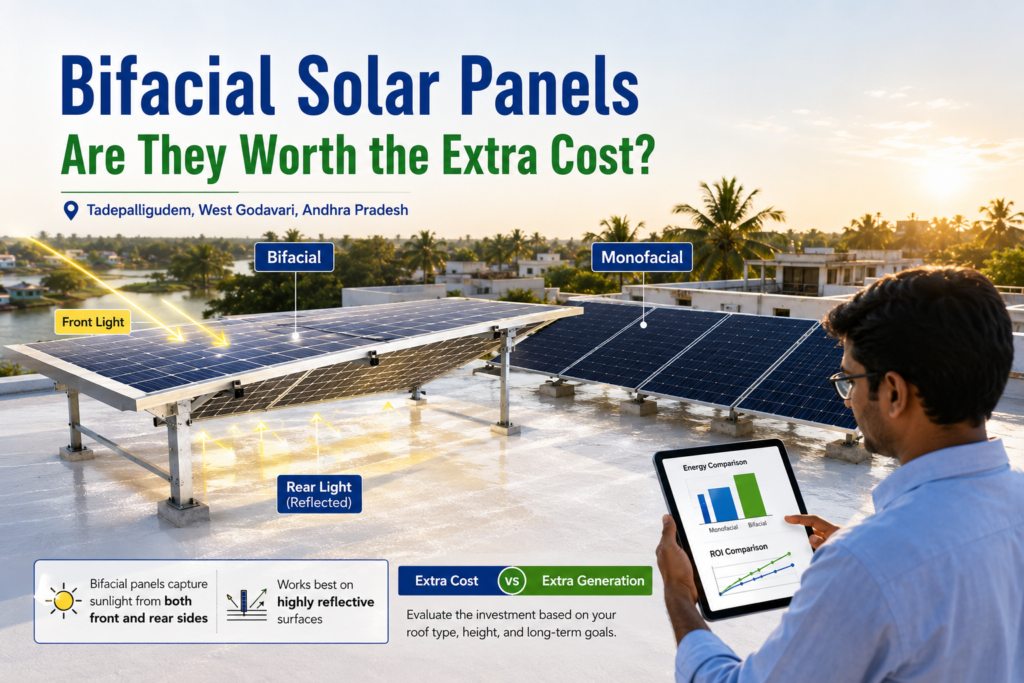
When homeowners compare Solar panels, one question is becoming increasingly common:
“Should I choose bifacial Solar panels because they can generate electricity from both sides?”
It sounds like an obvious upgrade.
If a conventional Solar panel captures sunlight primarily from the front, while a bifacial Solar panel can capture light reaching its rear side as well, shouldn’t the bifacial panel always produce more electricity?
Not necessarily.
Bifacial technology can deliver additional energy in the right installation conditions. But the rear side only adds meaningful generation when enough useful light reaches it.
A bifacial module installed directly above a dark roof with very little rear-side light may not deliver the dramatic improvement some advertisements suggest.
For homeowners in Andhra Pradesh, Tadepalligudem and West Godavari, the better question isn’t:
“Are bifacial panels better?”
It’s:
“Will my roof and mounting design allow the rear side of a bifacial panel to produce enough additional energy to justify its extra cost?”
That’s the calculation that matters.
Quick Answer: Are Bifacial Solar Panels Worth the Extra Cost?
Bifacial Solar panels can be worth the additional cost when the installation provides good rear-side light exposure, sufficient panel-to-roof clearance and a reflective surface. They tend to be more attractive for elevated rooftop systems, ground-mounted installations and commercial projects than for tightly mounted residential rooftops. The actual additional energy yield varies significantly with site conditions.
So don’t buy bifacial modules simply because:
“Two-sided panel = double generation.”
That is not how bifacial Solar works.
What Are Bifacial Solar Panels?
A bifacial Solar panel is a module designed to generate electricity from sunlight reaching both:
Front side
and
Rear side
A conventional monofacial panel primarily relies on sunlight entering through its front surface.
A bifacial module can use additional reflected or scattered light reaching its rear surface.
The additional energy comes from light reflected from surfaces such as:
- White roofs
- Light-coloured concrete
- Gravel
- Sand
- Certain reflective roofing materials
This reflected-light property is called albedo.
What Is Albedo?
Albedo is simply a measure of how much sunlight a surface reflects.
Think of:
Dark surface
Absorbs more sunlight → lower reflection.
White/light surface
Reflects more sunlight → higher reflection.
For bifacial Solar:
More useful light reaching the rear of the panel can mean more additional generation.
This is why installation design matters so much.
Do Bifacial Panels Generate Electricity From the Back?
Yes.
But there needs to be light available behind the module.
The rear side doesn’t magically generate electricity in darkness.
If the panel is mounted:
2–3 cm above a dark roof
there may be relatively little useful light reaching its rear surface.
If it is mounted:
higher above a reflective surface
the rear side may receive considerably more reflected and diffuse light.
Bifacial Does NOT Mean Double Electricity
This is probably the biggest misconception.
Suppose a panel generates:
100 units from the front
It does not automatically generate:
100 additional units from the rear.
The additional rear-side generation depends on:
- Rear irradiance
- Albedo
- Mounting height
- Panel spacing
- Row spacing
- Shading
- Module design
- Installation geometry
- Location
- Weather
Therefore:
Bifacial gain is site-specific.
How Much More Energy Can Bifacial Panels Produce?
There is no universal percentage.
Depending on installation conditions, bifacial systems can achieve a meaningful additional yield compared with equivalent monofacial systems.
But the actual gain can range from small to substantial.
A rooftop with:
- Low clearance
- Dark surface
- Dense panel layout
may see limited rear-side contribution.
A well-designed system with:
- High clearance
- Reflective surface
- Good spacing
- Strong rear illumination
can achieve a much larger bifacial advantage.
Therefore, don’t accept a fixed claim such as:
“Bifacial gives 30% more electricity.”
without a site-specific basis.
Bifacial vs Monofacial Solar Panels
| Feature | Monofacial | Bifacial |
|---|---|---|
| Front-side generation | Yes | Yes |
| Rear-side generation | Minimal/not designed for it | Yes |
| Requires rear-side light | No | Yes for additional gain |
| Best installation | Broadly suitable | Elevated/reflective installations |
| Rooftop suitability | Very broad | Depends on roof design |
| Ground-mounted suitability | Good | Often attractive |
| Potential energy yield | Standard | Potentially higher |
| Installation sensitivity | Lower | Higher |
| ROI | Often straightforward | Depends on bifacial gain + price premium |
Why Bifacial Panels Are Becoming Popular in India
India has seen rapid Solar deployment across:
- Utility-scale Solar
- Commercial rooftops
- Industrial installations
- Ground-mounted projects
- Large institutional projects
Bifacial modules can be attractive where developers have enough space to optimise:
Height + spacing + albedo + orientation
For large projects, even a relatively modest percentage increase in annual generation can have significant financial value.
Are Bifacial Panels Better for Homes?
Sometimes.
This depends heavily on the roof.
For a typical residential rooftop, the installer may want to maximise:
Panels per square metre
That can result in panels being mounted relatively close to the roof.
If the rear side receives very little light, the bifacial advantage can shrink.
In such a situation:
Paying a large premium for bifacial technology may not be economically justified.
When Bifacial Makes More Sense on a Rooftop
Bifacial Solar can become more interesting when:
1. Panels are elevated
More space underneath can allow additional light to reach the rear.
2. Roof is light-coloured
A reflective surface can increase rear-side irradiance.
3. Panels have sufficient spacing
This can improve exposure to reflected/diffuse light.
4. There is minimal obstruction underneath
5. The price premium is small
This is crucial.
The Price Premium Matters More Than the Technology
Suppose:
Monofacial system
₹X
Bifacial system
RsX + RsY
If bifacial increases annual generation only slightly, the additional cost may take many years to recover.
But if:
Extra cost = small
and
Extra annual generation = meaningful
then bifacial can make economic sense.
So:
Don’t ask whether bifacial is better. Ask whether bifacial’s extra generation pays for its extra cost.
A Simple Bifacial ROI Example
Suppose, purely as an illustration:
Monofacial system
Annual generation:
5,000 kWh
Bifacial system
Annual generation:
5,400 kWh
Additional generation:
400 kWh/year
If the value of that additional electricity is approximately:
Rs7/kWh
then additional annual value is:
400 × Rs7 = Rs2,800
If the bifacial upgrade costs:
Rs20,000 extra
simple additional payback would be roughly:
Rs20,000 ÷ Rs2,800 ≈ 7.1 years
This is only an illustrative example.
Actual economics depend on:
- Tariff
- Self-consumption
- Export compensation
- Solar yield
- Degradation
- Financing
- Additional maintenance
- System lifespan
What If the Bifacial Premium Is Very Small?
Then the decision changes.
If bifacial costs only slightly more than an equivalent monofacial system and provides measurable additional generation, it can become attractive.
This is why the market price difference matters.
Don’t decide based on technology alone.
Bifacial Solar in Tadepalligudem
For homeowners in Tadepalligudem, a bifacial system should be evaluated based on the actual rooftop.
Ask the installer to assess:
- Roof colour
- Roof material
- Panel clearance
- Shadow
- Mounting height
- Panel arrangement
- Row spacing
- Rear-side exposure
A white/light-coloured terrace with elevated mounting may provide better conditions than a tightly mounted panel over a dark surface.
Bifacial Solar in West Godavari
The same principle applies across West Godavari.
Local conditions such as:
- Dust
- Humidity
- Rain
- Roof material
- Bird activity
- Shading
can affect overall Solar generation.
However, these factors don’t automatically make bifacial panels better or worse.
The key question remains:
How much useful light reaches the rear side?
Does Rain Help Bifacial Panels?
Rain doesn’t directly make a bifacial module more powerful.
However, wet/light-coloured surfaces can change the amount of reflected light reaching the rear side.
The effect depends on:
- Surface
- Sun angle
- Weather
- Module height
- Installation geometry
So don’t treat rainy weather as a guaranteed bifacial advantage.
Does Dust Reduce Bifacial Gain?
It can.
Dust can affect:
Front-side generation
and potentially
Rear-side generation
if the rear surface or surrounding reflective area becomes heavily soiled.
This is particularly relevant where:
- Agricultural dust is present
- Construction activity occurs
- Roads are nearby
- Bird activity is high
Regular maintenance remains important.
Can Bifacial Panels Work on a White Roof?
Yes — and this can be a favourable condition.
A white or highly reflective rooftop can reflect more sunlight toward the rear of the panel.
But don’t assume:
White roof = 30% extra generation.
The actual gain depends on the entire installation.
Can Bifacial Panels Work on a Dark Roof?
Yes.
They will still generate electricity from the front.
The question is whether the rear side gets enough reflected light to provide a meaningful additional contribution.
A dark roof may offer less rear-side reflection than a bright surface.
Bifacial Panels on RCC Roofs
Many homes in Andhra Pradesh have RCC terraces.
Bifacial panels can be installed on RCC rooftops.
But the mounting structure should provide appropriate:
- Clearance
- Stability
- Wind resistance
- Drainage access
- Maintenance access
The exact mounting design matters more than simply choosing a bifacial module.
Bifacial Panels on Metal Roofs
Bifacial panels can also be used on certain metal-roof installations.
However, the system should be designed around:
- Roof structure
- Wind loading
- Corrosion resistance
- Mounting method
- Rear-side light availability
A metal roof isn’t automatically an ideal bifacial surface.
Bifacial Panels on Carports
Solar carports can be particularly interesting for bifacial modules.
Why?
Because panels can be elevated above the ground.
Light can reach both sides.
The ground underneath may also reflect some light.
This creates a more favourable geometry than a panel installed almost directly against a rooftop.
Bifacial Panels for Commercial Buildings
Commercial rooftops can sometimes provide better opportunities for bifacial systems because they may have:
- Larger roof areas
- Higher mounting structures
- Greater panel spacing
- Light-coloured roofs
- More predictable daytime loads
For businesses, however, the economics should be based on actual:
₹/kWh savings + project cost + financing + Solar yield
rather than marketing claims.
Bifacial Solar for Factories
For factories with large roofs, bifacial Solar may be worth evaluating.
Especially when:
- Roof has high reflectivity
- Panels can be elevated
- Electricity consumption is high during daytime
- Roof space is available
- Bifacial price premium is reasonable
The larger the installation, the more valuable even a modest generation improvement can become.
Bifacial Solar for Schools and Institutions
Schools may also evaluate bifacial panels for:
- Rooftop Solar
- Elevated structures
- Solar carports
- Institutional buildings
The decision should consider:
Lifecycle cost + generation + maintenance + safety
rather than panel technology alone.
Bifacial Panels for Agricultural Solar
Bifacial modules can be interesting for:
- Ground-mounted Solar
- Agricultural Solar projects
- Solar pump installations
- Elevated structures
- Agrivoltaic applications
Ground-mounted systems can provide more opportunities to optimise rear-side light.
Bifacial Solar for Solar Pumps
If panels are elevated over a suitable ground surface, bifacial modules may potentially capture additional reflected light.
But the additional energy should be quantified.
For agricultural applications:
Pump operating requirements should be compared against expected Solar generation.
Don’t size a pump Solar system based only on panel wattage.
What Is Bifaciality Factor?
You may see another term in Solar datasheets:
Bifaciality Factor
This describes the rear-side electrical response relative to the front-side performance under specified test conditions.
For example, a module might have a bifaciality factor expressed as a percentage.
But:
Bifaciality factor is not the same as actual energy gain.
A high bifaciality factor doesn’t guarantee high rear-side generation.
Why?
Because you still need actual light behind the panel.
Bifaciality Factor vs Bifacial Gain
This distinction is important.
Bifaciality Factor
A module characteristic.
Bifacial Gain
The additional energy actually produced by the complete system.
Bifacial gain depends on the site.
Therefore:
High bifaciality ≠ guaranteed high energy gain.
How Does Panel Height Affect Bifacial Gain?
Generally, increasing clearance can allow more light to reach the rear surface.
But higher mounting also affects:
- Wind load
- Structure cost
- Roof access
- Shading geometry
- Installation cost
So there is a trade-off.
You shouldn’t increase panel height indefinitely just to chase bifacial gain.
Why Ground-Mounted Solar Can Be Ideal for Bifacial
Ground-mounted systems provide more freedom to control:
Panel height
Row spacing
Ground surface
Tilt
Orientation
Rear-side exposure
This makes bifacial technology particularly attractive for utility-scale Solar.
Can Bifacial Panels Increase Solar Generation in Winter?
Potentially.
The actual effect depends on:
- Sun angle
- Ground/roof reflectivity
- Weather
- Module orientation
- Rear-side exposure
Bifacial performance isn’t simply a summer phenomenon.
Do Bifacial Panels Need Special Inverters?
Not necessarily.
Bifacial modules still produce DC electricity.
The inverter is selected based on:
- Module electrical characteristics
- String design
- System capacity
- Voltage/current limits
- Installation architecture
The inverter does not necessarily need a special “bifacial mode.”
However, the complete system must be correctly designed for the actual module specifications.
Do Bifacial Panels Need Special Mounting?
Often, yes — if you want to maximise the rear-side benefit.
A bifacial panel can physically be mounted like a conventional module.
But if the rear side is blocked or very close to a surface, you may sacrifice much of its potential advantage.
Therefore, mounting design becomes more important.
Transparent Backsheet vs Glass-Glass Modules
Many bifacial modules use glass-glass construction, allowing light to reach the rear cells.
This can provide:
- Rear-side light transmission
- Structural characteristics
- Potential durability benefits depending on design
But glass-glass modules may also be:
- Heavier
- More demanding in handling
- Different in mounting requirements
Always check the manufacturer’s installation instructions.
Are Bifacial Panels More Fragile?
Not automatically.
Module durability depends on:
- Glass design
- Frame
- Manufacturing quality
- Installation
- Mechanical loading
- Environmental conditions
Don’t judge durability solely from the fact that the panel is bifacial.
What About Andhra Pradesh’s Hot Weather?
High temperatures can reduce PV module electrical output.
This affects both monofacial and bifacial panels.
Good airflow behind elevated panels can help heat dissipate.
But don’t confuse:
Better rear ventilation
with:
Bifacial gain.
Both can occur, but they are different effects.
Bifacial Panels and Roof Temperature
Elevated Solar panels can shade the roof and potentially reduce heat entering the building.
This isn’t unique to bifacial modules.
A monofacial module can provide similar roof shading.
Therefore:
Don’t pay a bifacial premium solely because you want a cooler roof.
Bifacial Solar and Property Value
A well-installed rooftop Solar system may be viewed as a home improvement.
But don’t assume:
Bifacial panels = higher property resale value
automatically.
Property value depends on:
- Location
- Property quality
- Solar system ownership
- Electricity costs
- System condition
- Documentation
- Buyer preferences
Should You Choose Bifacial Panels for a New Home?
Consider them if:
✔ You have an elevated mounting design
✔ Roof is reflective
✔ Rear side has good light exposure
✔ Bifacial premium is reasonable
✔ Installer can provide a realistic generation estimate
Consider monofacial if:
✔ Panels sit close to the roof
✔ Rear side is mostly blocked
✔ Roof is dark
✔ Bifacial premium is high
✔ Your installer cannot quantify expected additional generation
Bifacial Solar: 7 Questions to Ask Your Installer
1. What is the bifaciality factor of the module?
2. What rear-side irradiance are you expecting?
3. What additional annual kWh do you estimate?
4. What is the price premium over monofacial?
5. What mounting height will be used?
6. What is the roof’s effective reflectivity?
7. What is the estimated payback for the additional bifacial cost?
If the answer to question #3 is:
“It will definitely generate 30% more.”
Ask for the calculation.
How to Compare Two Solar Quotations
Suppose you receive:
Quote A
Monofacial
₹X
Quote B
Bifacial
RsX + RsY
Don’t simply choose Quote B because it has a newer technology.
Ask both vendors for:
Expected annual kWh
Then calculate:
Additional annual generation
Bifacial kWh − Monofacial kWh
Then:
Additional value
Additional kWh × effective electricity value
Then:
Simple additional payback
Bifacial price premium ÷ additional annual value
This is a much more useful comparison.
What If Your Installer Cannot Give a Bifacial Generation Estimate?
That’s a warning sign.
They don’t need to predict the exact electricity output.
Solar generation always has uncertainty.
But a professional installer should be able to explain:
- Why bifacial is appropriate
- Expected rear-side contribution
- Assumptions used
- Mounting configuration
- Expected annual generation
If they can’t explain the assumptions, you’re buying marketing rather than engineering.
Bifacial Solar and Net Metering
If your system is eligible for net metering under the applicable rules, additional Solar generation can potentially increase the amount of electricity available for self-consumption/export.
But the economic value of that extra generation depends on the applicable:
- Tariff
- Metering arrangement
- Export treatment
- DISCOM rules
So bifacial gain should be converted into actual financial value, not just kWh.
Is Bifacial Solar Eligible for PM Surya Ghar?
Eligibility is not determined simply by the word “bifacial.”
For subsidised residential rooftop Solar, the system and components must comply with the applicable PM Surya Ghar/MNRE/DISCOM requirements, including applicable module/model eligibility and procurement conditions.
Before purchasing, confirm that the exact module model is acceptable for the scheme you’re applying under.
Bifacial Solar and ALMM
The Approved List of Models and Manufacturers (ALMM) is relevant to specified government-supported Solar projects.
If your residential project is being installed under a scheme requiring ALMM-compliant modules, verify the exact model and manufacturer, not merely the manufacturer’s brand.
This is especially important when a vendor offers:
“Premium bifacial panel.”
Ask:
“Is this exact model eligible under the applicable scheme?”
Are Bifacial Solar Panels More Expensive?
They can carry a price premium, although the difference varies by:
- Brand
- Module wattage
- Technology
- Market conditions
- Availability
- Project volume
Don’t use a fixed price premium in your financial calculation unless you have a current quotation.
Maintenance of Bifacial Panels
Maintenance is broadly similar to other PV modules:
- Periodic cleaning
- Visual inspection
- Cable checks
- Inverter monitoring
- Mounting inspection
However, because rear-side generation matters, don’t overlook the area behind the panels.
Obstructions or dirt underneath may reduce rear-side illumination.
Can You Clean Bifacial Panels Normally?
Yes, subject to the manufacturer’s cleaning instructions.
Use:
- Clean water where appropriate
- Soft cleaning tools
- Proper safety procedures
Avoid:
- Abrasive materials
- Harsh chemicals
- Walking on modules
- High-pressure cleaning that may damage components
Bifacial Panels During Cyclones
Andhra Pradesh can experience severe weather events.
Bifacial modules aren’t automatically more cyclone-resistant.
The critical factors include:
Mounting structure
Fasteners
Wind-load design
Roof anchoring
Installation quality
Building condition
A premium panel installed on a weak structure is still a poor Solar system.
Bifacial vs Monofacial: The Real Decision
Choose Bifacial when:
Rear-side light is available + price premium is reasonable + additional generation has measurable value.
Choose Monofacial when:
Rear-side light is limited + installation is tightly mounted + bifacial premium isn’t justified.
That’s the entire decision in one sentence.
Bifacial Solar for Tadepalligudem Homeowners
If you’re installing rooftop Solar in Tadepalligudem, don’t let the label “bifacial” determine the system.
Have your installer inspect:
Roof → Mounting → Reflectivity → Clearance → Shadow → Panel spacing → Annual generation
Then compare the bifacial option against a high-quality monofacial alternative.
Bifacial Solar for West Godavari Businesses
For larger commercial rooftops in West Godavari, bifacial technology can be worth a detailed feasibility study.
Particularly for:
- Factories
- Warehouses
- Schools
- Cold storages
- Rice mills
- Commercial buildings
- Solar carports
The larger the installation, the more important accurate yield modelling becomes.
The Bottom Line
Bifacial Solar panels can be excellent technology—but they’re not automatically the best choice for every roof.
Their advantage comes from the additional sunlight reaching the rear side.
That means the real equation is:
Bifacial Technology + Good Rear-Side Light + Suitable Mounting + Reasonable Price Premium = Potentially Better ROI
Without those conditions, a conventional high-quality monofacial panel may provide better value.
For homeowners in Tadepalligudem and West Godavari, don’t ask your installer:
“Is bifacial better?”
Ask:
“How many additional kWh will bifacial generate on my roof, how much extra will it cost, and how long will that extra investment take to pay back?”
That’s the question that turns Solar marketing into a real investment decision.
FAQs
1. What are bifacial Solar panels?
Bifacial Solar panels are designed to generate electricity from both their front and rear sides. The additional rear-side energy comes from sunlight reflected or scattered onto the back of the module.
2. Do bifacial panels generate twice as much electricity?
No. Bifacial does not mean double generation. The additional output depends on rear-side light, roof reflectivity, mounting height, spacing, shading and other site conditions.
3. Are bifacial Solar panels worth the extra cost?
They can be, but only when the additional generation justifies the price premium. Elevated and reflective installations generally offer better conditions for bifacial gain.
4. Are bifacial panels good for residential rooftops?
They can be suitable, but the roof design matters. Panels installed very close to a dark roof may receive limited rear-side light and therefore produce less additional energy.
5. Are bifacial panels better than monofacial panels?
Not universally. Bifacial panels have higher potential in suitable installations, while monofacial panels may provide better value where rear-side light is limited.
6. What is bifacial gain?
Bifacial gain is the additional energy generated because the rear side of a bifacial module receives useful light. It varies by installation and should not be treated as a fixed percentage.
7. What is bifaciality factor?
Bifaciality factor describes the module’s rear-side electrical response relative to its front-side response under specified test conditions. It is a module characteristic, not a guarantee of actual site-level energy gain.
8. Do bifacial panels work on RCC roofs?
Yes. They can work on RCC rooftops, especially when the mounting design provides adequate rear-side exposure. Roof reflectivity and panel clearance should be evaluated.
9. Are bifacial panels suitable for white roofs?
A light-coloured or reflective roof can provide favourable conditions because more light may be reflected toward the rear of the panel.
10. Are bifacial panels suitable for dark roofs?
Yes, but the rear-side gain may be lower if the dark roof reflects less light and the panels are installed close to the surface.
11. Do bifacial panels require a special inverter?
Not necessarily. The inverter should be appropriately matched to the module’s electrical specifications and the complete Solar system design.
12. Are bifacial panels eligible for PM Surya Ghar subsidy?
Eligibility depends on the exact module/system and the applicable scheme requirements. Confirm the exact model’s eligibility with the current PM Surya Ghar/MNRE/DISCOM requirements before purchase.
13. Are bifacial panels more expensive?
They can have a price premium, but the difference varies with brand, technology and market conditions. Compare current quotations rather than using a fixed assumed premium.
14. Are bifacial panels good for commercial Solar projects?
They can be particularly attractive for elevated, ground-mounted, carport and large commercial installations where rear-side light can be optimised.
15. How do I know if bifacial is right for my roof?
Ask your installer to compare a bifacial and monofacial design using your actual roof conditions and provide expected annual kWh, additional bifacial generation and the payback of the price premium.