
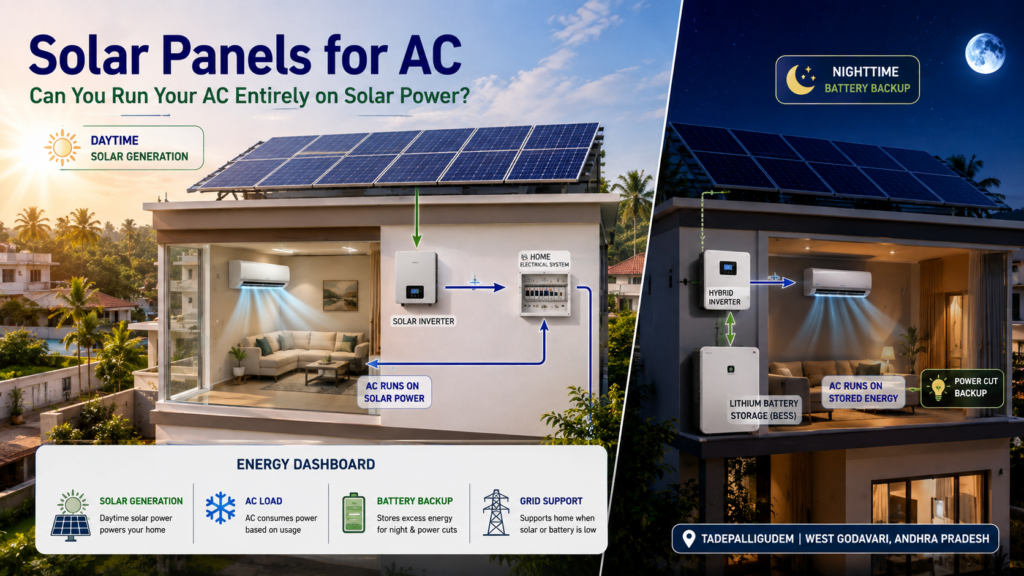
Summer arrives, the AC goes on, and the electricity bill follows.
For many homeowners in Tadepalligudem, West Godavari and across Andhra Pradesh, air conditioning can become one of the biggest household electricity loads during hot months.
That naturally leads to an attractive question:
“Can I run my AC entirely on Solar power and stop paying for the electricity it consumes?”
The short answer is: Yes, technically — but the system has to be designed correctly.
The bigger question is how you want to run the AC.
There are three very different possibilities:
- Grid-connected Solar + AC
- Solar + Battery + AC
- Dedicated off-grid Solar AC system
These are not interchangeable.
A homeowner who wants to run a 1.5-ton AC during sunny afternoons has a very different requirement from someone who wants the same AC to run through the night during a power cut.
So before buying more Solar panels, understand the load.
Quick Answer: Can Solar Panels Run an Air Conditioner?
Yes. A properly sized Solar PV system can supply the electricity needed to operate an air conditioner. A grid-connected system can offset AC consumption through Solar generation, while a Solar-plus-battery system can provide greater independence during grid outages. The required Solar capacity depends on the AC’s actual power consumption, operating hours, other household loads, Solar generation and whether battery backup is required.
India has substantial Solar resource; MNRE notes that most parts of India receive roughly 4–7 kWh/m²/day of solar energy, although actual rooftop generation varies by location, weather, system orientation, shading and equipment.
First Understand One Important Difference
There is a big difference between:
“Can Solar generate enough energy to offset my AC usage?”
and
“Can my AC run directly from Solar even when the grid is unavailable?”
The first is relatively straightforward with a properly designed on-grid rooftop Solar system.
The second generally requires:
Solar + suitable inverter architecture + battery storage
or a purpose-designed off-grid/hybrid solution.
How Much Electricity Does an AC Consume?
Don’t size Solar based only on the AC’s advertised tonnage.
A:
1.5-ton AC
doesn’t necessarily consume exactly:
1.5 kW
of electricity.
Its actual electrical input varies with:
- Model
- Inverter technology
- Room temperature
- Set temperature
- Outdoor temperature
- Compressor speed
- Room insulation
- Number of occupants
- Door opening
- Indoor heat load
A modern inverter AC may modulate its power consumption rather than continuously drawing the same amount.
Therefore:
Check the AC’s actual rated input power and energy-consumption specifications instead of assuming “1 ton = 1 kW.”
Can a 3kW Solar System Run a 1.5-Ton AC?
It can, under some conditions, but that does not mean a 3 kW Solar system is automatically sufficient for the entire home plus the AC.
Suppose your Solar system is producing strong daytime output.
The energy flow could look like:
Solar Panels → Solar Inverter → AC + Home Loads
If the AC needs around 1–1.5 kW at a particular moment and Solar is producing enough power, the AC can operate.
But the same home may simultaneously be using:
- Refrigerator
- Fans
- Lights
- TV
- Water pump
- Computers
- Kitchen appliances
So:
AC load ≠ Total household load
This is why Solar sizing should consider the whole load profile.
Can a 5kW Solar System Run a 1.5-Ton AC?
A properly designed 5 kW rooftop Solar system provides substantially more generation capacity than a smaller 3 kW system and can be a better fit for homes with high daytime consumption.
For example:
Solar generation
→ AC
→ Fans
→ Refrigerator
→ Other daytime loads
But again:
5 kW Solar does not mean 5 kW is available continuously all day.
Solar output rises and falls throughout the day.
Solar Output Is Not Constant
This is one of the biggest misconceptions.
At:
8:00 AM
Solar output may still be building.
12:30 PM
Generation may be much stronger.
5:30 PM
Output may be declining.
Night
Rooftop PV produces no electricity without sunlight.
Therefore, an AC that runs:
1 PM–4 PM
has a very different Solar requirement from one that runs:
7 PM–11 PM.
What Happens When Clouds Come?
Solar generation falls when sunlight is reduced.
Your AC doesn’t automatically reduce its electricity requirement just because clouds appear.
With an on-grid Solar system:
Solar insufficient → Grid supplies the difference
This is one reason grid-connected Solar is convenient.
You don’t necessarily need a huge battery simply to operate your AC during the day.
On-Grid Solar + AC: The Practical Option for Many Homes
For homeowners connected to the electricity grid, this can be one of the simplest approaches.
The basic concept:
Solar Panels
↓
Grid-connected inverter
↓
Home electrical system
↓
AC + Other Appliances
When Solar generation is insufficient:
Grid → Home
When Solar generation exceeds household demand:
Surplus → Grid, subject to the applicable metering arrangement.
MNRE’s rooftop Solar programme provides for grid-connected residential rooftop systems and CFA through the National Portal/DISCOM mechanisms, with installation and DISCOM verification forming part of the process.
Does On-Grid Solar Run the AC During a Power Cut?
Normally, no.
This is an extremely important point.
A standard grid-connected inverter generally shuts down when the utility grid goes down because of anti-islanding safety requirements.
So:
Solar panels + normal on-grid inverter
does not automatically mean
AC backup during a power cut.
If backup is important, you need an appropriate hybrid/battery-based architecture.
Solar + Battery + AC
Now consider a different situation.
You want your AC to continue operating during a power cut.
The architecture becomes:
Solar Panels
↓
Hybrid Inverter
↓
Battery
↓
AC + Selected Loads
This can provide backup.
But there is a catch:
Battery size can become expensive very quickly.
Why AC Is Difficult for Batteries
Consider a simplified example.
Suppose an AC averages:
1.2 kW
for:
5 hours
Energy required:
1.2 × 5 = 6 kWh
That’s 6 kWh of AC energy alone.
Now add:
- Inverter losses
- Battery losses
- Refrigerator
- Fans
- Lights
- Wi-Fi
- Other appliances
The required battery capacity becomes larger.
And actual AC consumption varies with operating conditions.
A 5kWh Battery Doesn’t Mean 5kWh of AC Runtime
A battery advertised at:
5 kWh
doesn’t necessarily deliver 5 kWh of usable AC-side energy.
There are:
- Conversion losses
- Battery operating limits
- Inverter losses
- Temperature effects
- Reserve requirements
Therefore, system design should use usable energy, not just the nameplate capacity.
Want AC All Night on Solar?
This is where the economics become more challenging.
Suppose you want:
AC from 9 PM to 5 AM
There is no Solar generation during those hours.
So your system needs:
Large battery
and
Enough daytime Solar
to recharge it.
That’s fundamentally different from:
AC running directly from Solar at 1 PM.
Daytime AC vs Night-Time AC
| Requirement | Best-Fit Approach |
|---|---|
| AC mainly during sunny afternoon | On-grid Solar can work well |
| AC during day + occasional grid support | On-grid Solar |
| AC during power cuts | Hybrid Solar + battery |
| AC every night without grid | Large Solar + battery/off-grid design |
| Whole house + AC backup | Larger hybrid system |
| One small AC + essential loads | Carefully sized hybrid system |
Why Inverter AC Is Better for Solar
An inverter AC can vary compressor speed according to cooling demand.
This can help reduce unnecessary cycling and improve efficiency compared with less efficient fixed-speed operation, depending on the model and operating conditions.
For Solar users, an efficient AC can be particularly valuable because:
Reducing the AC’s electricity consumption can be cheaper than adding more Solar capacity.
Before Adding More Solar, Improve the Room
This is where homeowners often make the wrong investment.
If your room is poorly insulated and gets direct afternoon heat, the AC has to work harder.
Consider:
Roof insulation
Curtains/blinds
External shading
Efficient windows
Sealing air leaks
Reflective roof treatment where appropriate
Efficient ceiling fans
Then calculate the Solar requirement.
Solar + AC + Ceiling Fan
A ceiling fan can improve perceived comfort without requiring the AC to operate at an extremely low temperature.
For example:
AC + fan
may allow comfortable operation at a slightly higher thermostat setting than:
AC alone
depending on the room and occupants.
That can reduce cooling energy use.
Don’t Set the AC to 18°C Just Because You Have Solar
This is a common psychological trap.
People think:
“Solar is generating free electricity, so I can run the AC at 18°C.”
But the AC still has to remove more heat to reach and maintain a lower temperature.
Solar electricity is not literally free after installation and financing costs.
Your goal should be:
Efficient comfort, not maximum electricity consumption.
Can Solar Run Two ACs?
Yes, a sufficiently sized Solar system can supply two ACs during periods of adequate generation.
But the correct question is:
How much total electrical demand do the two ACs create along with the rest of the house?
For example:
2 ACs + refrigerator + pump + kitchen appliances + lights
can create a significantly larger peak load than:
1 AC + fan + lights.
Can a 10kW Solar System Run Multiple ACs?
Potentially, yes.
A 10 kW rooftop Solar system can support substantial daytime electrical loads when generation is high.
But even 10 kW doesn’t mean:
10 kW × 24 hours
of energy.
Solar capacity is measured in power, while your electricity consumption is measured in energy (kWh).
This distinction matters.
kW vs kWh: Simple Explanation
kW = How much power
Think:
How much electricity is being used right now?
kWh = How much energy
Think:
How much electricity was used over time?
For example:
A 1 kW load running for 5 hours consumes approximately:
5 kWh
This is the basic calculation behind Solar and battery sizing.
How Many Solar Panels Are Needed for an AC?
There is no universal answer.
It depends on:
- Panel wattage
- AC consumption
- Hours of AC use
- Other household loads
- Solar irradiation
- Roof orientation
- Shadow
- Temperature
- System losses
- Desired backup
For example, if you use 550 W modules, a nominal 3 kW array would require roughly:
3,000 ÷ 550 ≈ 5.45
So you would need approximately 6 modules to exceed 3 kW nominal capacity.
But panel count alone does not tell you whether the system can run your AC reliably.
Can Solar Run a 2-Ton AC?
Yes, a suitably sized Solar system can operate a 2-ton AC.
But a 2-ton AC generally represents a larger cooling load than a smaller AC.
Before sizing Solar, check:
AC rated power input
Daily operating hours
Inverter vs fixed-speed
Other household loads
Day/night usage
Battery requirement
What About 3-Ton or Larger AC Systems?
At this point, residential Solar sizing can become substantial.
For large cooling loads, commercial-style energy analysis may be more appropriate.
If you’re cooling:
- Large living rooms
- Villas
- Offices
- Restaurants
- Shops
- Clinics
consider an actual load study rather than a simple Solar calculator.
Solar Air Conditioner vs Normal AC + Solar
These are different approaches.
Option 1: Normal AC + Rooftop Solar
Solar → Home → Normal AC
Advantages:
- Familiar equipment
- Flexible
- Grid support available
- Solar can serve all household loads
Option 2: Dedicated Solar AC
A dedicated Solar AC is designed specifically around Solar power and may have a different system architecture.
Advantages can include:
- Daytime Solar utilisation
- Purpose-designed control
- Potentially reduced grid dependence
But compare:
Total installed cost + maintenance + warranty + performance
rather than buying based on the word “Solar.”
Is a DC Solar AC Better?
Not automatically.
A DC Solar AC may reduce some conversion stages in certain architectures, but the overall system efficiency depends on:
- AC design
- Solar input
- Controller
- Battery
- Inverter
- Wiring
- Operating conditions
Don’t assume:
DC = always cheaper
or
DC = no inverter required anywhere.
The system architecture matters.
Can Solar Run AC Without an Inverter?
A conventional AC appliance requires appropriate AC electrical supply.
Some specialised Solar AC systems can use dedicated power electronics/controllers.
But a standard household AC cannot simply be connected directly to a Solar panel.
Solar PV output varies with sunlight and does not provide the same electrical characteristics as household AC supply.
Solar + AC During Andhra Pradesh Summers
This is where Solar becomes particularly interesting.
Hot weather means:
Cooling demand ↑
At the same time:
Solar irradiation can be strong during daytime.
That creates a useful match:
Sunlight → Solar generation ↑
while:
AC demand → ↑
This means a portion of daytime AC consumption can be directly offset by rooftop Solar.
Tadepalligudem Homeowners: Why Daytime AC Usage Matters
Suppose your family uses AC primarily:
11 AM – 5 PM
That’s a relatively Solar-friendly consumption pattern.
Your system can potentially use Solar generation directly for:
- AC
- Fans
- Refrigerator
- Pumps
- Other appliances
But if your family uses AC mainly:
10 PM – 2 AM
then battery storage or grid electricity becomes much more important.
West Godavari Homes: Monsoon Consideration
Solar generation isn’t constant throughout the year.
During cloudy or rainy weather:
PV output ↓
Your AC may still need to operate.
With an on-grid system:
Grid fills the gap.
With an off-grid system:
Battery must carry the gap.
That’s one reason grid-connected Solar can be more practical for many homes than trying to build a completely off-grid AC system.
Can Solar Run AC During a Power Cut?
With a normal on-grid system: No.
With a suitable hybrid Solar + battery system: Yes, potentially.
But the battery and inverter must be sized for the AC and other critical loads.
Don’t buy a battery based solely on:
“I want backup.”
Calculate:
Load × Runtime = Energy Requirement
Should You Put Your Entire House on Battery?
Not necessarily.
This is where load prioritisation becomes valuable.
During a power cut:
Priority 1
- One AC
- Fans
- Lights
- Refrigerator
- Wi-Fi
Priority 2
- TV
- Laptop
- Selected appliances
Low Priority
- Water heater
- Induction stove
- Washing machine
- Heavy motor loads
A smart hybrid system can be designed around critical loads rather than trying to back up every appliance.
Can BESS Make Solar AC Truly “24/7”?
Potentially, but the system becomes much larger.
To approach 24-hour AC operation, you need:
Adequate Solar generation
Large enough battery
Efficient AC
Enough Solar surplus to recharge the battery
Grid or backup source for prolonged bad weather, depending on design
The economics may not make sense for every home.
Don’t Oversize Solar Just for a Few Summer Days
If you size your Solar system only around the hottest possible day, you may create excess capacity during much of the year.
Instead, analyse:
- Annual consumption
- Summer consumption
- Daytime load
- AC operating hours
- Roof area
- Future loads
Then select the system.
How to Estimate Your AC Solar Requirement
Start with these five numbers:
1. AC rated input
Example:
1.4 kW
2. Daily operating hours
Example:
6 hours
3. Daily AC energy
1.4 × 6 = 8.4 kWh
4. Other household daytime consumption
Add:
- Fans
- Refrigerator
- Lights
- Pumps
- Electronics
5. Solar generation estimate
Your installer should calculate expected generation based on:
- Location
- Orientation
- Tilt
- Shading
- Module characteristics
- System losses
Then compare:
Solar generation vs actual daytime load.
Example: One AC + Home Loads
Suppose, purely as an illustration:
AC: 8 kWh/day
Other daytime loads: 5 kWh/day
Total:
13 kWh/day
If your Solar system can generate enough usable energy over the day, it may offset a large portion of that consumption.
But actual generation needs to be calculated for the specific site.
Why “3kW Solar Runs 2-Ton AC” Is a Bad SEO Claim
You may see headlines like:
“3 kW Solar is enough for a 2-ton AC.”
That statement is incomplete.
It ignores:
- AC efficiency
- Runtime
- Other loads
- Solar output
- Weather
- Battery
- Grid support
A technically honest article should say:
A 3 kW Solar system may be able to operate a 2-ton AC during periods of adequate Solar generation, but whether it can support the AC plus other household loads depends on the site’s actual load and Solar output.
That is the answer homeowners can actually use.
How Roof Solar Can Help AC Performance Indirectly
There’s another interesting benefit.
Elevated rooftop Solar panels can shade portions of the roof.
For some buildings, that can reduce roof heat gain and potentially reduce cooling demand.
Research on rooftop PV in Indian cities has found measurable reductions in roof and ceiling temperatures under PV shading, although actual results vary by building and installation.
So Solar can potentially provide:
Electricity Generation
plus
Rooftop Shading
These are two separate benefits.
Solar + AC: What About the Inverter?
The Solar inverter must be appropriately selected for:
- PV capacity
- AC load
- Household load
- Grid connection
- Battery, if applicable
- Surge characteristics
For hybrid systems, the battery inverter/charger also needs to handle the AC load appropriately.
A cheap inverter with inadequate capacity can become the weakest link.
AC Starting Current Matters
Traditional fixed-speed compressors can have higher starting demand.
Modern inverter ACs can behave differently because compressor speed is controlled electronically.
Still, system designers should consider the actual AC and inverter specifications.
Don’t size an inverter purely from:
Average AC consumption.
Peak and startup characteristics matter.
Earthing and Surge Protection
Solar + AC systems have significant electrical equipment.
A professional installation should consider:
- Earthing
- DC SPD
- AC SPD
- Appropriate protection devices
- Cable sizing
- Isolation
- Lightning protection where required
These aren’t optional decorative accessories.
Can Solar Power an AC and EV Together?
Yes, with sufficiently sized Solar and electrical infrastructure.
But this creates a bigger daytime load:
AC + EV charging + household loads
If you own an EV, don’t simply add:
EV charger kW + AC kW
and assume a Solar system of that exact size is enough.
Charging schedules, Solar generation and grid availability need to be coordinated.
Solar + EV + AC: Smart Energy Management
A future-oriented home could prioritise:
Solar Generation
↓
Home Loads
↓
EV Charging
↓
Battery Charging
↓
Grid Export
depending on the system and applicable rules.
This can increase Solar self-consumption.
Should You Add Battery Just to Run AC?
Not automatically.
If your main objective is:
Lower annual electricity bill
and you have a reliable grid,
an on-grid Solar system may be more economically attractive than buying a large battery solely for nighttime AC.
If your objective is:
AC during power cuts
then battery becomes much more relevant.
This is an important opportunity-cost decision.
When Solar + Battery Makes Sense
Consider BESS if:
✔ Power cuts are frequent
✔ AC backup is important
✔ You work from home
✔ Critical loads need uninterrupted power
✔ You want greater energy independence
✔ You have a suitable budget
When Battery May Not Make Sense
Think twice if:
❌ Grid reliability is high
❌ AC is used mostly during daytime
❌ Your main goal is simple bill reduction
❌ Battery cost significantly increases project cost
❌ You rarely experience outages
Solar AC Maintenance
Your AC still needs maintenance after Solar installation.
Keep:
- AC filters clean
- Outdoor unit unobstructed
- Refrigerant system healthy
- Electrical connections checked
And maintain the Solar system:
- Panel cleaning
- Inverter inspection
- Cable inspection
- Earthing checks
- Generation monitoring
An inefficient AC can undermine the benefits of an otherwise well-designed Solar system.
Solar Panels Need Cleaning Too
Dust accumulation can reduce PV output.
This matters in residential areas as well as commercial locations.
If Solar generation falls because of dirt, less Solar energy is available to offset your AC consumption.
So:
Solar installation + O&M
should be considered together.
The Smartest Way to Run AC on Solar
Don’t start by asking:
“How many panels do I need?”
Start with:
How many ACs?
What is their rated power?
How many hours per day?
Day or night?
What other loads operate simultaneously?
Do I need power-cut backup?
How much roof area is available?
Then size:
Solar + Inverter + Battery, if required
around those answers.
Tadepalligudem Homeowners: A Practical Solar-AC Strategy
For a typical homeowner in Tadepalligudem, consider this sequence:
Step 1 — Analyse 12 months of electricity bills
↓
Step 2 — Identify AC consumption
↓
Step 3 — Check daytime vs nighttime usage
↓
Step 4 — Improve AC/room efficiency
↓
Step 5 — Design rooftop Solar
↓
Step 6 — Decide whether BESS is actually necessary
↓
Step 7 — Add proper electrical protection
↓
Step 8 — Monitor Solar generation and AC consumption
This approach is much better than buying a large Solar system because someone promised:
“Your AC will be completely free.”
What About PM Surya Ghar Subsidy?
Eligible residential rooftop Solar systems may qualify for Central Financial Assistance under the applicable PM Surya Ghar framework, subject to current scheme and DISCOM requirements. MNRE states that residential consumers can apply through the National Portal/DISCOM mechanisms and that CFA is linked to successful installation and DISCOM verification.
But don’t choose an oversized Solar system only because of subsidy.
The Solar system should first make sense for your home’s electricity consumption.
Solar + AC: The Bottom Line
If your AC runs mostly during the day:
Rooftop Solar can be an excellent match.
If your AC runs mostly at night:
Grid electricity or battery storage becomes more important.
If you want AC during power cuts:
Consider hybrid Solar + BESS.
If you want complete off-grid AC:
Expect a substantially larger and more expensive system.
FAQs
1. Can I run my AC entirely on Solar power?
Yes, with a properly sized Solar system. Whether you can do it without grid electricity depends on the AC load, Solar generation, operating hours and whether adequate battery storage is available.
2. Can a 3 kW Solar system run a 1.5-ton AC?
It may be able to operate the AC during periods of adequate Solar generation, but the system also needs to supply other household loads. Actual suitability depends on the AC’s electrical input and the site’s Solar output.
3. Can a 5 kW Solar system run two ACs?
It can potentially support two ACs during strong Solar generation, but total household load, AC efficiency, operating hours and inverter capacity must be considered.
4. Can Solar run an AC at night?
Solar panels do not generate electricity at night. An AC can run at night using grid electricity or a sufficiently sized battery charged earlier from Solar.
5. Can my on-grid Solar AC work during a power cut?
A standard grid-connected Solar inverter normally shuts down when the grid fails. Backup operation requires an appropriately designed hybrid/battery system.
6. How much Solar do I need for a 1.5-ton AC?
There is no universal kW number. You need the AC’s actual electrical consumption, daily operating hours, other loads and site-specific Solar generation estimate.
7. Is a Solar AC better than a normal AC with rooftop Solar?
Not automatically. Compare total installed cost, efficiency, warranty, maintenance, grid dependence and expected usage before choosing between the two.
8. Can I run a 2-ton AC on Solar?
Yes, a sufficiently sized Solar system can power a 2-ton AC. The required capacity depends on actual electrical consumption and whether other appliances operate simultaneously.
9. Do I need batteries to run AC on Solar?
Not necessarily. If the AC operates during the day and the home remains grid-connected, an on-grid Solar system can offset much of the daytime consumption without batteries.
10. Is Solar worth installing mainly for AC?
It can be, especially for homes with high daytime cooling consumption. But analyse annual electricity consumption and compare the Solar investment against expected bill savings rather than assuming the AC becomes free.
11. Will Solar panels reduce the heat entering my top-floor room?
They can provide rooftop shading, which may reduce roof heat gain. The actual indoor effect depends on the building’s construction, insulation, panel arrangement and ventilation.
12. Can Solar run AC, an EV and the entire house together?
Yes, if the Solar and electrical system are adequately designed. However, simultaneous AC, EV charging and household loads can create substantial demand, so load management and system sizing are important.
Conclusion
Yes, you can run an air conditioner on Solar power.
But the phrase “run my AC entirely on Solar” can mean very different things.
If you mean:
“Can Solar offset the electricity my AC uses during the day?”
Yes — this is one of the most practical Solar applications for a home.
If you mean:
“Can my AC run through the night and during every power cut without the grid?”
Yes, potentially — but you will need a much larger system and battery storage, and the economics need careful evaluation.
For homeowners in Tadepalligudem and West Godavari, the smartest strategy is usually to start with your actual electricity bills and AC usage, not with an arbitrary Solar capacity.
Remember:
Solar capacity should be designed around your load. Battery capacity should be designed around your backup requirement.
And before spending more money on panels, improve the efficiency of the AC and the room itself.
Efficient AC + Efficient Home + Correctly Sized Solar = a much better investment than simply installing more panels.