
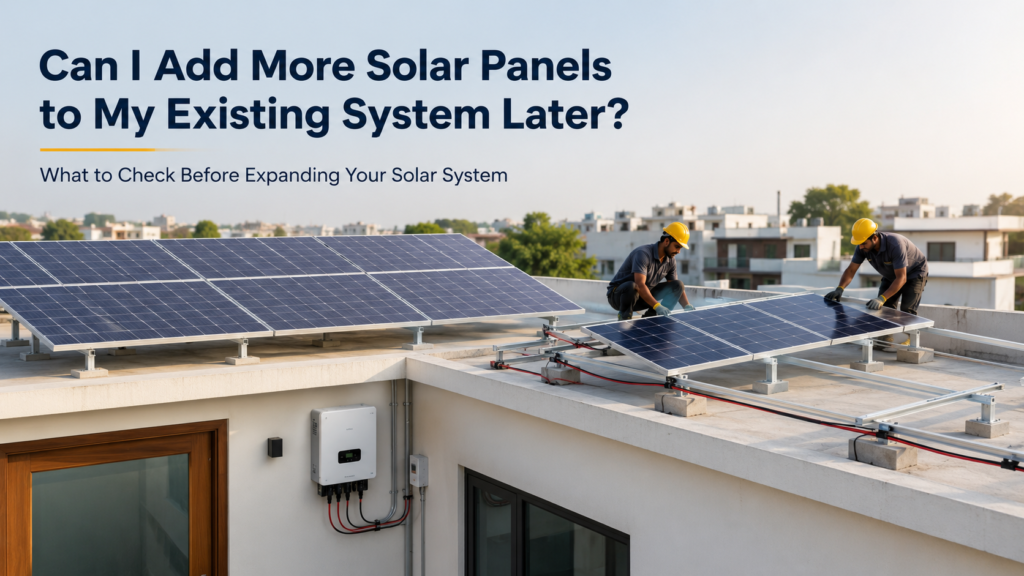
Installing Solar is often not a one-time decision.
Your electricity consumption can increase over the years.
For example, you may initially install Solar for:
- Basic household loads
- Fans and lights
- Refrigerator
- Television
- Washing machine
A few years later, you may add:
- Air conditioners
- An electric vehicle
- Water heater
- Additional appliances
- Home office equipment
- Battery storage
Suddenly, the Solar system that was sufficient earlier may no longer cover as much of your electricity requirement.
This raises an important question:
“Can I add more Solar panels to my existing system later?”
Yes, in many cases you can—but it depends on your inverter, existing system design, roof space, electrical limits, mounting structure and applicable DISCOM/metering requirements.
Adding panels isn’t simply a matter of finding an empty section of your roof and connecting more modules.
The existing Solar system needs to be checked first.
For homeowners in Tadepalligudem, West Godavari and across Andhra Pradesh, this guide explains when Solar expansion makes sense, when an inverter upgrade may be necessary, and what you should check before adding panels.
Quick Answer: Can You Add More Solar Panels Later?
Yes, an existing Solar system can often be expanded, but the additional panels must be compatible with the inverter and electrical design. The inverter may need additional capacity, the mounting structure and cables may need modification, and your sanctioned Solar capacity/metering arrangement may need to be updated with the applicable DISCOM. A professional site and system assessment should be completed before expansion.
The most important question is:
Does your existing inverter have enough capacity and compatible MPPT/string inputs to accept additional panels?
If not, simply adding panels isn’t the right solution.
Why Homeowners Add More Solar Panels
There are several reasons for Solar expansion.
1. Electricity consumption increased
Perhaps you installed a 3kW system when your household consumption was moderate.
Later, your electricity demand increased.
2. You Added an AC
A new 1.5-ton or 2-ton AC can significantly increase household electricity consumption.
3. You Bought an EV
EV charging can add a substantial new electricity load.
4. You Added More Appliances
Examples include:
- Induction cooking
- Water heater
- Dishwasher
- Washing machine
- Additional refrigerator
- Home office equipment
5. You Want More Backup Energy
You may want to add a battery system.
6. You Want to Increase Renewable-Energy Usage
You may simply want Solar to cover a larger proportion of your annual electricity consumption.
Can I Just Add Panels to the Existing Inverter?
Sometimes.
It depends on the inverter specifications.
An inverter has limits for:
- Maximum DC input power
- Maximum DC voltage
- Maximum input current
- Number of MPPTs
- Maximum number of strings
- MPPT voltage range
Suppose your existing inverter is designed for a particular DC capacity.
Adding too many panels can exceed its specifications.
Therefore:
Never add Solar panels based only on physical roof space.
Example: 3kW Solar System Expansion
Imagine you currently have:
3kW Solar system
with a compatible inverter.
You want to increase it to:
5kW
This may be possible.
But first check:
- Existing inverter’s maximum PV input
- MPPT voltage range
- String configuration
- Panel specifications
- Cable size
- Mounting structure
- Electrical protection
- Sanctioned capacity
- Metering arrangement
If the existing inverter cannot accommodate the additional DC capacity, an inverter upgrade or replacement may be required.
Can a 3kW Inverter Handle 5kW of Panels?
Not automatically.
Some Solar inverters are designed to accept a DC array larger than their AC output capacity within specified limits.
For example, an inverter may permit a certain amount of DC oversizing.
But the exact allowable ratio varies by inverter model.
Therefore:
Check the manufacturer’s technical datasheet—not a generic DC/AC ratio.
What Is DC Oversizing?
Suppose an inverter has:
5kW AC output
but the manufacturer allows:
6kW or more DC Solar input
This is called DC oversizing.
It can be useful because Solar panels rarely operate at their nameplate maximum throughout the entire day.
However, you must stay within the inverter’s specified:
- Maximum PV power
- Voltage
- Current
- MPPT limits
Why Adding Panels Can Be Better Than Replacing the Entire System
If your existing inverter has unused capacity, adding compatible panels can potentially be more economical than replacing everything.
For example:
Existing inverter → additional compatible panels → higher Solar generation
This can reduce the amount of new equipment required.
But the expansion needs to be engineered correctly.
When You May Need a Bigger Inverter
An inverter upgrade may be required when:
- Existing DC input limit is reached
- MPPT capacity is insufficient
- Additional strings cannot be connected
- Current limits are exceeded
- Desired Solar capacity exceeds inverter design
- Existing inverter doesn’t support the new panel electrical characteristics
The correct approach is:
Panel expansion calculation → inverter compatibility check → final system design
Can I Mix Different Solar Panel Brands?
Technically, sometimes—but it requires careful design.
Different panels can have different:
- Voltage
- Current
- Wattage
- Temperature coefficients
- Electrical characteristics
Connecting mismatched modules within the same string can reduce system performance or create compatibility problems.
Therefore:
The safest approach is generally to use electrically compatible modules and a properly designed string configuration.
Can I Add Higher-Wattage Panels to Older Panels?
Possibly.
For example, your existing system may use:
400W modules
while newer panels may be:
550W modules
But wattage isn’t the only specification that matters.
Compare:
- Voc
- Vmp
- Isc
- Imp
- Temperature coefficient
- Physical dimensions
The inverter and string design must accommodate them.
Why Voltage and Current Matter
Solar panels connected in a string don’t simply add wattage.
Series connection
Voltage increases.
Parallel connection
Current increases.
The inverter must remain within its operating limits.
A poorly designed expansion can result in:
- MPPT incompatibility
- Excess voltage
- Excess current
- Reduced performance
- Safety issues
That’s why Solar expansion should be designed by a qualified professional.
Can I Add Panels Without Changing the Inverter?
Yes, in some systems.
This can be possible if:
- Inverter has spare DC capacity
- MPPT input is available
- Voltage remains within range
- Current remains within limits
- Manufacturer permits the configuration
- Existing protection and wiring are adequate
If these conditions aren’t satisfied, an inverter upgrade may be necessary.
What If My Existing Inverter Is Already at Full Capacity?
You have several options.
Option 1: Replace the inverter
Install a higher-capacity compatible inverter.
Option 2: Add another inverter
Depending on system architecture and regulations.
Option 3: Add a separate Solar system
This can sometimes be simpler for a different electrical connection or building section.
The best option depends on your existing installation.
Can I Add Panels to an On-Grid Solar System?
Yes, potentially.
But grid-connected Solar systems have additional considerations.
Your expansion may involve:
- Sanctioned capacity
- DISCOM approval
- Net-metering/gross-metering rules
- Meter capacity
- Inverter capacity
- Electrical protection
So:
Adding panels is both a technical and regulatory decision.
Why DISCOM Approval Matters
Your Solar installation is connected to the electrical grid.
If you increase system capacity beyond the approved configuration, the applicable DISCOM process may need to be followed.
In Andhra Pradesh, the relevant DISCOM depends on the service area.
Therefore, don’t simply add panels and assume:
“The existing net meter will automatically accept the larger system.”
Confirm the applicable process first.
What About PM Surya Ghar Systems?
If your existing residential system was installed under PM Surya Ghar, an expansion should be checked against the scheme’s current rules and applicable subsidy structure.
Don’t assume:
“I already received a subsidy, so I can add another system and receive the same subsidy again.”
The subsidy is subject to applicable scheme limits, eligibility and process.
Verify the current rules before making an expansion decision.
Can I Get Additional Subsidy for Adding More Panels?
Do not assume so.
Government subsidy programs have specific:
- Capacity limits
- Eligibility conditions
- Installation requirements
- Documentation requirements
If you already received a subsidy, the treatment of a later expansion depends on the applicable rules at that time.
Always verify the current PM Surya Ghar guidelines before planning the project.
Solar Expansion and Net Metering
This is another important issue.
Suppose your existing system is:
3kW approved capacity
and you want:
5kW total capacity
The meter and grid connection may need to be evaluated under the applicable rules.
The approval isn’t simply about whether your roof can physically accommodate 5kW.
Can I Add Panels to a Hybrid Solar System?
Potentially, yes.
But hybrid systems introduce additional considerations.
You need to check:
- Hybrid inverter PV input limit
- Battery charging capacity
- Maximum Solar input
- MPPT configuration
- Backup-load capacity
- Battery compatibility
If the hybrid inverter is already operating near its maximum PV input, expansion may require a larger inverter.
Can I Add Panels to a Solar System With a Battery?
Yes, depending on the system architecture.
But additional Solar generation can affect:
- Battery charging
- Battery capacity utilisation
- Inverter loading
- Export to grid
- Backup operation
If your battery is relatively small compared with the expanded Solar system, some additional energy may not be stored.
Should I Add More Solar or Add a Bigger Battery?
These solve different problems.
Add more Solar when:
Your goal is to generate more electricity.
Add a bigger battery when:
Your goal is to store more Solar energy for later use.
If your current Solar already generates enough energy but you need more nighttime backup, additional panels alone may not solve the problem.
Solar Expansion for EV Owners
An EV can significantly increase electricity demand.
Suppose your home originally used:
400 units/month
After buying an EV, consumption increases to:
700 units/month
Your existing Solar system may no longer offset as much of your electricity requirement.
This can make Solar expansion worth evaluating.
Solar Expansion for Homes With Multiple ACs
If you add:
- 1.5-ton AC
- 2-ton AC
- Second bedroom AC
- Living-room AC
your electricity consumption may rise considerably.
But don’t size Solar based simply on the AC’s tonnage.
Analyse:
- AC efficiency
- Usage hours
- Seasonal usage
- Existing household consumption
Then determine the additional Solar requirement.
Can I Add Solar Panels Years After Installation?
Yes, potentially.
But older systems require additional checks.
For a 5–10-year-old system, inspect:
- Panels
- Inverter
- Cables
- Mounting structure
- Earthing
- Protection devices
- Roof condition
It may be more economical to replace certain older equipment rather than build an expansion around it.
Panel Degradation Matters During Expansion
Existing panels naturally degrade over time.
Suppose your old panels have been operating for several years.
New panels may have:
Higher rated output
and
Different electrical characteristics
Mixing them requires careful string design.
A professional may recommend separate MPPTs or other configurations to optimise compatibility.
Should New and Old Panels Face the Same Direction?
Ideally, Solar strings should be designed appropriately for their orientation and electrical characteristics.
If your roof has:
East-facing panels
and you want to add:
South-facing panels
they may need separate MPPT/string arrangements depending on the inverter.
Don’t combine differently oriented arrays without proper design.
What Happens If New Panels Have Different Shading?
Suppose your existing array receives:
Full sunlight
but the new roof section has:
Morning shade
Combining them in the same string can create mismatch.
A professional system designer should analyse:
- Shadow pattern
- String configuration
- MPPT allocation
- Module-level optimisation where appropriate
Solar Optimisers and Microinverters
For certain expansion projects, technologies such as:
- Power optimisers
- Microinverters
can help manage module-level differences.
But they also add:
- Equipment cost
- Installation complexity
- Maintenance considerations
They should be used when the system design benefits from them, not automatically.
Can I Add Panels From Another Manufacturer?
Possibly, but don’t decide based only on wattage.
Suppose:
Existing panel:
450W
New panel:
550W
The two aren’t necessarily electrically interchangeable.
Compare their datasheets.
A professional installer should determine whether they can be integrated safely and effectively.
Roof Space for Solar Expansion
Before adding panels, check whether you actually have sufficient usable roof area.
Consider:
- Water tanks
- Staircase rooms
- Satellite dishes
- Solar water heaters
- Trees
- Nearby buildings
- Future construction
- Maintenance pathways
Don’t use every available square metre.
Solar panels need appropriate access for maintenance.
Mounting Structure and Solar Expansion
Your existing mounting structure may not be designed for additional panels.
Check:
- Structural strength
- Corrosion
- Fasteners
- Wind loading
- Roof anchoring
- Panel dimensions
For Andhra Pradesh, strong winds and severe weather conditions make proper structural design particularly important.
Electrical Protection During Expansion
Expansion may require reviewing:
- DC isolators
- AC breakers
- Surge protection devices
- Earthing
- Lightning protection
- Cable sizing
Do not simply connect a new string to an existing cable because:
“The old cable is already there.”
The cable must be suitable for the new electrical configuration.
Can I Expand a 5kW Solar System to 10kW?
Potentially, but this is a substantial expansion.
At this scale, you may need:
- Larger inverter
- Additional inverter
- More mounting structure
- More electrical protection
- Larger cables
- DISCOM approval/modification
- Updated metering arrangements
The correct approach is to treat it as a system redesign, not simply a panel addition.
Can I Expand a 3kW System to 5kW?
Often more straightforward than a major expansion, but it still requires a compatibility check.
You need to assess:
Existing inverter → PV input → panel configuration → electrical protection → approved capacity
If all are compatible, additional panels may be possible.
If not, equipment upgrades may be required.
Should I Replace My Old Panels Instead?
Sometimes.
If your existing system is very old and uses lower-efficiency modules, you might compare:
Option A
Keep old panels + add new panels.
Option B
Replace old panels with newer high-efficiency modules.
Option C
Keep panels but replace inverter.
Option D
Install a separate new Solar system.
The best option depends on the condition and economics of the existing system.
Solar Expansion Cost
There is no universal price.
Expansion cost depends on:
- Number of new panels
- Panel wattage
- Inverter requirement
- Mounting structure
- Cables
- Protection equipment
- Labour
- Roof accessibility
- DISCOM-related work
- Existing equipment compatibility
A panel-only expansion can be relatively straightforward.
An inverter replacement can significantly increase the project cost.
Don’t Compare Only the Panel Price
Suppose you need:
2kW additional Solar
The panel price is only one component.
You may also need:
- Mounting
- DC cables
- Connectors
- Protection
- Installation
- Inverter upgrade
- Metering changes
Therefore:
Compare the complete expansion cost, not ₹/panel alone.
Is Solar Expansion Economically Worth It?
Calculate:
Additional Solar investment
vs
Additional annual electricity-cost savings
For example, suppose:
Expansion cost = Rs1,00,000
Expected additional annual electricity value:
Rs15,000
Simple payback:
RS1,00,000 ÷ Rs15,000 = 6.7 years
This is only an illustration.
Actual payback depends on:
- Electricity tariff
- Solar generation
- Self-consumption
- Export value
- Financing
- Degradation
- Maintenance
Solar Expansion Can Be Better Than a New System
If your existing system has:
- Good panels
- A relatively new inverter
- Healthy mounting
- Good wiring
- Available MPPT capacity
then expansion may be simpler than starting from scratch.
But if your existing equipment is outdated, a complete redesign may offer better long-term value.
Solar Expansion for Tadepalligudem Homeowners
If you installed Solar a few years ago in Tadepalligudem and your electricity consumption has increased, start by checking:
Existing Solar capacity
Inverter model
Panel specifications
Current generation
12-month electricity consumption
Roof availability
Net-metering/sanctioned capacity
This gives you the information needed to determine whether expansion is practical.
Solar Expansion in West Godavari
For homeowners and businesses in West Godavari, the same process applies.
Local environmental conditions such as:
- Heat
- Dust
- Humidity
- Rain
- Bird activity
- Strong winds
should be considered when evaluating the condition of the existing system.
Commercial Solar Expansion
The same concept applies to:
- Factories
- Hotels
- Supermarkets
- Schools
- Hospitals
- Poultry farms
- Rice mills
- Cold storages
A business may initially install:
50kW
and later expand to:
100kW
because electricity consumption has increased.
At commercial scale, the expansion should include a proper:
Load study + generation study + financial analysis + electrical design
Why Businesses Often Need Expansion
Commercial electricity consumption can increase because of:
- New machinery
- Additional refrigeration
- New AC systems
- Production expansion
- EV charging
- Extended operating hours
Solar capacity should grow with the business where the economics justify it.
Solar Expansion and Future-Proofing
If you’re installing Solar today but expect electricity consumption to increase, discuss future expansion with your installer.
You may be able to plan for:
- Spare inverter capacity
- Extra MPPT inputs
- Expandable mounting
- Electrical infrastructure
- Future battery integration
- EV charging
This can make a future upgrade easier.
7 Questions to Ask Before Adding Solar Panels
1. Can my existing inverter handle more panels?
2. How much additional DC capacity is allowed?
3. Are the new panels electrically compatible?
4. Do I need a new inverter?
5. Does my approved Solar capacity need to change?
6. Will the existing mounting structure support the expansion?
7. What will the total expansion cost and expected annual generation be?
If your installer can answer all seven clearly, you have a much better basis for making the decision.
Common Solar Expansion Mistakes
Mistake 1: Adding Panels Without Checking the Inverter
This can exceed electrical limits.
Mistake 2: Mixing Panels Without Checking Specifications
Different electrical characteristics can create string mismatch.
Mistake 3: Ignoring DISCOM Requirements
Approved capacity and metering arrangements matter.
Mistake 4: Using the Same Old Mounting Structure Without Inspection
Structural condition matters.
Mistake 5: Focusing Only on Panel Wattage
System-level design matters more.
Mistake 6: Assuming More Solar Always Means More Savings
Additional generation has value only according to your actual consumption and applicable export/metering arrangement.
Mistake 7: Ignoring Old Equipment
If the inverter is already near the end of its useful service life, an expansion may be the right time to consider replacement.
The Best Time to Plan Solar Expansion
Consider an expansion when:
✔ Electricity consumption has increased
✔ You added an EV
✔ You installed additional ACs
✔ Existing Solar isn’t covering enough consumption
✔ Roof space is available
✔ Existing equipment is compatible
✔ Additional generation has economic value
When Solar Expansion May Not Make Sense
Expansion may be less attractive when:
- Electricity consumption is low
- Most additional generation would be exported at low value
- Roof space is heavily shaded
- Existing inverter is outdated
- Expansion requires replacing multiple components
- The project cost is too high
A financial analysis should come before installation.
VMJ Solar Solutions: Solar System Expansion in Tadepalligudem
For homeowners in Tadepalligudem and West Godavari, VMJ Solar Solutions can evaluate an existing Solar system before recommending additional panels.
A proper expansion assessment should include:
Existing System Inspection
↓
Panel & Inverter Compatibility
↓
12-Month Electricity Bill Analysis
↓
Roof & Shadow Assessment
↓
Additional Solar Capacity
↓
DISCOM/Metering Check
↓
Expansion Cost
↓
Expected Additional Generation
↓
ROI / Payback Assessment
This approach helps determine whether you need:
More panels
or:
A larger inverter
or:
A complete system upgrade
or:
No expansion at all
FAQs
1. Can I add more Solar panels to my existing system?
Yes, in many cases. The existing inverter, panel specifications, electrical limits, roof space, mounting structure and approved Solar capacity must be checked first.
2. Can I add more panels without replacing my inverter?
Possibly. If the inverter has sufficient allowable DC input capacity, MPPT capacity and compatible voltage/current limits, additional panels may be added without replacing it.
3. Can I expand a 3kW Solar system to 5kW?
It may be possible, depending on the inverter, existing panel configuration, electrical infrastructure and applicable DISCOM requirements. A technical assessment is necessary.
4. Can I add 550W panels to an existing 400W Solar system?
Possibly, but wattage alone doesn’t determine compatibility. Voltage, current, string configuration, MPPT range and inverter limits must be checked.
5. Can I mix different Solar panel brands?
It can be technically possible, but different panels may have different electrical characteristics. Proper string and MPPT design is required.
6. Do I need a bigger inverter when adding Solar panels?
Not always. If the existing inverter permits additional DC input within its specifications, an inverter upgrade may not be necessary. Otherwise, a larger or additional inverter may be required.
7. Can I add more panels to an on-grid Solar system?
Yes, potentially, but the approved capacity, net-metering/gross-metering arrangement and applicable DISCOM process need to be checked.
8. Can I get additional PM Surya Ghar subsidy after expanding my Solar system?
Don’t assume that you can. Subsidy eligibility depends on the applicable scheme rules, capacity limits and your previous subsidy history. Verify the current requirements before expansion.
9. Is it better to add panels or a battery?
It depends on your objective. Additional panels increase generation, while a battery stores electricity for later use. If your main requirement is nighttime or outage backup, a battery may address the problem more directly.
10. Can I expand a Solar system after 5 years?
Potentially, yes. However, the condition and age of the existing inverter, panels, cables, mounting structure and protection equipment should be inspected first.
11. How much does Solar system expansion cost in India?
There is no fixed cost. It depends on the additional capacity, panel price, inverter requirements, mounting, electrical work, labour and applicable approvals.
12. Is Solar expansion worth it financially?
It can be worthwhile when additional Solar generation has significant value relative to the expansion cost. Calculate expected annual additional generation and electricity-cost savings before investing.
13. Can I add Solar panels for my new EV?
Yes, an EV can be a good reason to evaluate Solar expansion. The additional Solar capacity should be based on your actual EV charging consumption and household load.
14. Can I add more Solar panels if my roof has limited space?
Possibly, by using higher-wattage modules or improving system design. However, structural clearances, maintenance access and shading must still be considered.
15. Should I expand my Solar system or install a new system?
If the existing system is relatively new and compatible, expansion may be practical. If the inverter or other equipment is old, a complete redesign may provide better long-term value.
Conclusion
Yes, you can often add more Solar panels to an existing system—but Solar expansion should never be treated as simply adding panels to an empty roof.
Before expanding, check:
Inverter capacity
MPPT configuration
Panel compatibility
DC voltage/current limits
Mounting structure
Cables and protection
Roof space
Approved Solar capacity
DISCOM/metering requirements
Financial return
For a homeowner who started with a 3kW Solar system and later added an EV or multiple ACs, expansion may be a practical way to increase Solar generation.
But sometimes the better solution is:
More panels + existing inverter
while in other cases it may be:
More panels + inverter upgrade
or even:
Complete Solar system redesign
The right answer depends on the existing system.
For homeowners and businesses in Tadepalligudem and West Godavari, get the existing installation assessed before purchasing new panels.
The goal isn’t simply to install more Solar capacity.
The goal is to create an expanded system that is technically compatible, safe, compliant and financially worthwhile.