
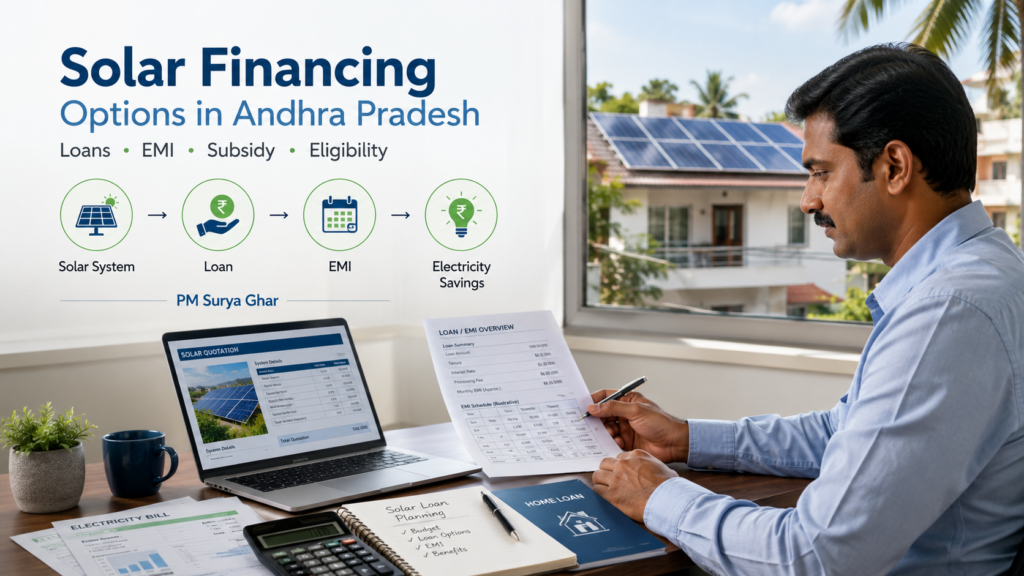
Installing rooftop Solar can reduce long-term electricity costs, but the upfront investment can still be a major hurdle for many homeowners.
That leads to an important question:
“What are the best Solar financing options in Andhra Pradesh, and can I pay for my Solar system through EMI?”
The answer is yes, several financing routes are available, particularly for residential rooftop Solar.
Under the PM Surya Ghar: Muft Bijli Yojana, the government has also promoted lending products for residential rooftop Solar. The scheme framework provides for low-interest products for smaller systems and standardized financing products for other eligible beneficiaries, with integration between the National Portal and Jan Samarth for loan applications.
However, the cheapest Solar loan is not necessarily the best Solar loan.
You need to compare:
- Interest rate
- Loan amount
- Upfront margin
- Processing fees
- Tenure
- Prepayment rules
- Credit-score requirements
- Subsidy treatment
- Vendor eligibility
- Total interest payable
This guide explains the major Solar financing options in Andhra Pradesh, with particular relevance for homeowners in Tadepalligudem and West Godavari.
Quick Answer: What Are the Best Solar Financing Options in Andhra Pradesh?
For residential rooftop Solar, the first options to compare are PM Surya Ghar-linked bank loans, regular bank Solar/home-improvement loans, and financing offered through eligible Solar vendors or financial institutions. For businesses, dedicated commercial Solar term loans can be more appropriate. The right option depends on your project cost, credit profile, Solar capacity, subsidy eligibility and repayment ability.
For example, SBI currently publishes a PM Surya Ghar Solar rooftop loan with a maximum loan amount of Rs6 lakh, while Canara Bank publishes separate PM Surya Ghar-linked products for loans up to Rs2 lakh and above Rs2 lakh up to Rs6 lakh.
Why Solar Financing Is Becoming Important
A homeowner may have enough income to pay a monthly electricity bill but may not want to spend a large amount upfront on Solar.
For example, instead of paying:
Rs2,00,000–Rs3,00,000 upfront
the homeowner may prefer:
Solar system + EMI
while using the electricity-bill savings to offset part of the monthly repayment.
But there is an important caveat:
Solar savings should not automatically be assumed to equal the EMI.
Your actual savings depend on:
- Solar generation
- Electricity tariff
- Household consumption
- Self-consumption
- Export treatment
- Fixed charges
- System cost
- Financing cost
What Is a Solar Loan?
A Solar loan is financing specifically intended to fund the purchase and installation of a Solar PV system.
Depending on the lender, it may cover:
- Solar panels
- Inverter
- Mounting structure
- Electrical protection
- Installation
- Associated equipment
Some lenders have dedicated PM Surya Ghar rooftop Solar loan products, while others may offer Solar financing through housing or other loan categories.
Main Solar Financing Options in Andhra Pradesh
Homeowners generally have these routes to consider:
1. PM Surya Ghar-linked Solar Loan
Best suited to eligible residential rooftop Solar applicants.
2. Bank-specific Rooftop Solar Loan
Some banks offer dedicated Solar products outside or alongside scheme-linked products.
3. Housing + Solar Loan
Some banks allow Solar financing to be combined with a housing loan.
4. Personal Loan
Possible in some situations, but the interest cost may be less attractive than a dedicated Solar product.
5. Solar Vendor/Financial Partner EMI
Some EPC companies facilitate financing through partner banks or financial institutions.
6. Commercial Solar Term Loan
Relevant for:
- Factories
- Shops
- Schools
- Hotels
- Hospitals
- Poultry farms
- Rice mills
- Cold storages
- Offices
1. PM Surya Ghar Solar Loan
For homeowners, this is one of the first financing routes worth checking.
The PM Surya Ghar framework specifically provides for lending instruments for rooftop Solar beneficiaries and envisages integration with Jan Samarth and participating financial institutions.
The government’s own PM Surya Ghar material highlights lower-interest loans as one of the scheme’s features.
The important point is:
You still need to meet the lender’s credit and eligibility requirements.
A government-backed Solar scheme does not mean every applicant receives a loan automatically.
SBI Surya Ghar Solar Loan
SBI currently publishes a dedicated Surya Ghar loan for rooftop Solar.
According to SBI’s published information:
- Maximum loan: Rs6 lakh
- Up to Rs2 lakh: no minimum CIBIL score is specified
- Above Rs2 lakh up to Rs6 lakh: minimum CIBIL score of 650
- Upfront margin: 10% of project cost
- Maximum rooftop Solar capacity: up to 10 kW
- Repayment: up to 10 years
- Loan application can be initiated after PM Surya Ghar registration through Jan Samarth.
SBI’s published rate information currently shows:
- 5.75% p.a. for loans up to Rs2 lakh
- 7.90% p.a. for loans above Rs2 lakh up to Rs6 lakh
The bank’s page states these rates as applicable as of its published update and also notes that its broader rate information is subject to change and terms. Always verify the rate at the time of application.
Canara Bank Solar Loan
Canara Bank Rooftop Solar Loan
Canara Bank Solar Loan Above Rs2 Lakh
Canara Bank currently publishes separate CRTS-PM Surya Ghar products.
For loans up to ₹2 lakh, its published product covers residential on-grid rooftop Solar and specifies:
- Maximum loan: Rs2 lakh
- Minimum borrower contribution: 10%
- No minimum annual-income/NTH criterion stated for this product
- No processing charges listed on the product page.
For loans above Rs2 lakh and up to Rs6 lakh, Canara publishes:
- Maximum loan: Rs6 lakh
- Minimum margin: 20%
- Minimum annual income: Rs3 lakh
- Maximum repayment period: 10 years.
Canara also has a Housing Cum Solar Loan that can finance rooftop Solar alongside a housing loan, with a Solar component of up to Rs10 lakh and repayment potentially extending up to 20 years under the stated product conditions.
Is SBI Always the Best Solar Loan?
No.
A bank offering the lowest advertised rate isn’t automatically the cheapest overall option for every borrower.
Compare:
Interest rate + fees + margin + tenure + subsidy treatment + total interest
rather than just:
Interest rate
For example, a slightly higher rate with lower fees and a shorter repayment period may produce a different total cost than a lower advertised rate over a longer tenure.
Solar Loan Interest Rates in Andhra Pradesh
Interest rates change.
Therefore, don’t publish a permanent statement such as:
“Solar loans are available at exactly X% everywhere in Andhra Pradesh.”
Instead, check the lender’s current product page and sanction letter.
As of the currently published information reviewed for this article, SBI’s PM Surya Ghar product shows 5.75% p.a. up to ₹2 lakh and 7.90% p.a. above ₹2 lakh to ₹6 lakh, while other lenders may use different pricing structures.
Your sanctioned rate can depend on the lender, product, credit profile and prevailing terms.
Solar Loan EMI: How Does It Work?
EMI depends on:
Loan amount + Interest rate + Tenure
For example, suppose you borrow:
₹2,00,000
at an illustrative:
7.90% annual interest
for:
5 years
The EMI would be approximately:
₹4,050/month
This is an illustrative calculation, not a bank quotation.
A longer tenure can reduce monthly EMI but increase the total interest paid.
₹3 Lakh Solar Loan EMI Example
Suppose:
Loan = Rs3,00,000
Interest = 7.90%
Tenure = 5 years
Illustrative EMI:
≈ ₹6,070/month
Again, this is an example for understanding the mathematics.
Actual bank EMI may differ based on:
- Rate
- Disbursement
- Fees
- Insurance
- Loan structure
- Rate revisions
₹5 Lakh Solar Loan EMI Example
Suppose:
Loan = Rs5,00,000
Interest = 7.90%
Tenure = 5 years
Illustrative EMI:
≈ ₹10,100/month
The important question is not:
“Can I afford Rs10,100 EMI?”
It is:
“What will my Solar system realistically save, and how much of the EMI will that saving offset?”
Solar EMI vs Electricity Bill Savings
This is where homeowners need to think carefully.
Suppose:
Solar EMI = Rs8,000/month
Expected electricity-cost reduction:
Rs5,000/month
Then:
Rs8,000 − Rs5,000 = Rs3,000
You still need to fund approximately Rs3,000 from your household cash flow, before considering other factors.
So don’t believe claims such as:
“Your electricity bill will pay your entire Solar EMI.”
It may happen in some projects, but it is not guaranteed.
When Can Solar Savings Cover Most of the EMI?
The possibility improves when:
- Electricity consumption is high
- Solar system is correctly sized
- Daytime self-consumption is high
- Electricity tariffs are relatively high
- Solar project cost is competitive
- Loan interest is reasonable
- Loan tenure is appropriate
But actual economics must be calculated for the individual property.
PM Surya Ghar Subsidy and Solar Loans
This is one of the biggest advantages of scheme-linked financing.
The PM Surya Ghar framework allows the CFA amount to be associated with the beneficiary’s loan account so that the subsidy can help prepay part of the loan, subject to the applicable process.
MNRE also states that CFA for eligible residential rooftop Solar is transferred after successful installation and verification by the State DISCOM under the applicable mechanism.
This means homeowners should understand:
Subsidy and loan are connected financially, but they are not the same thing.
Does ₹78,000 Subsidy Mean You Need a Smaller Loan?
Potentially, yes.
For an eligible residential installation, the applicable central CFA can reduce the effective financed amount depending on the lender’s process.
But don’t assume:
Solar cost − Rs78,000 = automatic loan amount
because the final project price, borrower margin and bank financing structure also matter.
Example: Solar Project + Subsidy + Loan
Suppose:
Solar project cost = Rs2,50,000
Eligible CFA:
Rs78,000
If the financing structure permits the subsidy to reduce the loan balance, the economic burden after CFA can be lower.
But the exact cash-flow structure depends on:
- Vendor
- Bank
- National Portal
- DISCOM verification
- CFA processing
- Loan terms
So get the repayment schedule in writing.
Should You Finance the Entire Solar Project?
Not necessarily.
If you have savings available, a partial-financing strategy can sometimes reduce interest cost.
For example:
30–40% own contribution + balance loan
could result in:
- Lower EMI
- Lower total interest
- Less financial pressure
But don’t drain your emergency fund just to avoid a Solar loan.
Solar Loan vs Paying Cash
| Factor | Cash Purchase | Solar Loan |
|---|---|---|
| Upfront cost | High | Lower |
| EMI | None | Yes |
| Interest cost | None | Yes |
| Savings available for other needs | Lower | Higher |
| Solar ownership | Immediate | Subject to loan/security terms |
| Financial flexibility | Lower after purchase | Higher initially |
| Best for | Strong cash reserves | Buyers wanting to preserve liquidity |
Solar Loan vs Personal Loan
A personal loan can be convenient.
But compare carefully.
Personal Loan
Pros:
- Flexible use
- Usually simple documentation
Cons:
- Potentially higher interest
- May have shorter tenure
- May not offer Solar-specific benefits
Solar Loan
Pros:
- Purpose-specific
- Potentially lower rate
- May be linked to PM Surya Ghar
- May have Solar-specific repayment structures
Cons:
- More eligibility requirements
- Vendor/documentation requirements
- Loan amount may be capped
For a residential Solar purchase, a dedicated Solar loan should generally be compared before taking a generic personal loan.
Housing Loan + Solar Loan
If you’re already taking a home loan, ask whether the lender offers a combined housing-plus-Solar product.
Canara Bank, for example, currently publishes a Housing Cum Solar Loan with a Solar component of up to ₹10 lakh under its stated conditions.
This can be relevant when:
- Building a new home
- Buying a house
- Renovating
- Adding rooftop Solar
But compare the total cost and security structure carefully.
Commercial Solar Loans in Andhra Pradesh
Home loans aren’t appropriate for every Solar project.
For:
- Factories
- Rice mills
- Poultry farms
- Cold storages
- Supermarkets
- Hotels
- Schools
- Offices
a commercial Solar term loan may be more appropriate.
SBI’s Surya Shakti Solar Finance, for example, is designed for eligible SME/business enterprises installing grid-connected rooftop or ground-mounted Solar for captive use. Its published product shows loan limits up to Rs10 crore or Rs50 crore depending on the facility, with repayment up to 10 or 15 years and borrower contribution requirements.
For a business, the analysis should focus on:
Solar savings → Debt servicing → Cash flow → DSCR
rather than household EMI alone.
Poultry Farms: Solar Loan Can Be Especially Relevant
A poultry farm may consume substantial electricity through:
- Ventilation fans
- Cooling systems
- Pumps
- Lighting
- Feed equipment
If Solar reduces daytime grid consumption, the savings can contribute toward debt servicing.
But commercial lenders may evaluate:
- Business turnover
- Credit history
- Existing debt
- DSCR
- Project cost
- Solar generation estimate
So business Solar financing is fundamentally different from a Rs2 lakh residential Solar loan.
Solar Loan for Farmers in Andhra Pradesh
Farmers considering Solar for:
- Agricultural pumps
- Dairy operations
- Cold storage
- Farm processing
- Poultry
- Aquaculture
should distinguish between residential rooftop Solar loans and agricultural/commercial/project financing.
The correct financing route depends on:
Purpose + property + electricity connection + scheme + borrower profile.
Don’t assume PM Surya Ghar residential financing applies to an agricultural project.
Can Renters Get Solar Loans?
This can be complicated.
A standard rooftop Solar loan may require:
- Roof rights
- Residential electricity connection
- Property-related eligibility
- Vendor documentation
For example, SBI and Canara Bank’s published residential Solar loan requirements refer to rooftop rights and suitable roof area.
Therefore, a tenant should not assume:
“The electricity bill is in my name, so I can automatically take a rooftop Solar loan.”
Landlord consent and the lender’s requirements need to be checked.
Credit Score and Solar Loans
Your credit profile can matter.
For example, SBI currently specifies different CIBIL requirements depending on loan amount, while Canara Bank also publishes credit/eligibility conditions for its Solar loan products.
Before applying:
Check your credit report
Avoid multiple unnecessary loan applications
Clear overdue payments
Keep existing EMIs under control
A low Solar-loan rate doesn’t help if you cannot qualify for it.
How Much Margin Money Is Required?
This varies by lender.
For example:
SBI
Its published PM Surya Ghar product specifies 10% upfront margin.
Canara Bank
Its published product shows:
- 10% minimum margin for the lower loan category
- 20% minimum margin for loans above Rs2 lakh up to Rs6 lakh.
So if your Solar project costs:
Rs3,00,000
you may need to contribute a portion yourself even if the bank approves the loan.
Processing Fees Matter
Never compare Solar loans based only on interest rates.
Check:
Processing fee + GST
Some current PM Surya Ghar products advertise no processing charges, while other products may have fees.
Canara’s published PM Surya Ghar products currently show no processing charges, while its Housing Cum Solar Loan has a separate processing-fee structure.
Always check the exact product being sanctioned.
Loan Tenure: 3 Years vs 5 Years vs 10 Years
3-Year Loan
Higher EMI
Lower total interest
5-Year Loan
Middle ground
10-Year Loan
Lower monthly EMI
Higher total interest
A longer tenure can make Solar look affordable monthly while making it more expensive overall.
Example of Tenure Trade-Off
Imagine a:
₹3 lakh loan
at an illustrative interest rate.
3 years
Higher EMI
Lower total interest
5 years
Moderate EMI
Moderate interest
10 years
Lower EMI
Much longer interest payment period
Therefore:
Choose the shortest tenure you can comfortably afford, not simply the lowest EMI.
Should Solar EMI Be Equal to Your Electricity Bill?
This is a dangerous way to calculate.
Suppose your current electricity bill:
Rs6,000/month
and Solar EMI:
Rs6,000/month
You may think:
“The Solar is free because my bill is paying the EMI.”
But Solar economics also involve:
- Fixed charges
- Maintenance
- Inverter replacement risk
- Panel degradation
- Loan interest
- Seasonal generation
- Future tariff changes
So the correct comparison is:
Lifetime Solar Cost vs Lifetime Avoided Electricity Cost
Solar Loan Calculation: What You Should Compare
Ask your lender for:
Loan Amount
Interest Rate
EMI
Annual Percentage Rate / effective rate, if provided
Processing Fee
Insurance
Tenure
Total repayment
Prepayment charges
Subsidy treatment
Then compare at least 2–3 lenders.
Don’t Ignore the Solar System Cost
Financing a bad Solar quotation doesn’t make it a good investment.
Suppose:
Vendor A
System cost: ₹2,20,000
Vendor B
System cost: ₹2,60,000
Vendor B offers a slightly cheaper loan.
That does not automatically make Vendor B cheaper.
You need:
System cost + financing cost − subsidy − realistic energy savings
Cheapest Solar Loan vs Cheapest Solar Project
The right target is:
Lowest total cost of ownership
not:
Lowest interest rate
A Solar project should be evaluated as a combined package:
Equipment + Installation + Financing + Subsidy + O&M + Energy Savings
How to Apply for a PM Surya Ghar Solar Loan
A typical process is:
Step 1
Register on the PM Surya Ghar National Portal.
Step 2
Enter your electricity-connection details.
Step 3
Complete the applicable rooftop Solar application process.
Step 4
Select an eligible/empanelled vendor.
Step 5
Obtain the Solar quotation and required documents.
Step 6
Apply for the loan through the relevant bank/Jan Samarth route where available.
Step 7
Complete bank verification.
Step 8
Loan sanction and disbursement.
Step 9
Solar installation.
Step 10
DISCOM inspection/verification and applicable metering/commissioning.
Step 11
CFA/subsidy processing.
The National Portal framework explicitly supports financing integration and DISCOM verification for the rooftop Solar process.
What Documents Are Usually Needed?
Requirements vary by lender, but you may be asked for:
- Aadhaar/KYC
- PAN
- Electricity bill
- Bank statements
- Income proof
- Salary slips
- ITRs
- Solar quotation
- Vendor details
- Site feasibility information
- Roof/property rights information
SBI and Canara Bank both publish detailed document requirements for their residential Solar products.
Tadepalligudem Homeowners: What Should You Do First?
If you’re planning Solar in Tadepalligudem, don’t start by asking a vendor:
“How much EMI can you give me?”
Start with:
1. What is my annual electricity consumption?
2. How much Solar do I actually need?
3. What is the total project cost?
4. What subsidy am I eligible for?
5. How much can I comfortably contribute upfront?
6. What EMI can my household afford?
Then compare lenders.
Solar Financing in West Godavari
For homeowners in West Godavari, the same principle applies whether you are in:
- Tadepalligudem
- Tanuku
- Bhimavaram
- Narsapur
- Palakollu
- Nearby towns and villages
Your electricity connection and applicable DISCOM process matter more than simply the town name.
The National Rooftop Solar Portal also maintains Andhra Pradesh-related rooftop Solar resources, including a case study on an APEPDCL Solar Rooftop Consumer Financing Scheme, showing that DISCOM-assisted financing has been explored in the state.
Andhra Pradesh’s Solar Policy Supports Rooftop Solar
Andhra Pradesh’s Clean Energy Policy states that the state will promote grid-connected rooftop Solar across domestic, commercial and industrial sectors through applicable net/gross metering arrangements under APERC regulations and government schemes.
That creates a favourable policy environment for rooftop Solar, but policy support does not mean every project has the same financial return.
Your actual economics still depend on your property and electricity usage.
Solar Loan for a New Home
If you’re constructing a new home in Tadepalligudem or West Godavari, Solar financing can potentially be considered alongside the house financing.
This can make sense because:
Roof design + Solar design
can be planned together.
You can also plan:
- Electrical conduits
- Inverter location
- Earthing
- Roof access
- Water-tank placement
- EV charging
- Future BESS
before construction is completed.
Solar Financing for Existing Homes
For an existing house, the process is slightly different.
Before taking a loan:
Check roof condition
Check shadow
Check electrical load
Analyse 12 months of bills
Estimate Solar generation
Get at least 2 quotations
Then decide how much to finance.
Should You Finance a 3kW or 5kW System?
Don’t choose based solely on loan eligibility.
For example:
3kW
May be suitable for a moderate residential load.
5kW
May make sense for higher electricity consumption, multiple ACs, EV charging or future loads.
But the correct capacity depends on actual consumption and roof conditions.
Solar Loan + EV + BESS
Homeowners increasingly want:
Solar + EV + Battery
This can create a larger capital requirement.
Instead of financing everything immediately, consider a staged approach:
Stage 1
Solar
Stage 2
EV charger
Stage 3
BESS
This can reduce unnecessary borrowing.
If you already have an EV, however, the Solar sizing should account for charging demand.
Should You Take a Loan for BESS Too?
Think carefully.
A battery adds:
Cost + replacement risk + financing cost
If your objective is only:
Lower annual electricity bill
an on-grid Solar system may be more economical.
If your objective includes:
Power-cut backup + energy independence
BESS may justify the additional investment.
Commercial Solar Financing: Don’t Use Residential EMI Logic
Rs20 lakh Solar project
the correct question isn’t:
“Can I afford the EMI?”
It’s:
“Will Solar savings generate sufficient cash flow to service the debt while maintaining the business’s required coverage ratios?”
Commercial lenders may evaluate DSCR, collateral/security, promoter guarantees, credit scores and project economics.
SBI’s current Surya Shakti Solar Finance product, for example, includes financial benchmarks such as minimum DSCR and coverage ratios for eligible business borrowers.
10 Questions to Ask a Solar Loan Provider
Before signing:
- What is the current interest rate?
- Is it fixed or floating?
- What is the effective cost?
- What is the processing fee?
- What is the required margin?
- What is the maximum tenure?
- Is prepayment allowed without charges?
- How is the PM Surya Ghar subsidy handled?
- Is insurance mandatory?
- What happens if the Solar installation is delayed?
10 Questions to Ask Your Solar Vendor
- Is the quotation subsidy-inclusive or subsidy-exclusive?
- Is the vendor eligible/empanelled under the applicable scheme?
- What exact modules are being offered?
- What inverter model is included?
- What is the expected annual generation?
- What is the installation warranty?
- What O&M is included?
- Who handles DISCOM coordination?
- Who handles subsidy documentation?
- What happens if the bank disbursement is delayed?
Common Solar Financing Mistakes
Mistake 1: Choosing the Lowest EMI
Low EMI can simply mean a longer tenure.
Mistake 2: Ignoring Total Interest
A ₹5,000 EMI may look attractive while costing much more over a long loan period.
Mistake 3: Financing an Oversized Solar System
More Solar does not automatically mean more savings.
Mistake 4: Assuming Subsidy Is Immediate
CFA processing is subject to the applicable installation and verification process.
Mistake 5: Choosing the Vendor Because They Offer EMI
Financing convenience doesn’t prove equipment or installation quality.
Mistake 6: Comparing Only Interest Rates
Compare the total repayment cost.
Mistake 7: Ignoring Roof Condition
If the roof needs major repairs, factor that into the project.
Mistake 8: Using a Personal Loan Without Comparison
A dedicated Solar loan may offer different terms.
A Better Solar Financing Strategy
For a homeowner, a sensible sequence is:
Step 1 — Analyse electricity bills
↓
Step 2 — Determine the right Solar capacity
↓
Step 3 — Get competitive EPC quotations
↓
Step 4 — Calculate subsidy
↓
Step 5 — Decide your own contribution
↓
Step 6 — Compare 2–3 lenders
↓
Step 7 — Compare total repayment
↓
Step 8 — Select vendor and lender
↓
Step 9 — Complete installation and DISCOM process
This separates the Solar purchase decision from the loan decision.
That is important.
What Is a Good Solar Loan for You?
A good Solar loan should have:
✔ Competitive interest rate
✔ Reasonable processing costs
✔ Comfortable tenure
✔ Transparent subsidy treatment
✔ Manageable EMI
✔ Fair prepayment terms
✔ Clear documentation
✔ No unnecessary bundled products
But the final choice should be based on your own financial situation.
Is Solar Financing Worth It in Andhra Pradesh?
It can be, particularly for homes with:
- High electricity consumption
- Significant daytime usage
- Multiple ACs
- EV charging
- Suitable rooftop space
- Long-term occupancy
The economics are weaker when:
- Electricity consumption is very low
- Roof is heavily shaded
- The property may be sold soon
- Installation cost is unusually high
- Loan interest is expensive
- The Solar system is oversized
VMJ Solar Solutions: Solar Financing Guidance in Tadepalligudem
For homeowners in Tadepalligudem and West Godavari, the right starting point is not:
“Which bank gives the cheapest EMI?”
It is:
“What Solar system gives me the best balance between investment, electricity savings and financing cost?”
VMJ Solar Solutions can help homeowners evaluate the Solar side of that equation:
Electricity Bill Analysis → Solar Capacity → Generation Estimate → Project Cost → Subsidy Eligibility → Financing Requirement
Then you can compare bank financing separately.
That approach helps prevent a common mistake:
Taking a large loan first and trying to make the Solar system fit the EMI.
Instead:
Design the right Solar system first. Then finance the amount that makes financial sense.
FAQs
1. What are the best Solar financing options in Andhra Pradesh?
For residential users, compare PM Surya Ghar-linked bank loans, dedicated rooftop Solar loans, housing-plus-Solar products and other eligible financing. Businesses should generally evaluate commercial Solar term loans.
2. What is the current Solar loan interest rate in Andhra Pradesh?
There is no single Andhra Pradesh-wide Solar loan rate. Rates depend on the bank, product, loan amount and borrower profile. For example, SBI currently publishes 5.75% p.a. for PM Surya Ghar loans up to ₹2 lakh and 7.90% p.a. for loans above ₹2 lakh up to ₹6 lakh. Rates can change, so verify the current sanction terms before applying.
3. How much Solar loan can I get under PM Surya Ghar?
This depends on the lender. SBI currently publishes a maximum of ₹6 lakh for its Surya Ghar Solar rooftop loan. Canara Bank also publishes products up to ₹6 lakh for residential PM Surya Ghar installations.
4. Can I get a Solar loan without a CIBIL score?
Some products have different requirements depending on loan size. SBI currently states that no minimum CIBIL score is specified for loans up to ₹2 lakh, while its higher loan category requires a minimum CIBIL score of 650, subject to its other conditions.
5. Can I use PM Surya Ghar subsidy to reduce my Solar loan?
The PM Surya Ghar financing framework allows CFA to flow into the beneficiary’s loan account for prepayment of part of the loan, subject to the applicable process.
6. Is a Solar loan better than a personal loan?
Not automatically, but a dedicated Solar loan may offer purpose-specific terms that can be more attractive than a generic personal loan. Compare the effective interest cost, fees, tenure and total repayment.
7. Can I get a Solar loan for a 5kW system?
Potentially, depending on the lender’s capacity and loan limits. SBI and Canara Bank currently publish residential Solar financing for systems up to 10 kW under their respective products, subject to eligibility and loan limits.
8. How much down payment is required for a Solar loan?
It varies by lender. SBI’s published PM Surya Ghar product specifies 10% upfront margin, while Canara Bank’s published products specify 10% for the lower loan category and 20% for loans above ₹2 lakh up to ₹6 lakh.
9. Can tenants get Solar loans?
It depends on the lender and property arrangement. Residential Solar loan products may require rooftop rights and suitable roof area. A tenant should obtain landlord consent and verify lender/DISCOM requirements before applying.
10. Can businesses get Solar loans in Andhra Pradesh?
Yes, eligible businesses can explore commercial Solar financing. SBI, for example, publishes Surya Shakti Solar Finance for eligible SME/business enterprises installing grid-connected Solar for captive use.
11. Should I choose a 5-year or 10-year Solar loan?
A 10-year loan can reduce the monthly EMI but generally increases total interest paid. If your cash flow permits, a shorter tenure can reduce financing costs.
12. Can Solar savings completely cover my EMI?
Sometimes the numbers may come close, but it should never be guaranteed. Actual Solar savings depend on electricity consumption, generation, tariff, metering, system cost and other charges.
Conclusion
The best Solar financing option in Andhra Pradesh is not necessarily the bank advertising the lowest interest rate.
For homeowners, the better approach is:
Choose the right Solar system first. Then choose the financing structure.
For many residential consumers, PM Surya Ghar-linked Solar loans are worth comparing because the scheme framework supports standardized lending products and integration with the National Portal/Jan Samarth.
Currently published bank examples show that dedicated financing is available from major lenders. SBI publishes a PM Surya Ghar loan up to ₹6 lakh, while Canara Bank publishes separate products up to ₹2 lakh and above ₹2 lakh up to ₹6 lakh, along with a housing-plus-Solar option.
But don’t make the decision based on EMI alone.
Compare:
Solar Cost + Loan Interest + Fees − Applicable Subsidy − Realistic Electricity Savings
That is the number that matters.
For Tadepalligudem and West Godavari homeowners, a well-designed Solar system combined with sensible financing can turn a large upfront expense into a manageable long-term investment—but only when the Solar capacity, project price and loan terms all make sense together.