
When you buy a rooftop Solar system, the salesperson may tell you:
“The panels have a 25-year warranty.”
That sounds reassuring.
But what does “25-year warranty” actually mean?
Does it cover a broken panel?
Does it cover reduced electricity generation?
Does it cover labour?
Does it cover the inverter?
What happens if a panel develops a hot spot?
What if the installation causes a roof leak?
And who pays for removing and reinstalling the panel during a warranty claim?
These are very different questions.
For homeowners in Andhra Pradesh, Tadepalligudem and West Godavari, understanding Solar warranties before signing a quotation can prevent expensive misunderstandings later.
The most important point is:
A Solar system does not have one single warranty. Different components and different problems can have different warranty terms.
This guide explains what Solar warranties usually cover, what they may exclude, how performance warranties work, and what you should ask your Solar installer before installation.
Quick Answer: What Does a Solar Panel Warranty Cover?
Solar panels commonly come with separate product/material warranties and performance warranties. The product warranty generally addresses manufacturing or material defects, while the performance warranty specifies the minimum expected power output over time. Inverters, mounting structures, batteries and installation work have separate warranty terms. Exact coverage depends on the manufacturer, model, warranty document and installation conditions.
Never rely only on a salesperson saying:
“25-year warranty.”
Ask:
“25-year warranty for what exactly?”
That single question can reveal a lot.
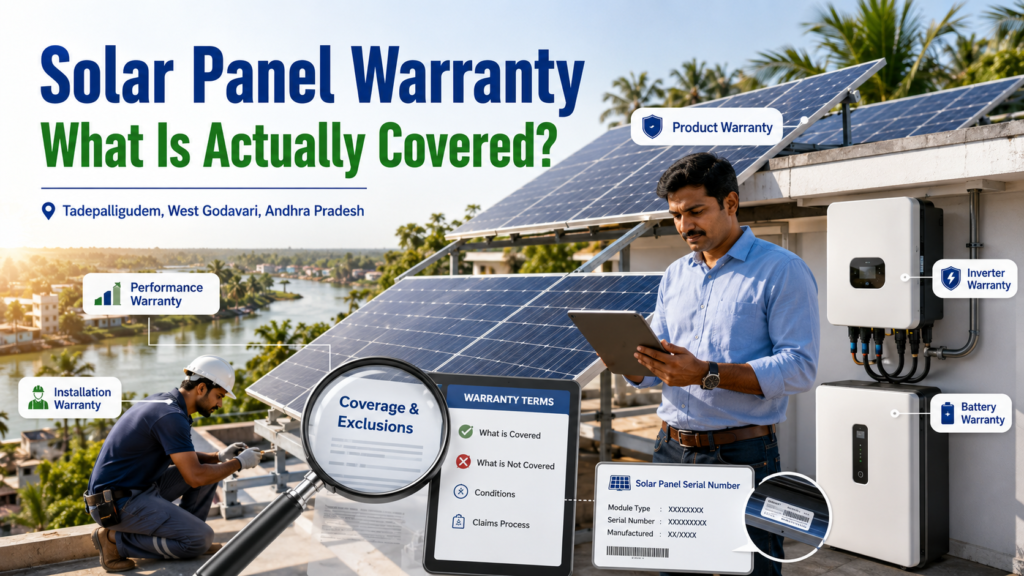
The 4 Main Warranties in a Solar System
A rooftop Solar system may involve several different warranty categories.
1. Solar Panel Product Warranty
Covers specified manufacturing/material defects.
2. Solar Panel Performance Warranty
Covers the manufacturer’s stated minimum power output over time.
3. Inverter/Battery Warranty
Covers the respective equipment according to its own warranty terms.
4. Installation Warranty
Covers workmanship-related problems, subject to the installer’s stated terms.
These warranties should not be treated as interchangeable.
1. Solar Panel Product Warranty
The Solar panel product warranty generally covers defects related to manufacturing, materials or workmanship, subject to the manufacturer’s terms.
Potential examples may include:
- Manufacturing defects
- Certain material failures
- Certain premature component failures
- Defects in junction boxes or other specified components
But the exact coverage depends on the manufacturer’s warranty document.
What a Product Warranty Usually Does NOT Mean
A product warranty does not necessarily cover every physical problem that happens to the panel.
For example, exclusions may apply to damage caused by:
- Improper installation
- Accidents
- Physical impact
- Unauthorized modifications
- Incorrect handling
- Natural disasters, depending on the warranty
- Improper maintenance
- Chemical exposure
- Other excluded conditions
Therefore:
Warranty ≠ insurance.
If a tree branch falls on your Solar panel, you should not automatically assume the manufacturer’s product warranty will replace it.
2. Solar Panel Performance Warranty
This is one of the most misunderstood parts of Solar warranties.
A performance warranty generally addresses how much power the module is expected to retain over a specified period.
For example, a manufacturer might specify:
Initial rated power
↓
Minimum guaranteed power after a defined period
The exact degradation rate and warranty structure vary by module technology and manufacturer.
What Is Solar Panel Degradation?
Solar panels naturally lose a small amount of output over time.
This is called:
Degradation
For example, a panel rated at:
550 W
will not necessarily produce exactly 550 W forever.
Its output gradually changes over its operating life.
A performance warranty is designed to establish a minimum power-retention level according to the manufacturer’s published terms.
Is a “25-Year Warranty” the Same as 25 Years of Full Power?
No.
This is one of the biggest misconceptions.
A statement such as:
“25-year Solar panel warranty”
does not normally mean:
“The panel will produce its original rated output for 25 years.”
It may instead refer to:
- Product warranty period
- Performance warranty period
- Maximum degradation
- Minimum retained power
You need to read the actual warranty conditions.
Product Warranty vs Performance Warranty
| Warranty | What It Generally Addresses |
|---|---|
| Product Warranty | Manufacturing/material defects |
| Performance Warranty | Minimum power output over time |
| Inverter Warranty | Inverter defects/failures |
| Battery Warranty | Battery defects/performance/cycles depending on terms |
| Installation Warranty | Workmanship-related issues |
This distinction should be explained to every Solar customer before installation.
What Does a 25-Year Performance Warranty Mean?
Suppose a manufacturer states that a panel has a 25-year performance warranty.
That does not mean the panel will generate the same electricity every day for 25 years.
Performance depends on:
- Sunlight
- Temperature
- Shading
- Dust
- Orientation
- System losses
- Electrical conditions
The warranty is generally about specified power retention under stated conditions, not a guarantee of your home’s electricity production.
Solar Warranty Does Not Guarantee Your Electricity Bill
This is another critical distinction.
A manufacturer may guarantee panel performance.
It does not necessarily guarantee:
Your monthly electricity bill
Your annual Solar generation
Your net-metering savings
Your payback period
Your electricity tariff
These depend on many factors outside the panel warranty.
Example: Why Generation and Warranty Are Different
Imagine a Solar panel has a guaranteed minimum power output according to its warranty.
Your actual annual Solar generation can still fall because of:
- Heavy shading
- Dust
- Cloudy weather
- Poor orientation
- High temperatures
- Inverter issues
- Cable losses
- System downtime
So:
Panel performance warranty ≠ guaranteed annual kWh generation.
Does Solar Panel Warranty Cover Cracks?
Not necessarily.
A crack caused by:
- Impact
- Improper handling
- Installation damage
- External force
may be excluded.
But if the manufacturer determines that a defect resulted from a covered manufacturing issue, the outcome may be different.
This is why cause of failure matters.
What About Microcracks?
Microcracks can be difficult to identify visually.
They may require specialised testing such as:
- Electroluminescence testing
- Thermal imaging
- Electrical testing
Whether a particular microcrack is covered by warranty depends on its cause and the manufacturer’s warranty conditions.
Don’t assume:
“Microcrack = automatic replacement.”
What About Hot Spots?
A hot spot is a localised area of elevated temperature that can occur because of electrical mismatch, cell damage, shading or other issues.
Hot spots can potentially reduce performance and, in severe cases, create safety concerns.
If you suspect a hot spot:
Step 1
Check Solar monitoring data.
Step 2
Inspect the system professionally.
Step 3
Use thermal imaging if appropriate.
Step 4
Document the issue.
Step 5
Contact the installer/manufacturer.
The warranty decision depends on the cause and applicable warranty terms.
Does Warranty Cover Bird Droppings?
Usually, bird droppings themselves are not a manufacturing defect.
If bird droppings reduce Solar output, cleaning is generally an operations and maintenance responsibility, not a panel warranty claim.
This is why regular Solar panel cleaning can matter.
Does Warranty Cover Dust?
Generally, dust accumulation is a maintenance issue rather than a product defect.
In parts of Andhra Pradesh, dust, agricultural activity and bird activity can contribute to soiling.
Cleaning frequency should depend on:
- Local environment
- Rainfall
- Dust
- Bird activity
- Panel tilt
Does Warranty Cover Cyclone Damage?
This is especially important for Andhra Pradesh.
Severe weather can damage Solar equipment.
But:
Do not assume cyclone damage is automatically covered by the product warranty.
Warranty documents may exclude damage caused by extraordinary weather events, external forces or improper installation.
This is where insurance may provide a different form of protection.
For homes in cyclone-prone coastal areas of Andhra Pradesh, ask your installer about:
Wind-load design + mounting quality + insurance
rather than relying solely on a product warranty.
Warranty vs Insurance
Think of them differently.
Warranty
Protects against specified product/workmanship defects.
Insurance
Can potentially protect against specified accidental or natural-peril damage, depending on the policy.
For example:
Manufacturing defect
→ Potential warranty issue
Cyclone damage
→ May be an insurance issue, depending on policy
Panel cleaning
→ Maintenance
Normal degradation
→ Addressed through performance warranty limits
Does the Inverter Have the Same Warranty as the Panel?
No.
This is another common mistake.
A Solar system might have:
Panel warranty: long-term
while:
Inverter warranty: shorter
The exact periods depend on the manufacturer and product.
The inverter is an electronic device and may have a different warranty and replacement economics.
Therefore:
Ask for the inverter warranty separately.
Why Inverter Warranty Matters
The inverter is one of the most important components in a grid-connected Solar system.
It converts:
DC electricity from Solar panels
into:
AC electricity used by your home/grid system.
If the inverter fails, the Solar panels may still be physically fine but the system may not generate usable AC power.
What Does Inverter Warranty Usually Cover?
Depending on the manufacturer, it may cover:
- Hardware defects
- Manufacturing defects
- Certain electronic component failures
But exclusions may apply to:
- Improper installation
- Water ingress
- Voltage conditions outside specifications
- Unauthorized repairs
- Physical damage
- Environmental conditions
- Improper maintenance
Read the actual warranty terms.
Does Inverter Warranty Include Labour?
Not always.
This is an important question to ask.
A warranty may cover the replacement component but not necessarily:
- Technician visit
- Travel
- Removal
- Reinstallation
- Transportation
- Scaffolding
Ask:
“If the inverter fails under warranty, who pays for labour and replacement installation?”
Get the answer in writing.
What About Solar Installation Warranty?
Your EPC/installer may provide a separate workmanship warranty.
This can potentially cover problems caused by installation quality.
Examples may include:
- Loose mounting
- Improper cable routing
- Certain workmanship defects
- Installation-related water leakage
But coverage varies by installer.
Roof Leakage: Who Is Responsible?
This should be discussed before installation.
Suppose a Solar mounting structure is installed on a rooftop and later there is water leakage.
The critical question becomes:
Was the leakage caused by Solar installation workmanship?
If your installer provides a workmanship warranty covering such issues, you may have a route for resolution.
But if the roof already had cracks or waterproofing problems, responsibility can be more complicated.
Therefore:
Inspect the roof before Solar installation.
Document existing defects.
Mounting Structure Warranty
The mounting structure can also have its own warranty.
Important factors include:
- Material
- Corrosion resistance
- Fasteners
- Wind-load design
- Installation method
In coastal or humid environments, corrosion resistance deserves particular attention.
For Andhra Pradesh properties exposed to coastal conditions, ask:
“What material and corrosion protection are being used for the mounting structure?”
Solar Cable Warranty
Solar cables are often overlooked.
But poor-quality cables can create:
- Energy losses
- Heating
- Insulation failures
- Safety problems
Ask your installer about:
- Cable specification
- Manufacturer
- UV resistance
- Installation quality
- Warranty
Battery Warranty
If your system includes:
BESS / lithium-ion battery
the warranty is different again.
Battery warranties may be based on:
- Years
- Energy throughput
- Cycle count
- Remaining capacity
- Operating conditions
For example, a battery warranty might specify a minimum remaining capacity after a certain number of years or energy throughput.
So:
Battery warranty should be read differently from a Solar panel warranty.
What Does a Battery Warranty Not Mean?
A battery warranty does not necessarily mean:
“The battery will have its original capacity forever.”
Battery capacity naturally changes with:
- Usage
- Temperature
- Depth of discharge
- Charging conditions
- Time
The warranty defines what performance level the manufacturer commits to under stated conditions.
Does Solar Panel Warranty Cover Labour?
This depends on the warranty.
Some warranties may cover replacement of the product but have limitations on:
- Labour
- Transportation
- Removal
- Reinstallation
- Travel expenses
Therefore, ask:
“Is this a replacement-only warranty or a complete service warranty?”
That question can save money later.
What Happens If the Manufacturer Leaves India?
This is an uncomfortable but important question.
A warranty is only useful if you can realistically access the warranty process.
Before buying, check:
- Manufacturer presence
- Local service network
- Distributor support
- Installer support
- Warranty claim process
- Spare-part availability
Don’t select equipment solely because it has an impressive warranty number.
Manufacturer Warranty vs Installer Warranty
These are different relationships.
Manufacturer
Usually responsible for product-specific warranty.
Installer/EPC
Usually responsible for installation workmanship and possibly service coordination.
If something goes wrong, you should know:
Who is your first point of contact?
A good EPC should help coordinate the warranty process rather than simply handing you a manufacturer’s phone number.
What Documents Should You Keep?
Create a Solar Warranty File containing:
- Solar invoice
- Module serial numbers
- Inverter serial number
- Battery serial number
- Warranty certificates
- Installation completion report
- System commissioning report
- Electrical test records
- DISCOM documentation
- Product datasheets
- Vendor contact details
- Maintenance records
This becomes extremely useful when making a claim.
Why Serial Numbers Matter
Solar panels have individual identification/serial information.
If a warranty claim is made, the manufacturer may need to verify:
- Product identity
- Manufacturing details
- Installation information
- Purchase records
Don’t throw away the documentation after installation.
How to Make a Solar Warranty Claim
A typical process may look like:
Step 1 — Identify the problem
Example:
One panel’s output has dropped.
Step 2 — Check monitoring data
Look for abnormal generation.
Step 3 — Contact the installer
Provide:
- Invoice
- Serial number
- Photos
- Monitoring screenshots
Step 4 — Technical diagnosis
The installer/manufacturer may inspect the system.
Step 5 — Warranty assessment
They determine whether the problem is covered.
Step 6 — Repair/replacement
If approved, the applicable remedy is provided according to warranty terms.
What Evidence Should You Collect?
For a suspected Solar failure, keep:
- Photos
- Videos
- Inverter error codes
- Monitoring screenshots
- Generation history
- Installation records
- Cleaning records
- Weather information, if relevant
Good documentation makes a dispute easier to investigate.
Does Cleaning Affect Solar Warranty?
Regular cleaning generally helps maintain performance.
But cleaning must be done correctly.
Avoid:
- Abrasive materials
- Harsh chemicals
- Scratching the glass
- Pressure-washing sensitive components
- Walking on modules
Follow the manufacturer’s cleaning recommendations.
Can Improper Cleaning Void Warranty?
Potentially, if the damage results from improper cleaning or maintenance and falls under an exclusion.
For example:
Scratched module glass
caused by an abrasive cleaning method may not be treated like a manufacturing defect.
Does Shading Void Solar Warranty?
Shading usually isn’t a warranty issue.
But it can reduce energy generation.
For example:
Tree shade → Lower Solar output
doesn’t mean:
Panel warranty failure
This distinction is important when evaluating your Solar system’s performance.
What About Poor Installation?
If panels are installed incorrectly, the manufacturer may reject a claim if the warranty excludes damage resulting from improper installation.
That’s why choosing the right EPC is critical.
A long product warranty cannot compensate for poor installation quality.
What Should You Ask Your Solar Installer?
Before signing the quotation, ask these 12 questions:
1. What is the exact panel product warranty?
2. What is the exact performance warranty?
3. What degradation rate is specified?
4. What is the inverter warranty?
5. What is the mounting-structure warranty?
6. What is the installation/workmanship warranty?
7. Does labour come under warranty?
8. Who pays transportation for replacement equipment?
9. What events are excluded?
10. Who handles the warranty claim?
11. How long does a typical claim take?
12. What happens if the manufacturer/distributor changes?
If your installer cannot clearly answer these questions, don’t sign yet.
Beware of “Lifetime Warranty” Marketing
The phrase:
“Lifetime warranty”
sounds impressive.
But it can be misleading if you don’t understand:
- Whose lifetime?
- Which component?
- What period?
- What is actually covered?
- What are the exclusions?
- Is labour included?
- Is the warranty transferable?
Always replace marketing language with:
“Show me the written warranty document.”
Is a 30-Year Warranty Always Better Than a 25-Year Warranty?
Not necessarily.
Suppose:
Panel A: 25-year performance warranty
Panel B: 30-year performance warranty
Panel B isn’t automatically better.
Compare:
- Product warranty
- Performance guarantee
- Degradation
- Technology
- Manufacturer reputation
- Certifications
- Service network
- Price
- Installer quality
A warranty number alone isn’t enough.
What Is More Important Than Warranty Length?
For a homeowner, consider:
Warranty quality
rather than simply:
Warranty duration
A strong warranty should be:
- Clearly documented
- Easy to understand
- Backed by a credible manufacturer
- Supported by a service network
- Specific about remedies
- Clear about exclusions
Solar Warranty and ALMM
For eligible government-supported residential rooftop Solar projects, module eligibility and procurement requirements can matter.
The Approved List of Models and Manufacturers (ALMM) is relevant to certain government-supported/regulated Solar applications.
However:
ALMM listing and product warranty are not the same thing.
ALMM relates to approved module models/manufacturers under the applicable framework.
Warranty relates to the manufacturer’s contractual product/performance commitments.
Don’t treat one as a substitute for the other.
Solar Warranty for PM Surya Ghar Systems
If you’re installing Solar under PM Surya Ghar, don’t assume the subsidy itself provides a universal warranty for every component.
The Solar equipment still comes with manufacturer and installer terms.
Your system may involve:
Module warranty
Inverter warranty
Installation warranty
Applicable scheme/DISCOM requirements
Read each separately.
Does Warranty Transfer When You Sell the House?
Maybe — but don’t assume it.
Some manufacturers may permit warranty transfer under conditions.
Others may require:
- Registration
- Notice
- Documentation
- Transfer fee
- Proof of ownership
If you’re installing Solar as a property improvement and may sell the home later, check whether the warranty is transferable to the new owner.
Solar Warranty and Resale Value
A documented Solar installation can be easier for a future homeowner to evaluate.
Keep:
- Original invoice
- Warranty documents
- Installation date
- Generation history
- Maintenance records
This can make the system more transparent during a property sale.
Don’t advertise:
“25 years guaranteed electricity savings.”
Instead communicate the actual equipment warranties and documented system performance.
How Warranty Affects Solar ROI
Warranty matters because it can reduce certain long-term equipment risks.
But don’t calculate ROI assuming:
“Every component is covered for 25 years.”
Instead account for the possibility that some equipment has shorter warranty periods.
The inverter may require replacement or repair during the Solar system’s long operating life.
Battery systems have their own lifecycle considerations.
Solar Warranty in Tadepalligudem
For homeowners in Tadepalligudem, ask your installer for a component-wise warranty sheet.
It should ideally identify:
| Component | Warranty to Verify |
|---|---|
| Solar Panels | Product + Performance |
| Inverter | Product warranty |
| Mounting Structure | Material/workmanship |
| Battery | Product + capacity/throughput |
| Installation | Workmanship |
| Cables | Product warranty |
| Protection Equipment | Manufacturer warranty |
This is far more useful than a quotation that simply says:
“25-year warranty.”
Solar Warranty in West Godavari
For homeowners in West Godavari, environmental conditions should also be considered.
Depending on the property’s location, you may need to pay attention to:
- Humidity
- Coastal air
- Dust
- Bird activity
- Heavy rain
- Strong winds
- Cyclonic weather exposure
Ask the installer whether the selected mounting system and installation method are suitable for the property’s conditions.
Warranty vs AMC: Don’t Confuse Them
Warranty
Protects against specified covered defects.
AMC
Annual Maintenance Contract.
An AMC may include:
- Cleaning
- Inspection
- Preventive maintenance
- Performance checks
- Fault response
Having a warranty does not necessarily mean free annual maintenance.
Do You Need an AMC for Solar?
Not necessarily.
Some homeowners can arrange periodic maintenance independently.
But an AMC can be useful if you want:
- Regular cleaning
- Preventive inspection
- Monitoring
- Faster fault response
Compare the AMC cost against the actual services included.
Solar Warranty Checklist Before You Sign
Panel
☐ Product warranty
☐ Performance warranty
☐ Degradation terms
☐ Exclusions
Inverter
☐ Warranty period
☐ Replacement process
☐ Labour coverage
Installation
☐ Workmanship warranty
☐ Roof leakage responsibility
☐ Mounting structure coverage
Battery
☐ Warranty period
☐ Cycle/throughput conditions
☐ Minimum capacity guarantee
Service
☐ Local support
☐ Claim process
☐ Response time
☐ Escalation contact
The Biggest Solar Warranty Mistakes
Mistake 1: Looking Only at “25 Years”
Ask what the 25 years actually covers.
Mistake 2: Ignoring Inverter Warranty
The inverter is critical.
Mistake 3: Assuming Labour Is Free
Check the warranty terms.
Mistake 4: Ignoring Exclusions
External damage may not be covered.
Mistake 5: Losing Serial Numbers
Keep your documentation.
Mistake 6: Choosing the Cheapest Installer
Poor installation can create problems that a product warranty may not cover.
Mistake 7: Treating Warranty as Insurance
They protect against different risks.
How VMJ Solar Solutions Can Help
For homeowners considering rooftop Solar in Tadepalligudem and West Godavari, warranty comparison should be part of the Solar buying process—not something discussed after installation.
Before finalising your system, ask for:
Panel warranty
→ Performance warranty
→ Inverter warranty
→ Installation warranty
→ Mounting structure warranty
→ Battery warranty, if applicable
→ Service and claim procedure
The goal isn’t simply to find the longest warranty.
It’s to understand what you are actually buying and what happens if something goes wrong.
FAQs
1. How long is a typical Solar panel warranty?
Solar panels commonly have long-term product and performance warranties, but the exact period varies by manufacturer and model. Always check the official warranty document rather than relying on a salesperson’s summary.
2. Is a 25-year Solar panel warranty really 25 years?
It may refer to a 25-year performance warranty, product warranty or another specific commitment. It does not necessarily mean the panel produces its original rated output for 25 years.
3. What is the difference between product and performance warranty?
A product warranty generally covers specified manufacturing/material defects. A performance warranty addresses the minimum power output the manufacturer guarantees over a defined period.
4. Does Solar panel warranty cover physical damage?
Not automatically. Damage caused by impact, improper handling, installation errors or other excluded events may not be covered.
5. Does Solar warranty cover inverter failure?
The inverter normally has its own warranty. Check the manufacturer’s terms for warranty duration, exclusions, labour and replacement procedures.
6. Does Solar panel warranty cover cleaning?
Normal cleaning is generally a maintenance responsibility, not a manufacturing warranty claim.
7. Does warranty cover bird droppings?
Bird droppings are normally a maintenance/soiling issue rather than a product defect.
8. Does Solar warranty cover cyclone damage in Andhra Pradesh?
Don’t assume it does. Severe-weather damage may be excluded from product warranties and may need to be addressed through appropriate insurance, depending on the policy.
9. Who pays for labour during a Solar warranty claim?
It depends on the warranty and installer agreement. Confirm whether labour, transportation, removal and reinstallation are included.
10. Can Solar warranty be transferred when I sell my house?
Sometimes, but this depends on the manufacturer’s terms. Check whether warranty transfer is permitted and what documentation is required.
11. Does PM Surya Ghar provide a 25-year warranty?
The scheme does not create one universal 25-year warranty covering every Solar component. Equipment and installation warranties come from the relevant manufacturers/installers and must be checked separately.
12. Is a 30-year Solar warranty better than a 25-year warranty?
Not necessarily. Compare the actual product warranty, performance guarantee, degradation terms, exclusions, manufacturer reputation, service network and system price.
13. What documents should I keep after installing Solar?
Keep the invoice, module and inverter serial numbers, warranty certificates, installation documents, commissioning records, product datasheets and maintenance records.
14. Can a Solar warranty guarantee my electricity savings?
No. Equipment warranties generally cover specified product defects or performance conditions. Your actual savings depend on Solar generation, consumption, tariff, metering and other factors.
Conclusion
A Solar panel warranty is valuable—but only if you understand what it actually covers.
The biggest mistake homeowners make is hearing:
“25-year warranty”
and assuming the entire Solar system is protected for 25 years against every possible problem.
That’s not how Solar warranties work.
A rooftop Solar system can have separate warranties for:
Panels
Performance
Inverter
Battery
Mounting structure
Installation
and sometimes other equipment.
For homeowners in Tadepalligudem and West Godavari, the smartest approach is to request a component-by-component warranty document before paying the installation advance.
And remember:
A longer warranty number isn’t automatically a better warranty.
Look at the coverage, exclusions, claim process, service network, labour responsibility and manufacturer credibility.
The best Solar purchase isn’t simply the one with the longest warranty.
It’s the one where you know exactly what happens if something fails five, ten or twenty years after installation.