
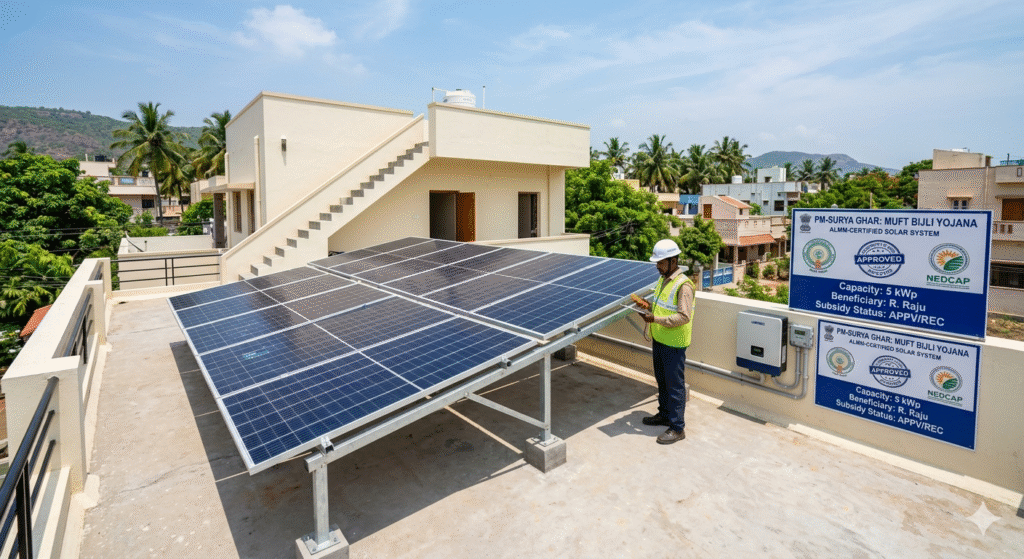
As rooftop solar adoption grows across India, homeowners are becoming more aware of subsidy eligibility rules under schemes like the PM Surya Ghar Muft Bijli Yojana.
But during the installation process, many people hear unfamiliar terms like:
- ALMM-approved solar panels
- MNRE-certified modules
- DCR compliance
- Subsidy-approved solar systems
Most homeowners focus on:
- Solar panel price
- System size
- Electricity savings
while overlooking one critical factor:
Whether the solar panels are actually approved for subsidy eligibility.
This is where ALMM certification becomes important.
For homeowners in Andhra Pradesh considering rooftop solar installation, understanding ALMM approval is essential because choosing the wrong panels can directly affect subsidy approval.
For companies like VMJ Solar Solutions, ensuring proper compliance is not just a technical formality—it’s a critical part of building reliable and subsidy-eligible solar systems.
What Is ALMM in Solar?
ALMM stands for:
Approved List of Models and Manufacturers
It is an official list maintained by the Government of India that includes:
- Approved solar panel manufacturers
- Certified solar module models
The list is managed under government renewable energy policies to ensure:
- Product quality
- Manufacturing standards
- Supply chain reliability
- Compliance with Indian regulations
In simple terms:
If a solar panel is not ALMM-approved, it may not qualify for government subsidy programs.
Why Was ALMM Introduced?
The government introduced ALMM requirements to address several concerns in the solar industry.
These included:
- Low-quality imported panels
- Inconsistent manufacturing standards
- Long-term reliability issues
- Difficulty in quality verification
The goal was to create a more standardized and trustworthy solar ecosystem.
Why ALMM Panels Are Mandatory for Subsidies
Under many government-supported rooftop solar schemes—including PM Surya Ghar—subsidy approval is linked to compliant equipment.
This means:
- The government wants subsidy-supported systems to use verified components.
- ALMM certification helps ensure minimum quality and compliance standards.
Without ALMM-approved panels:
- Subsidy applications may get rejected
- Installations may fail verification
- Financial benefits may not apply
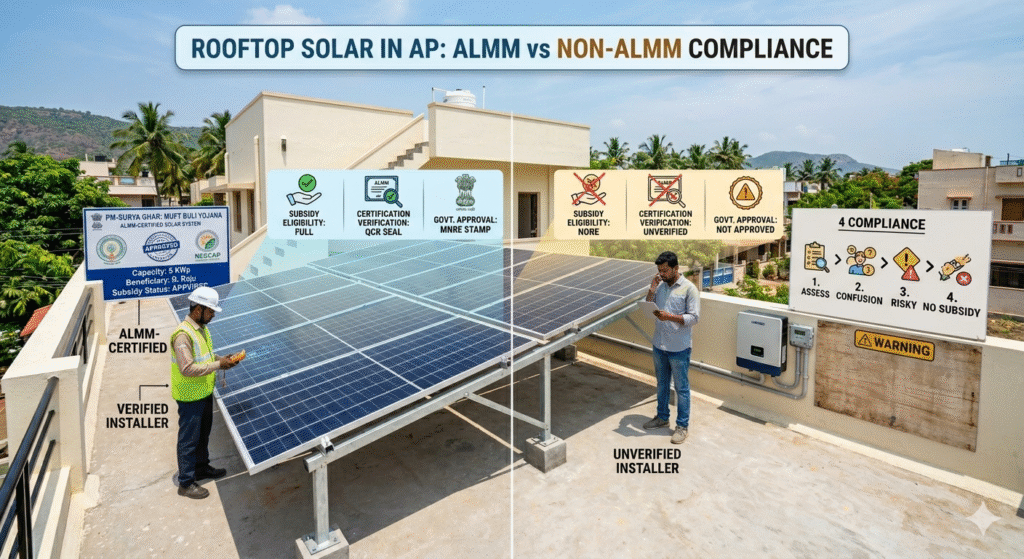
ALMM vs Non-ALMM Panels: What’s the Difference?
| Feature | ALMM Panels | Non-ALMM Panels |
|---|---|---|
| Government Approved | Yes | No |
| Subsidy Eligibility | Generally eligible | Usually not eligible |
| Manufacturer Verification | Certified | May vary |
| PM Surya Ghar Compliance | Required in most cases | Risk of rejection |
| Quality Standard Assurance | Higher regulatory oversight | Less standardized |
Does ALMM Automatically Mean Better Solar Panels?
Not necessarily.
This is where homeowners need realistic understanding.
ALMM approval means:
- The manufacturer meets government compliance requirements
- The modules satisfy specific certification standards
But it does not automatically mean:
- Every ALMM panel is premium quality
- Every non-ALMM panel is poor quality
Actual performance still depends on:
- Manufacturing quality
- Installation standards
- Inverter performance
- System design
- Maintenance practices
However, for subsidy compliance, ALMM status matters significantly.
Why Homeowners in Andhra Pradesh Should Pay Attention
Search interest in Andhra Pradesh continues increasing for:
- PM Surya Ghar subsidy
- ALMM solar panels
- MNRE approved solar panels
- Rooftop solar subsidy AP
- Best solar company Andhra Pradesh
- DCR solar panels India
As solar adoption grows, some installers market low-cost systems without properly explaining subsidy implications.
This creates a common problem:
Homeowners discover too late that their panels are not subsidy compliant.
At that stage:
- Replacing panels becomes expensive
- Subsidy claims may fail
- Rework delays increase costs
The Bigger Reason Behind ALMM Policy
This policy is not only about technical standards.
It also supports:
- Domestic manufacturing growth
- Supply chain stability
- Reduced dependence on imported modules
- Long-term solar ecosystem development in India
The government wants subsidy funds to support systems that align with national manufacturing and quality goals.
Common Mistakes Homeowners Make
❌ Focusing Only on Lowest Price
Some non-compliant systems appear cheaper upfront.
But losing subsidy eligibility can eliminate those savings quickly.
❌ Assuming Every Solar Panel Qualifies
Not all solar panels sold in the market are subsidy-approved.
Verification matters.
❌ Ignoring Documentation
Homeowners should always request:
- Manufacturer details
- ALMM compliance proof
- Module certifications
- Warranty documents
How to Verify If a Solar Panel Is ALMM Approved
Before installation, homeowners should:
- Ask the installer directly
- Request manufacturer certification details
- Verify approved models through official channels if necessary
Professional installers usually provide:
- Compliance documentation
- Approved product details
- Transparent specifications
If an installer avoids these discussions, that’s a warning sign.
Does ALMM Affect Solar System Cost?
Sometimes slightly.
ALMM-approved systems may:
- Cost somewhat more upfront
- Have limited model availability compared to unrestricted imports
But homeowners should compare:
- Total system reliability
- Subsidy eligibility
- Long-term performance
- Warranty confidence
—not just panel price alone.
The Real Cost of Ignoring ALMM Compliance
This is where many homeowners miscalculate.
Choosing a cheaper non-compliant system can lead to:
- Subsidy rejection
- Reduced financial return
- Documentation problems
- Long-term support issues
The “cheaper” option sometimes becomes more expensive overall.
Why Proper Installation Matters as Much as Panel Approval
Even with ALMM-certified panels, poor installation can still create:
- Roof leakage
- Lower efficiency
- Electrical risks
- Maintenance issues
That’s why solar success depends on:
- Approved components
- Correct installation
- Proper system design
- Long-term service support
—not certification alone.
Conclusion
ALMM-approved solar panels are mandatory for many government rooftop solar subsidy programs because they help ensure:
- Regulatory compliance
- Product verification
- Quality assurance
- Reliable system standards
For homeowners in Andhra Pradesh applying under PM Surya Ghar or similar schemes, choosing ALMM-certified panels is not optional—it’s often essential for subsidy eligibility.
But the smarter perspective goes beyond compliance.
The best rooftop solar system is not simply:
- The cheapest
- The highest wattage
- The most aggressively marketed
It’s the system that combines:
- Approved components
- Reliable installation
- Long-term performance
- Proper support and documentation
For providers like VMJ Solar Solutions, the real value lies in helping customers navigate both technical performance and subsidy compliance correctly from the start.
Because in rooftop solar, avoiding the wrong decision is often just as important as making the right one.
Frequently Asked Questions (FAQs)
1. What does ALMM mean in solar panels?
ALMM stands for Approved List of Models and Manufacturers maintained by the Government of India.
2. Are ALMM panels mandatory for PM Surya Ghar subsidy?
In most residential subsidy cases, yes. ALMM-approved panels are generally required.
3. Can non-ALMM panels still work technically?
Yes, but they may not qualify for government subsidy benefits.
4. Does ALMM guarantee better solar performance?
Not automatically. Performance depends on overall system quality and installation
5. How can I verify whether my solar panel is ALMM approved?
Ask your installer for certification details and manufacturer compliance documentation.
6. Are ALMM panels more expensive?
Sometimes slightly, but subsidy eligibility and long-term reliability often offset the difference.