
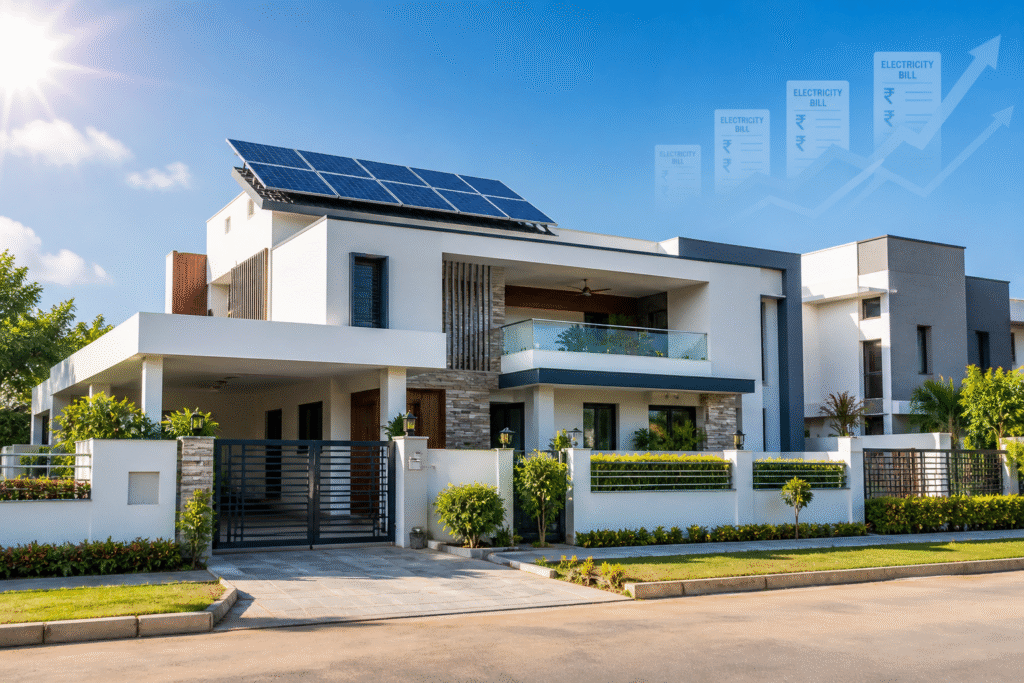
If you’ve been thinking about installing solar panels, 2026 isn’t just another year—it’s a turning point.
Electricity prices are rising, solar technology is becoming more accessible, and government support is still active. At the same time, delays in adoption are starting to carry a real cost.
So the question is no longer “Should I go solar?”
It’s “Why haven’t I done it yet?”
For homeowners and businesses in Andhra Pradesh, 2026 presents a unique window where cost, policy, and demand are aligned in your favor—but that window won’t stay open forever.
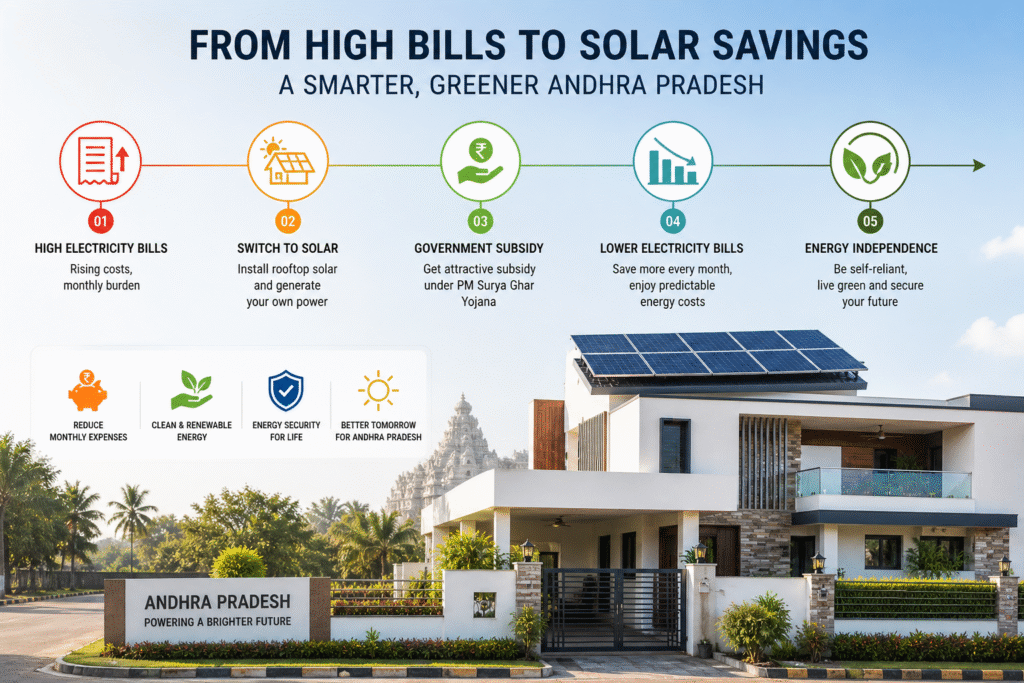
1. Electricity Costs Are Only Going One Way
Let’s start with the uncomfortable truth:
Electricity is not getting cheaper.
- Tariffs have steadily increased over the years
- Fuel costs and infrastructure expenses continue to rise
- Future hikes are highly likely
What this means for you:
- The longer you delay solar, the more you pay to the grid
- Your return on investment starts later
Solar essentially locks in your energy cost for the next 20–25 years. Waiting delays that benefit.
2. Solar Costs Have Stabilized (But Not Guaranteed to Drop Further)
There was a time when waiting made sense because solar prices were falling rapidly.
That phase is largely over.
In 2026:
- Panel prices have stabilized
- Installation quality has improved
- Supply chains are more predictable
But here’s the catch:
- Global demand for solar is increasing
- Policy changes or import costs could push prices up
Waiting now is not a strategy—it’s a gamble.
3. Government Subsidies Still Make Solar Affordable
India continues to promote rooftop solar through:
- Central government subsidies
- State-level support in Andhra Pradesh
- Net metering benefits
These incentives significantly reduce upfront costs.
But policies evolve.
- Subsidy structures can change
- Eligibility criteria can tighten
- Net metering rules may be revised
2026 still offers accessible financial support—something you can’t assume for the future.
4. Net Metering Advantage Is Still Strong
Net metering allows you to:
- Export excess solar power to the grid
- Offset your electricity bill
- Improve overall savings
In Andhra Pradesh, this remains one of the biggest advantages of going solar.
However:
- Policies are reviewed periodically
- Future caps or restrictions are possible
Installing now means locking in current benefits.
5. Solar Awareness Has Increased—Competition Has Too
A few years ago, having solar made your property stand out instantly.
Now:
- More homes and businesses are adopting solar
- Buyers are becoming more informed
- Solar is shifting from “premium feature” to “expected feature”
If you delay:
- You lose early-mover advantage
- Your property competes with solar-equipped alternatives
In 2026, you’re still ahead of the curve—but not for long.
6. Technology Is Mature Enough to Trust
Earlier concerns about solar included:
- Reliability
- Maintenance
- Performance in Indian conditions
Today:
- Panels last 20–25 years
- Inverters are more efficient
- Monitoring systems are smarter
You’re no longer investing in an emerging technology—you’re adopting a proven system.
7. Faster Payback Periods
Because of rising electricity costs and stable solar pricing:
- Payback periods are becoming shorter
- Typical residential systems recover costs in 4–6 years (depending on usage)
After that, the electricity you generate is essentially free.
Delay that by 2 years, and you’re pushing your breakeven further away.
8. Financing Options Are Better Than Before
One of the biggest barriers used to be upfront cost.
In 2026:
- EMI options are widely available
- Solar loans are more accessible
- Flexible payment models are emerging
This means you don’t need to wait years to save up—you can start benefiting immediately.
9. Energy Independence Is Becoming a Priority
Power cuts, voltage fluctuations, and grid dependency are still concerns in parts of Andhra Pradesh.
Solar (especially with battery options):
- Reduces dependence on the grid
- Provides backup during outages
- Improves reliability
This is no longer just about savings—it’s about control over your energy.
10. The Opportunity Cost of Waiting
This is where most people miscalculate.
Let’s say you delay solar by 2 years:
- You pay higher electricity bills during that time
- You miss out on savings
- You risk losing current subsidies
- You delay ROI
The real cost of waiting is not visible upfront—but it adds up quickly.
Conclusion
2026 is not “just a good time” to switch to solar in Andhra Pradesh—it’s one of the most balanced moments you’ll get:
- Costs are stable
- Incentives are available
- Technology is reliable
- Electricity prices are rising
But here’s the reality:
The advantage lies with those who act early, not those who wait for “perfect timing.”
For homeowners and businesses working with providers like VMJ Solar Solutions, the smarter move is to treat solar as a strategic investment, not a delayed decision.
Because every month you wait, you’re still paying for energy you could be generating yourself.
Frequently Asked Questions (FAQs)
1. Is 2026 really better than waiting for 2027 or later?
Right now, subsidies and net metering benefits are favorable. Future policies are uncertain, so waiting carries risk.
2. How long does it take to install a solar system?
Typically 2–6 weeks, depending on approvals and system size.
3. What is the average lifespan of solar panels?
Most panels last 20–25 years with proper maintenance
4. Will solar work during power cuts?
Grid-tied systems usually shut off during outages unless paired with batteries.
5. Is solar suitable for small homes?
Yes. Even 1kW–3kW systems can significantly reduce electricity bills.
6. Can I expand my solar system later?
Yes, most systems can be scaled based on future needs.