
Many industries in Andhra Pradesh are investing in solar power to reduce electricity costs and improve energy independence. But there’s a hidden factor that often gets ignored—and it can quietly reduce your savings:
Power Factor.
You can install a well-designed solar system and still not achieve expected financial returns if your power factor is poor. In some cases, industries even continue paying penalties despite generating their own solar energy.
If you’re serious about maximizing solar ROI, you can’t afford to overlook this.
What Is Power Factor (In Simple Terms)?
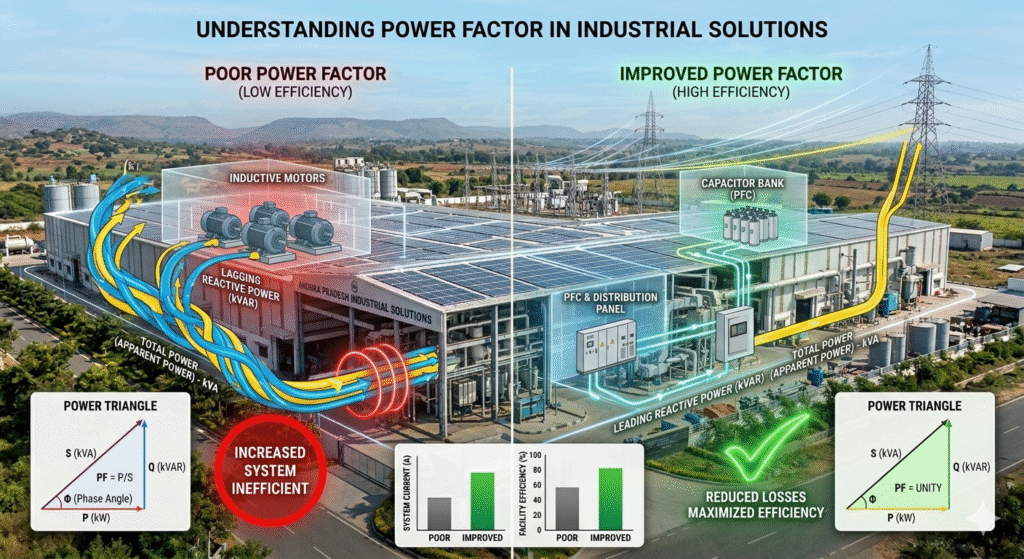
Power factor measures how efficiently electricity is being used in your system.
- A power factor of 1 (or 100%) means all supplied power is being used effectively
- A low power factor means some power is wasted due to inefficiencies
This typically happens because of inductive loads like:
- Motors
- Pumps
- Compressors
- Industrial machinery
Here’s the fundamental relationship:
Power Factor=Real Power (kW)Apparent Power (kVA)\text{Power Factor} = \frac{\text{Real Power (kW)}}{\text{Apparent Power (kVA)}}Power Factor=Apparent Power (kVA)Real Power (kW)
In practical terms:
You may be drawing more power than you actually use—and paying for that inefficiency.
Why Power Factor Matters More After Installing Solar
Here’s where most industries get it wrong.
Solar panels generate real power (kW). But your utility billing and system performance depend on apparent power (kVA) and overall efficiency.
What happens if your power factor is low?
- You still draw excess reactive power from the grid
- You may face power factor penalties from DISCOMs
- Your solar savings get diluted
In short:
Solar reduces your energy cost—but poor power factor reduces your savings.
The Direct Impact on Industrial Solar Efficiency
1. Reduced Effective Utilization of Solar Power
If your system is inefficient:
- Not all generated solar power translates into useful work
- Some capacity is effectively “wasted”
2. Higher Demand Charges
Industries are often billed based on kVA demand:
- Lower power factor → higher apparent demand
- Higher demand → higher charges
Even with solar, this component remains.
3. Penalties from Utilities
In Andhra Pradesh, utilities may impose penalties if:
- Power factor drops below a specified limit (often around 0.9 or 0.95)
This is an avoidable cost—but many industries ignore it until bills spike.
4. Undersized or Inefficient Solar ROI
You might think your solar system is underperforming.
But the real issue could be:
- Poor internal electrical efficiency
- Not generation capacity
Common Causes of Low Power Factor in Industries
Let’s be specific. If you’re running:
- Textile units
- Rice mills
- Cold storage facilities
- Manufacturing plants
You likely have:
- Heavy motor loads
- Inductive machinery running continuously
- Fluctuating load patterns
All of these contribute to a lagging power factor.
How to Improve Power Factor (And Boost Solar Efficiency)
1. Install APFC Panels (Automatic Power Factor Correction)
These systems:
- Automatically adjust capacitor banks
- Maintain power factor close to 1
- Reduce penalties and inefficiencies
This is often the first and most impactful upgrade.
2. Use Capacitor Banks Strategically
Capacitors offset reactive power:
- Improve system efficiency
- Reduce load on transformers
- Support better solar utilization
3. Audit Your Load Profile
Without understanding your energy usage, you’re guessing.
A proper audit helps you:
- Identify peak inefficiencies
- Align solar generation with consumption
- Optimize system design
4. Integrate Solar + Electrical Optimization
This is where many installations fall short.
Solar should not be treated as a standalone system. It must align with:
- Existing electrical infrastructure
- Load behavior
- Power quality parameters
Real-World Scenario: Andhra Pradesh Industry
Consider a mid-sized rice mill:
- Installs a 100 kW solar system
- Expects significant bill reduction
But:
- Power factor remains at 0.82
- Utility penalties continue
- Demand charges stay high
Result?
Actual savings fall short of expectations.
Now compare that with:
- Power factor improved to 0.98 using APFC
- Better load management
Outcome:
- Lower penalties
- Reduced demand charges
- Higher effective solar savings
Same solar system. Completely different results.
The Strategic Insight Most Businesses Miss
Installing solar is not just about generation—it’s about system efficiency.
If you ignore power factor:
- You’re optimizing only one part of the equation
- You leave money on the table every month
Industries that treat solar as part of a broader energy optimization strategy consistently see better ROI.
When Should You Address Power Factor?
Don’t wait until after installation.
You should evaluate power factor:
- Before installing solar
- During system design
- As part of ongoing maintenance
This ensures your solar investment performs as expected from day one.
Conclusion
Power factor is not a technical detail—it’s a financial lever.
In industrial solar setups across Andhra Pradesh, it directly impacts:
- Cost savings
- System efficiency
- Return on investment
Ignoring it leads to underperformance. Managing it unlocks the full value of your solar system.
For businesses working with providers like VMJ Solar Solutions, the real advantage lies in combining solar generation with electrical efficiency optimization—not treating them as separate decisions.
Frequently Asked Questions (FAQs)
1. What is a good power factor for industries?
Typically 0.95 or above is considered good and helps avoid penalties.
2. Does solar improve power factor automatically?
No. Solar generates real power but does not correct power factor on its own.
3. What happens if my power factor is low?
You may face higher demand charges, penalties, and reduced system efficiency.
4. What is an APFC panel?
An Automatic Power Factor Correction panel adjusts capacitor usage to maintain optimal power factor.
5. Is improving power factor expensive?
Compared to ongoing penalties and losses, it is usually a cost-effective investment.
6. Can improving power factor increase solar ROI?
Yes. It ensures more efficient use of generated power and reduces unnecessary charges.