
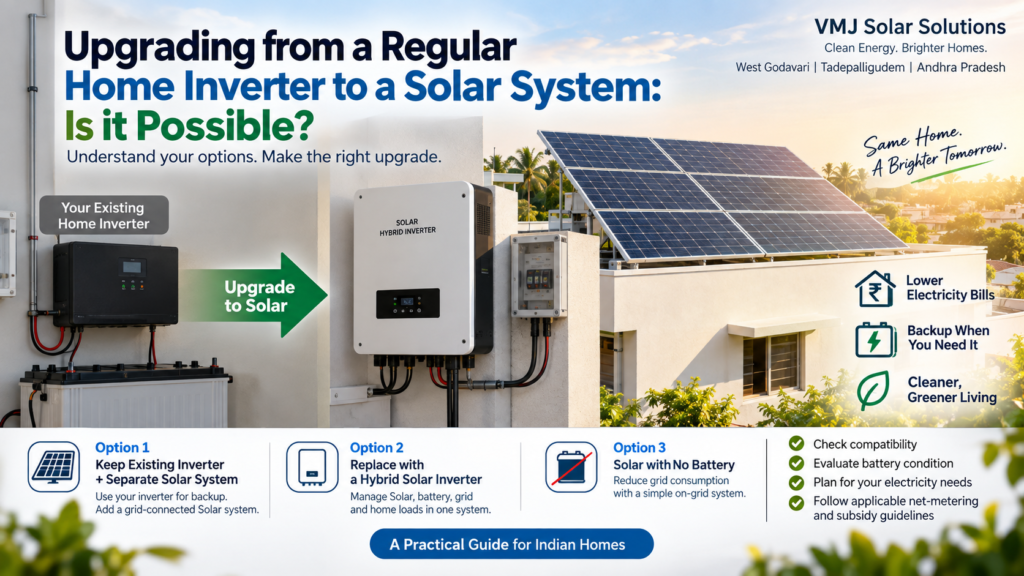
Many Indian homes already have a conventional inverter and battery for power backup.
As rooftop Solar becomes more accessible, homeowners often ask:
“Can I add Solar panels to my existing home inverter?”
The short answer is:
Sometimes—but not always.
A conventional home inverter is generally designed to convert battery DC power into AC electricity for backup loads. A Solar system needs additional functions such as Solar MPPT charging, Solar input management, grid synchronisation and, depending on the system, anti-islanding protection and export control.
So, simply connecting Solar panels to a regular inverter is generally not a safe or technically correct upgrade.
The good news is that your existing battery, wiring or backup-load setup may sometimes be reusable, depending on the equipment.
Can a Normal Home Inverter Be Upgraded to Solar?
Yes, in some cases.
There are three common situations:
1. Existing inverter is Solar-compatible
If your inverter already has a suitable Solar input and MPPT/charge-controller functionality, adding Solar panels may be possible after checking its specifications.
2. Existing inverter is a conventional UPS/inverter
A normal inverter generally cannot directly accept Solar PV input.
You may need:
Solar panels + Solar charge controller + compatible inverter arrangement
or, more commonly for a modern rooftop system:
Solar panels + hybrid/grid-interactive Solar inverter
3. You want rooftop Solar with net metering
For a grid-connected rooftop Solar system, replacing the conventional inverter with an appropriate grid-interactive or hybrid Solar inverter is often the more practical approach.
The exact configuration depends on whether you want:
- Lower electricity consumption
- Battery backup
- Net metering
- Backup during grid outages
- Solar battery charging
- A combination of these
Why Can’t I Just Connect Solar Panels to My Existing Inverter?
A conventional inverter and a Solar inverter perform different jobs.
Conventional home inverter
A typical backup inverter:
Battery → Inverter → AC loads
It takes DC power stored in the battery and converts it into AC electricity.
Solar system
A rooftop Solar system typically involves:
Solar panels → MPPT → Solar inverter → Home loads/grid
If batteries are included:
Solar → Solar inverter → Battery → Loads
A grid-connected system also needs to synchronise correctly with the utility grid and provide required protection.
Therefore, a conventional inverter may not have the electronics required to:
- Track the Solar panel’s maximum power point
- Accept the required PV voltage/current
- Manage Solar charging
- Synchronise with the grid
- Control battery charging appropriately
- Handle grid outage conditions safely
That is why the inverter should be treated as a key part of the Solar system rather than simply a backup appliance.
What Is an MPPT and Why Does It Matter?
MPPT stands for Maximum Power Point Tracking.
Solar panels do not produce a fixed voltage and current under all conditions.
Their electrical output changes with:
- Sunlight
- Temperature
- Shading
- Panel configuration
An MPPT controller continuously adjusts the operating point so the Solar array can operate near its maximum available power point within the controller’s design limits.
A conventional home inverter may not have an MPPT Solar charge controller.
If it doesn’t, Solar panels cannot simply be connected to its PV side because there may not even be a suitable PV input.
Can I Keep My Existing Battery?
Possibly.
This is one of the most useful aspects of an upgrade.
If your existing battery is relatively new and compatible with the proposed Solar inverter, it may be possible to reuse it.
But compatibility must be checked.
Important factors include:
- Battery voltage
- Battery chemistry
- Battery capacity
- Maximum charging current
- Inverter battery-voltage range
- Battery communication requirements
- Battery age
- Battery condition
- Manufacturer compatibility
For example, an older lead-acid battery may not be appropriate for a newer lithium-based hybrid inverter if the inverter requires battery communication or a specific battery management system.
Therefore:
Existing battery ≠ automatically compatible with new Solar inverter
Can I Keep My Existing Inverter?
This depends on what type of inverter you have.
Conventional inverter
If it is a standard home UPS/inverter without a Solar input, it generally cannot directly become a grid-connected Solar inverter just by adding panels.
Solar inverter
If the inverter already supports Solar PV input, it may be possible to expand or configure the system.
Hybrid inverter
A hybrid inverter is specifically designed to manage combinations such as:
Solar + Grid + Battery + Home Loads
This can make it suitable for homeowners who want both Solar generation and battery backup.
The manufacturer’s specifications should always be checked before adding panels or batteries.
Three Common Ways to Upgrade
Option 1: Keep the Existing Inverter + Add a Separate Solar System
This approach can make sense when the existing inverter is still useful for backup.
The setup could look like:
Solar panels → Grid-connected Solar inverter → Home/grid
and separately:
Existing battery inverter → Selected backup loads
This creates two systems.
Advantages
- Existing inverter may continue to be used
- Solar system can be designed independently
- Can be useful when the existing battery/inverter still has significant useful life
Limitations
- Two separate systems
- More equipment
- More complex wiring
- Existing inverter may not be charged by Solar unless specifically designed for it
Option 2: Replace the Existing Inverter with a Hybrid Solar Inverter
For many homeowners who want Solar + battery backup, this can be a cleaner approach.
A hybrid inverter can potentially manage:
Solar + Grid + Battery + Loads
depending on the model and configuration.
During the day:
Solar → Home loads
Excess Solar may:
Charge battery / export to grid, depending on the system configuration and applicable regulations.
During a grid outage:
Battery/Solar → Backup loads
provided the inverter is designed and configured for backup operation.
This approach can reduce the need for separate inverter systems.
Option 3: Solar With No Battery
If your primary goal is to reduce electricity purchased from the grid, you may not need a battery.
A grid-connected Solar system can operate approximately as:
Solar → Home loads
and when Solar generation is insufficient:
Grid → Home loads
When Solar generation exceeds the home’s instantaneous consumption, the treatment of excess electricity depends on the applicable metering/settlement arrangement.
This type of system is different from a backup inverter.
Important point
A typical grid-connected Solar inverter does not keep your home powered during a grid outage.
This is because grid-connected systems normally shut down when the grid fails to protect utility workers and equipment.
If backup power during outages is required, the system needs an appropriate backup/hybrid configuration.
What Happens to My Old Battery?
The answer depends on its condition.
If the battery is relatively new
It may potentially be reused if compatible with the new inverter.
If the battery is old
Replacing it may make more sense than designing the new Solar system around it.
Lead-acid batteries gradually lose usable capacity through ageing and cycling.
If you want lithium-ion storage
A lithium battery can offer different characteristics such as higher usable depth of discharge and potentially longer cycle life, but it also requires a compatible battery management and inverter configuration.
The decision should be based on:
- Remaining battery life
- Backup requirements
- New inverter compatibility
- Battery replacement cost
- Expected usage
- Warranty
Can I Add Solar Panels to My Existing Battery?
This depends on how the battery is charged.
A conventional inverter may charge the battery from the grid.
A Solar-compatible system can be designed to charge it from Solar.
But simply connecting Solar panels to the battery directly is generally not recommended.
Solar PV voltage and current vary significantly, while battery charging requires controlled voltage/current management.
A suitable Solar charge controller or compatible hybrid inverter should regulate the charging process.
What Size Solar System Do I Need?
Do not determine Solar capacity only from your existing inverter size.
For example:
1 kVA inverter ≠ automatically 1 kW Solar requirement
Solar system sizing should consider:
- Monthly electricity consumption
- Annual electricity consumption
- Daytime load
- Nighttime load
- Roof area
- Shading
- Inverter capacity
- Battery requirements
- Future electricity usage
- Applicable DISCOM rules
A home using significant electricity during daylight may have a different Solar requirement from a home whose major loads operate at night.
What About a 1 kVA, 2 kVA or 3 kVA Inverter?
The inverter’s VA rating represents its ability to supply AC loads under specified conditions.
Solar capacity is normally discussed in kW or kWp.
These are not interchangeable numbers.
For example, a 2 kVA home inverter does not automatically mean that you should install a 2 kW Solar array.
The Solar array and inverter need to be matched according to the manufacturer’s electrical specifications and the home’s load profile.
Can My Existing Wiring Be Reused?
Some wiring may be reusable, but Solar installation introduces additional electrical circuits.
A rooftop Solar system can require:
- DC Solar cables
- DC isolators/protection
- Surge protection
- AC cables
- AC protection
- Earthing
- Lightning protection where applicable
- Solar inverter connections
- Metering connections
- Monitoring equipment
Existing household wiring should therefore be inspected rather than assumed to be suitable.
What About My Existing Backup Loads?
This is an important advantage of a hybrid system.
Instead of backing up the entire house, you can define essential loads.
For example:
Backup loads
- Fans
- Lights
- Wi-Fi router
- Refrigerator
- Television
- Selected sockets
High-load/non-essential loads
- Large air conditioner
- Electric water heater
- Heavy pump
- Induction cooktop
- Large appliances
The actual selection depends on inverter capacity, battery capacity and Solar generation.
This can make battery storage more practical.
Can Solar Run My AC During a Power Cut?
Potentially, but it depends on the system.
A conventional on-grid Solar system generally will not operate during a grid outage.
A properly designed hybrid/backup Solar system can operate selected loads during an outage if:
- The inverter supports backup operation
- Battery capacity is sufficient
- Solar generation is available
- AC load is within the inverter’s backup rating
- Appropriate electrical protection and isolation are installed
Large air conditioners can create significant starting and operating loads.
Therefore, an AC should not be assumed to work during an outage simply because Solar panels are installed.
Can I Get Net Metering After Upgrading?
If the new system is designed as an eligible grid-connected rooftop Solar system, the applicable state/DISCOM net-metering or other settlement framework may apply.
In Andhra Pradesh, APERC’s rooftop Solar framework has been amended through Regulation No. 10 of 2025, with the regulatory framework continuing to govern grid-interactive rooftop PV under net/gross metering. APERC also lists subsequent 2026 regulations and proceedings, so current requirements should be verified before installation.
For a homeowner in Andhra Pradesh, the Solar installer should coordinate the application and metering process with the relevant DISCOM.
What About PM Surya Ghar Subsidy?
If you are considering a residential Solar installation under PM Surya Ghar: Muft Bijli Yojana, do not assume that your existing inverter automatically qualifies the system for subsidy.
The subsidy process applies to eligible rooftop Solar installations under the scheme’s requirements, including applicable vendor, equipment, installation and DISCOM verification conditions. MNRE’s current rooftop-Solar programme information directs residential consumers through the National Portal/empanelled-vendor process.
The important point is:
Replacing or retaining an old inverter does not by itself determine subsidy eligibility.
The complete Solar installation and applicable scheme requirements matter.
What If I Want Solar + Battery + Net Metering?
This is possible in some configurations, but the system needs careful design.
A typical architecture could be:
Solar panels → Hybrid inverter
Then:
Hybrid inverter → Home loads
Hybrid inverter → Battery
Hybrid inverter ↔ Grid
The exact operation during:
- Normal grid operation
- Solar surplus
- Nighttime
- Grid outage
- Battery low state
depends on the inverter’s programming and applicable metering arrangement.
The installer should clearly explain the operating modes before installation.
Should I Replace My Old Inverter or Add a Solar Inverter?
Use this simple decision framework.
Keep the existing inverter if:
- It is relatively new
- It is functioning properly
- You only want to add grid-connected Solar
- You are comfortable with separate backup and Solar systems
Consider replacing it with a hybrid inverter if:
- You want Solar + battery integration
- You want a single energy-management system
- Your existing inverter is old
- You want better monitoring and control
- You need selected-load backup
Consider a Solar-only system if:
- Your main objective is reducing daytime grid consumption
- Backup is not important
- You don’t need battery storage
A Simple Example
Imagine a home currently has:
2 kVA inverter + 150 Ah battery
The homeowner wants rooftop Solar.
There are several possible approaches.
Scenario A: Keep the existing inverter
Install a separate grid-connected Solar system.
The existing inverter continues to provide backup.
Scenario B: Upgrade to hybrid
Replace the existing inverter with a compatible hybrid Solar inverter and evaluate whether the existing battery can be reused.
Scenario C: Solar + new lithium battery
Replace the old inverter and battery with a hybrid inverter + compatible lithium battery.
Which option makes sense depends on the home’s electricity consumption, backup requirements, equipment condition and budget.
Common Mistakes to Avoid
1. Connecting Solar panels directly to a normal inverter
A conventional inverter may not have a suitable PV input or MPPT controller.
2. Assuming inverter kVA equals Solar kW
They are different specifications.
3. Reusing an old battery without checking compatibility
Battery voltage, chemistry and charging requirements matter.
4. Assuming on-grid Solar provides backup
A conventional grid-connected system generally shuts down during a grid outage.
5. Installing more Solar than the roof or electrical system can support
Roof area, structure and electrical capacity must be assessed.
6. Ignoring future electricity usage
If you plan to add an AC, EV charger, heat pump or other major load, consider it during system sizing.
7. Choosing an inverter based only on price
Compare:
- MPPT range
- Maximum PV input
- Battery compatibility
- Backup capacity
- Efficiency
- Monitoring
- Warranty
- Protection features
- Service support
8 Questions to Ask Before Upgrading
Before purchasing a Solar system, ask your installer:
- Can my existing inverter accept Solar input?
- Can my existing battery be reused?
- What Solar capacity is suitable for my electricity consumption?
- Will the system provide backup during a power cut?
- Which loads will be backed up?
- Can I use net metering with this configuration?
- Is the system eligible for applicable Solar subsidy schemes?
- What equipment will need to be replaced now or later?
Getting clear answers to these questions can prevent compatibility and cost problems.
Upgrade Checklist
Before converting a conventional inverter setup to Solar:
☐ Check inverter model and specifications
☐ Check battery voltage and chemistry
☐ Check battery age and condition
☐ Review recent electricity bills
☐ Analyse daytime electricity consumption
☐ Identify essential backup loads
☐ Check roof area and shading
☐ Estimate required Solar capacity
☐ Check inverter MPPT range
☐ Check maximum PV input
☐ Evaluate hybrid vs on-grid configuration
☐ Check applicable DISCOM requirements
☐ Verify subsidy eligibility, if applicable
☐ Plan earthing and surge protection
☐ Compare warranty and after-sales service
Solar Upgrade Options for Homes in Andhra Pradesh
For homeowners in West Godavari, Tadepalligudem and other parts of Andhra Pradesh, the choice between an on-grid, hybrid or separate Solar-plus-existing-inverter configuration should be based on actual electricity consumption and backup requirements.
Andhra Pradesh’s Solar rooftop framework allows grid-connected rooftop Solar under applicable net/gross metering arrangements, with the exact conditions governed by APERC regulations and amendments.
A site assessment can help determine whether the existing inverter and battery can be retained or whether replacing them with a modern Solar/hybrid inverter is more practical.
How VMJ Solar Solutions Can Help
If you already have a home inverter and want to move toward Solar, VMJ Solar Solutions can evaluate the existing setup before recommending replacement.
The assessment can include:
- Existing inverter inspection
- Battery condition
- Electricity-bill analysis
- Solar capacity planning
- Roof/shadow assessment
- Hybrid vs on-grid comparison
- Backup-load planning
- Inverter compatibility
- Battery compatibility
- Net-metering requirements
- Solar protection and earthing
- Future load planning
This can help homeowners avoid replacing equipment unnecessarily while also avoiding compatibility problems caused by trying to reuse equipment that is not suitable.
FAQs
1. Can I convert my normal home inverter into a Solar inverter?
Usually, you cannot convert a conventional inverter simply by adding Solar panels. If it lacks a Solar PV input and MPPT controller, a suitable Solar or hybrid inverter is generally required.
2. Can I use my existing battery with a Solar inverter?
Possibly. Battery voltage, chemistry, capacity, charging limits and inverter compatibility must be checked first.
3. Can I keep my old inverter after installing Solar?
Yes, in some cases. A separate grid-connected Solar system can operate alongside an existing backup inverter, provided the electrical installation is properly designed.
4. Can Solar charge my existing inverter battery?
It can be possible with a suitable Solar charge controller or compatible hybrid inverter. Solar panels should not normally be connected directly to a battery without appropriate charge-control equipment.
5. Can an on-grid Solar system work during a power cut?
Normally, no. Standard grid-connected Solar inverters shut down when the grid is unavailable. Backup requires an appropriately designed hybrid or battery-based system.
6. Can I run an AC during a power cut using Solar?
A suitably designed hybrid Solar + battery system may run a selected AC if the inverter, battery and Solar capacity can support the load. It should not be assumed automatically.
7. Do I need to replace my battery when upgrading to Solar?
Not necessarily. A compatible and healthy battery may be reusable. An installer should check its condition and compatibility.
8. Should I choose an on-grid or hybrid Solar system?
It depends on your priority. On-grid Solar may suit homeowners primarily seeking Solar generation and grid interaction, while hybrid systems may be more appropriate when battery backup is also important.
9. Can I get PM Surya Ghar subsidy when upgrading my inverter?
The subsidy applies to eligible rooftop Solar installations under the scheme’s current requirements. Simply replacing an inverter does not make a project eligible. Check the current portal, vendor and DISCOM requirements.
10. Is a Solar inverter better than a regular home inverter?
They serve different purposes. A Solar or hybrid inverter has additional functionality for managing Solar generation, while a conventional inverter is primarily designed for battery backup.
Conclusion
Upgrading from a regular home inverter to Solar is possible, but the existing inverter should not be assumed to be Solar-compatible.
The most important step is to identify what equipment you already have.
If your inverter is Solar-compatible, you may be able to add Solar with the appropriate configuration.
If it is a conventional inverter, you can consider either:
Existing inverter + separate Solar system
or
Hybrid Solar inverter + battery + Solar panels
or simply:
Grid-connected Solar without battery
The right choice depends on your electricity consumption, backup requirements, battery condition, roof space, budget and applicable DISCOM regulations.
For homeowners in West Godavari, Tadepalligudem and Andhra Pradesh, a professional assessment of the existing inverter, battery and electricity consumption can help determine the most practical upgrade path.
Don’t start by buying Solar panels. Start by checking the complete electrical system.