
Solar panel technology has changed significantly over the last decade.
Traditional full-cell modules have increasingly given way to more advanced module architectures designed to improve electrical performance, reduce internal losses and make better use of available rooftop space.
One of the most important developments is half-cut Solar cell technology.
By 2026, half-cut cell architecture has become a mainstream design in modern crystalline-silicon Solar modules. It is commonly combined with newer cell technologies such as N-type TOPCon, bifacial technology and other high-efficiency architectures.
But what exactly is a half-cut Solar cell?
Does cutting a Solar cell in half actually make the panel more powerful?
And why are manufacturers using this design so widely?
Let’s understand the technology.
Quick Answer: What Is Half-Cut Solar Cell Technology?
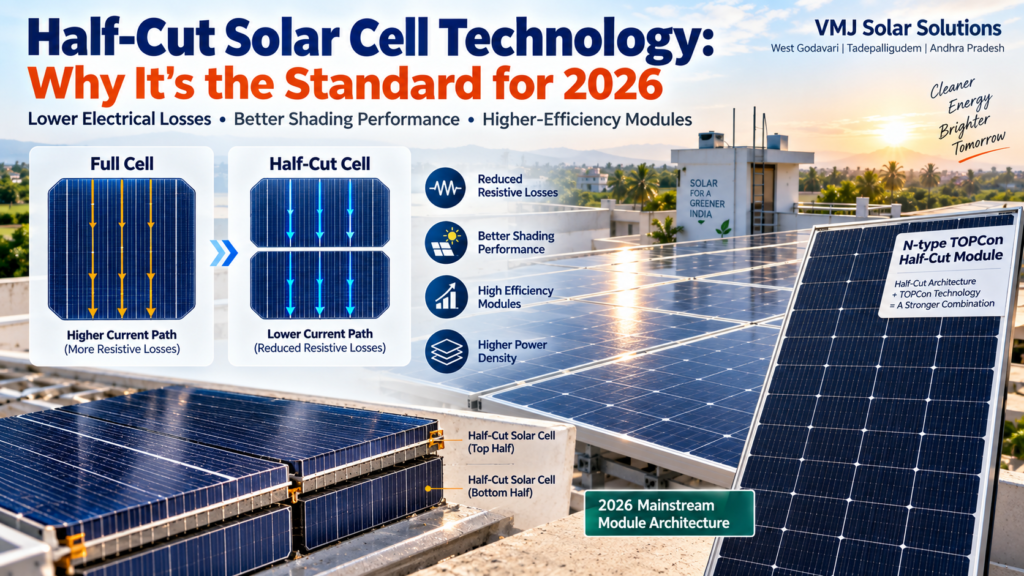
A half-cut Solar module uses Solar cells that are physically divided into two smaller sections.
Instead of using one full-size cell, the cell is cut into two electrically separated half-cells and arranged within the module.
The smaller cells carry lower current through each electrical path. Because resistive losses are related to the square of current, reducing current in a conductor can reduce resistive losses significantly, depending on the module’s electrical design.
Half-cut architecture can also provide improved behaviour under certain partial-shading conditions because the module is typically divided into more independent electrical sections.
It is important to understand that half-cut is not a separate Solar cell chemistry.
For example, a module can be:
- Half-cut P-type
- Half-cut N-type TOPCon
- Half-cut bifacial
- Half-cut HJT
- Half-cut monocrystalline
Therefore:
Half-cut = module/cell architecture
while:
TOPCon, HJT, PERC, etc. = cell technology/structure
Why Did Solar Manufacturers Move to Half-Cut Cells?
The basic objective is straightforward:
Reduce electrical losses while increasing usable module power and improving module-level performance.
As Solar modules became more powerful, manufacturers had to deal with higher electrical currents and the associated resistive losses.
NREL research on half-size cells explains that reducing the cell size approximately halves the current in the interconnect wires, allowing thinner wires to be used while maintaining low resistive losses.
This is particularly useful as module power continues to increase.
How Does a Half-Cut Solar Cell Work?
Let’s simplify the difference.
Traditional full-cell module
A conventional module uses full-size Solar cells connected into electrical strings.
Electric current travels through the cell and interconnection network.
Half-cut module
The original cells are divided into two halves.
The module is then designed with additional electrical sections so that current is distributed through smaller cell groups.
A simplified representation is:
Full Cell Module
Solar cells → Higher current path → Electrical losses
Half-Cut Module
Half-cells → Lower current per path → Reduced resistive losses
The actual electrical architecture varies by manufacturer and module design, so the precise string configuration should always be checked in the module datasheet.
1. Lower Internal Electrical Losses
One of the biggest advantages of half-cut technology is the potential reduction in resistive losses.
Electrical resistance losses can be represented by:
Power Loss = I²R
where:
- I = current
- R = resistance
If current through a conductor is reduced, the resistive loss can decrease substantially.
For example, if the current through a particular resistive path is approximately halved while resistance remains comparable, the theoretical I²R loss in that path becomes approximately one-quarter.
This is one reason half-cut architecture can be useful as module power increases.
However, the actual efficiency improvement of a finished Solar module depends on the complete design, including:
- Cell efficiency
- Busbars
- Interconnects
- Ribbon/wire design
- Cell layout
- Electrical configuration
- Inverter matching
- Operating temperature
Therefore, it would be incorrect to assume that every half-cut panel automatically produces a fixed percentage more electricity than every full-cell panel.
2. Better Performance Under Certain Partial-Shading Conditions
Shading is one of the biggest challenges for rooftop Solar.
A shadow from:
- Water tanks
- Lift rooms
- Trees
- Nearby buildings
- Poles
- Antennas
- Parapet walls
can affect Solar generation.
Half-cut modules generally use a more segmented electrical architecture. Because the module is divided into multiple sections, partial shading may affect a smaller portion of the module’s electrical output compared with some conventional full-cell arrangements.
This does not mean half-cut Solar panels are “shade-proof.”
If a rooftop has significant shading, the Solar system can still lose substantial generation.
Module orientation, string design, bypass diodes, inverter MPPT configuration and the location and duration of the shade all matter.
So the correct statement is:
Half-cut architecture can improve the module’s response to certain partial-shading conditions; it does not eliminate shading losses.
3. Higher Power From Similar Module Dimensions
Another important benefit is power density.
Manufacturers can combine improved cell efficiency with half-cut architecture to produce higher-wattage modules within practical module dimensions.
Modern Solar panels can therefore provide considerably more power per module than older generations.
This is especially useful when roof space is limited.
For example, a homeowner may have only a certain amount of usable rooftop area after accounting for:
- Water tanks
- Walkways
- Setbacks
- Shade
- Maintenance access
- Structural restrictions
Higher-power modules can potentially help designers achieve the required system capacity using fewer modules.
However, fewer panels does not always mean a smaller roof footprint because modern high-power modules can also be physically larger.
The correct comparison is therefore:
Required system capacity + module dimensions + layout efficiency
rather than simply looking at panel wattage.
4. Half-Cut Cells Can Reduce Some Internal Heating
Electrical resistance produces heat.
When resistive losses are reduced, some of the electrical energy that would otherwise be dissipated as heat can be reduced as well.
This can contribute to better module operating behaviour.
Some manufacturer testing has reported lower operating temperatures for half-cell designs compared with conventional module designs, but the actual temperature difference depends heavily on the module construction and test conditions.
A Solar panel’s operating temperature is also influenced by:
- Ambient temperature
- Solar irradiance
- Wind
- Mounting clearance
- Roof surface
- Module construction
- Installation configuration
Therefore, half-cut technology should not be marketed as a guaranteed “cooling technology.”
5. Better Use of Modern High-Efficiency Cells
Half-cut architecture works particularly well as part of a broader module technology stack.
A modern Solar module might combine:
N-type TOPCon + half-cut cells + multi-busbar + bifacial design
or another combination of technologies.
These technologies solve different engineering problems.
Half-cut
Primarily an electrical/module architecture.
TOPCon
A cell technology designed to improve carrier management and efficiency.
HJT
A heterojunction cell architecture combining crystalline silicon with thin semiconductor layers.
Bifacial
Allows the module to generate electricity from light reaching the rear side as well as the front, depending on site conditions and module design.
Multi-busbar
Uses multiple electrical collection pathways to reduce current concentration and improve electrical/mechanical characteristics.
These technologies are complementary rather than mutually exclusive.
Half-Cut vs Full-Cell Solar Panels
| Feature | Full-Cell Module | Half-Cut Module |
|---|---|---|
| Cell size | Full-size cells | Cells divided into halves |
| Current per cell path | Higher | Lower |
| Resistive losses | Higher in comparable electrical paths | Can be lower |
| Electrical sections | Fewer | More segmented |
| Partial-shading response | Conventional | Can be better in certain conditions |
| Module power | Depends on cell technology | Often available in high-power designs |
| Compatibility with TOPCon | Yes | Yes |
| Compatibility with bifacial | Yes | Yes |
| Rooftop suitability | Good | Good |
| Technology status in 2026 | Older architecture | Mainstream modern architecture |
The table shows why half-cut architecture has become common in modern modules, but it should not be treated as the only factor determining Solar panel quality.
Half-Cut Does Not Mean “Half the Power”
This is a common misunderstanding.
Cutting a Solar cell into two pieces does not mean cutting the panel’s power in half.
The two half-cells are electrically arranged within the module so that the module continues to deliver its designed voltage and power.
Think of it as changing the electrical architecture, not simply throwing away half of each cell.
Manufacturing processes have also evolved to handle cell cutting, interconnection and reliability requirements.
Some newer approaches even use more than two cuts.
What About Multi-Cut Solar Cells?
Half-cut is no longer necessarily the end of the evolution.
Some manufacturers are experimenting with:
- Half-cut
- Third-cut
- Quarter-cut
- Multi-cut
- Multi-busbar
- Back-contact architectures
For example, manufacturer technical documentation describes multi-cut architectures designed to further reduce shading effects and improve power density.
This means the Solar industry is moving toward increasingly segmented and electrically optimized module designs.
So while half-cut is mainstream, it may not remain the final form of cell segmentation.
Is Half-Cut the Same as TOPCon?
No.
This distinction is important when comparing Solar panels.
Half-cut = Cell configuration
It describes how the cells are divided and arranged within the module.
TOPCon = Cell technology
It refers to a passivated-contact Solar cell architecture.
A module can therefore be:
N-type TOPCon + half-cut
rather than choosing between TOPCon and half-cut.
Similarly, bifacial capability can also be combined with half-cut architecture.
When comparing quotations, always ask the vendor to specify both the cell technology and the module architecture.
Is Half-Cut Better for Indian Conditions?
It can be advantageous for Indian rooftop applications, but the complete module and system design matter more than the “half-cut” label alone.
India has many conditions that can affect Solar generation:
- High temperatures
- Dust
- Bird droppings
- Partial shading
- Humidity
- Monsoon weather
- Strong winds
- Roof-mounted equipment
- High Solar irradiance
Half-cut architecture may help reduce some internal electrical losses and improve response to certain shading patterns.
But it does not eliminate:
- Soiling losses
- Temperature-related power reduction
- Poor installation
- Inverter losses
- Cable losses
- Shading
- Module degradation
- Poor ventilation
A high-quality half-cut module installed incorrectly can still perform poorly.
Why Half-Cut Technology Matters for West Godavari and Tadepalligudem
For rooftop Solar projects in West Godavari and Tadepalligudem, module selection should consider the actual rooftop environment.
Many commercial and residential roofs have obstacles such as:
- Water tanks
- Staircase rooms
- Parapet walls
- Trees
- Adjacent buildings
- Electrical equipment
This makes shading analysis particularly important.
A modern half-cut module can be useful as part of the system design, but the installer should still perform a proper shadow analysis and Solar layout study.
For larger commercial facilities such as:
- Factories
- Rice mills
- Cold storages
- Supermarkets
- Hotels
- Hospitals
- Poultry farms
- Dairy facilities
the module selection should also consider system voltage, inverter compatibility, module dimensions, structural loading, maintenance access and long-term reliability.
Does Half-Cut Technology Increase Solar Generation?
Potentially, yes—but there is no universal percentage increase.
A half-cut module can reduce certain internal electrical losses and may respond better under some partial-shading conditions.
However, annual Solar generation depends on many factors:
Annual generation = Solar resource × module characteristics × system design × operating conditions × losses
Factors include:
- Solar irradiation
- Module efficiency
- Temperature
- Shading
- Soiling
- Orientation
- Tilt
- Inverter efficiency
- Cable losses
- Module degradation
- System availability
Therefore, claims such as “half-cut gives exactly 10% more generation” should be treated cautiously unless supported by a specific product comparison under defined test conditions.
What Should You Check When Buying Half-Cut Solar Panels?
Don’t choose a Solar panel only because it says “half-cut.”
Check the complete datasheet.
1. Module Efficiency
Higher module efficiency can help when roof area is limited.
2. Power Rating
Check the actual rated power under the applicable test conditions.
3. Temperature Coefficient
This indicates how module power changes as operating temperature increases.
4. Product Warranty
Check the manufacturer’s product warranty and its conditions.
5. Performance Warranty
Understand the degradation assumptions and guaranteed output over time.
6. Mechanical Load Rating
Important for rooftops exposed to wind and other environmental loads.
7. Bifaciality
If it is a bifacial module, check the manufacturer’s bifaciality specification and consider whether the installation can actually provide useful rear-side irradiance.
8. DCR/ALMM Requirements
For projects where government rules require specific module eligibility, verify the applicable MNRE requirements.
MNRE’s current ALMM framework states that modules included in ALMM List-I are eligible for specified government, government-assisted, government-scheme, open-access and net-metering projects. MNRE’s ALMM page shows the list is being updated during 2026.
Do not assume that every half-cut module automatically qualifies.
Half-Cut Solar Panels and PM Surya Ghar
If you’re installing Solar under a subsidy-supported residential programme, the panel selection must satisfy the applicable scheme requirements.
The technology label “half-cut” does not itself establish subsidy eligibility.
Depending on the project and current rules, other requirements such as:
- DCR compliance
- Eligible vendor
- Approved equipment
- Portal registration
- DISCOM verification
may apply.
Therefore, homeowners should verify the current requirements before purchasing modules.
Are Half-Cut Solar Panels More Expensive?
Not necessarily in a simple one-to-one comparison.
Half-cut has become a mainstream manufacturing architecture, so it should not automatically be treated as an expensive premium technology.
The final Solar system price depends on:
- Cell technology
- Module efficiency
- Manufacturer
- Module wattage
- Warranty
- Inverter
- Mounting structure
- Electrical protection
- Installation
- Monitoring
- Project scale
- Market conditions
A high-efficiency half-cut TOPCon module may cost more than an older technology module, but comparing only the panel price can be misleading.
The better comparison is cost per installed kW and expected system performance, along with warranty and service support.
Common Myths About Half-Cut Solar Technology
Myth 1: Half-cut means half the panel is used
Fact: The cells are divided and electrically configured within the module. The module is designed to deliver its specified power.
Myth 2: Half-cut panels never lose power under shade
Fact: Partial shading can still cause significant losses. Half-cut architecture can improve the response under certain shading patterns but cannot eliminate shading losses.
Myth 3: Half-cut is a type of Solar chemistry
Fact: Half-cut describes cell/module architecture. It can be combined with TOPCon, HJT, bifacial and other technologies.
Myth 4: Every half-cut panel has the same performance
Fact: Module design, cell technology, wiring, efficiency, temperature coefficient and manufacturing quality all matter.
Myth 5: Higher wattage automatically means better Solar generation
Fact: Module wattage must be considered alongside efficiency, dimensions, roof layout, shading, temperature and system design.
Half-Cut Solar Technology: Is It the Standard for 2026?
If by “standard” we mean a mandatory technical requirement, the answer is no.
There is no general rule that every Solar panel installed in 2026 must use half-cut cells.
But if “standard” means a mainstream design used across modern high-efficiency crystalline-silicon modules, half-cut architecture has become highly established.
This is because it works well with the industry’s broader move toward:
- Higher module power
- Higher efficiency
- N-type cell technologies
- Bifacial modules
- Multi-busbar designs
- Better power density
- More segmented electrical layouts
Current manufacturer product lines continue to combine half-cut architecture with newer technologies such as N-type TOPCon.
So the more accurate statement is:
Half-cut technology is a mainstream module architecture for modern Solar panels in 2026, but it is not a mandatory industry standard.
What Comes After Half-Cut?
Solar technology continues to evolve.
Future module designs may increasingly use:
Multi-Cut Cells
More cell segmentation can potentially reduce current in individual electrical pathways and improve module layout flexibility.
Back-Contact Technology
Moving electrical contacts toward the rear of the cell can reduce front-side shading from conventional metallisation.
HJT
Heterojunction technology combines crystalline silicon with thin semiconductor layers to achieve high efficiency and other performance characteristics.
Tandem Solar Cells
Perovskite-silicon tandem cells are being developed to exceed the efficiency limits associated with conventional single-junction silicon architectures.
However, emerging technologies should be evaluated based on commercial availability, bankability, warranty, manufacturing scale, field performance and total system economics, not laboratory efficiency alone.
Practical Buying Checklist for 2026
Before purchasing a Solar panel, ask:
☐ Is it half-cut or another cell architecture?
☐ What is the underlying cell technology?
☐ What is the module efficiency?
☐ What is the temperature coefficient?
☐ Is it bifacial?
☐ What is the product warranty?
☐ What is the performance warranty?
☐ What is the expected degradation specification?
☐ Is it suitable for the selected inverter?
☐ Does it meet applicable DCR/ALMM requirements?
☐ What are its mechanical load ratings?
☐ Is the manufacturer financially and technically established?
☐ Is the module suitable for the local environmental conditions?
☐ Does the quotation include proper installation and protection?
Conclusion
Half-cut Solar cell technology has become a mainstream architecture for modern Solar modules in 2026.
Its key advantages come from the way the cells are divided and electrically interconnected.
It can help:
- Reduce certain resistive losses
- Improve electrical segmentation
- Provide better response under some partial-shading conditions
- Support higher module power
- Work effectively with TOPCon and other modern cell technologies
- Improve power density for space-constrained rooftops
But half-cut technology should not be considered a magic feature.
The quality of a Solar system depends on the cell technology, module construction, inverter, mounting structure, installation quality, shading, temperature, electrical protection and long-term maintenance.
For homeowners and businesses in West Godavari, Tadepalligudem and across Andhra Pradesh, choosing the right module should therefore involve a complete technical comparison rather than simply asking whether a panel is half-cut.
The best approach is to evaluate the entire Solar system, not one technology label.
FAQs
1. What is a half-cut Solar cell?
A half-cut Solar cell is a conventional Solar cell that is physically divided into two smaller cells. These half-cells are arranged and electrically connected within the module to reduce current in individual electrical pathways and help reduce certain resistive losses.
2. Are half-cut Solar panels better than full-cell panels?
Half-cut modules can offer advantages such as lower internal electrical losses and improved performance under certain partial-shading conditions. However, overall Solar performance also depends on cell technology, module efficiency, temperature coefficient, inverter, installation and shading.
3. Does half-cut technology mean the Solar panel has half the power?
No. Cutting the cells in half does not mean cutting the panel’s power in half. The half-cells are electrically arranged so that the complete module can deliver its rated power.
4. Do half-cut Solar panels work better in shade?
They can perform better under certain partial-shading conditions because the module has more segmented electrical pathways. However, half-cut panels are not shade-proof, and significant shading can still reduce Solar generation.
5. Is half-cut the same as TOPCon?
No. Half-cut describes the cell/module architecture, while TOPCon describes a Solar cell technology. A Solar panel can therefore use both technologies—for example, a half-cut N-type TOPCon module.
6. Do half-cut Solar panels generate more electricity?
They can reduce certain electrical losses and may improve energy yield under some operating conditions. However, annual generation depends on many factors, including Solar irradiation, temperature, shading, soiling, module efficiency, orientation, inverter efficiency and installation quality.
7. Are half-cut Solar panels suitable for Indian conditions?
They can be suitable for Indian rooftop applications. However, panel selection should also consider temperature coefficient, mechanical load rating, warranty, degradation, environmental conditions and the quality of the complete Solar system.
8. Are half-cut Solar panels more expensive?
Not necessarily. Half-cut has become a mainstream module architecture, so price depends more on the manufacturer, cell technology, efficiency, wattage, warranty and overall module design.
9. Are half-cut Solar panels required for PM Surya Ghar subsidy?
No. Half-cut technology itself does not establish subsidy eligibility. Subsidy-supported installations must meet the applicable PM Surya Ghar requirements, including relevant module, vendor, DCR and installation conditions.
10. Are half-cut panels required under ALMM?
No. ALMM eligibility is based on the applicable MNRE requirements and listed models/manufacturers, not simply whether a module uses half-cut cells. Always verify the current ALMM list for projects where ALMM requirements apply.