
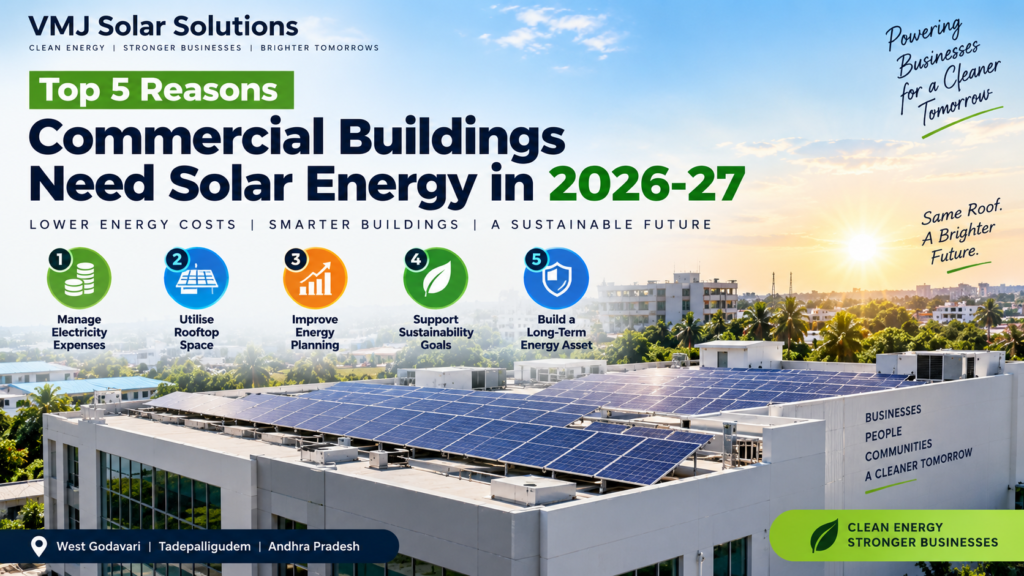
Electricity is one of the recurring operating expenses for commercial buildings. Offices, hotels, hospitals, supermarkets, schools, warehouses, factories, shopping complexes and other commercial facilities often operate during the same daytime hours when Solar PV systems can generate electricity.
That makes commercial Solar energy more than simply a renewable-energy choice. Depending on the building’s electricity consumption, tariff structure, available roof area, Solar resource, system design and applicable regulations, rooftop Solar can become part of a broader strategy for managing energy costs, improving energy resilience and meeting sustainability objectives.
India’s Solar sector has also continued to expand. According to the Ministry of New and Renewable Energy (MNRE), cumulative Solar capacity reached 168.04 GW as of 31 August 2026, including 32.59 GW of grid-connected rooftop Solar.
So, why should commercial building owners and businesses seriously evaluate Solar during 2026-27?
Here are five important reasons.
Quick Answer: Why Do Commercial Buildings Need Solar in 2026-27?
The five major reasons are:
- To manage recurring electricity expenses
- To use available rooftop space productively
- To improve energy planning and resilience
- To support sustainability and corporate environmental goals
- To build a long-term energy asset and reduce dependence on conventional electricity alone
However, Solar is not automatically suitable for every commercial building. A professional feasibility assessment should consider electricity bills, load profile, sanctioned load, roof condition, shading, structural capacity, tariff structure, grid regulations and future electricity requirements before installation.
1. Solar Can Help Commercial Buildings Manage Electricity Expenses
For many businesses, electricity is not a one-time expense. It is a recurring operating cost.
A supermarket may operate refrigeration systems, lighting, air conditioning and display equipment.
A hotel may have:
- Air-conditioning systems
- Water pumps
- Kitchen equipment
- Refrigeration
- Lighting
- Elevators
- Laundry equipment
A hospital can have a much more continuous electricity demand because of medical equipment, HVAC systems, lighting, pumps and other essential loads.
Similarly, factories, rice mills, cold storages, schools and warehouses can have substantial electricity consumption.
Solar PV can offset a portion of this electricity consumption when the system generates power.
How does commercial Solar reduce grid dependence?
Consider a simplified example.
Suppose a commercial building consumes electricity throughout the day.
During daylight hours:
Solar generation → Building loads → Remaining requirement from grid
If Solar generation exceeds the building’s instantaneous requirement, the treatment of surplus electricity depends on the applicable electricity regulations and the system’s metering arrangement.
At night:
Grid electricity → Building loads
A battery energy storage system can change this operating pattern by storing some Solar energy for later use, where technically and economically appropriate.
The actual financial benefit depends on several factors, including:
- Electricity tariff
- Solar generation
- Daytime consumption
- System size
- Export/settlement mechanism
- Demand charges, where applicable
- System losses
- Operation and maintenance
- Financing cost
- Applicable taxes and regulations
Therefore, businesses should evaluate Solar based on their actual electricity consumption profile, rather than choosing a system only by its kW capacity.
2. Commercial Buildings Already Have Valuable Rooftop Space
One of the biggest advantages of rooftop Solar is that it can use space that already exists.
Large commercial buildings frequently have:
- RCC rooftops
- Metal sheet roofs
- Factory sheds
- Warehouse roofs
- Parking structures
- Institutional buildings
- Hotel rooftops
- School buildings
- Hospital buildings
Instead of requiring additional land for a ground-mounted Solar plant, a properly designed rooftop system can make productive use of an existing building surface.
But not every roof is Solar-ready
Before installation, the roof should be assessed for:
- Structural strength
- Roof age
- Waterproofing condition
- Available installation area
- Shading
- Roof orientation
- Roof inclination
- Wind exposure
- Maintenance access
- Fire-safety requirements
- Electrical cable routes
For sheet-roof commercial buildings, the mounting method also matters.
The Solar structure should be designed according to the roof type and structural conditions rather than simply attaching panels wherever space is available.
Why roof assessment matters
Installing a large Solar system on a weak or deteriorating roof can create problems later.
A commercial Solar project should therefore be considered a building + electrical + Solar engineering project, not simply a panel installation.
3. Solar Can Improve Long-Term Energy Planning
Commercial businesses increasingly need predictable and well-planned energy strategies.
Electricity consumption can change because of:
- Business expansion
- Additional machinery
- New air-conditioning systems
- Electric vehicle charging
- Increased refrigeration
- Extended operating hours
- New production lines
- Data and IT infrastructure
- Building expansion
Solar can become one component of a longer-term energy plan.
Solar + BESS can provide another layer of flexibility
Battery Energy Storage Systems (BESS) can store electricity and supply it later, depending on system design.
For example:
Daytime:
Solar → Building loads
Solar → Battery charging
Solar → Grid export, where permitted
Evening/night:
Battery → Selected building loads
Grid → Remaining loads
However, BESS should not be treated as an automatic requirement for every commercial Solar project.
Battery systems add additional capital cost, thermal-management requirements, controls and replacement considerations. Their suitability depends on the building’s load profile, backup requirements, tariff structure and desired operating strategy.
For a business that mainly consumes electricity during daylight hours, a conventional grid-connected rooftop Solar system may be evaluated differently from a facility with significant nighttime consumption.
4. Solar Supports Corporate Sustainability Goals
Sustainability is becoming increasingly relevant for businesses, institutions and commercial property owners.
Companies may have environmental targets related to:
- Renewable electricity
- Carbon reduction
- ESG reporting
- Green building initiatives
- Renewable energy procurement
- Energy efficiency
- Environmental reporting
- Customer expectations
Installing Solar does not automatically make a building “net zero” or carbon neutral.
However, Solar electricity can be one component of a broader sustainability strategy.
Solar can complement energy-efficiency measures
A commercial building should not look at Solar in isolation.
A more complete energy strategy could include:
Energy efficiency + Solar + smart monitoring + efficient HVAC + LED lighting + power-quality management + BESS where appropriate
For example, reducing unnecessary air-conditioning consumption before sizing a Solar system may change the building’s electricity profile.
Similarly, installing smart energy monitoring can help identify when and where electricity is being consumed.
5. Solar Can Become a Long-Term Business Energy Asset
Commercial Solar is generally a long-term infrastructure investment rather than a short-term purchase.
A properly designed system can operate for many years, although individual components such as inverters, monitoring equipment, batteries and other electrical equipment may have different operating lives and warranty periods.
This means businesses should evaluate more than the initial Solar installation price.
Look at the complete lifecycle
A commercial Solar evaluation should consider:
- Initial system cost
- Financing cost
- Electricity consumption
- Solar generation
- O&M cost
- Inverter replacement considerations
- Panel degradation
- Roof maintenance
- Insurance
- Electrical safety
- Monitoring
- Applicable taxes
- Future expansion
For eligible business assets, the Income-tax Rules 2026 list solar power generating systems under renewable energy devices with a 40% depreciation rate. This is a depreciation provision, not a 40% tax rebate. The actual tax impact depends on the taxpayer’s circumstances, applicable tax regime and other provisions.
Businesses should consult their chartered accountant or tax professional before making investment decisions based on depreciation.
Commercial Solar in Andhra Pradesh: What Businesses Should Know
Andhra Pradesh has an evolving regulatory framework for rooftop Solar.
The Andhra Pradesh Electricity Regulatory Commission (APERC) has regulations covering grid-interactive Solar rooftop systems under net/gross metering, with subsequent amendments.
APERC’s 2026 directions also addressed monthly energy settlement and billing for Solar rooftop prosumers and payment for excess electricity exported to the grid under the applicable framework.
The exact arrangement for a commercial consumer depends on the applicable category, system size, metering mechanism, connection conditions and current DISCOM/APERC requirements.
Therefore, businesses should verify the current rules before finalising a project.
Is Commercial Solar Subsidy Available?
This is an important question.
Commercial customers should not assume that residential Solar subsidy schemes automatically apply to commercial buildings.
MNRE’s earlier Grid Connected Rooftop Solar Programme Phase-II provided Central Financial Assistance primarily to residential electricity consumers, with the stated scheme period ending on 31 March 2026.
Commercial Solar projects should therefore be evaluated under the applicable commercial electricity, rooftop Solar, net-metering, open-access and tax framework rather than assuming residential CFA eligibility.
Rules can change, so businesses should verify the applicable scheme and regulations at the time of project approval.
Safety Is Critical for Commercial Rooftop Solar
A commercial Solar system is an electrical installation operating at potentially significant DC and AC voltages.
Safety should therefore be considered from the design stage.
The Central Electricity Authority’s Solar safety requirements include provisions concerning lightning and overvoltage protection, surge protection, overcurrent protection, isolation, earth-fault protection and insulation monitoring for Solar PV systems.
The CEA currently lists both the 2023 Safety and Electric Supply Regulations and the 2026 amendment regulations, so installations should be designed according to the applicable current requirements.
Commercial Solar projects should consider:
- Proper earthing
- DC and AC protection
- Surge protection devices
- Lightning protection
- Correct cable selection
- Proper cable routing
- Inverter protection
- Fire-safety considerations
- Safe maintenance access
- Isolation arrangements
- Warning and identification labels
Safety should never be sacrificed to reduce installation cost.
What Types of Commercial Buildings Can Consider Solar?
Solar can be evaluated for many types of commercial and institutional facilities.
Offices
Daytime electricity consumption from lighting, computers, HVAC and other equipment can make rooftop Solar worth evaluating.
Hotels
Hotels may have significant loads from air conditioning, kitchens, refrigeration, hot-water systems, lighting and pumps.
Supermarkets
Refrigeration, HVAC and lighting can create substantial electricity demand.
Hospitals
Hospitals have complex electricity requirements and may require careful consideration of backup power and critical loads.
Schools and Colleges
Daytime operation can align with Solar generation, although usage varies significantly by institution.
Warehouses
Warehouses may have relatively large roof areas and electricity demand from lighting, material-handling equipment, HVAC and other systems.
Factories
Industrial facilities may benefit from Solar depending on operating hours, connected load, tariff structure, roof availability and electricity consumption.
Rice Mills and Cold Storages
These facilities can have significant electrical loads from processing equipment, motors, refrigeration and associated infrastructure.
Commercial Solar for West Godavari and Tadepalligudem Businesses
For businesses in West Godavari and Tadepalligudem, Solar planning should consider the actual operating environment of the building.
A proper site assessment can evaluate:
- Roof type
- Roof area
- Shading
- Structural condition
- Electricity bills
- Sanctioned load
- Connected load
- Daytime consumption
- Transformer details
- Existing electrical infrastructure
- Future load expansion
- Net-metering or other applicable arrangements
- Monitoring requirements
For industrial and commercial facilities, the Solar system should be sized based on actual electricity consumption and operating patterns, rather than simply installing the maximum possible number of panels.
7 Questions a Business Should Ask Before Installing Solar
Before signing a commercial Solar quotation, ask:
1. How much electricity does our building actually consume?
Review at least recent electricity bills and, where possible, interval/load data.
2. How much of our electricity consumption occurs during Solar generation hours?
This can materially affect the economics of a grid-connected Solar system.
3. Is our roof structurally suitable?
A structural assessment can be particularly important for older buildings and large sheet-roof structures.
4. What metering arrangement applies?
Ask about the applicable net metering, net billing, gross metering, group/virtual arrangements or other mechanisms available to the consumer.
5. What happens if we expand the business?
Consider whether the electrical infrastructure and Solar system can accommodate future load changes.
6. What protection and safety equipment is included?
The quotation should clearly identify earthing, SPDs, protection devices, isolation equipment, lightning protection where required and other relevant components.
7. What happens after installation?
Ask about:
- Monitoring
- Preventive maintenance
- Warranty support
- Cleaning
- Fault response
- Inverter servicing
- Documentation
- Performance monitoring
Common Mistakes Commercial Buildings Should Avoid
Choosing a Solar system only by price
The lowest quotation may not include the same equipment, structural work, protection, monitoring or after-sales service as another quotation.
Compare the complete system, not only the per-kW price.
Ignoring the roof condition
A Solar system can remain operational for many years, while the building roof may require repair earlier.
Roof maintenance should be considered before installation.
Oversizing without analysing consumption
More Solar capacity is not automatically better.
The appropriate system size depends on electricity consumption, applicable export/settlement rules, available roof area, sanctioned load and project economics.
Ignoring future electricity demand
A business may add machinery, AC units, refrigeration or EV charging after installing Solar.
Future expansion should be considered during system planning.
Treating Solar as a zero-maintenance asset
Solar systems require monitoring, periodic inspection and appropriate maintenance.
Cleaning frequency can also depend on dust, pollution, bird activity, local weather and site conditions.
Commercial Solar Checklist for 2026-27
Before proceeding, a business can use this checklist:
☐ Review 12 months of electricity bills
☐ Analyse daytime and nighttime consumption
☐ Check sanctioned and connected load
☐ Inspect roof condition
☐ Conduct structural assessment where required
☐ Analyse shading
☐ Estimate annual Solar generation
☐ Compare applicable electricity settlement options
☐ Evaluate BESS only if there is a clear use case
☐ Check inverter and panel specifications
☐ Verify applicable compliance requirements
☐ Plan earthing and surge protection
☐ Review warranty terms
☐ Include monitoring and maintenance
☐ Evaluate financing and tax implications
☐ Consider future business expansion
☐ Compare total lifecycle cost rather than only installation price
Why 2026-27 Could Be an Important Year to Evaluate Commercial Solar
India’s Solar capacity continues to expand, while rooftop Solar is becoming an increasingly established part of the electricity landscape.
For commercial buildings, the decision is not simply:
“Should we install Solar?”
A better question is:
“How can Solar fit into our building’s electricity consumption, financial planning, safety requirements and long-term energy strategy?”
For some businesses, rooftop Solar may be a practical way to offset daytime electricity consumption.
For others, a combination of Solar, energy efficiency, smart monitoring, BESS or other renewable-energy procurement options may make more sense.
The right solution depends on the individual facility.
How VMJ Solar Solutions Can Help Commercial Businesses
For commercial and industrial customers, VMJ Solar Solutions can evaluate the complete Solar requirement rather than focusing only on panel capacity.
The assessment can include:
- Electricity bill analysis
- Solar capacity planning
- Rooftop feasibility
- Shadow analysis
- Structural considerations
- Inverter selection
- Electrical protection
- Earthing and lightning protection
- Monitoring
- Net-metering-related guidance
- Maintenance planning
- Future expansion considerations
For businesses in West Godavari, Tadepalligudem and surrounding areas, local site conditions and electricity consumption patterns can be incorporated into the Solar design process.
The objective should be to develop a Solar system that is technically suitable, safely installed and aligned with the business’s actual electricity requirements.
FAQs: Commercial Solar Energy in 2026-27
1. Is Solar worth considering for commercial buildings in 2026-27?
It can be worth evaluating, particularly for buildings with significant daytime electricity consumption and suitable rooftop space. Actual financial benefits depend on tariffs, consumption, Solar generation, system cost, regulations and financing.
2. Can a commercial building install rooftop Solar?
Yes, commercial buildings can install rooftop Solar subject to applicable electricity regulations, technical requirements, building conditions and DISCOM procedures.
3. Do commercial buildings get the same Solar subsidy as homes?
Not necessarily. Residential Central Financial Assistance should not be assumed to apply to commercial consumers. The applicable scheme and regulations should be verified for the specific project.
4. Can Solar power run a commercial building at night?
Solar PV generally generates electricity during daylight. At night, the building can use grid electricity or, where appropriately designed, stored energy from a BESS.
5. How much Solar capacity does a commercial building need?
There is no universal capacity. It depends on electricity consumption, daytime load, available roof area, sanctioned load, Solar resource, metering rules and the business’s objectives.
6. Is BESS necessary with commercial Solar?
No. BESS is not automatically required. It may be considered when a business needs energy shifting, backup for selected loads, peak-demand management or other storage-related functions.
7. Can factories install Solar on sheet roofs?
Yes, where the roof and structure are suitable. The mounting system should be designed according to the roof type, structural capacity, wind conditions and maintenance requirements.
8. Can hotels and supermarkets benefit from Solar?
They can be good candidates for Solar evaluation because they may have substantial daytime electricity consumption from HVAC, refrigeration, lighting, pumps and other equipment. Actual suitability depends on the individual facility.
9. Does Solar eliminate a commercial electricity bill?
Not necessarily. A Solar system may offset part of electricity consumption, but the remaining grid consumption, fixed charges, demand-related charges and applicable settlement rules can continue to affect the bill.
10. Should a business choose Solar based only on the lowest quotation?
No. The comparison should include panels, inverter, mounting structure, electrical protection, installation quality, warranties, monitoring, maintenance, compliance and long-term service.
Conclusion
For commercial buildings, Solar energy in 2026-27 is increasingly worth evaluating as part of a broader energy-management strategy.
The five major reasons are:
1. Manage recurring electricity expenses
2. Use existing rooftop space productively
3. Improve long-term energy planning
4. Support sustainability objectives
5. Build a long-term renewable-energy asset
But the right Solar system is not simply the largest or cheapest system.
A successful commercial Solar project should start with electricity-bill analysis, load assessment, roof evaluation, regulatory review, technical design and lifecycle-cost analysis.
For businesses across West Godavari and Tadepalligudem, a site-specific feasibility assessment can help determine whether rooftop Solar, Solar plus BESS, or another renewable-energy strategy fits the facility.