
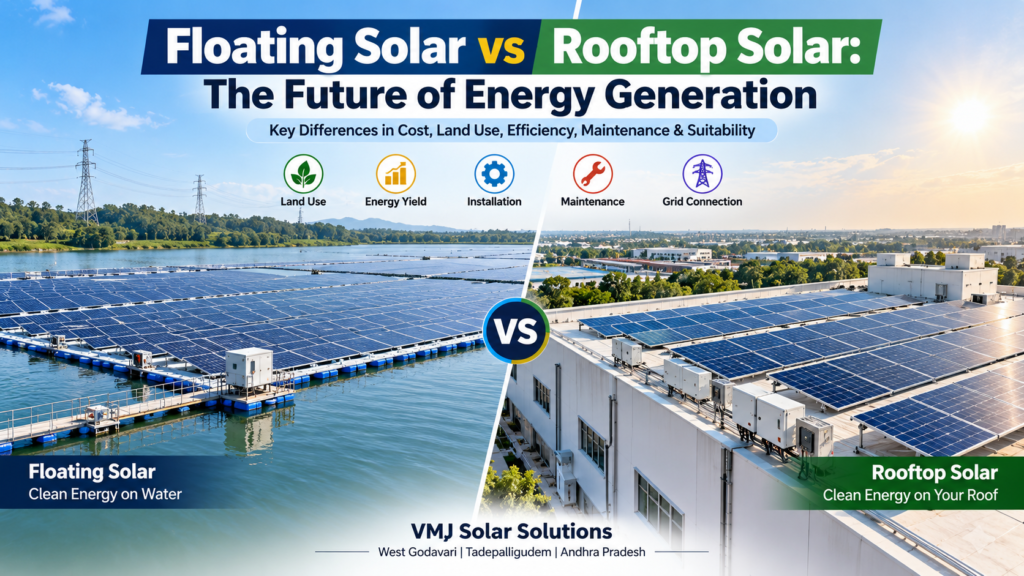
Solar energy is no longer limited to large ground-mounted power plants.
As demand for renewable energy continues to grow, Solar panels are increasingly being installed on residential and commercial rooftops, reservoirs, lakes and other suitable water bodies.
Two important approaches are Rooftop Solar and Floating Solar.
Rooftop Solar uses existing building surfaces to generate electricity close to the point of consumption. Floating Solar, also known as Floating Photovoltaic (FPV) or Floating Solar PV, installs photovoltaic modules on floating structures over suitable water bodies.
Both technologies use the same basic Solar PV principle, but their installation environment, engineering requirements, costs, maintenance and ideal applications can be very different.
India is already developing both approaches. MNRE’s current Solar information includes a dedicated Floating Solar PV Potential Assessment Report and a Floating Solar Potential Map, while its rooftop programme supports grid-connected rooftop Solar.
So, which technology has the greater future?
The answer may not be Floating Solar versus Rooftop Solar.
The future is more likely to involve different Solar technologies for different sites and energy requirements.
Quick Answer: Floating Solar vs Rooftop Solar
Rooftop Solar
Solar panels are installed on:
- Homes
- Apartments
- Schools
- Hospitals
- Offices
- Hotels
- Factories
- Warehouses
- Commercial buildings
Its biggest advantage is that it can use existing roof space without requiring additional land for the Solar array.
Floating Solar
Solar panels are installed on floating structures placed on suitable:
- Reservoirs
- Lakes
- Irrigation ponds
- Industrial water bodies
- Hydropower reservoirs
Its major advantage is the ability to use water-surface areas that may otherwise have limited direct use for electricity generation.
Floating Solar can also benefit from the cooling environment around water, although actual energy gains depend on site conditions and system design. The World Bank identifies land-use efficiency and potential cooling-related energy-yield benefits among the advantages of Floating Solar, while also noting challenges involving anchoring, water quality and maintenance.
What Is Rooftop Solar?
Rooftop Solar is a photovoltaic system installed on the roof of a building.
A typical system looks like:
Solar Panels → Inverter → Building Loads → Grid
During the day, Solar electricity can be consumed directly by the building.
Depending on the applicable grid connection and metering arrangement, surplus electricity may be exported to the grid.
Rooftop Solar can therefore be particularly useful where electricity is consumed close to the Solar installation.
What Is Floating Solar?
Floating Solar uses photovoltaic modules mounted on specially designed floating structures.
A simplified system looks like:
Floating Solar Modules → DC System → Inverter → Transformer → Grid
The floating platform is generally supported by buoyant structures, while the array is held in position using an appropriate anchoring and mooring system.
Floating Solar is generally considered for larger water bodies rather than ordinary household ponds.
The World Bank’s India Floating Solar report highlights the opportunity to use underutilized water surfaces while avoiding conversion of land to Solar generation.
Floating Solar vs Rooftop Solar: At a Glance
| Factor | Rooftop Solar | Floating Solar |
|---|---|---|
| Installation surface | Building roof | Water body |
| Typical scale | Residential to commercial | Generally larger projects |
| Additional land requirement | Low | Very low land footprint |
| Water body required | No | Yes |
| Direct building consumption | Very suitable | Usually requires grid connection |
| Installation complexity | Moderate | Higher |
| Anchoring/mooring | Not normally required | Required |
| Water-quality considerations | No | Important |
| Roof condition | Important | Not applicable |
| Shading | Building surroundings matter | Waterbody surroundings matter |
| Maintenance access | Roof access | Floating platform/access system |
| Main opportunity | Distributed generation | Large-scale Solar on water |
| Main challenge | Roof area/structure | Waterbody engineering |
1. Land Use: One of the Biggest Differences
Land availability is a major consideration for large Solar projects.
A ground-mounted Solar plant can require significant land.
Rooftop Solar reduces this problem by using an existing building surface.
Floating Solar takes this concept further by using suitable water surfaces.
This can be particularly useful in regions where:
- Land is expensive
- Agricultural land is valuable
- Large water reservoirs are available
- Hydropower infrastructure already exists
- Irrigation reservoirs are available
The World Bank identifies land constraints as one of the reasons Floating Solar can be attractive, particularly in densely populated regions.
However, a water body should not automatically be considered suitable for Floating Solar. Technical, environmental, water-use and regulatory assessments are required.
2. Rooftop Solar Uses Existing Infrastructure
One of the strongest advantages of Rooftop Solar is that the building already exists.
For example:
A factory may have thousands of square metres of unused roof area.
Instead of acquiring additional land, Solar panels can potentially be installed on that roof.
The same principle applies to:
- Supermarkets
- Hotels
- Schools
- Warehouses
- Rice mills
- Cold storages
- Hospitals
- Dairy farms
- Poultry farms
This can make Rooftop Solar particularly attractive for businesses with significant daytime electricity consumption.
3. Floating Solar Can Unlock Underused Water Surfaces
Floating Solar can convert part of a suitable water surface into an electricity-generating area.
This does not necessarily mean covering the entire reservoir.
The World Bank has highlighted that Floating Solar projects can be deployed on reservoirs while using only a portion of the water surface, subject to site-specific considerations.
The actual percentage of water surface that can or should be covered depends on:
- Reservoir use
- Environmental conditions
- Water level variation
- Navigation
- Irrigation
- Aquatic ecology
- Anchoring requirements
- Project design
- Regulatory approvals
Therefore, “more water coverage = more Solar” is not a suitable planning rule.
4. Which One Can Generate More Electricity?
This depends on the system design and location.
Solar generation is influenced by:
- Solar irradiation
- Panel capacity
- Panel orientation
- Tilt
- Temperature
- Shading
- Soiling
- System losses
- Inverter efficiency
- Availability
Floating Solar can benefit from the cooling environment around the water surface.
The World Bank notes that the cooling effect of water can contribute to higher energy yield, although the overall project economics and performance depend on site-specific conditions.
NREL assessments also use an evaporative-cooling multiplier when modelling Floating PV potential, illustrating that cooling can be incorporated into technical yield assessments rather than assumed as a fixed percentage for every project.
Therefore, it is better to compare actual site-specific energy yield estimates rather than claiming that Floating Solar will always generate more electricity than Rooftop Solar.
5. Rooftop Solar Has an Important Advantage: Energy Is Generated Where It Is Used
For a factory with high daytime electricity consumption, rooftop Solar can provide electricity very close to the loads.
For example:
Solar Panels → Factory Loads
This can reduce the amount of electricity that needs to be supplied from the grid, subject to the system’s generation profile and applicable regulations.
Floating Solar generally involves generation at a separate waterbody location.
Electricity then needs to be transmitted to the point of consumption or grid connection.
This means the project may require additional:
- Transmission infrastructure
- Cables
- Transformers
- Evacuation equipment
- Grid interconnection arrangements
6. Floating Solar Requires Special Anchoring and Mooring
This is one of the biggest engineering differences.
A rooftop Solar system is fixed to a building structure.
Floating Solar needs to remain in the intended position despite:
- Wind
- Waves
- Water-level fluctuations
- Currents
- Weather conditions
Therefore, floating platforms require carefully designed:
- Anchors
- Mooring lines
- Floaters
- Walkways
- Cable routes
- Electrical equipment
- Access systems
The World Bank identifies anchoring and mooring as among the important technical challenges for Floating Solar.
7. Water Levels Can Change
Reservoirs and lakes do not necessarily maintain a constant water level.
Seasonal rainfall, irrigation demand and reservoir operations can cause significant changes.
The Floating Solar design may therefore need to accommodate:
- Maximum water level
- Minimum water level
- Seasonal changes
- Wind movement
- Wave conditions
- Mooring movement
This makes site surveys particularly important.
8. Rooftop Solar Has Its Own Structural Challenges
Rooftop Solar may be easier to access than Floating Solar, but that does not mean every roof is automatically suitable.
Before installation, the roof should be assessed for:
- Structural capacity
- Roof age
- Roof condition
- Shading
- Available area
- Orientation
- Waterproofing
- Mounting method
- Wind exposure
- Cable routing
For industrial sheet roofs, the mounting system and structural attachment method require particular attention.
9. What About Maintenance?
Maintenance requirements are different.
Rooftop Solar Maintenance
Typical activities can include:
- Panel cleaning
- Inverter inspection
- Cable inspection
- Connector checks
- Earthing inspection
- Mounting structure inspection
- Monitoring
- Vegetation/shading checks
Floating Solar Maintenance
It may include all relevant electrical maintenance plus inspection of:
- Floaters
- Walkways
- Anchoring
- Mooring lines
- Cable support systems
- Water-level movement
- Corrosion
- Access equipment
Maintenance can therefore be more operationally complex for Floating Solar.
The World Bank specifically notes that maintenance of some Floating Solar components, particularly electrical components, can be more complicated than conventional Solar installations.
10. Floating Solar Can Potentially Reduce Water Evaporation
One potential benefit of Floating Solar is reduced exposure of part of the water surface to direct sunlight and wind.
This can reduce evaporation in some conditions.
The World Bank identifies reduced evaporation as one potential benefit of Floating Solar, particularly on reservoirs and water bodies where water conservation is important.
However, the actual water-saving effect depends on:
- Percentage of surface covered
- Climate
- Wind
- Reservoir characteristics
- Waterbody geometry
- Local evaporation rate
It should therefore be treated as a site-specific benefit, not a guaranteed fixed percentage of water savings.
11. What About Water Quality?
This is an important consideration for Floating Solar.
Installing a Solar array over part of a water body can change:
- Sunlight penetration
- Water temperature
- Wind interaction
- Evaporation
- Aquatic conditions
The environmental impact can vary by project.
The World Bank has identified potential water-quality effects as an area that requires assessment when developing Floating Solar projects.
Andhra Pradesh’s Clean Energy Policy specifically states that Floating Solar projects should not cause environmental concerns to the relevant water bodies and should comply with applicable technical standards.
This means Floating Solar development should include environmental assessment rather than focusing only on electricity generation.
12. Floating Solar in Andhra Pradesh
Andhra Pradesh has significant relevance for Floating Solar because the state’s Clean Energy Policy 2024 explicitly promotes Floating Solar projects on existing reservoirs, dams of hydropower stations and other water bodies.
The policy provides for development of Floating Solar projects with or without energy storage, subject to relevant technical standards and environmental considerations.
This creates an opportunity for Floating Solar in appropriate locations across the state.
However, the suitability of any specific reservoir, lake or pond needs to be assessed individually.
13. What About Rooftop Solar in Andhra Pradesh?
Rooftop Solar is already an important part of India’s Solar deployment.
As of 31 August 2026, MNRE reported India’s cumulative grid-connected rooftop Solar capacity at 32.59 GW.
Rooftop Solar is particularly relevant for:
- Homes
- Commercial buildings
- Industrial facilities
- Schools
- Hospitals
- Hotels
- Warehouses
The national rooftop programme has also supported residential Solar through applicable mechanisms and DISCOM verification processes.
For individual property owners, Rooftop Solar will generally be much more practical than Floating Solar because it does not require access to a suitable water body or large-scale floating infrastructure.
14. Which Is More Suitable for Homes?
For individual homeowners, Rooftop Solar is generally the practical option because the electricity is generated directly at the property.
A typical residential system may include:
Solar Panels → Inverter → Home Loads → Grid
A homeowner normally does not need a reservoir, floating platform, anchoring system or waterbody environmental assessment.
For homes in Tadepalligudem, West Godavari and other parts of Andhra Pradesh, rooftop Solar can be evaluated based on:
- Electricity bills
- Roof area
- Shading
- Roof condition
- Solar capacity
- Inverter selection
- Grid connection
- Applicable subsidy or metering rules
15. Which Is More Suitable for Factories?
Factories can potentially use either technology depending on their circumstances.
Rooftop Solar may be suitable when:
- Large roof area is available
- Daytime electricity demand is high
- The roof is structurally suitable
- Generation can be consumed near the point of production
Floating Solar may be considered when:
- A suitable waterbody is available
- The project is sufficiently large
- Land availability is constrained
- Grid evacuation is feasible
- Environmental and water-use conditions permit the project
For many industrial users, the first step should be evaluating the available rooftop area before looking for a separate waterbody.
16. Floating Solar for Reservoirs and Hydropower
Floating Solar can have an interesting relationship with hydropower.
A hydropower reservoir can potentially support both:
Hydropower + Floating Solar
Solar produces electricity primarily during daylight hours.
Hydropower can offer operational flexibility at other times, depending on the plant and reservoir operation.
The World Bank has highlighted the potential for combining floating Solar with hydropower infrastructure, including the possibility of using Solar generation during the day while hydropower contributes at other times.
This is one reason Floating Solar can be particularly relevant for large energy infrastructure.
17. Does Floating Solar Need Battery Storage?
Not necessarily.
Floating Solar can operate:
- With grid connection
- With energy storage
- As part of hybrid projects
- With hydropower integration
Andhra Pradesh’s Clean Energy Policy explicitly allows Floating Solar projects to be developed with or without energy storage systems.
The decision depends on:
- Grid requirements
- Energy demand
- Project economics
- Curtailment risk
- Desired dispatchability
- Storage costs
18. Rooftop Solar Can Also Work With Battery Storage
Rooftop Solar and BESS can be combined as well.
For example:
Solar → Building Loads
Excess:
Solar → Battery
Night or outage:
Battery → Selected Loads
This can be useful for customers who want:
- Backup power
- Higher Solar self-consumption
- Reduced grid dependence
- Energy time shifting
However, batteries add cost and complexity, so their value should be evaluated based on actual load patterns.
19. What About Cost?
It is difficult to say that one technology is always cheaper.
Rooftop Solar can have relatively straightforward installation when suitable roof space already exists.
Floating Solar involves additional infrastructure such as:
- Floating platforms
- Anchoring
- Mooring
- Waterbody surveys
- Specialized installation
- Access systems
- Electrical evacuation
The World Bank’s India Floating Solar research notes that Floating Solar can currently have higher generation costs than ground-mounted Solar in India due to factors including limited manufacturing capacity, unclear site eligibility in some contexts and standards/certification challenges.
However, project economics can change as technology, supply chains and deployment scale develop.
Therefore, compare projects based on levelized cost, generation, infrastructure, financing and lifecycle costs, rather than installation price alone.
20. Which Has Higher Maintenance Complexity?
Rooftop Solar
Generally easier physical access.
Technicians can reach panels from the roof, subject to safe access arrangements.
Floating Solar
Technicians may need:
- Boats
- Floating walkways
- Safety equipment
- Special access procedures
Electrical equipment may also be exposed to a waterbody environment.
This can make maintenance planning more complex.
However, actual maintenance requirements depend heavily on project design and site conditions.
21. What About Safety?
Both technologies require professional engineering.
Rooftop Solar Safety
Important areas include:
- Structural integrity
- Electrical protection
- Earthing
- Lightning protection
- DC/AC isolation
- Safe roof access
- Cable management
- Fire safety
Floating Solar Safety
In addition to electrical safety, projects need to consider:
- Water access
- Worker fall protection
- Floating platform stability
- Boat operations
- Mooring safety
- Electrical equipment near water
- Emergency response
Floating Solar therefore requires a broader site-safety plan.
22. Which Has a Smaller Land Footprint?
Floating Solar has an advantage when the comparison is specifically about land occupation because the PV array is located on water.
Rooftop Solar also has a very low additional land footprint because it uses an existing building.
Therefore:
Rooftop Solar: Uses existing built-up space.
Floating Solar: Uses suitable water-surface space.
Both can reduce the need for dedicated land compared with ground-mounted Solar.
23. Can Floating Solar Replace Rooftop Solar?
No.
They solve different site constraints.
A homeowner with a suitable roof has little reason to construct a Floating Solar plant.
Similarly, a utility developer with a large suitable reservoir may have an opportunity that cannot be addressed through rooftop Solar alone.
The future Solar market can therefore include:
Rooftop + Floating + Ground-Mounted + Agrivoltaics + Solar Parks + Hybrid Solar
rather than one technology replacing all others.
24. What Does the Future of Solar Generation Look Like?
Solar deployment is likely to become increasingly diverse.
India’s Solar capacity continues to grow, with MNRE reporting 168.04 GW of cumulative Solar capacity as of 31 August 2026, including ground-mounted, rooftop, hybrid and off-grid segments.
At the same time, MNRE is actively publishing resources related to Floating Solar potential, showing that water-based Solar is being considered as part of India’s broader renewable-energy landscape.
This suggests that future Solar development will not depend on a single installation model.
25. Floating Solar vs Rooftop Solar: Which One Should You Choose?
The answer depends on the project.
Choose Rooftop Solar when:
- You own or control a suitable roof
- Electricity is consumed at the building
- You want distributed generation
- Roof structure is suitable
- The project is residential or commercial
Consider Floating Solar when:
- A suitable waterbody is available
- Land availability is a constraint
- The project is sufficiently large
- Grid evacuation is practical
- Water-use and environmental requirements can be satisfied
- Specialized engineering is feasible
26. A Simple Decision Framework
Before choosing the technology, ask these questions:
Question 1: Do you have suitable roof space?
If yes, evaluate Rooftop Solar first.
Question 2: Is there a suitable waterbody?
If no, Floating Solar is not an option.
Question 3: How much electricity do you need?
Small residential demand generally points toward rooftop systems.
Large utility-scale demand may support Floating Solar.
Question 4: Where is the electricity consumed?
If electricity is consumed at the same building, rooftop generation can reduce the need for transmission.
Question 5: Is the waterbody technically suitable?
Check water level, wind, waves, anchoring, environmental conditions and water use.
Question 6: What is the grid connection?
Both systems require appropriate electrical evacuation/interconnection planning.
Question 7: What is the lifecycle cost?
Compare not only installation cost but also:
- Generation
- Maintenance
- Replacement
- Insurance
- Financing
- Grid infrastructure
- Decommissioning
27. What Should Businesses in West Godavari Consider?
For businesses in West Godavari and Tadepalligudem, Rooftop Solar can be particularly relevant for properties such as:
- Rice mills
- Cold storages
- Supermarkets
- Hotels
- Factories
- Dairy farms
- Poultry farms
- Aqua-related businesses
- Warehouses
The first assessment should generally consider the building’s electricity consumption and available roof area.
For larger industrial or infrastructure projects with access to suitable reservoirs or other water bodies, Floating Solar can be evaluated separately.
28. Why Site Assessment Matters More Than Technology Hype
Floating Solar is an exciting technology, but it should not be selected simply because it is newer.
Likewise, Rooftop Solar should not be selected simply because it is familiar.
The right technology depends on:
Site + Load + Space + Grid + Cost + Regulations + Environment + Maintenance
A professional feasibility study can compare the available options before capital is committed.
29. Common Myths About Floating and Rooftop Solar
Myth 1: Floating Solar always produces more electricity.
Fact: Water can provide cooling benefits, but actual energy yield depends on site and system conditions.
Myth 2: Floating Solar eliminates land requirements completely.
Fact: It greatly reduces land occupation for the PV array, but projects still need land or infrastructure for electrical equipment, access and grid connection.
Myth 3: Rooftop Solar is only for homes.
Fact: Rooftop Solar can also be used on commercial, institutional and industrial buildings.
Myth 4: Floating Solar can be installed on any lake.
Fact: Waterbody suitability must be assessed for technical, environmental, water-use and regulatory factors.
Myth 5: Floating Solar does not need maintenance.
Fact: Floating Solar requires specialized inspection of platforms, mooring, electrical equipment and access systems.
Myth 6: One technology will replace the other.
Fact: Rooftop and Floating Solar address different site conditions and can complement each other.
30. VMJ Solar Solutions: Choosing Solar Based on Your Site
For homeowners and businesses in Tadepalligudem, West Godavari and surrounding Andhra Pradesh, the most practical Solar solution should start with the property and its electricity requirements.
For a rooftop project, VMJ Solar Solutions can assess:
- Electricity consumption
- Roof area
- Shading
- Structural suitability
- Solar capacity
- Inverter selection
- Electrical protection
- Grid connection
- Monitoring
- Maintenance
For larger commercial or infrastructure projects, the evaluation can also consider whether alternative Solar configurations could be technically and economically suitable.
The objective is not to choose Solar technology because it is the latest trend.
It is to choose the technology that fits the site, energy demand, budget and long-term operating requirements.
Frequently Asked Questions
What is Floating Solar?
Floating Solar is a photovoltaic system installed on floating structures over suitable water bodies such as reservoirs, lakes or ponds.
What is Rooftop Solar?
Rooftop Solar is a photovoltaic system installed on the roof of a building to generate electricity for the property and, where applicable, export surplus electricity to the grid.
Is Floating Solar better than Rooftop Solar?
Neither is universally better. Floating Solar can be useful where suitable water surfaces are available and land is constrained, while Rooftop Solar is highly practical for buildings with suitable roof space.
Does Floating Solar generate more electricity than Rooftop Solar?
Not necessarily. Floating Solar may benefit from a cooling environment around the water, but actual generation depends on the site, module technology, orientation, temperature and system design.
Is Floating Solar suitable for homes?
Generally, conventional Rooftop Solar is much more practical for individual homes. Floating Solar is usually considered for larger projects with access to suitable water bodies.
What are the benefits of Floating Solar?
Potential benefits include reduced land use, use of underutilized water surfaces, possible cooling-related energy-yield benefits and potential reduction in evaporation.
What are the disadvantages of Floating Solar?
Challenges can include higher engineering complexity, anchoring and mooring requirements, water-quality considerations, specialized maintenance and project-specific environmental assessments.
Is Floating Solar available in Andhra Pradesh?
Andhra Pradesh’s Clean Energy Policy 2024 explicitly promotes Floating Solar on suitable reservoirs, hydropower dams and other water bodies, subject to applicable technical and environmental requirements.
Is Rooftop Solar still important in India’s future energy mix?
Yes. Rooftop Solar remains an important part of India’s distributed Solar strategy. MNRE reported 32.59 GW of grid-connected rooftop Solar capacity as of 31 August 2026.
Can Floating Solar use battery storage?
Yes. Andhra Pradesh’s Clean Energy Policy allows Floating Solar projects with or without energy storage, subject to applicable requirements.
Which Solar system is better for a factory?
It depends on the factory’s roof area, electricity consumption, load profile, grid connection and project economics. Rooftop Solar can be particularly useful when substantial daytime electricity is consumed at the factory.
Can Floating Solar reduce water evaporation?
It can reduce evaporation from the covered portion of a waterbody in suitable conditions, but the actual reduction depends on the percentage covered, climate, wind and characteristics of the waterbody.
Will Floating Solar replace Rooftop Solar?
There is no indication that one technology needs to replace the other. Both can expand Solar generation by using different available spaces.
Conclusion
Floating Solar vs Rooftop Solar is not really a competition between two technologies.
Both are different solutions to the same broader challenge: how to generate more clean electricity while making efficient use of available space.
Rooftop Solar makes use of existing buildings and can generate electricity close to where it is consumed.
Floating Solar makes use of suitable water surfaces and can provide a way to develop larger Solar projects where land availability is a constraint.
Floating Solar can offer potential advantages such as:
- Lower land occupation
- Use of underutilized water surfaces
- Potential cooling-related generation benefits
- Potential reduction in evaporation
But it also introduces additional considerations such as:
- Anchoring
- Mooring
- Water-level changes
- Water quality
- Environmental assessment
- Specialized maintenance
- Electrical evacuation
Rooftop Solar, meanwhile, remains highly practical for homes, businesses, schools, hospitals, farms and industrial buildings.
For Andhra Pradesh, both technologies have a role. The state’s Clean Energy Policy explicitly promotes Floating Solar, while rooftop Solar continues to expand as an important distributed-generation option.
So the future of Solar generation may not be:
Floating Solar OR Rooftop Solar
It may be:
Floating Solar + Rooftop Solar + Ground-Mounted Solar + Energy Storage + Hybrid Renewable Systems
The best choice ultimately depends on the available space, electricity demand, grid connection, environmental conditions, project economics and long-term operating requirements.