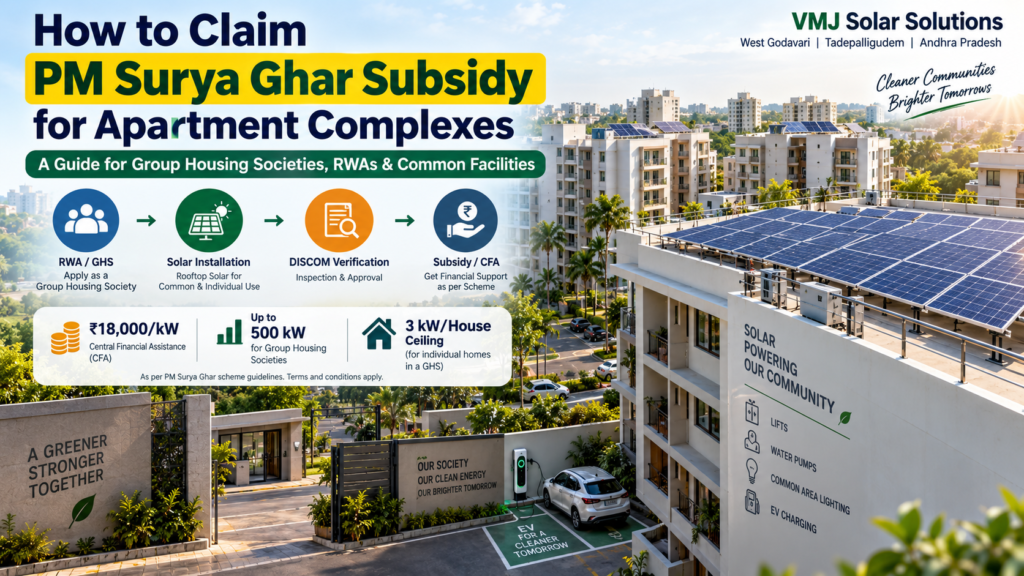
Apartment communities have an important opportunity to use rooftop Solar not only for individual flats but also for common facilities such as lifts, corridor lighting, water pumps, security systems, clubhouse loads and EV charging.
Under PM Surya Ghar: Muft Bijli Yojana, Group Housing Societies (GHS), Resident Welfare Associations (RWAs), Apartment Owner Associations (AOAs) and similar resident-created entities can be eligible for Central Financial Assistance (CFA) for rooftop Solar installed for eligible common facilities.
The scheme’s residential-consumer guidelines provide CFA of Rs18,000 per kW for GHS/RWA common-facility Solar, including EV charging, subject to an overall capacity limit of 500 kW and 3 kW per house, with the 3-kW-per-house upper limit inclusive of individual rooftop plants installed by residents in the GHS/RWA.
The scheme is scheduled to be implemented through 31 March 2027, subject to the applicable guidelines and portal procedures.
This makes it important for apartment associations to understand who can apply, what Solar capacity is eligible, how the subsidy is calculated, what documents are required and how the claim is processed.
Quick Answer: Can Apartment Complexes Get PM Surya Ghar Subsidy?
Yes.
Eligible Group Housing Societies, RWAs and similar resident-created entities can receive CFA for rooftop Solar used for common facilities, including EV charging.
The current guideline provides:
- Rs18,000 per kW
- Maximum eligible GHS/RWA capacity: 500 kW
- Capacity ceiling: 3 kW per house
- The 3-kW-per-house ceiling includes individual rooftop Solar systems installed by residents
- The Solar connection supported under the GHS/RWA component must be dedicated to common facilities
- It should not be used to supply electricity directly to individual residential consumers
The exact eligible amount depends on the number of houses, existing individual rooftop installations, the common-facility Solar capacity and the applicable portal/DISCOM verification.
What Is PM Surya Ghar for Apartment Complexes?
PM Surya Ghar: Muft Bijli Yojana is India’s national rooftop Solar programme for the residential sector.
The scheme was approved with a total outlay of Rs75,021 crore and is intended to support rooftop Solar installations in one crore residential households by FY 2026–27.
For apartment communities, the scheme recognises that residents share many electricity-consuming facilities.
Examples include:
- Lift systems
- Water pumps
- Common-area lighting
- Parking-area lighting
- Security systems
- CCTV systems
- Clubhouse facilities
- Swimming-pool equipment
- Common-area ventilation
- Sewage treatment systems
- Common-area water systems
- EV charging infrastructure
A properly designed Solar system can potentially offset part of the electricity used by these common facilities.
Who Can Claim the Subsidy?
The PM Surya Ghar guidelines specifically recognise several forms of resident-created organisations.
These may include:
- Resident Welfare Associations (RWAs)
- Group Housing Societies (GHS)
- Apartment Owner Associations (AOAs)
- Cooperative Housing Societies
- Similar entities responsible for maintaining common facilities
The important point is that the organisation should have responsibility for the overall maintenance and upkeep of the common facilities.
Therefore, an apartment complex does not necessarily need to use the exact legal name “RWA” to qualify.
The actual eligibility depends on the entity structure, electricity connection, project configuration and applicable scheme requirements.
How Much Subsidy Can an Apartment Complex Get?
The current CFA structure for GHS/RWAs is:
Rs18,000 per kW
for eligible common-facility rooftop Solar, including EV charging.
However, there are two important limits:
Limit 1: Maximum 500 kW
The GHS/RWA common-facility component has an upper limit of 500 kW.
Limit 2: 3 kW Per House
The eligible capacity is also limited to 3 kW per house.
Most importantly, the guidelines state that this upper limit is inclusive of individual rooftop Solar plants already installed by individual residents within the GHS/RWA.
Therefore, an apartment association should not simply calculate:
Number of flats × 3 kW = automatically available common Solar subsidy
The calculation needs to consider the individual rooftop systems already installed within the community.
Example: How the 3 kW Per House Rule Works
Suppose an apartment community has 100 houses.
The theoretical 3-kW-per-house ceiling would be:
100 × 3 kW = 300 kW
If the RWA installs a 250-kW Solar system for common facilities, the project can potentially fall within the 300-kW ceiling, subject to the other scheme conditions.
The maximum CFA at Rs18,000/kW would be:
250 × Rs18,000 = Rs45,00,000
This is an illustration of the CFA calculation, not a guarantee that Rs45 lakh will be sanctioned.
The actual claim remains subject to eligibility, installation, documentation, DISCOM verification and the current National Portal process.
Why Individual Residents’ Solar Systems Matter
This is one of the most important points for apartment associations.
Suppose the same 100-flat community already has individual rooftop Solar installations.
Those individual installations count toward the overall 3 kW per house ceiling.
Therefore, an association planning a common-area Solar system should first prepare a Solar inventory showing:
| Information | What to Check |
|---|---|
| Total apartments | Number of eligible houses |
| Individual Solar systems | Capacity installed by residents |
| Proposed common Solar | Planned capacity |
| EV charging | Proposed charging capacity/use |
| Common electricity connection | Consumer/account details |
| Total eligible capacity | Subject to the 3 kW/house ceiling |
| Maximum scheme ceiling | 500 kW |
This calculation should be completed before finalising the Solar project size.
What Does “Common Facilities” Mean?
The subsidy is intended for Solar connected to facilities used by the apartment community rather than supplying individual flats through the common connection.
Common facilities may include:
Lifts
Solar-generated electricity can potentially offset part of the electricity consumption associated with lift systems, subject to system design.
Water Pumps
Apartment complexes often operate:
- Borewell pumps
- Transfer pumps
- Booster pumps
- Water-treatment systems
These can represent recurring electricity loads.
Common Lighting
Solar can be considered for:
- Corridors
- Staircases
- Parking areas
- Security areas
- External lighting
Clubhouse
Where applicable, common-area electricity consumption may include:
- Lighting
- HVAC
- Pumps
- Equipment
- Other community facilities
EV Charging
The PM Surya Ghar GHS/RWA component specifically includes EV charging within the common-facility CFA framework.
This can make Solar planning relevant for apartment communities where EV adoption is increasing.
Important: The Subsidy Is Not for Supplying Individual Flats
This distinction is critical.
The PM Surya Ghar guidelines state that the GHS/RWA connection eligible under this component should be dedicated to common facilities and should not be used to supply electricity to residential consumers within the GHS/RWA.
In simple terms:
Common-area Solar → Common-area electricity consumption
rather than:
RWA Solar connection → Direct electricity supply to individual flats
Individual apartment owners can separately explore their own eligible residential rooftop Solar arrangements where technically and legally feasible.
Can an Apartment Developer Claim the Subsidy?
Yes, there is an important clarification for projects where a developer or promoter is maintaining common areas before an RWA/GHS has been formally constituted.
MNRE issued a clarification stating that CFA support under the GHS/RWA segment can be provided directly to developers/promoters in such cases, subject to an undertaking that the Solar asset will eventually be handed over to the RWA/GHS/AOA/cooperative or another collective created by residents for maintenance.
The developer/promoter must also undertake that the subsidy benefits will be passed on to residents through reduced charges/tariffs for common facilities.
Therefore, newly developed apartment projects should not automatically assume that the absence of a formally constituted RWA makes the project impossible.
Documentation and applicable requirements remain important.
Step-by-Step: How to Claim PM Surya Ghar Subsidy for an Apartment Complex
Step 1: Confirm the Apartment Community’s Eligibility
First identify the organisation responsible for common facilities.
This may be:
- RWA
- GHS
- AOA
- Cooperative Housing Society
- Other eligible resident-created entity
Also identify the electricity connection serving the common facilities.
The connection and Solar project configuration should be compatible with the scheme and the applicable state/DISCOM regulations.
Step 2: Pass an Association Resolution
Before starting the project, the association should formally approve the Solar proposal.
The resolution can cover:
- Solar installation
- Proposed capacity
- Common-facility usage
- EV charging, if applicable
- Vendor selection
- Funding
- Subsidy application
- Authorised representative
- Bank account for eligible CFA
- Maintenance responsibility
A properly documented association decision can help avoid disputes later.
Step 3: Calculate the Eligible Solar Capacity
Do not immediately select a system size based only on available roof space.
Calculate:
Number of houses × 3 kW
Then consider:
- Existing individual rooftop Solar
- Proposed common-facility Solar
- 500-kW overall scheme ceiling
- Actual common-area electricity demand
- Roof availability
- Structural limitations
- Electrical infrastructure
- Applicable DISCOM requirements
The eligible CFA-supported capacity should be established before finalising the project.
Step 4: Analyse Common-Area Electricity Consumption
Collect electricity bills for the common connection.
Ideally, review at least the recent 12 months.
Look for:
- Monthly units consumed
- Maximum demand, where applicable
- Daytime consumption
- Pumping schedules
- Lift usage
- Common-area lighting
- Clubhouse consumption
- EV charging requirements
- Seasonal changes
Solar capacity should be based on the community’s actual electricity requirements rather than simply the maximum subsidy available.
Step 5: Check the Rooftop
A professional rooftop survey should check:
- Available roof area
- Shading
- Roof orientation
- Roof condition
- Structural strength
- Waterproofing
- Wind exposure
- Maintenance pathways
- Fire-safety access
- Cable routing
- Inverter location
- Earthing points
Apartment rooftops often contain water tanks, lift rooms, antennas, communication equipment and other structures.
These should be considered during Solar layout planning.
Step 6: Apply Through the PM Surya Ghar National Portal
The scheme’s residential CFA guidelines state that eligible consumers apply through the PM Surya Ghar National Portal.
The application is associated with a valid consumer account number or equivalent consumer ID for the local distribution utility.
The portal generates an application ID.
For an apartment association, the authorised entity should ensure that the consumer/account details correspond to the eligible common-facility connection.
Do not use an individual flat owner’s electricity connection for a Solar system intended for the entire apartment’s common facilities unless the applicable configuration specifically permits it.
Step 7: Select a Registered Solar Vendor
The PM Surya Ghar CFA process requires eligible consumers to choose a vendor registered on the National Portal.
The association should compare vendors based on:
- Solar module specifications
- DCR compliance
- Inverter quality
- Mounting structure
- Electrical protection
- Earthing
- Lightning protection
- Monitoring
- Warranty
- Installation experience
- O&M support
- Vendor rating
- Total project cost
The lowest quotation should not automatically be selected.
Step 8: Finalise the Technical Design
The vendor and association should agree on:
- Solar capacity
- Module type
- Inverter configuration
- Mounting structure
- DC/AC cable design
- Protection equipment
- Earthing
- Surge protection
- Monitoring
- EV charging integration
- Metering arrangement
- Maintenance access
The final design should also account for future common-area electricity requirements.
Step 9: Complete Installation
The registered vendor installs the Solar system according to the approved design and applicable technical requirements.
The vendor should also complete:
- Electrical checks
- Safety checks
- Earthing
- Protection installation
- System commissioning
- Monitoring setup
- Documentation
For subsidy eligibility, the equipment and installation should meet the applicable PM Surya Ghar requirements.
Step 10: Upload Installation Details and Documents
After installation, the required project details and documents need to be updated on the National Portal.
The guidelines provide for uploading relevant documentation and geo-tagged photographs after installation.
The vendor may assist the consumer/entity with this process.
Incorrect photographs, missing documents or mismatched system details can delay processing.
Step 11: DISCOM Inspection and Verification
The concerned DISCOM verifies the installed Solar system.
The inspection can cover:
- System installation
- Technical compliance
- Metering arrangements
- Electrical safety
- System capacity
- Documentation
The DISCOM can approve the application or return it for corrections/reject it with appropriate justification.
The CFA process proceeds after the required physical verification and portal process are completed.
Step 12: Meter Installation and Agreement
Where applicable, the DISCOM completes the relevant metering arrangement and agreement.
The PM Surya Ghar guidelines recognise metering mechanisms approved by the respective State Electricity Regulatory Commission, including arrangements such as:
- Net metering
- Gross metering
- Net billing
- Virtual net metering
- Group net metering
However, the exact mechanism available to an apartment community depends on the applicable state regulations and DISCOM procedures.
Step 13: CFA Processing
The PM Surya Ghar guidelines provide for an e-token-based CFA release process.
After the application, required documents and DISCOM inspection are completed, the e-token is activated with the eligible CFA based on the actual installed capacity.
The eligible consumer then redeems the e-token through the portal.
The guidelines state that CFA is processed within 15 days of approval by the concerned DISCOM.
This should not be interpreted as a guaranteed end-to-end project timeline because installation, documentation, inspection, meter-related work and corrections can take additional time.
What Documents Should an Apartment Association Keep Ready?
Requirements can vary according to the portal and DISCOM process, but an apartment association should generally prepare:
Organisation Documents
- RWA/GHS/AOA registration documents
- Association constitution/bylaws
- Authorisation letter
- Board/committee resolution
- Authorised representative details
Electricity Documents
- Common-area electricity bill
- Consumer/account number
- DISCOM details
- Sanctioned load/connection information
- Existing metering details
Solar Project Documents
- Solar quotation
- Technical proposal
- System capacity
- Module details
- Inverter details
- Installation agreement
- Vendor details
- Equipment specifications
Bank/CFA Documents
- Eligible entity bank account details
- Cancelled cheque or applicable bank verification document
- Other portal-requested financial documents
Installation Documents
- Geo-tagged photographs
- Commissioning information
- Meter-related documents
- Inspection documents
- Required agreements
The exact document checklist should be confirmed on the current National Portal and with the concerned DISCOM before submission.
Domestic Content Requirement: A Critical Subsidy Condition
One of the most important technical conditions is Domestic Content Requirement (DCR).
The PM Surya Ghar CFA guidelines state that Solar modules used for installations receiving CFA must satisfy the DCR condition, meaning the modules must be domestically manufactured from domestically manufactured cells.
Using non-DCR modules can make an installation ineligible for CFA.
Therefore, an apartment association should not select Solar modules solely on price.
Ask the vendor to clearly document:
- Module manufacturer
- Module model
- Cell origin
- DCR eligibility
- Applicable compliance documentation
This should be checked before installation rather than after the project is completed.
Can an Apartment Complex Install More Than 500 kW?
The Solar plant itself may potentially be larger depending on the project’s technical and regulatory circumstances.
However, the PM Surya Ghar GHS/RWA CFA component has a 500-kW ceiling, along with the 3-kW-per-house limit.
Therefore:
Solar system capacity ≠ automatically subsidised capacity
An apartment complex may decide to install additional capacity beyond the CFA-supported portion, but the additional capacity should not be assumed to receive PM Surya Ghar subsidy.
The association should separately evaluate the applicable electricity regulations, financing and project economics for any non-subsidised capacity.
Can EV Charging Be Included?
Yes.
The PM Surya Ghar guidelines explicitly include EV charging within the GHS/RWA common-facility CFA component.
This is relevant for apartment complexes because EV charging can create additional electricity demand.
A community considering Solar and EV charging together should evaluate:
- Number of EV chargers
- Charger capacity
- Expected charging hours
- Daytime vs nighttime charging
- Common electricity connection
- Solar generation profile
- Load management
- Future EV adoption
- Distribution transformer capacity
- Metering and electrical safety
Solar should not be sized for EV charging using a simple assumption such as “one EV equals X kW of Solar.”
Actual charging patterns matter.
PM Surya Ghar Subsidy for Apartments in Andhra Pradesh
Apartment associations in Andhra Pradesh need to consider both the central PM Surya Ghar guidelines and the applicable Andhra Pradesh electricity regulations.
APERC’s rooftop Solar framework permits eligible consumers to use approved arrangements such as net metering, gross metering, net billing and other applicable mechanisms, with specific capacity and technical conditions.
APERC has also issued regulations/amendments concerning rooftop Solar, including provisions relevant to group and virtual net-metering arrangements.
Therefore, an Andhra Pradesh apartment association should confirm the applicable arrangement with its DISCOM before finalising the Solar design.
For communities in West Godavari and Tadepalligudem, the project should be assessed against the requirements applicable to the concerned distribution area.
Common Mistakes Apartment Associations Should Avoid
Mistake 1: Assuming every flat automatically gets ₹78,000
The household subsidy and GHS/RWA common-facility subsidy are different components.
Do not calculate the apartment association’s subsidy by simply multiplying the individual household maximum subsidy.
Mistake 2: Ignoring individual rooftop Solar installations
The 3 kW per house upper limit for GHS/RWA capacity is inclusive of individual rooftop systems installed by residents.
This can materially affect the eligible common-facility capacity.
Mistake 3: Using the common Solar connection for individual flats
The GHS/RWA CFA-supported connection is intended for common facilities.
Individual residential supply should not simply be routed through the association’s subsidised common-facility connection.
Mistake 4: Choosing non-DCR modules
Non-DCR modules can make the installation ineligible for CFA.
The association should verify DCR compliance before purchasing modules.
Mistake 5: Choosing a vendor only because of the lowest price
A Solar project includes:
- Modules
- Inverters
- Structures
- Cables
- Protection
- Earthing
- Installation
- Monitoring
- Documentation
- Metering coordination
- Maintenance
The cheapest quotation may not provide the same scope or quality.
Mistake 6: Installing Solar before understanding the subsidy process
Starting construction before understanding the applicable portal, vendor, documentation and DISCOM requirements can create avoidable problems.
The association should plan the application and installation sequence in advance.
Mistake 7: Ignoring roof structural capacity
Apartment rooftops can have water tanks, equipment rooms and other loads.
A Solar installation should not proceed without considering structural suitability and safe access.
Apartment Solar Subsidy Checklist
Before applying, an RWA/GHS can use this checklist:
☐ Confirm eligible association/entity
☐ Identify common-area electricity connection
☐ Collect recent electricity bills
☐ Count total apartments/houses
☐ Identify existing individual rooftop Solar systems
☐ Calculate 3-kW-per-house ceiling
☐ Check 500-kW maximum CFA-supported capacity
☐ Analyse common-area electricity consumption
☐ Assess rooftop structure and shading
☐ Plan EV charging requirements, if applicable
☐ Select a National Portal-registered vendor
☐ Verify DCR module compliance
☐ Finalise technical design
☐ Submit application through the National Portal
☐ Complete DISCOM requirements
☐ Install Solar system
☐ Upload required documents and geo-tagged photographs
☐ Complete DISCOM inspection
☐ Complete metering agreement/process
☐ Redeem e-token where applicable
☐ Track CFA processing
☐ Maintain project and warranty documents
Frequently Asked Questions
1. Can an apartment complex get PM Surya Ghar subsidy?
Yes. Eligible GHS/RWAs and similar resident-created entities can receive CFA for Solar installed for eligible common facilities, including EV charging.
2. How much is the PM Surya Ghar subsidy for an RWA?
The current CFA structure provides ₹18,000 per kW for eligible GHS/RWA common-facility Solar, subject to the scheme’s capacity limits and conditions.
3. What is the maximum Solar capacity eligible for an RWA?
The GHS/RWA CFA component has a maximum of 500 kW, with an additional ceiling of 3 kW per house. The 3-kW-per-house limit includes individual rooftop Solar installations by residents.
4. Can the subsidy be used for apartment lifts and water pumps?
Common facilities such as lifts and water pumps can be part of the common electricity demand served by the eligible Solar system, subject to the applicable connection and project configuration.
5. Can apartment Solar subsidy be used for EV charging?
Yes. EV charging is specifically included within the GHS/RWA common-facility CFA component.
6. Can individual flat owners also claim Solar subsidy?
Eligible individual residential consumers may separately apply under the residential component, subject to the applicable rules. Individual and GHS/RWA capacity limits should be considered together where the scheme specifies an inclusive ceiling.
7. Can a developer apply before an RWA is formed?
MNRE has clarified that, in certain cases where common areas are being maintained by the developer/promoter before an RWA/GHS is constituted, CFA support can be provided to the developer/promoter subject to specified undertakings and conditions.
8. Does an RWA need to use a registered Solar vendor?
For CFA under the scheme’s National Portal process, the consumer must choose a vendor registered on the National Portal.
9. Are DCR Solar panels required for PM Surya Ghar subsidy?
Yes. The CFA guidelines require Solar modules used for subsidised installations to satisfy the applicable Domestic Content Requirement.
10. Can an RWA install more than 500 kW?
A project may potentially have additional non-CFA capacity subject to applicable technical and regulatory requirements, but the PM Surya Ghar GHS/RWA CFA component is capped at 500 kW and is also subject to the 3-kW-per-house ceiling.
11. How long does the subsidy take after DISCOM approval?
The scheme guidelines state that CFA is processed within 15 days of approval by the concerned DISCOM. The overall project timeline can be longer because installation, documentation, inspection and metering processes occur before final approval.
12. Can an apartment association in Tadepalligudem apply?
Apartment associations in Tadepalligudem can evaluate eligibility under the PM Surya Ghar scheme, subject to the applicable DISCOM, National Portal and Andhra Pradesh regulatory requirements.
How VMJ Solar Solutions Can Help Apartment Complexes
For apartment communities in West Godavari, Tadepalligudem and Andhra Pradesh, the first step should be a proper feasibility assessment rather than immediately selecting a Solar capacity.
VMJ Solar Solutions can help evaluate:
- Common-area electricity consumption
- Number of apartments
- Existing individual Solar installations
- Eligible CFA capacity
- Rooftop availability
- Shadow analysis
- Structural considerations
- Solar system sizing
- DCR module requirements
- Inverter selection
- Earthing and protection
- EV charging integration
- Monitoring
- Documentation
- DISCOM coordination
- Maintenance planning
The association can then compare the expected Solar generation and project cost with its actual common-area electricity consumption.
Conclusion
PM Surya Ghar: Muft Bijli Yojana provides a specific CFA pathway for Group Housing Societies, RWAs, Apartment Owner Associations and similar entities to install Solar for common facilities.
The key points are:
- Rs18,000 per kW CFA for eligible GHS/RWA common-facility Solar
- Up to 500 kW
- Subject to a 3-kW-per-house ceiling
- The ceiling includes individual rooftop Solar installations by residents
- EV charging is included in the common-facility component
- The supported connection is for common facilities, not individual residential supply
- Eligible applications follow the PM Surya Ghar National Portal process
- DISCOM verification is an important part of CFA release
- DCR-compliant modules are required for CFA eligibility
- Andhra Pradesh apartment communities must also consider applicable APERC and DISCOM requirements
For an apartment complex, the most important step is to calculate the actual eligible capacity before ordering the Solar system.
A properly planned project can help an apartment community evaluate Solar not only as a subsidy opportunity, but as a long-term strategy for managing common-area electricity consumption, EV charging and future energy requirements.