
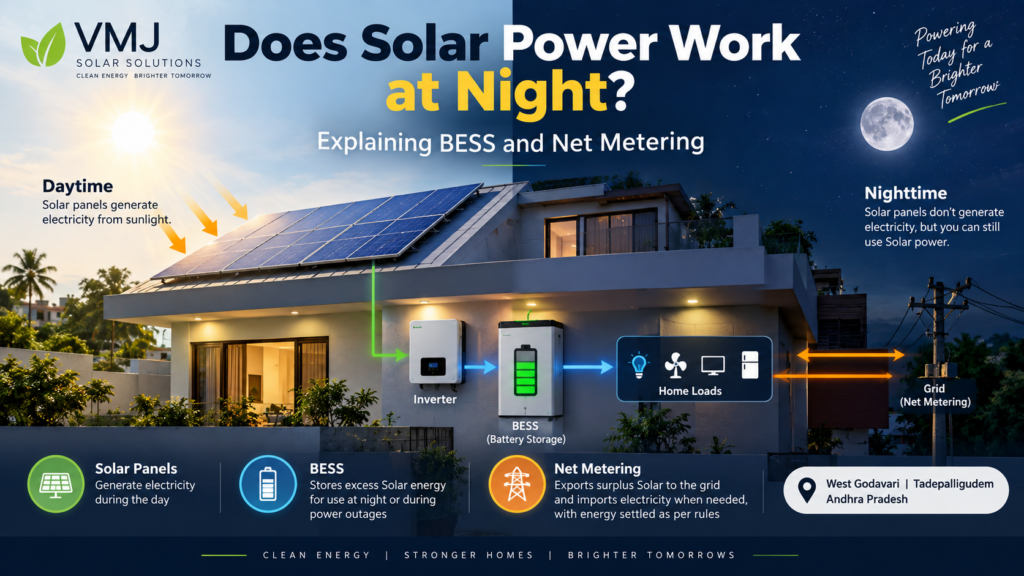
One of the most common questions people ask before installing rooftop Solar is:
“If Solar panels don’t produce electricity at night, how can I use Solar power after sunset?”
The answer depends on how your Solar system is designed.
A typical grid-connected rooftop Solar system can meet nighttime electricity demand in two main ways:
- Using electricity from the grid through net metering
- Using stored electricity from a Battery Energy Storage System (BESS)
These two approaches are often confused, but they work very differently.
A battery actually stores electricity for later use. Net metering, on the other hand, is primarily a metering and energy-settlement mechanism that accounts for electricity exported to and imported from the grid.
Understanding this difference can help homeowners and businesses choose the right Solar configuration.
Quick Answer: Does Solar Power Work at Night?
Solar panels generally do not generate useful electricity from sunlight at night.
However, a Solar-powered property can still use electricity after sunset.
With a grid-connected Solar system:
Solar energy generated during the day can be used immediately. Excess generation can be exported to the grid, while electricity can be imported from the grid when Solar generation is insufficient, subject to the applicable net-metering rules.
With BESS:
Excess Solar electricity generated during the day can be stored in batteries and used later, including at night.
So:
Solar Panels = Generate electricity
BESS = Stores electricity
Net Metering = Accounts for grid import/export according to applicable rules
Grid = Supplies electricity when Solar and/or battery cannot meet the load
Why Don’t Solar Panels Generate Electricity at Night?
Solar photovoltaic panels convert sunlight into electrical energy.
During the daytime, sunlight reaches the Solar cells and produces DC electricity.
The inverter then converts the electricity into usable AC power for household or commercial loads.
At night, there is no normal sunlight available for conventional rooftop PV generation.
Therefore, the Solar panels themselves generally do not provide meaningful electricity after sunset.
This does not mean your Solar investment becomes useless at night.
It means the system needs another source of electricity.
How Does a Normal On-Grid Solar System Work at Night?
A standard grid-connected Solar system usually works differently from a battery-backed system.
During the day:
Solar Panels → Inverter → Home/Business Loads
If Solar generation is higher than your immediate consumption:
Solar Panels → Inverter → Excess Electricity → Grid
At night:
Grid → Home/Business Loads
This is where net metering can become useful.
The grid acts as a kind of energy balancing mechanism, while the meter records electricity flowing between your property and the grid.
However, it is important not to describe net metering as if the electricity itself is physically stored in the grid for you.
What Is Net Metering?
Net metering is a mechanism through which electricity exported to and imported from the grid is measured and settled according to the applicable regulations.
Imagine a simple example.
During the afternoon:
- Solar generates 20 kWh
- Your home uses 8 kWh
- 12 kWh is exported to the grid
At night:
- Your home uses 10 kWh
- 10 kWh is imported from the grid
The meter records the relevant import and export.
The applicable settlement rules determine how those quantities are accounted for in your bill.
So net metering does not mean:
“My Solar panels stored 12 kWh for tonight.”
Instead, the grid remains connected and electricity is physically exchanged with the grid while the metering and billing mechanism accounts for those flows.
How Net Metering Works in Andhra Pradesh
Andhra Pradesh has a regulatory framework for grid-interactive rooftop Solar systems under APERC.
APERC’s rooftop Solar framework allows systems with or without Battery Energy Storage Systems (BESS) and provides for mechanisms including net metering, gross metering and net billing/net feed-in, subject to the applicable provisions.
Under the APERC net-metering provisions, exported Solar energy is adjusted against consumption from the DISCOM during the applicable billing period. If there is excess export over import in a billing month, the applicable provisions provide for payment for the excess at the prescribed feed-in tariff.
In February 2026, APERC also directed the DISCOMs to implement monthly energy settlement and billing for covered rooftop Solar prosumers and make payments for excess exported energy through electronic transfer.
This is particularly relevant for Solar consumers connected through AP distribution companies, including projects in areas served by APEPDCL.
Because regulations and tariff orders can change, consumers should verify the current applicable rules before making a project decision.
What Is BESS?
BESS stands for Battery Energy Storage System.
It stores electrical energy and makes it available when required.
A Solar-plus-BESS system can work approximately like this:
During the Day
Solar Panels → Inverter → Home Loads
Excess Solar:
Solar → Battery → Stored Energy
At Night
Battery → Inverter → Home Loads
If the battery becomes depleted:
Grid → Home Loads
Depending on the system configuration, the battery can also provide backup power during a grid outage.
Net Metering vs BESS: What Is the Difference?
This is the most important distinction in this topic.
| Feature | Net Metering | BESS |
|---|---|---|
| Physically stores electricity? | No | Yes |
| Uses the grid? | Yes | Can use grid depending on configuration |
| Uses Solar directly? | Yes | Yes |
| Can shift daytime Solar to night? | Through grid settlement/accounting, subject to rules | Yes, physically through battery storage |
| Backup during grid outage? | Usually not with a standard on-grid inverter | Can provide backup if designed for backup operation |
| Battery required? | No | Yes |
| Main purpose | Energy import/export accounting | Energy storage and time shifting |
Therefore, net metering and BESS are not competing technologies in exactly the same sense.
A Solar system can potentially use both.
Can I Use Solar Electricity at Night Without a Battery?
Yes, if your property remains connected to the electricity grid and the applicable net-metering arrangement allows the relevant energy settlement.
For example:
During the day:
Solar generation > Home consumption → Excess exported to grid
At night:
Solar generation = 0 → Electricity imported from grid
The net-metering mechanism then accounts for the applicable energy flows according to the regulatory framework.
This is one reason many residential rooftop Solar systems can operate without batteries.
Then Why Would I Need a Battery?
A battery becomes more interesting when your objective is not just reducing grid electricity consumption but also storing energy and controlling when it is used.
A BESS may be considered for:
- Nighttime Solar usage
- Backup power
- Reducing grid dependence
- Increasing self-consumption
- Managing variable loads
- Supporting critical loads
- Energy time shifting
- Reducing reliance on grid supply during selected periods
Whether a battery makes financial sense depends on the electricity tariff, Solar generation profile, load pattern, battery cost, battery life, efficiency, backup requirements and applicable regulations.
BESS Can Increase Solar Self-Consumption
Consider a home where most electricity is consumed after 6 PM.
Without a battery:
Daytime Solar → Some direct consumption + grid export
Night → Grid import
With a battery:
Daytime Solar → Direct consumption + battery charging
Night → Battery discharge + grid if required
This can increase the percentage of Solar electricity used directly by the property rather than exported.
However, battery charging and discharging involve energy losses, so storing every available Solar unit is not automatically the most economical strategy.
Example: Solar Without Battery
Suppose a house has:
- 5 kWh Solar generation during a particular period
- 2 kWh daytime consumption
- 3 kWh excess Solar
The 3 kWh may be exported to the grid under the applicable metering arrangement.
Later at night:
- Household consumption = 4 kWh
- Solar generation = 0 kWh
The house imports electricity from the grid.
The physical energy used at night is grid electricity, not the same electrons generated by the rooftop panels earlier in the day.
The billing mechanism accounts for the relevant import/export quantitieExample: Solar With BESS
Now consider a similar system.
During the day:
- Solar generation = 5 kWh
- Direct consumption = 2 kWh
- Available surplus = 3 kWh
Instead of exporting all 3 kWh:
Some or all of the surplus can charge the battery, depending on the system’s configuration and battery state of charge.
At night:
- Battery supplies part of the household load
- Grid supplies any remaining requirement
This allows some daytime Solar energy to be physically shifted to nighttime use.
Does BESS Mean I Can Run My Whole House All Night?
Not necessarily.
Battery performance depends on:
- Battery capacity in kWh
- Maximum discharge power in kW
- State of charge
- Usable capacity
- Battery efficiency
- Inverter capacity
- Household load
- Backup configuration
- Duration of use
For example, a battery with a nominal capacity of 10 kWh does not necessarily provide 10 kWh of usable AC electricity to the home under every operating condition.
The usable energy depends on the system design and operating limits.
Battery Capacity vs Inverter Power
These two numbers are often confused.
Battery Capacity — kWh
This indicates how much energy the battery can store.
Battery/Inverter Power — kW
This indicates how much power the system can deliver or absorb at a particular time.
For example:
A battery may have a relatively large energy capacity but still have a maximum discharge power that limits how many high-power appliances can operate simultaneously.
Therefore, when designing a BESS, you need to consider both:
How long should the battery run?
and
How much load should it support at one time?
What Happens During a Power Cut?
This is an important difference between standard on-grid Solar and a Solar-plus-BESS system.
A conventional grid-connected Solar inverter generally shuts down when the grid is unavailable because of anti-islanding and grid-safety requirements.
Therefore:
On-grid Solar ≠ Automatic backup power
A battery system can provide backup only if it has the appropriate:
- Hybrid/backup inverter
- Battery system
- Backup circuits
- Automatic transfer/control equipment
- Protection
- System configuration
Therefore, if backup power is important to you, tell your installer before selecting the inverter.
What Loads Should Be Connected to Battery Backup?
A battery does not necessarily need to power every appliance in your home.
You can create a critical-load backup circuit for important equipment such as:
- Lights
- Fans
- Wi-Fi router
- Computers
- Security systems
- Refrigerators
- Selected pumps
- Medical equipment where appropriate and properly designed
High-power loads such as:
- Large air conditioners
- Electric geysers
- Induction cooktops
- Pumps
- EV chargers
can require significantly more battery and inverter capacity.
The correct design depends on the actual electrical load.
Can I Charge My BESS From the Grid?
This depends on the battery system, inverter configuration and applicable regulations/operating settings.
For a Solar-focused system, homeowners may prefer a configuration that prioritizes charging from Solar.
APERC’s rooftop Solar framework expressly addresses Solar rooftop systems with or without BESS, while the exact operating arrangement must comply with applicable technical and regulatory requirements.
Always confirm the intended battery charging logic with your installer and the applicable DISCOM requirements.
Is BESS Better Than Net Metering?
There is no universal answer.
The right option depends on your electricity consumption pattern and objective.
Net Metering May Be Attractive When:
- You have reliable grid supply
- Most Solar generation can be exported
- You want a simpler system
- Backup power is not a priority
- Battery costs do not justify the additional investment
BESS May Be Attractive When:
- A large share of your electricity demand occurs after sunset
- Backup power is important
- You want greater Solar self-consumption
- Grid supply is unreliable
- You have suitable battery economics
- You need controlled energy storage
In some cases, Solar + Net Metering + BESS can be considered together.
Solar + BESS + Net Metering: Can They Work Together?
Yes, a Solar system can be designed with both battery storage and grid interaction, subject to applicable regulations and system configuration.
A simplified flow can look like:
Solar Panels
↓
Hybrid Inverter
↓
Home Loads
↓
Battery
↓
Grid
During the day:
Solar → Home + Battery
Excess, depending on system controls:
Solar → Grid
At night:
Battery → Home
If battery energy is insufficient:
Grid → Home
The exact power flow depends on the inverter architecture, battery settings, load profile and applicable interconnection requirements.
Does Net Metering Make a Battery Unnecessary?
Not always.
Net metering can reduce the need for batteries for consumers who have a reliable grid and are primarily interested in reducing electricity bills.
But net metering does not provide the same functionality as a battery.
A battery can provide:
- Backup
- Energy storage
- Self-consumption optimisation
- Time shifting
Net metering provides:
- Grid import/export measurement
- Energy settlement according to applicable rules
So the decision should be based on your objective.
What About Businesses?
The Solar-at-night question becomes even more important for commercial users.
Consider:
- Hotels
- Hospitals
- Supermarkets
- Cold storages
- Rice mills
- Factories
- Dairy farms
- Poultry farms
- Aqua farms
Many businesses may have significant electricity demand outside peak Solar generation hours.
A BESS can potentially shift some Solar energy to later periods.
However, commercial BESS economics should be analysed carefully.
The analysis may include:
- 24-hour load profile
- Demand charges
- Tariff structure
- Solar generation
- Battery size
- Battery degradation
- Round-trip efficiency
- Backup requirements
- Operating cycles
- Financing cost
A larger battery is not automatically a better investment.
BESS and Battery Degradation
Batteries are different from Solar panels.
Solar modules are designed for long operating lives with gradual performance degradation.
BESS batteries undergo charging and discharging cycles, and their usable capacity can decline over time.
Battery life depends on factors such as:
- Battery chemistry
- Depth of discharge
- Operating temperature
- Charge/discharge rate
- Cycling frequency
- Battery management system
- Installation conditions
Therefore, when comparing BESS quotations, don’t look only at the initial battery price.
Ask about:
- Usable capacity
- Warranty
- Cycle or throughput warranty
- Maximum depth of discharge
- Efficiency
- Operating temperature
- Replacement terms
- Battery management system
- Fire and safety provisions
Lithium-Ion BESS for Rooftop Solar
Lithium-ion battery systems are widely used for modern energy storage applications.
However, “lithium-ion” is a broad category.
Different battery chemistries have different characteristics.
For rooftop applications, buyers should evaluate the complete battery system rather than selecting a battery solely because it uses lithium-ion technology.
Important considerations include:
- Chemistry
- Cell quality
- Battery Management System
- Thermal management
- Enclosure
- Protection
- Warranty
- Installer experience
- Safety certification
- Service availability
What Is the Difference Between Hybrid and On-Grid Inverters?
On-Grid Inverter
Primarily converts Solar DC into AC and synchronizes with the utility grid.
It generally does not provide backup during a grid outage.
Hybrid Inverter
Can coordinate Solar generation, battery storage, loads and the grid, depending on the model and configuration.
It can support backup functionality when properly designed.
Therefore, if nighttime Solar usage and backup are important, ask whether you need a hybrid inverter rather than a standard on-grid inverter.
Can a Battery Replace Net Metering?
Not necessarily.
A battery can reduce the amount of electricity exported to the grid by storing surplus Solar.
But net metering and battery storage serve different purposes.
You can think of them this way:
Net Metering = Exchange and settlement with the grid
BESS = Physical storage inside your property
One does not automatically replace the other.
Which Is Better for a Home in Andhra Pradesh?
The answer depends on your household’s electricity usage.
Choose a simpler grid-connected Solar system if:
- Your grid supply is reliable
- Most of your daytime Solar can be used or appropriately settled through the grid
- You do not need backup
- You want to minimise upfront complexity
Consider Solar + BESS if:
- You have substantial nighttime consumption
- Backup power is important
- You want more Solar self-consumption
- Your grid supply has interruptions
- The battery economics work for your usage pattern
For homeowners in Tadepalligudem, West Godavari and surrounding areas, the best choice should be based on actual electricity bills, load profile, roof Solar potential and backup requirements rather than simply choosing the most expensive technology.
A Simple Decision Example
Suppose a household consumes electricity throughout the day and has relatively high daytime loads.
A standard on-grid Solar system may already allow significant direct Solar consumption.
In that situation, adding a large battery may not provide enough additional value to justify its cost.
Now consider another home where:
- Daytime electricity consumption is low
- Evening consumption is high
- Backup power is important
- Grid interruptions are frequent
A BESS could potentially provide greater value because it can store part of the daytime Solar generation and use it later.
This is why load analysis should come before battery selection.
Questions to Ask Before Installing BESS
Before buying a Solar battery, ask your installer:
- What is the battery’s usable capacity?
- What is the maximum discharge power?
- What battery chemistry is being used?
- What is the expected operating life?
- What does the warranty cover?
- Is there a cycle or throughput warranty?
- What is the round-trip efficiency?
- Can it provide backup during a grid outage?
- Which circuits will receive backup power?
- Can the battery charge only from Solar or also from the grid?
- How does the system interact with net metering?
- What happens if the battery is fully charged?
- What happens if the battery is empty?
- How is the battery protected against overheating?
- Where will the battery be installed?
- What maintenance is required?
- What happens at the end of the battery warranty?
Common Myths About Solar at Night
Myth 1: Solar panels generate electricity at night.
Fact: Conventional Solar PV panels require sunlight and generally do not generate useful electricity at night.
Myth 2: Net metering stores my daytime Solar electricity.
Fact: Net metering does not physically store electricity. It measures and settles electricity exported to and imported from the grid under the applicable rules.
Myth 3: Every Solar system needs a battery.
Fact: Many grid-connected rooftop Solar systems operate without batteries.
Myth 4: A battery automatically gives whole-house backup.
Fact: Backup depends on battery capacity, inverter power, backup circuit design and system configuration.
Myth 5: A bigger battery is always better.
Fact: The right battery size depends on your load profile, Solar generation, backup requirements and economics.
Myth 6: Solar + battery means no electricity bill.
Fact: A Solar-plus-battery system can reduce grid dependence, but it does not guarantee a zero bill. Grid consumption, fixed charges, tariff rules, system losses and other factors still matter.
Solar Power at Night: Which System Is Right for You?
Here is a simple comparison:
| Requirement | On-Grid Solar | Solar + BESS |
|---|---|---|
| Daytime Solar generation | ✓ | ✓ |
| Nighttime grid supply | ✓ | ✓ |
| Physical energy storage | ✗ | ✓ |
| Backup during outage | Usually ✗ | Possible |
| Solar self-consumption optimisation | Limited to direct use | Higher potential |
| System complexity | Lower | Higher |
| Upfront cost | Generally lower | Generally higher |
| Battery replacement consideration | No | Yes |
| Best for | Bill reduction with reliable grid | Storage + backup + higher self-consumption |
This table is a general guide. The actual suitability depends on the property and system design.
VMJ Solar Solutions: Designing Solar for Day and Night Requirements
At VMJ Solar Solutions, the right Solar system should be based on how a customer actually uses electricity—not just on the number of Solar panels installed.
For homes and businesses in West Godavari, Tadepalligudem and surrounding Andhra Pradesh areas, system planning can consider:
- Electricity consumption
- Daytime vs nighttime load
- Solar capacity
- Roof area
- Inverter type
- Battery requirement
- Backup loads
- Net-metering arrangement
- Grid reliability
- Future electricity demand
- Long-term maintenance
For some customers, a standard on-grid Solar system may be sufficient.
For others, Solar + BESS may make more sense.
The important thing is to select the system based on actual energy requirements rather than assuming that every Solar installation needs a battery.
Frequently Asked Questions
1.Does Solar power work at night?
Solar panels generally do not generate useful electricity at night because there is no normal sunlight. Nighttime electricity can come from the grid or a battery storage system.
2.Can I use Solar electricity at night without a battery?
Yes. With a grid-connected Solar system and applicable net-metering arrangement, daytime exports and nighttime imports can be accounted for under the applicable settlement rules.
3.Does net metering store Solar energy?
No. Net metering does not physically store electricity. It measures electricity imported from and exported to the grid and applies the relevant billing and settlement mechanism.
4.What is BESS in Solar?
BESS stands for Battery Energy Storage System. It stores electrical energy, often from Solar generation, for later use.
5.Is BESS necessary for rooftop Solar?
No. Many grid-connected rooftop Solar systems operate without batteries. BESS becomes more relevant when backup power, nighttime Solar use or higher self-consumption is important.
6.Can BESS provide power during a grid outage?
It can, if the Solar-plus-battery system has the appropriate backup-capable inverter, battery capacity, controls and backup circuits.
7.Can Solar and BESS work with net metering?
They can be combined in appropriately designed grid-interactive systems, subject to applicable regulations, metering arrangements and technical requirements. Andhra Pradesh’s rooftop Solar framework explicitly provides for systems with or without BESS.
8.Is a 10 kWh battery enough for a house?
It depends on the household’s actual load. A 10 kWh nominal battery does not mean the home can automatically consume 10 kWh of AC electricity from it under all conditions.
9.Is Solar + battery better than Solar + net metering?
Neither is universally better. Net metering can be attractive for grid-connected bill reduction, while BESS adds physical storage and potentially backup capability. The right choice depends on the user’s load and objectives.
10.Does a battery eliminate the electricity bill?
No. It may reduce grid consumption, but fixed charges, remaining grid usage, system losses and applicable tariff/settlement rules can still affect the bill.
11.Should I install a battery with a 3 kW Solar system?
It depends on your daytime and nighttime electricity consumption, backup requirements, battery cost and expected usage. A load analysis should be completed before choosing the battery size.
12.What is the difference between kW and kWh in a BESS?
kW refers to power—the rate at which electricity can be delivered or consumed.
kWh refers to energy—the amount of electricity stored or used over time.
Conclusion
So, does Solar power work at night?
The Solar panels themselves generally do not generate useful electricity after sunset.
But your home or business can still use Solar-supported electricity at night through two main approaches:
Option 1: Grid + Net Metering
Solar electricity generated during the day is used directly or exported to the grid, while nighttime electricity can be imported from the grid according to the applicable metering and settlement rules.
Option 2: Solar + BESS
Surplus daytime Solar can be stored in a battery and used later, including after sunset and potentially during grid outages when the system is designed for backup operation.
The key difference is simple:
Net metering manages energy exchange with the grid. BESS physically stores energy for later use.
For many homes, a standard grid-connected Solar system may be sufficient. For properties with significant nighttime loads or backup requirements, BESS may be worth evaluating.
The best Solar system is therefore not necessarily the one with the most panels or the biggest battery.
It is the system that matches your generation, consumption, grid connection, backup needs and long-term energy goals.