
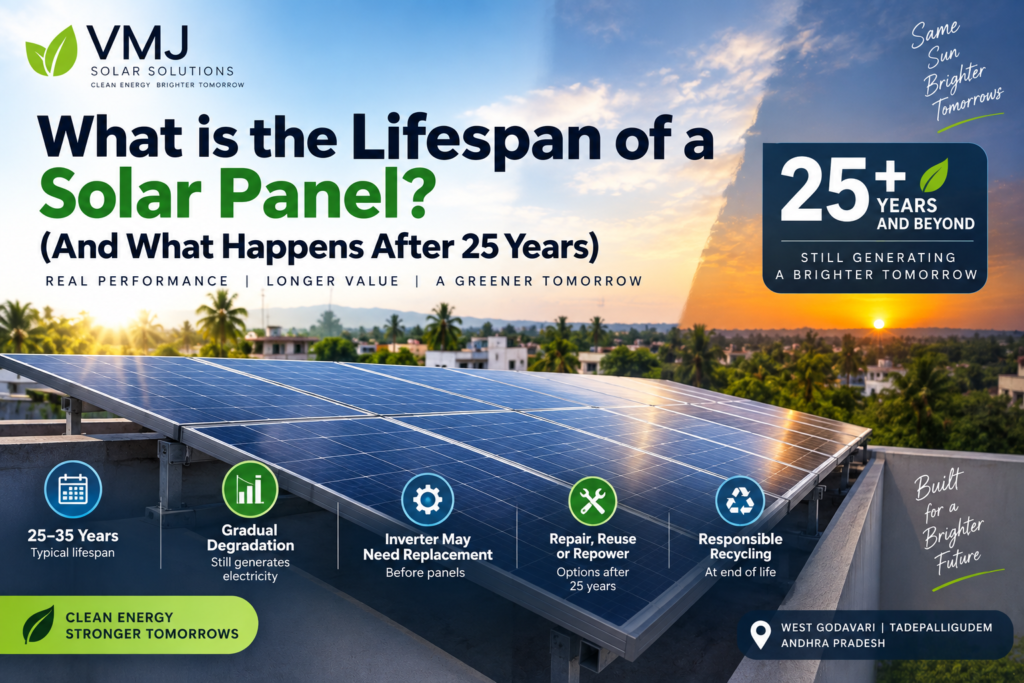
One of the first questions people ask before investing in rooftop Solar is:
“How long will Solar panels last?”
You may have heard that Solar panels have a 25-year warranty, which can create another question:
“Does that mean Solar panels stop working after 25 years?”
No.
A 25-year performance warranty does not necessarily mean that a Solar panel stops producing electricity after 25 years.
Modern photovoltaic (PV) systems are generally designed for long operating lives. The U.S. Department of Energy notes that Solar panels manufactured in recent years may have expected operational lifetimes of around 25–35 years, while broader PV systems are commonly considered over a 20–30-year performance period.
Solar panels gradually lose some power-generating capability as they age. This process is called degradation.
So, what actually happens after 25 years?
In many cases, the panel may still generate electricity. However, its output may be lower than when it was new, and other system components—especially inverters and electrical equipment—may require repair or replacement before the panels themselves reach the end of their useful life.
Quick Answer: How Long Do Solar Panels Last?
A modern Solar panel can often remain operational for 25–35 years or potentially longer, depending on its design, manufacturing quality, installation conditions, environmental exposure and maintenance.
However:
25 years ≠ panel stops working
Instead, Solar panel output generally declines gradually over time.
Many performance warranties specify that a panel will retain a certain percentage of its original rated power after a specified period. NREL notes that module performance warranties historically commonly covered around 80–90% of original power after 25–30 years, depending on the product and warranty.
The actual degradation of an individual panel can be different from the warranty threshold.
What Does “25-Year Solar Panel Warranty” Actually Mean?
This is one of the most important things to understand before buying Solar.
A Solar panel can have different types of warranties.
1. Product Warranty
A product warranty generally covers specified defects in materials or workmanship for a defined period.
The exact duration and exclusions depend on the manufacturer and product.
2. Performance Warranty
A performance warranty addresses the panel’s power output over time.
For example, a manufacturer may specify that the panel will retain a particular percentage of its original rated output after a certain number of years.
The exact percentage and degradation schedule differ between products.
3. Installation Warranty
This is separate from the panel manufacturer’s product or performance warranty.
It may cover workmanship by the installer for a specified period.
Therefore:
Panel warranty ≠ Installation warranty
And:
25-year performance warranty ≠ 25 years of identical electricity generation
Always read the actual warranty document rather than relying only on the number displayed in a quotation.
What Is Solar Panel Degradation?
Solar panel degradation means the gradual reduction in the panel’s ability to generate electricity.
A simple example:
Imagine a panel has an initial rated capacity of:
550W
If its long-term performance declines gradually, its output capability after many years may be lower than its original rating.
This does not mean the panel suddenly loses power at a particular anniversary.
Degradation generally occurs progressively.
The rate varies according to:
- Panel technology
- Manufacturing quality
- Climate
- Temperature
- Humidity
- UV exposure
- Installation conditions
- Mechanical stress
- Potential-induced degradation
- Light-induced degradation
- Thermal cycling
- Moisture ingress
- Maintenance
How Much Do Solar Panels Degrade Each Year?
There is no single degradation rate that applies to every Solar panel.
The U.S. Department of Energy notes an approximate historical degradation rate around 0.5% per year, while field data and newer technologies can show different results.
NREL’s PV Fleet analysis found a median system-level performance loss of around 0.75% per year across a large U.S. fleet, illustrating why actual system performance can differ from a simple panel warranty assumption.
More recent NREL lifetime research has observed annual degradation rates below 0.5% per year for several tested module types, although individual technologies and modules can behave differently.
Therefore, it is better to say:
Solar panels generally degrade gradually, but the actual rate depends on the module and operating conditions.
Avoid assuming that every panel loses exactly 0.5% every year.
What Could a Solar Panel Produce After 25 Years?
Let’s use a simplified example rather than treating it as a guaranteed real-world result.
Suppose a Solar panel starts with:
550W rated power
If we hypothetically assume a constant degradation rate of 0.5% per year, the theoretical output capacity after 25 years would be approximately:
550 × (1 − 0.005)²⁵ ≈ 485W
That is roughly 88% of the original rating.
But this is only a mathematical illustration.
Actual performance depends on the manufacturer’s degradation warranty, panel technology, operating conditions and field performance.
This is why you should use the specific panel’s warranty and technical datasheet rather than applying one universal degradation number.
Does a Solar Panel Stop Working After 25 Years?
No.
The 25-year figure is often associated with the performance warranty period, not a mandatory shutdown date.
A panel that reaches the end of its performance warranty may still generate electricity.
The more relevant questions are:
- How much power is it producing?
- Is it physically damaged?
- Is its degradation acceptable?
- Are other system components working?
- Is maintenance becoming expensive?
- Is replacing it economically sensible?
The U.S. Department of Energy specifically notes that most homeowners may benefit from keeping existing rooftop Solar systems operating for as long as practical rather than automatically replacing them when a warranty period ends.
What Happens to Solar Panels After 25 Years?
There are several possibilities.
Option 1: Continue Using Them
If the panels remain safe and produce acceptable electricity, they can potentially continue operating.
This can be particularly attractive if:
- The panels are physically healthy
- Inverters are functioning
- Energy production remains useful
- Maintenance costs are manageable
- There is no need for additional capacity
Option 2: Repair or Replace Individual Components
Not every aging Solar system needs a complete replacement.
An inspection may identify individual problems such as:
- Failed connectors
- Damaged cables
- Inverter failure
- Broken junction boxes
- Mounting problems
- Monitoring equipment failure
- Individual module faults
In some cases, repairing or replacing specific components can extend the system’s useful life.
Option 3: Replace the Inverter
The inverter may need replacement before the Solar panels reach the end of their useful life.
This is important because a Solar system’s lifespan is not determined only by its panels.
A rooftop system includes:
Panels + Inverter + Mounting + Cables + Protection + Monitoring + Electrical Equipment
Different components have different expected lifetimes.
The U.S. Department of Energy notes that power electronics such as inverters experience wear and can have shorter lifetimes than PV modules.
Why the Inverter Can Become the Main Concern
Solar panels have no large number of moving mechanical parts.
Inverters, however, contain electronic power-conversion components and thermal-management systems.
Over time, these components can experience:
- Heat stress
- Electrical stress
- Component ageing
- Fan or cooling issues
- Capacitor degradation
- Software/communication issues
Therefore, an older Solar system may still have healthy panels while its inverter needs replacement.
This is one reason a 25-year Solar system should be evaluated as a complete system, not just by looking at the panel warranty.
What Happens to the Mounting Structure After 25 Years?
The mounting structure can also affect the long-term life of a rooftop Solar system.
Depending on the material and installation environment, inspect for:
- Corrosion
- Loose fasteners
- Structural movement
- Water ingress
- Metal fatigue
- Damaged roof attachment points
- Sealant deterioration
- Rust around connections
For coastal or humid environments, corrosion protection can become particularly important.
The condition of the roof itself should also be considered.
A Solar panel may still have useful operating life while the original roof requires repair or replacement.
Can Solar Panels Last More Than 30 Years?
They can.
The U.S. Department of Energy currently cites average operational lifetimes of approximately 25–35 years for Solar panels based on industry-professional survey data, while research continues toward even longer lifetimes.
This means a 25-year-old panel should not automatically be considered waste.
Instead, its condition and performance should be assessed.
Some systems may continue operating beyond their original performance warranty when the economics and safety of continued operation make sense.
What Factors Affect Solar Panel Lifespan?
1. Panel Quality
Manufacturing quality can influence long-term reliability.
A panel should not be selected only on its initial price.
Consider:
- Manufacturer reputation
- Warranty terms
- Degradation specification
- Certifications
- Product history
- Service support
2. Temperature
Solar panels operate outdoors and are exposed to heat.
Repeated heating and cooling cycles can place mechanical stress on module materials.
High operating temperatures can also reduce instantaneous efficiency.
Over many years, thermal stress can contribute to ageing.
3. Humidity and Moisture
Moisture ingress can contribute to degradation of electrical and material components.
Proper module construction, encapsulation and installation are therefore important.
4. UV Exposure
Solar modules are designed to withstand long-term sunlight exposure, but ultraviolet radiation contributes to material ageing over time.
5. Strong Winds and Severe Weather
Extreme weather can cause physical damage even if a panel would otherwise have many years of expected life remaining.
Potential issues include:
- Cracked glass
- Frame damage
- Mounting damage
- Cable damage
- Structural movement
This is why proper installation and structural design matter.
6. Poor Installation
Installation quality can affect long-term reliability.
Problems may arise from:
- Incorrect mounting
- Poor cable management
- Connector mismatch
- Improper tightening
- Poor drainage
- Inadequate earthing
- Incorrect roof penetrations
A high-quality panel cannot fully compensate for poor system installation.
Does Cleaning Extend Solar Panel Life?
Regular cleaning can help maintain energy production when dust, dirt or other soiling accumulates.
However, cleaning should be done appropriately.
Avoid:
- Abrasive materials
- Aggressive chemicals
- Scratching the glass
- Walking on panels
- High-pressure cleaning that may damage components
- Cleaning during unsafe electrical/weather conditions
Cleaning does not stop natural module degradation.
Its main benefit is maintaining performance by reducing avoidable soiling losses.
What About Bird Droppings?
Bird droppings can create localized shading and may contribute to hotspots under certain conditions.
Accumulated droppings can therefore affect energy production and potentially create localized stress.
The appropriate cleaning approach depends on the module, installation and site conditions.
Do not scrape dried material aggressively because the module glass or coating could be damaged.
What About Solar Panels in Andhra Pradesh?
Solar panels installed in Andhra Pradesh can experience a combination of:
- High temperatures
- Seasonal humidity
- Dust
- Monsoon rain
- Strong winds
- Thunderstorms
- Bird activity
The exact impact depends on the location and installation environment.
For Solar systems in West Godavari and Tadepalligudem, long-term maintenance should therefore include periodic inspection of:
- Panels
- Mounting structures
- Cables
- Connectors
- Earthing
- Inverter
- Protection devices
- Roof condition
- Monitoring data
The objective is not to prevent every form of ageing.
It is to identify avoidable problems before they become expensive failures.
How Can You Tell If Old Solar Panels Are Still Performing Well?
Don’t judge an old Solar system simply by looking at the panels.
Monitor actual generation.
Useful information can include:
- Daily generation
- Monthly generation
- Annual generation
- Inverter performance
- System downtime
- Performance trends
- Fault alerts
- Historical electricity production
Compare actual production with expected production after accounting for:
- Weather
- Seasonality
- Shading
- Soiling
- System availability
- Age-related degradation
A drop in generation does not automatically mean the panels are reaching the end of their life.
The cause should be investigated.
What If Solar Generation Drops Suddenly?
A gradual decline can be consistent with ageing.
A sudden drop may indicate another problem.
Possible causes include:
- Inverter fault
- String fault
- Cable issue
- Connector problem
- New shading
- Heavy soiling
- Module damage
- Monitoring failure
- Electrical protection issue
A sudden generation reduction should therefore be investigated rather than automatically blamed on panel age.
Solar Panel Lifespan vs Solar System Lifespan
These are not exactly the same.
Solar Panel
May remain operational for 25–35 years or longer depending on technology and conditions.
Inverter
May require replacement earlier depending on model, operating conditions and component ageing.
Battery
If a battery is part of the system, its useful life depends on chemistry, cycling, temperature, depth of discharge and warranty.
Mounting Structure
Can potentially remain in service for many years if properly designed and maintained, but corrosion and mechanical condition need to be assessed.
Roof
The roof itself may require repair or replacement independently of the Solar system.
Therefore:
The lifespan of a Solar system is determined by the combined condition of its components, not just the panel warranty.
What Is Repowering a Solar System?
Repowering means upgrading an existing Solar system rather than simply abandoning the site.
This may involve:
- Replacing old Solar panels
- Installing higher-efficiency modules
- Replacing the inverter
- Upgrading electrical equipment
- Improving monitoring
- Reconfiguring the system
- Increasing system capacity where permitted
The U.S. Department of Energy identifies repowering as one possible pathway when an aging PV system reaches the end of its original performance period.
For some older installations, repowering may provide more value than maintaining outdated equipment.
Why Repowering Can Be Attractive After 25 Years
Solar technology has improved significantly over time.
A 25-year-old Solar system may have:
- Lower-efficiency modules
- Older inverter technology
- Limited monitoring
- Older protection equipment
- Higher maintenance requirements
A newer system could potentially provide:
- Higher power density
- Better monitoring
- Improved inverter functionality
- More efficient use of available roof area
- Better integration with batteries
However, repowering should be evaluated based on the economics of the existing system rather than assuming replacement is automatically better.
Can You Replace Only the Old Panels?
Potentially, yes—but the answer depends on the existing system.
Before adding or replacing modules, check:
- Existing inverter capacity
- MPPT voltage range
- Maximum current
- String configuration
- Module dimensions
- Connector compatibility
- Mounting structure
- Cable capacity
- Protection devices
- Applicable regulations
You should not simply connect new modules to an old system based only on wattage.
A professional assessment is recommended.
What Happens to the Old Solar Panels?
When panels are removed from service, there are several potential pathways:
Reuse
A panel that still functions may potentially have a secondary use, depending on its condition and applicable requirements.
Refurbishment
Some components may be repairable or suitable for refurbishment.
Recycling
PV modules contain materials that can potentially be recovered through recycling processes.
Responsible Disposal
Panels and other electronic components should be handled according to applicable waste-management requirements.
The U.S. Department of Energy describes recycling, reuse, refurbishment and responsible end-of-life management as important parts of the PV lifecycle.
What About Solar Panel Recycling in India?
India has specific regulatory provisions for Solar PV modules, panels and cells under the E-Waste (Management) Rules, 2022.
The rules include a dedicated chapter covering Solar PV modules, panels and cells. Among other provisions, manufacturers and producers are required to register on the relevant portal and maintain information regarding Solar PV waste as specified in the rules.
The Ministry of Environment, Forest and Climate Change also identifies Solar PV waste within India’s e-waste framework and notes the Extended Producer Responsibility approach under the 2022 rules.
This means the end of a panel’s useful life should not simply be treated as ordinary household waste.
For an actual disposal or recycling decision, owners should follow the current applicable requirements and use appropriate authorised channels.
Should You Replace Solar Panels After 25 Years?
Not automatically.
Consider replacement when one or more of the following apply:
- Output has declined significantly
- Modules are physically damaged
- Repairs are becoming frequent
- Inverter technology is obsolete
- Replacement parts are difficult to obtain
- Maintenance costs are increasing
- Roof work requires removal
- A newer system offers a strong economic advantage
- Additional Solar capacity is needed
- Safety or compliance requirements have changed
If the panels continue to produce useful electricity and the system remains safe and economical to operate, continuing to use them may make sense.
When Should You Consider Keeping an Old Solar System?
Continuing to operate an older system may be reasonable when:
- Generation remains acceptable
- Inverter is healthy
- Mounting is structurally sound
- Electrical protection remains appropriate
- Maintenance costs are manageable
- There is no significant physical damage
- The system continues to provide useful energy value
Age alone should not determine replacement.
When Should You Consider Repowering?
Repowering may deserve consideration when:
- The system has significantly degraded
- Inverter replacement is already required
- Roof space can support more generation
- Modern modules provide substantially more power in the same area
- Existing equipment is becoming difficult to maintain
- New monitoring or storage capabilities are desired
- The economics justify the investment
A detailed technical and financial comparison should be completed first.
10 Tips to Extend the Useful Life of Your Solar System
1. Choose Quality Equipment
Consider the manufacturer’s track record, warranty and technical specifications.
2. Use Professional Installation
Correct installation can reduce avoidable long-term problems.
3. Monitor Generation
Track system output rather than waiting for an electricity bill to reveal a problem.
4. Clean When Necessary
Remove excessive dust and other soiling using appropriate methods.
5. Inspect Cables and Connectors
Look for signs of damage, loose connections or deterioration.
6. Check the Inverter
Monitor alarms, temperature and performance.
7. Inspect the Mounting Structure
Look for corrosion, loose fasteners and other structural issues.
8. Maintain Proper Earthing and Protection
Electrical safety equipment should be inspected as appropriate.
9. Keep Warranty Documents
Maintain invoices, serial numbers, datasheets and warranty certificates.
10. Schedule Periodic Maintenance
A periodic inspection can identify problems before they become major failures.
What Should You Ask Your Solar Installer About Panel Lifespan?
Before installing Solar, ask:
- What is the panel’s product warranty?
- What is the performance warranty?
- What is the first-year degradation specification?
- What is the annual degradation specification?
- What power level is guaranteed at 25 or 30 years?
- Which conditions can void the warranty?
- Who handles warranty claims?
- What is the inverter warranty?
- What maintenance is recommended?
- What happens if a panel fails after several years?
- Are labour and replacement costs covered?
- What records should I maintain?
These questions can help you understand the real long-term value of the Solar system.
Is a 30-Year Solar Panel Better Than a 25-Year Solar Panel?
Not necessarily.
A longer performance warranty can be useful, but it should not be the only buying criterion.
Compare:
- Degradation rate
- Guaranteed output
- Product warranty
- Manufacturer reliability
- Module technology
- Temperature coefficient
- Mechanical specifications
- Certifications
- Service support
- Price
- Expected energy yield
A panel with a 30-year warranty is not automatically the best panel for every roof.
The overall system economics and reliability matter more than a single warranty number.
Does a Higher Wattage Panel Last Longer?
No.
Panel wattage and lifespan are different characteristics.
A 600W panel is not automatically more durable than a 550W panel.
Lifespan depends on:
- Construction
- Materials
- Cell technology
- Encapsulation
- Manufacturing quality
- Environmental exposure
- Installation
- Maintenance
Compare the complete technical specification rather than assuming higher wattage means longer life.
Does Heat Reduce Solar Panel Life?
High temperatures can affect Solar module performance and contribute to long-term thermal stress.
However, Solar modules are specifically designed for outdoor operation.
The relevant question is not simply:
“Is my location hot?”
It is:
“Is the selected module designed appropriately for the operating environment, and is the system installed and maintained correctly?”
Temperature coefficients in the module datasheet can also help compare how different modules respond to operating temperature.
Does Rain Damage Solar Panels?
Normal rain does not mean that Solar panels will automatically be damaged.
PV modules are designed for outdoor exposure.
However, severe weather can cause damage through:
- Hail
- Strong winds
- Falling objects
- Flooding
- Water ingress from damaged components
- Structural failures
Therefore, the quality of the module and installation both matter.
Can a Solar Panel Last 40 Years?
It is possible for a panel to remain operational beyond its original performance warranty, but it would be inappropriate to guarantee a 40-year useful life for every module.
The DOE notes that current industry expectations are generally in the 25–35-year range, while research is working toward substantially longer lifetimes.
A 40-year-old system would need to be assessed based on its actual condition, performance, safety and economics.
VMJ Solar Solutions: Think Beyond the 25-Year Warranty
For homeowners, farmers and businesses considering Solar in Tadepalligudem, West Godavari and surrounding Andhra Pradesh areas, Solar should be viewed as a long-term energy asset.
At VMJ Solar Solutions, system planning can consider:
- Appropriate Solar capacity
- Panel technology
- Inverter selection
- Roof condition
- Mounting structure
- Electrical protection
- Monitoring
- Maintenance
- Warranty
- Future expansion
- Long-term system performance
The goal should not simply be to install a system that works today.
It should be to design a system that can remain safe, maintainable and economically useful for many years.
Frequently Asked Questions
How many years do Solar panels last?
Modern Solar panels are commonly expected to operate for around 25–35 years or longer depending on technology, quality, environmental conditions and maintenance.
Do Solar panels stop working after 25 years?
No. The end of a 25-year performance warranty does not automatically mean the panel stops producing electricity.
What happens to Solar panels after 25 years?
They may continue operating with reduced output, undergo repair or refurbishment, be repowered with newer equipment, or eventually be removed and recycled or otherwise managed according to applicable requirements.
How much do Solar panels degrade each year?
There is no universal number. Historical industry figures are often around 0.5% per year, while actual field performance varies by technology, system and environment.
Can Solar panels last more than 30 years?
Yes, some panels can remain operational beyond 30 years, although their output and economic value may decline over time.
Does a 25-year warranty mean the Solar panel will produce 100% power for 25 years?
No. A performance warranty generally specifies a minimum power level after a defined period rather than guaranteeing the original rated output throughout the entire warranty.
What component usually needs replacement first?
The inverter may require replacement before the Solar panels because power electronics can have a shorter service life than PV modules.
Should I replace my Solar panels after 25 years?
Not automatically. Evaluate actual generation, physical condition, inverter health, maintenance costs and the economics of replacement or repowering.
Can old Solar panels be recycled in India?
Solar PV modules, panels and cells are covered by specific provisions in India’s E-Waste (Management) Rules, 2022. End-of-life handling should follow the applicable rules and authorised channels.
Can I add new Solar panels to an old Solar system?
Potentially, but compatibility must be checked. The inverter, voltage/current characteristics, string design, mounting system, protection equipment and applicable regulations all need to be considered.
Is a 30-year warranty always better than a 25-year warranty?
Not necessarily. Warranty duration should be evaluated alongside degradation rate, guaranteed output, product quality, manufacturer support, price and expected energy yield.
How can I extend the life of my Solar system?
Proper installation, regular monitoring, appropriate cleaning, electrical inspections, structural checks and timely maintenance can help reduce avoidable failures and support long-term performance.
Conclusion
A 25-year Solar panel warranty is not an expiration date.
Modern Solar panels are designed for long-term operation, and many can continue generating electricity beyond their original performance warranty. The important difference is that their output generally declines gradually rather than stopping suddenly.
After 25 years, a Solar system may:
- Continue operating
- Need repairs
- Require an inverter replacement
- Benefit from refurbishment
- Be repowered with newer equipment
- Eventually be decommissioned and recycled
The right decision depends on the system’s actual performance, safety, maintenance requirements and economics.
For Solar owners, the best approach is to monitor performance throughout the system’s life rather than waiting until the 25-year mark.
And for anyone planning a new rooftop Solar installation, don’t look only at today’s price.
Look at the next 25–30 years of energy production, maintenance, warranty support and system reliability.
A good Solar investment is not simply a panel that lasts 25 years. It is a well-designed system that continues to provide useful energy value for many years.