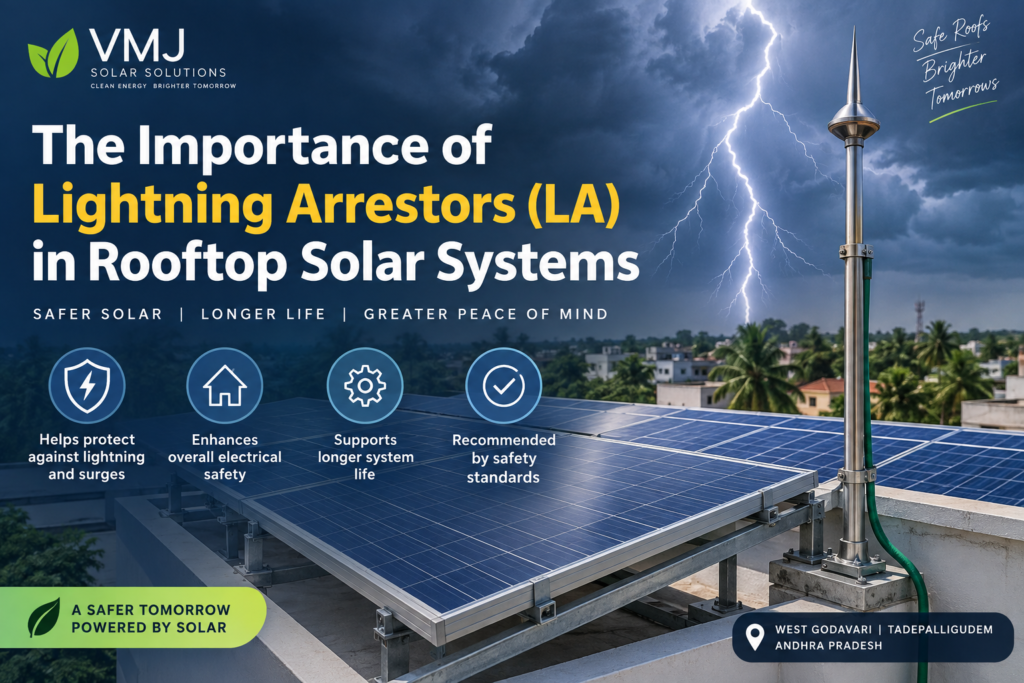
Rooftop Solar panels are installed outdoors and are therefore exposed to changing weather conditions, including thunderstorms and lightning activity.
While a Solar PV system can be designed with electrical and lightning protection measures, a lightning arrestor (LA) should not be treated as a simple add-on or a substitute for the complete protection system.
A properly designed rooftop Solar installation may require a combination of lightning protection, earthing, surge protective devices (SPDs), overcurrent protection and appropriate equipment installation.
The Central Electricity Authority (CEA) Safety and Electric Supply Regulations, 2023 specifically provide for lightning and overvoltage protection in Solar PV installations, including required lightning arresters and suitable surge protection in combiner boxes, according to applicable standards.
For Solar systems in West Godavari, Tadepalligudem and across Andhra Pradesh, understanding the difference between a lightning arrestor, earthing system and SPD can help property owners make better decisions about rooftop Solar safety.
Quick Answer: Why Is a Lightning Arrestor Important in Rooftop Solar?
A lightning arrestor is part of a lightning protection system designed to provide a controlled path for lightning-related electrical energy toward earth, helping reduce the risk of dangerous voltage effects on the Solar installation and nearby equipment.
However, an LA does not guarantee that a Solar system will never be damaged by lightning.
Effective protection depends on the complete design, including:
- Lightning protection layout
- LA location and coverage
- Earthing
- Equipotential bonding
- Surge protection devices
- DC and AC protection
- Cable routing
- Inverter protection
- Applicable standards
- Site-specific risk assessment
The CEA defines a lightning arrester as a device intended to divert an excessive electrical surge to earth and interrupt follow-on current where applicable.
What Is a Lightning Arrestor (LA)?
A Lightning Arrestor (LA), sometimes called a lightning arrester or lightning protection device depending on its application, is designed to provide a controlled path for electrical surge energy associated with lightning or overvoltage conditions.
In a Solar installation, the objective is not to “attract” lightning toward the rooftop Solar panels.
Instead, a properly designed lightning protection system aims to control the path of lightning current and reduce the possibility of damaging overvoltages reaching sensitive equipment.
This distinction is important.
A Lightning Arrestor Does Not:
- Guarantee that lightning will never strike the property
- Make Solar panels lightning-proof
- Replace earthing
- Replace surge protection devices
- Eliminate all electrical damage risk
- Guarantee protection against every type of surge
It is one component of a broader protection strategy.
Why Rooftop Solar Systems Need Lightning Protection
Solar panels are installed on exposed rooftop structures.
The system also contains sensitive electrical equipment such as:
- Solar modules
- DC cables
- Connectors
- Junction boxes
- Inverters
- AC cables
- Monitoring equipment
- Protection devices
- Electrical distribution equipment
Lightning can create extremely high transient voltages and currents.
Even when lightning does not directly strike the Solar array, nearby lightning activity can potentially produce induced or conducted surges through electrical and metallic pathways.
These transient events can affect electronic equipment.
That is why lightning protection should be considered during the initial Solar system design rather than added only after installation.
Lightning Protection Is Not the Same as Surge Protection
This is one of the most important concepts for Solar owners.
Lightning Arrestor
An LA is part of the external or overall lightning protection arrangement and is intended to provide a controlled path for lightning-related current.
Surge Protective Device (SPD)
An SPD is designed to limit transient overvoltages at the equipment or circuit where it is installed.
Earthing System
Earthing provides a controlled electrical connection to earth and helps establish appropriate reference and fault-current paths.
These systems work together, but they do different jobs.
A rooftop Solar system should therefore not be described as “protected” merely because someone installed an earthing electrode or one surge protector.
How Does a Lightning Arrestor Work?
In simple terms, a lightning protection system attempts to provide a preferred and controlled path for lightning current.
A simplified concept is:
Lightning Event → Lightning Protection System → Down Conductor → Earthing System → Earth
The actual engineering arrangement depends on the building, Solar array, risk level, applicable standards and site conditions.
The purpose is to reduce uncontrolled current paths through:
- Solar modules
- Mounting structures
- Inverters
- Building electrical systems
- Communication equipment
- Other sensitive components
The protection system must be properly designed and installed to achieve this objective.
What Happens If a Solar System Has Poor Lightning Protection?
Depending on the event and system design, lightning-related surges can potentially damage sensitive equipment.
Possible consequences may include:
- Inverter failure
- Damage to electronic components
- DC-side equipment damage
- AC-side equipment damage
- Communication or monitoring equipment failure
- Cable or connector damage
- Damage to protection equipment
- Fire risk in severe fault conditions
- System downtime
The actual outcome depends on factors such as the type of lightning event, surge path, protection arrangement, equipment design and installation quality.
Therefore, it is not accurate to say that an LA will prevent every possible lightning-related failure.
Role of Earthing in Solar Lightning Protection
Earthing is a fundamental part of electrical safety and lightning protection.
Solar installations contain several metallic and electrical components that may need appropriate grounding and bonding.
These can include:
- Module mounting structures
- Inverter enclosures
- Electrical equipment
- Protective conductors
- Lightning protection components
The CEA’s 2023 safety regulations include requirements relating to earthing systems and Solar installations.
However, earthing and lightning protection should not be treated as interchangeable terms.
A good earthing system does not automatically mean that the Solar installation has a complete lightning protection system.
Why Equipotential Bonding Matters
Lightning and surge protection can become more complicated when different metallic parts of a building have different electrical potentials during a transient event.
Equipotential bonding helps reduce dangerous potential differences between appropriately connected conductive parts.
This is particularly relevant where a Solar installation includes:
- Metal mounting structures
- Lightning protection conductors
- Building earthing
- Electrical equipment
- Communication cables
- Other conductive paths
The design should be handled according to applicable electrical and lightning protection standards rather than through improvised connections.
The Role of Surge Protective Devices (SPDs)
A Lightning Arrestor and SPD should not be considered the same device.
SPDs are used to limit transient overvoltages and protect electrical/electronic equipment.
Solar systems can require protection on both:
DC Side
The DC side includes:
Solar Panels → DC Cables → DC Protection → Inverter
AC Side
The AC side includes:
Inverter → AC Protection → Building/Grid Connection
The appropriate SPD type, rating, location and coordination depend on the system design and applicable standards.
MNRE technical documentation for Solar PV systems has also addressed external surge protection on the DC side and the use of applicable standards for SPDs.
Why the Inverter Needs Special Attention
The inverter is one of the most important and sensitive components in a rooftop Solar system.
It contains electronic power-conversion and control circuits.
A lightning-related surge entering through the:
- DC Solar array
- AC grid
- Communication line
- Other conductive pathway
could potentially affect the inverter if appropriate protection is not provided.
Therefore, Solar protection should consider both the Solar array side and the grid/building side of the inverter.
Does a Lightning Arrestor Protect Solar Panels?
It can form part of a protection system designed to reduce lightning-related risks to the Solar installation.
However, it would be inaccurate to say:
“A lightning arrestor guarantees that Solar panels will never be damaged.”
Lightning is a high-energy natural phenomenon, and the effectiveness of protection depends on system design, installation quality, equipment ratings, earthing, bonding, SPD coordination and the characteristics of the lightning event.
The correct objective is to reduce risk and provide controlled protection, not promise zero damage.
Where Should a Lightning Arrestor Be Installed?
The location of an LA or air-terminal arrangement should be determined by the lightning protection design.
It should not simply be installed wherever there is available space on the rooftop.
Important factors can include:
- Protection zone
- Height
- Distance from Solar modules
- Building geometry
- Array layout
- Wind loading
- Shading
- Down-conductor routing
- Earthing arrangement
- Maintenance access
- Applicable lightning protection standard
Importantly, historical MNRE rooftop Solar quality-control documentation states that a lightning arrester should not be installed directly on the Solar mounting structure and discusses protecting the array using the required number of lightning arrestors.
This is an important point to discuss with your Solar installer before installation.
Can an LA Create Shadow on Solar Panels?
Yes, the placement of a lightning protection mast or air terminal can potentially create shading.
Even small areas of shading can affect Solar output depending on:
- Position
- Time of day
- Season
- Panel layout
- Module electrical configuration
- Bypass diode behaviour
Therefore, lightning protection design should consider both electrical safety and Solar energy production.
The LA should be positioned so that the required protection zone is achieved while unnecessary shading of the Solar array is avoided.
Lightning Protection and Solar Panel Mounting Structures
A common misconception is:
“The Solar panel mounting structure is metal, so it can automatically act as a lightning conductor.”
This should not be assumed.
The mounting structure may need appropriate bonding and earthing, but it is not automatically equivalent to a designed lightning protection system.
The lightning protection path should be intentionally designed.
The CEA’s Solar safety provisions specifically address earthing of photovoltaic module mounting structures and lightning/overvoltage protection.
Lightning Protection for RCC Rooftops
RCC rooftops are common for residential and commercial Solar installations.
For an RCC roof, the protection design may consider:
- Building height
- Existing lightning protection system
- Solar array position
- Roof dimensions
- Metallic structures
- Down-conductor routes
- Earth termination system
- Electrical service entry
- Nearby structures
If the building already has a lightning protection system, the Solar installer should assess whether the existing system and Solar installation can be appropriately coordinated.
Do not simply connect new Solar equipment to an existing conductor without engineering verification.
Lightning Protection for Sheet-Roof Solar Installations
Industrial buildings, warehouses, poultry farms, rice mills and commercial properties often use metal sheet roofs.
These installations require additional attention to:
- Roof structure
- Mounting arrangement
- Lightning protection layout
- Earthing
- Cable routing
- Equipment location
- Wind loading
- Corrosion
- Separation distances
A sheet roof does not automatically provide adequate lightning protection.
For larger commercial Solar systems, the lightning protection design should be developed as part of the overall electrical and structural design.
How Lightning Protection Can Help Protect Your Inverter
The inverter is often one of the most expensive electronic components in a rooftop Solar system.
A properly coordinated protection system can help reduce exposure to damaging transient overvoltages.
Protection may involve:
External Lightning Protection + Earthing + DC SPD + AC SPD + Proper Bonding + Inverter Protection
The exact configuration should be determined by the inverter manufacturer’s requirements and the applicable electrical and lightning protection standards.
Lightning Arrestor vs SPD vs Earthing
Here’s a simple comparison:
| Component | Main Purpose |
|---|---|
| Lightning Arrestor / Lightning Protection System | Helps provide a controlled path for lightning-related current |
| SPD | Limits transient overvoltage reaching protected equipment |
| Earthing | Provides appropriate connection to earth and supports electrical safety/protection |
| Bonding | Helps reduce dangerous potential differences between conductive parts |
| Inverter Protection | Protects the inverter through internal/external protective measures |
These components are complementary, not interchangeable.
Does Every Rooftop Solar System Need the Same LA Design?
No.
A 3 kW residential system and a large commercial rooftop Solar plant may have very different protection requirements.
The design can depend on:
- Building height
- Location
- Solar system size
- Array dimensions
- Existing lightning protection
- Local lightning exposure
- Building use
- Electrical configuration
- Risk assessment
- Applicable standards
Therefore, avoid selecting the number or rating of lightning arrestors based only on the Solar system’s kW capacity.
There is no simple rule such as “one LA for every 5 kW of Solar.”
The protection arrangement should be engineered for the site.
IEC 62305 and Lightning Protection
The IEC 62305 series is an important international reference for protection against lightning.
The current IEC 62305 series covers areas including:
- General principles
- Risk management
- Physical damage to structures
- Protection against lightning electromagnetic effects
IEC published the current consolidated 2026 series in July 2026.
For a Solar installation, the applicable standards should be identified based on the type of protection system and project requirements.
Indian project specifications may also reference relevant Indian Standards and IEC standards.
CEA Requirements for Solar Lightning Protection
The CEA’s Measures relating to Safety and Electric Supply Regulations, 2023 specifically address Solar installations.
The regulations state that Solar PV power plants should have lightning and overvoltage protection using the required number of lightning arresters according to relevant standards.
They also address surge protective devices in combiner boxes and overcurrent protection of combiner-box input circuits.
The CEA currently lists both the 2023 regulations and a 2026 amendment, so Solar installers should always verify the latest applicable regulatory version rather than relying on an old checklist.
Common Lightning Protection Mistakes in Rooftop Solar
1. Thinking Earthing Alone Is Enough
Earthing is essential, but it does not automatically provide complete lightning protection.
2. Installing an LA Without Considering the Protection Zone
The position and height of the lightning protection equipment matter.
3. Ignoring SPDs
Lightning protection and surge protection should be considered together.
4. Using Incorrect Cable Routing
The routing and length of protection conductors can influence surge behaviour.
5. Connecting Everything Improperly
Improvised connections between Solar, building and lightning earthing systems can create problems.
6. Ignoring Existing Building Protection
If the building already has lightning protection, the Solar system should be evaluated in relation to it.
7. Installing the LA Where It Creates Unnecessary Shading
Protection should be designed without unnecessarily reducing Solar generation.
8. Choosing an LA Only by Price
Lightning protection is a safety-related engineering component. The cheapest product is not necessarily the right solution.
9. Skipping Periodic Inspection
Connections, conductors, earth systems and protective devices should be inspected as appropriate for the installation.
How to Check Your Rooftop Solar Lightning Protection
If you already have Solar installed, ask your installer these questions:
1. Does my Solar system have a lightning protection design?
2. Where is the lightning arrestor located?
3. What area does it protect?
4. Is the LA properly earthed?
5. Is the Solar mounting structure appropriately bonded and earthed?
6. Are DC and AC surge protection measures provided where required?
7. What type and rating of SPD are installed?
8. Does the protection system comply with applicable standards?
9. Could the lightning protection equipment create shading on my Solar panels?
10. How frequently should the protection system be inspected?
These questions can help identify whether the installation has been designed as a complete protection system rather than simply having an “earthing wire” added.
Lightning Protection in Andhra Pradesh
Weather conditions can vary significantly across Andhra Pradesh, and thunderstorms can occur during different periods of the year.
For rooftop Solar installations in West Godavari and Tadepalligudem, lightning protection should therefore be considered during the initial design rather than treated as an optional afterthought.
This can be particularly important for:
- Independent houses
- Apartments
- Schools
- Hospitals
- Dairy farms
- Poultry farms
- Aqua farms
- Rice mills
- Cold storages
- Supermarkets
- Hotels
- Factories
- Large commercial rooftops
Larger or more exposed buildings may require a more detailed lightning risk assessment and protection design.
Lightning Protection for Commercial Solar Systems
Commercial and industrial Solar installations can involve larger arrays, longer cable runs and more extensive electrical infrastructure.
A lightning protection design for these systems may need to consider:
- Array size
- Building dimensions
- Inverter locations
- AC distribution equipment
- Transformer equipment where applicable
- Communication networks
- Existing building lightning protection
- Earthing grid
- Surge protection coordination
- Maintenance access
For larger installations, protection should be incorporated into the electrical engineering design instead of being added after the Solar plant is completed.
What About Solar Insurance?
Lightning protection and Solar insurance serve different purposes.
A protection system attempts to reduce the risk of damage.
Insurance, where available and subject to policy terms, may provide financial protection against specified insured events.
Therefore:
Lightning Protection ≠ Insurance
A well-designed Solar installation can consider both technical risk reduction and appropriate insurance coverage.
What Should You Ask Your Solar Installer Before Installation?
Before signing a Solar installation contract, ask for clarity on:
- Lightning protection
- Earthing
- AC surge protection
- DC surge protection
- Inverter protection
- Mounting structure bonding
- Protection-zone design
- Applicable standards
- Testing and commissioning
- Documentation
- Periodic inspection requirements
It is better to clarify these points before installation than to discover protection gaps after a lightning event.
VMJ Solar Solutions: Safety Should Be Part of the Solar Design
At VMJ Solar Solutions, rooftop Solar should be considered as a complete electrical and structural system—not simply as Solar panels installed on a roof.
For projects in Tadepalligudem, West Godavari and surrounding areas, a properly planned Solar installation can consider:
- Solar system sizing
- Roof assessment
- Panel and inverter selection
- Mounting structure
- Earthing
- Lightning protection
- Surge protection
- Electrical safety
- Monitoring
- Installation quality
- Applicable DISCOM requirements
- Long-term maintenance
The exact lightning protection arrangement should always be determined based on the site, system design, applicable regulations and relevant standards.
Frequently Asked Questions
What is a Lightning Arrestor in a Solar system?
A Lightning Arrestor is a protective device used as part of a lightning protection arrangement to provide a controlled path for excessive electrical surge energy toward earth.
Is a Lightning Arrestor necessary for rooftop Solar?
Lightning and overvoltage protection requirements depend on the Solar installation and applicable standards. CEA’s 2023 safety regulations specifically address lightning and overvoltage protection for Solar PV power plants.
Does an LA protect Solar panels from direct lightning strikes?
It can reduce risk as part of a properly designed lightning protection system, but it cannot guarantee that Solar panels will never be damaged by lightning.
Is an LA the same as an SPD?
No. A Lightning Arrestor and Surge Protective Device perform different functions and can work together as part of a broader protection system.
Is earthing enough to protect a Solar system from lightning?
No. Earthing is an important part of electrical and lightning protection, but it should not automatically be considered a complete lightning protection system.
Can a Lightning Arrestor be installed directly on the Solar panel mounting structure?
Historical MNRE rooftop Solar technical documentation specifically states that the lightning arrester should not be installed on the mounting structure. The final arrangement should follow the applicable current standards and project design.
Can a Lightning Arrestor cause shading?
Yes, depending on its location and height. The protection design should consider the Solar array’s shading requirements as well as the lightning protection zone.
Does every Solar system need the same number of Lightning Arrestors?
No. The required arrangement depends on site conditions, building geometry, array layout, protection design and applicable standards.
Does lightning protection increase the cost of Solar installation?
It can add equipment and installation costs, but the appropriate protection should be evaluated as part of the overall safety and reliability design rather than selected solely on initial price.
Should existing building lightning protection be connected to Solar?
Do not make an improvised connection. The existing building protection and new Solar installation should be assessed and coordinated by a qualified professional according to applicable standards.
Conclusion
A rooftop Solar system is exposed to the outdoor environment for many years, making electrical protection an important part of its design.
A Lightning Arrestor (LA) can play an important role in a properly designed lightning protection system, but it should not be viewed as a standalone solution.
Effective protection may require a combination of:
Lightning Protection + Earthing + Bonding + DC/AC Surge Protection + Proper Equipment Installation + Regular Inspection
For Solar owners in West Godavari, Tadepalligudem and across Andhra Pradesh, discussing lightning protection during the initial Solar design can help avoid costly protection gaps later.
Most importantly, don’t ask only:
“Does my Solar system have an LA?”
Ask:
“Does my complete Solar installation have a properly designed lightning and surge protection system?”
That is the more important question for long-term Solar safety