
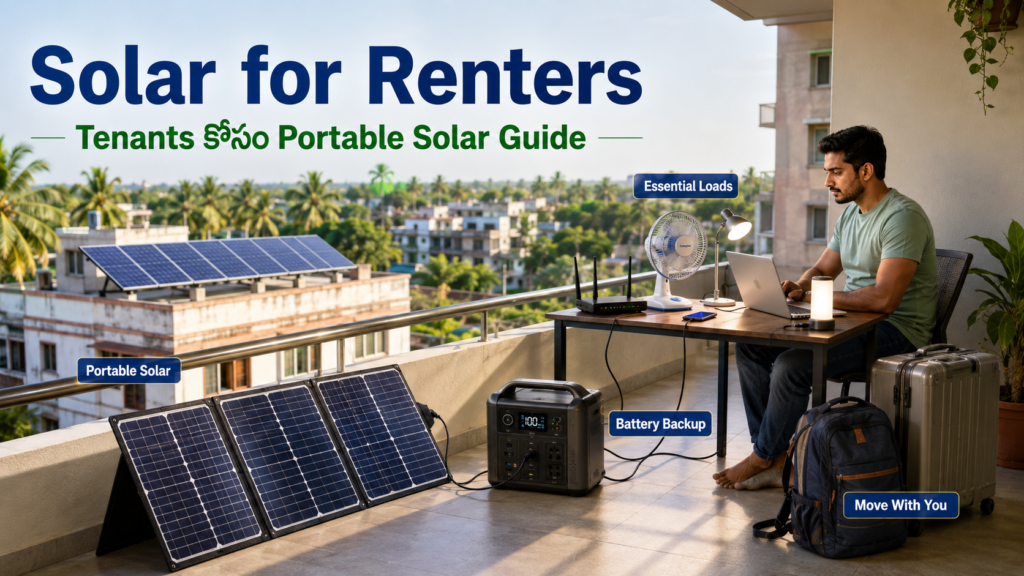
If you live in a rented house or apartment, you may have thought about Solar but stopped at one question:
“Why should I invest in Solar when I don’t own the property?”
That’s a reasonable concern.
A conventional rooftop Solar system is usually a long-term installation. It may involve:
- Roof access
- Mounting structures
- Electrical wiring
- Grid connection
- DISCOM approvals
- Net metering
- Property-owner consent
For a tenant, this can make rooftop Solar considerably more complicated than it is for a homeowner.
But that doesn’t mean renters have no Solar options.
Portable Solar panels, battery power stations, small plug-and-play systems and other movable Solar solutions can provide some of the benefits of Solar without permanently modifying the property.
The important distinction is:
A portable Solar solution is not automatically a replacement for a conventional rooftop Solar system.
For renters, the goal is often portable energy + backup power + lower dependence on the grid, rather than trying to reproduce a 3 kW or 5 kW rooftop installation.
Quick Answer: Can Renters Install Solar Panels?
Renters can use portable Solar solutions, but installing a permanent rooftop Solar system on a rented property generally requires the property owner’s permission and may involve the applicable DISCOM approval, metering and electrical requirements. Tenants should not permanently modify the roof or electrical system without written consent.
For a conventional grid-connected rooftop Solar installation, the property owner’s cooperation and electricity-connection requirements matter.
For portable systems, the situation can be much simpler because the equipment can potentially move with the tenant.
What Are the Best Solar Options for Renters?
There are several approaches.
1. Portable Solar Panels
Small Solar panels that can be moved or stored.
2. Portable Solar Power Station
A battery-based unit that can be charged from Solar and used to power selected appliances.
3. Solar + Battery Backup
Useful for:
- Lights
- Wi-Fi
- Fans
- Phones
- Laptops
- Small appliances
4. Balcony Solar
Possible in some situations, but it requires careful consideration of:
- Building rules
- Safety
- Structural mounting
- Wind
- Electrical connection
- Landlord approval
5. Permanent Rooftop Solar With Owner Consent
Potentially the best option if the landlord is willing to cooperate.
Why Conventional Rooftop Solar Is Different for Renters
A normal grid-connected rooftop Solar system isn’t simply:
Panel → Plug → Electricity Bill Reduction
It can involve:
Solar Panels → Inverter → AC Protection → Metering → Grid → Home Loads
Because the system is connected to the building’s electrical installation and potentially the grid, ownership and approval questions become important.
Can a Tenant Install a 3 kW Solar System?
Technically possible in some rental arrangements, but not something a tenant should install independently.
A 3 kW rooftop system typically involves:
- Multiple Solar modules
- Mounting structure
- Inverter
- DC/AC wiring
- Earthing
- Surge protection
- Roof access
- Grid connection
- Metering arrangements
If you don’t own the roof or building, you need to establish:
Who owns the Solar system?
Who owns the roof?
Who pays for installation?
Who receives the electricity-bill benefit?
What happens when the tenant moves out?
These questions matter more than the panel brand.
What If the Landlord Agrees?
This changes the situation considerably.
A landlord and tenant could potentially agree to install a rooftop Solar system.
But don’t rely on a verbal agreement.
Put the arrangement in writing.
The agreement should clearly cover:
- Solar system ownership
- Installation cost
- Maintenance responsibility
- Electricity-bill benefit
- Roof access
- Repair responsibility
- Insurance, if applicable
- Removal rights
- What happens when the tenant leaves
- Whether the system remains with the property
A Better Idea: Landlord + Tenant Solar Agreement
Suppose a tenant expects to stay for:
5–10 years
and the landlord owns a suitable roof.
A mutually beneficial arrangement could potentially be structured around:
Landlord provides roof access → Tenant contributes to system → Tenant benefits from electricity savings → System remains with property or is transferred according to agreement.
The exact commercial/legal arrangement should be documented properly.
This can turn a rental property into a Solar-ready property.
Portable Solar: The More Practical Option for Many Renters
If you don’t have permission to install anything permanently, portable Solar can be much more attractive.
A typical setup could look like:
Portable Solar Panel
↓
Solar Charge Controller / Power Station
↓
Battery
↓
AC/DC Outputs
↓
Selected Appliances
This is not the same as a grid-connected rooftop system.
But it can solve a different problem:
“I want backup power that I can take with me when I move.”
What Can Portable Solar Power?
It depends on the system capacity.
Smaller portable Solar/battery systems can potentially handle:
- Mobile phones
- Wi-Fi router
- Laptop
- LED lights
- Small fans
- Cameras
- Small electronics
Larger power stations may support:
- Refrigerator
- Larger fans
- TV
- Selected kitchen appliances
- Some higher-power equipment
But runtime depends on:
Battery capacity + Appliance power + Solar input + Weather + Conversion losses
Can a Portable Solar System Run an AC?
This is where renters need realistic expectations.
A small portable Solar system generally cannot be expected to run a conventional 1.5-ton or 2-ton AC for long periods.
Air conditioners consume significantly more power than:
- Fans
- Lights
- Wi-Fi
- Laptops
A large battery can run an AC for some period, but battery cost and capacity become substantial.
Therefore:
Portable Solar is usually better suited to essential loads than whole-house air conditioning.
Can Renters Run a Refrigerator on Solar?
Potentially, yes.
But refrigerator compressors have startup characteristics that need to be considered.
The system must have:
- Adequate inverter capacity
- Sufficient battery capacity
- Appropriate surge capability
- Enough Solar input
A power station rated only for low-power electronics may not be suitable for a refrigerator.
What About Fans?
Fans are one of the most practical loads for renter-focused Solar backup.
For example:
Solar → Battery → Inverter → Fan
can provide backup during a power cut.
This can be especially useful during hot weather when maintaining airflow is more important than keeping the entire house powered.
Solar for Renters During Power Cuts
This may actually be the strongest use case.
A renter may not need to reduce the entire electricity bill.
Instead, they may want:
Lights + Fan + Wi-Fi + Phone Charging
during outages.
A portable battery charged from Solar can provide this type of backup without requiring permanent rooftop installation.
Portable Solar vs Rooftop Solar
| Feature | Portable Solar | Rooftop Solar |
|---|---|---|
| Permanent installation | Usually no | Yes |
| Landlord permission | Often simpler, but still needed for any property attachment | Generally important |
| Grid connection | Usually no | Usually yes for on-grid |
| Net metering | Generally no | Applicable systems may use it |
| Can move with tenant | Yes | Usually not practical |
| Whole-home power | Limited by system size | More practical |
| Initial installation complexity | Lower | Higher |
| Backup capability | Strong with battery | Depends on system |
| Electricity bill reduction | Limited/indirect | Can be substantial depending on usage |
| Best for | Renters & mobility | Homeowners/long-term occupants |
What Is Plug-and-Play Solar?
The term Plug-and-Play Solar is often used loosely in the market.
It can refer to small Solar/battery systems designed for relatively simple installation or connection.
But “plug and play” does not mean “plug anywhere without checking safety.”
You still need to consider:
- Electrical load
- Circuit rating
- Earthing
- Inverter type
- Battery safety
- Manufacturer instructions
- Building rules
Never connect an unknown Solar inverter to a household wall socket simply because someone calls it “plug-and-play.”
Can Renters Install Solar Panels on an Apartment Balcony?
This is much more complicated than placing a small portable panel near a window.
A balcony installation may involve:
- Building association rules
- Landlord permission
- Structural attachment
- Wind loading
- Falling-object risk
- Shading
- Cable routing
- Electrical safety
In a multi-storey building, wind safety is particularly important.
A panel loosely attached to a balcony can become a serious hazard.
What About Balcony Solar Panels Without Net Metering?
A small Solar + battery system can potentially be used as a standalone setup for selected loads.
For example:
Balcony Solar Panel → Battery Power Station → Wi-Fi + Lights + Fan
This is fundamentally different from:
Balcony Solar → Home Wiring → Grid
The second arrangement involves electrical safety and grid-interconnection considerations and should not be improvised.
Can a Tenant Connect Solar Directly to a Wall Socket?
Do not assume that you can.
Improperly connecting an inverter or Solar system into household wiring can create:
- Backfeeding risk
- Electric shock risk
- Fire risk
- Equipment damage
- Grid safety problems
A grid-connected system should use an appropriate approved architecture and professional installation.
Can Portable Solar Reduce a Tenant’s Electricity Bill?
Potentially, but don’t expect the same economics as rooftop Solar.
If your portable Solar system powers:
Fan + lights + electronics
instead of drawing those loads from the grid, your grid consumption can decrease.
However:
Small Solar panel + battery + portable power station
may have a higher cost per unit of electricity generated than a properly designed larger rooftop Solar system.
The advantage is mobility, not necessarily the lowest lifetime electricity cost.
The Opportunity Cost Renters Should Understand
This is important.
Suppose you spend a significant amount on a portable Solar setup.
Ask:
“Would that money be better spent on a smaller battery backup, energy-efficient appliances, or simply negotiating Solar installation with my landlord?”
A portable system may be ideal if:
- You move frequently
- Landlord won’t allow permanent installation
- You need backup power
- You want equipment you can take with you
But if you expect to stay in the same property for 10+ years, negotiating a permanent rooftop system could make more economic sense.
Solar for Renters: Start With Your Loads
Don’t start with:
“I want a 1 kW Solar system.”
Start with:
“What do I need to keep running?”
Make two lists.
Critical Loads
- Fan
- Lights
- Wi-Fi
- Phone
- Laptop
- Refrigerator
Non-Critical Loads
- Washing machine
- Water heater
- Iron
- Microwave
- AC
- Induction stove
Then size the battery and inverter around the critical loads.
Why Load Prioritisation Matters
Suppose you want backup for:
Fan + Wi-Fi + lights
That’s a very different system from:
AC + refrigerator + induction stove + water heater.
The second setup requires much more inverter and battery capacity.
Therefore:
The cheapest way to build a useful backup system is often to reduce the number of loads you expect it to power.
Portable Solar Battery Capacity Explained Simply
Battery capacity is commonly expressed in:
Wh — Watt-hours
For example:
A 1,000 Wh battery theoretically contains around 1 kWh of stored energy.
But you cannot necessarily use all of that energy because of:
- Depth of discharge
- Inverter losses
- Battery-management limits
- Temperature
- Battery age
So usable energy will be lower than the headline rating.
Simple Runtime Example
Suppose a battery has:
1,000 Wh nominal capacity
and your connected load is:
100 W
A very simplified calculation is:
1,000 ÷ 100 = 10 hours
But actual runtime will be lower because of system losses and usable battery limits.
This is why:
Battery capacity alone does not tell you exactly how long your appliances will run.
Can Portable Solar Charge During a Power Cut?
Yes, if the Solar panel is receiving sunlight and is connected to a compatible battery/power station.
This creates:
Solar → Battery → Loads
even when the grid is unavailable.
But the charging rate depends on:
- Panel wattage
- Sunlight
- Panel orientation
- Weather
- Battery input limit
Monsoon and Cloudy Weather
Renters in Andhra Pradesh should remember:
Solar generation changes with weather.
During cloudy or rainy periods, Solar output can fall.
That’s why battery capacity should be designed around realistic usage rather than assuming maximum Solar generation every day.
For a backup system, grid charging may also be useful where the equipment supports it.
Portable Solar for Tadepalligudem Renters
For renters in Tadepalligudem, a practical portable setup could focus on:
Fan
LED lights
Wi-Fi
Mobile charging
Laptop
Emergency electronics
rather than trying to power the entire home.
This is especially relevant if:
- You’re renting temporarily
- You cannot modify the roof
- You experience power interruptions
- You expect to move within a few years
Solar for Renters in West Godavari Apartments
Apartment tenants in West Godavari should check:
- Apartment association rules
- Balcony restrictions
- Landlord permission
- Electrical wiring rules
- Common-area Solar policies
before installing anything permanently.
In apartments, community Solar or building-level rooftop Solar can sometimes be more practical than individual balcony panels.
Could a Landlord Install Solar Instead?
Absolutely.
This may actually be the better long-term solution.
The landlord owns:
Roof + Property
and the tenant pays:
Electricity Bill
This creates an opportunity for a landlord to install Solar and potentially use it as a property-value or rental-attractiveness feature.
But the financial arrangement should be transparent.
For example:
Option A
Landlord pays for Solar → Tenant pays normal electricity bill under agreed arrangement.
Option B
Landlord pays for Solar → Tenant pays lower agreed electricity rate.
Option C
Tenant contributes toward Solar → Agreement defines benefit and ownership.
These arrangements need proper documentation.
Solar Can Make Rental Properties More Attractive
For landlords, Solar can become a property feature.
A rental house advertised with:
“Rooftop Solar + Lower Electricity Consumption”
may be more attractive to some tenants.
But avoid advertising:
“Zero Electricity Bill Guaranteed.”
Actual bills depend on:
- Tenant consumption
- Solar generation
- Tariff
- Metering
- Fixed charges
What Happens When the Tenant Moves Out?
This is the biggest issue with permanent Solar.
Suppose a tenant spends:
Rs2–5 lakh
on a rooftop Solar system.
Then leaves after two years.
Who owns the system?
Can it be removed?
Who pays removal costs?
Does the next tenant benefit?
Does the landlord compensate the original tenant?
These questions should be answered before installation, not after.
Portable Solar Solves the Ownership Problem
This is one of its biggest advantages.
You purchase the:
Panel + Battery + Power Station
and move it to your next home.
That’s why portable Solar can make sense even if it isn’t the cheapest electricity-generation option.
You’re buying:
Energy + Mobility
rather than just electricity.
Solar Generator vs Portable Power Station
The term Solar Generator is often used in marketing.
In many cases, it refers to:
Battery + Inverter + Charging Electronics
rather than a generator in the traditional fuel-powered sense.
Check the actual specifications:
- Battery chemistry
- Capacity
- Continuous output
- Surge output
- Solar input
- AC charging
- Warranty
- Cycle life
before purchasing.
Lithium vs Lead-Acid for Renters
For portable systems, lithium-based batteries are often more convenient because they can offer:
- Lower weight
- Higher usable energy
- Longer cycle life, depending on chemistry and usage
- Better portability
Lead-acid can have lower upfront cost in some applications, but it is:
- Heavier
- Less convenient for moving
- More sensitive to deep discharge
For a renter who expects to physically move the equipment, portability matters.
Should Renters Buy a Portable Solar System?
Consider it if:
✔ You rent and cannot modify the roof
✔ You move frequently
✔ You need backup power
✔ You want to power essential loads
✔ You want equipment you can take with you
Think twice if:
❌ You want to run the entire house
❌ You expect major electricity-bill savings
❌ You want to run large AC loads continuously
❌ You have no suitable place for Solar panels
❌ The portable system costs nearly as much as a permanent Solar solution
Portable Solar vs Inverter Battery Backup
This is another important comparison.
If your primary problem is:
“I only want backup during power cuts.”
A conventional battery inverter system may sometimes be simpler.
If your goal is:
“I want backup + renewable charging + portability.”
Portable Solar + battery becomes more interesting.
Solar for Renters: Best Use Cases
Use Case 1 — Student Rental
Solar power:
Laptop + Wi-Fi + Lights + Phone
Use Case 2 — Family Rental
Solar/battery:
Fans + Lights + Wi-Fi + Refrigerator
Use Case 3 — Work From Home
Solar/battery:
Laptop + Router + Monitor + Lights + Fan
Use Case 4 — Frequent Power Cuts
Solar/battery:
Critical loads + emergency backup
What Renters Should Not Do
❌ Drill into the roof without permission
❌ Attach panels to a balcony railing without structural assessment
❌ Connect an inverter directly into a wall socket without an approved design
❌ Modify the meter yourself
❌ Install grid-connected Solar without the required process
❌ Assume portable Solar is automatically safe
❌ Buy a battery based only on advertised Wh
10 Questions to Ask Before Buying Portable Solar
- What is the usable battery capacity?
- What is the continuous AC output?
- What is the surge output?
- What is the maximum Solar input wattage?
- Can it charge from both Solar and grid?
- What battery chemistry is used?
- What is the expected cycle life?
- What warranty is provided?
- Can replacement batteries be obtained?
- Can the system safely support my intended appliances?
Solar for Renters: A Practical Decision Tree
Do you own the property?
Yes → Consider conventional rooftop Solar.
No →
Does your landlord permit permanent Solar?
Yes → Explore a documented rooftop Solar arrangement.
No →
Do you mainly need backup power?
Yes → Consider portable Solar + battery.
No →
Do you mainly want lower electricity bills?
Yes → First consider energy efficiency and negotiate a landlord-supported Solar solution.
Energy Efficiency Before Solar
Renters often have one major advantage:
You can reduce electricity consumption without touching the roof.
Start with:
5-Star AC
Efficient ceiling fans
LED lighting
Efficient refrigerator
Smart power management
Reducing standby consumption
This reduces your electricity bill regardless of whether you install Solar.
Solar for Renters: The Financial Reality
Suppose a portable Solar system costs:
Rs1,00,000
and saves:
Rs10,000/year
on electricity.
Simple payback:
10 years
But if you move after two years, the economics become less attractive.
However, if you take the system with you and continue using it for another eight years, the calculation changes.
That’s why:
Portability has economic value that a simple rooftop payback calculation may not capture.
Does PM Surya Ghar Subsidy Apply to Renters?
This requires careful distinction.
The PM Surya Ghar Muft Bijli Yojana is a residential rooftop Solar scheme. Eligibility and CFA are tied to the eligible residential electricity connection and scheme requirements.
Being a tenant does not automatically mean you can claim subsidy for a portable Solar power station.
A portable battery/panel system is not the same thing as a scheme-compliant grid-connected rooftop Solar installation.
If you are a tenant, check the current scheme rules and your electricity connection/property arrangement before assuming you qualify for CFA.
Can a Tenant Apply for Rooftop Solar in Their Name?
This depends on the electricity connection, property rights, landlord consent and applicable DISCOM process.
Do not assume:
“The electricity bill is in my name = I can install Solar on the roof.”
The electricity connection and ownership of the building/roof are separate matters.
Get the landlord’s written consent and confirm the applicable DISCOM requirements before proceeding.
Tadepalligudem Renters: What Is the Practical Choice?
For a tenant in Tadepalligudem:
Short-term rental
→ Portable Solar + battery
Long-term rental + cooperative landlord
→ Explore rooftop Solar with written agreement
Apartment tenant
→ Check association rules and consider portable Solar or building-level/community Solar
Frequent power cuts
→ Prioritize battery backup for fans, lights, Wi-Fi and essential loads
Main goal = lower electricity bill
→ Energy efficiency first; then evaluate Solar economics
West Godavari Renters: Think Beyond Rooftop Solar
Solar for renters doesn’t necessarily mean:
“Panels on the roof.”
It can mean:
Portable Solar + Battery + Efficient Appliances + Smart Load Management
This approach is often more flexible for tenants.
And if you’re living in a rental property for many years, a landlord-tenant Solar agreement could potentially provide a better long-term solution.
VMJ Solar Solutions: Solar Advice for Renters
For renters in Tadepalligudem and West Godavari, the first question should not be:
“Which Solar panel should I buy?”
It should be:
“Do I need bill reduction, backup power, portability, or all three?”
If you own the property, conventional rooftop Solar may be the stronger long-term option.
If you’re renting, compare:
Portable Solar + Battery
against:
Landlord-approved Rooftop Solar
and:
Energy-efficiency improvements.
The best solution is the one that fits your remaining rental period, electricity consumption, budget and ability to take the equipment with you.
FAQs
1. Can tenants install Solar panels on a rented house?
A tenant may be able to install Solar with the landlord’s permission and subject to applicable electrical/DISCOM requirements. Do not permanently modify a rented property’s roof or electrical system without written approval.
2. What is the best Solar solution for renters?
For many renters, a portable Solar panel + battery power station is the simplest option because it can potentially move with them.
3. Can portable Solar reduce my electricity bill?
Yes, if the Solar/battery system powers appliances that would otherwise consume grid electricity. However, the economics may be less favourable than a properly sized rooftop Solar system.
4. Can a portable Solar system run an AC?
Some large battery systems can run an AC for a limited period, but continuous AC operation requires substantial battery and inverter capacity. It is generally not the most economical use of a small portable Solar system.
5. Can renters install Solar panels on an apartment balcony?
Potentially, but building rules, landlord permission, structural safety, wind loading and electrical requirements must be considered. Never attach a panel to a balcony railing without proper assessment.
6. Can I plug a Solar inverter directly into a wall socket?
Do not do this unless the equipment and installation are specifically designed and approved for that configuration. Improper backfeeding can create serious safety risks.
7. Do renters get PM Surya Ghar subsidy?
PM Surya Ghar is a residential rooftop Solar scheme with specific eligibility and CFA requirements. A portable Solar power station does not automatically qualify for the rooftop CFA simply because the user is a residential tenant.
8. Is portable Solar better than rooftop Solar?
Not universally. Rooftop Solar is generally more suitable for long-term property owners seeking larger-scale electricity generation. Portable Solar prioritizes mobility and backup.
9. What appliances should renters prioritize for Solar backup?
Fans, lights, Wi-Fi, phones, laptops and selected essential appliances are usually easier to support than high-power loads such as water heaters, induction cooktops and large ACs.
10. Should a landlord or tenant pay for Solar?
There is no universal answer. The decision should consider the remaining rental period, electricity savings, ownership of the system and what happens when the tenant moves out. Put the arrangement in writing.
Conclusion
Renting a house doesn’t mean you have to give up on Solar.
But renters should stop thinking about Solar exactly the way homeowners do.
For homeowners:
Rooftop Solar = Long-term electricity generation + potential bill reduction
For renters:
Portable Solar = Mobility + backup power + selected-load energy savings
And for long-term tenants with cooperative landlords:
Landlord-approved rooftop Solar = Potentially the best of both worlds
The biggest mistake is spending heavily on a Solar system without considering how long you will remain in the property.
If you are moving in two years, portability may matter more than maximum Solar generation.
If you expect to stay for ten years and the landlord owns a suitable roof, a properly documented rooftop Solar arrangement may make more sense.
For renters in Tadepalligudem and West Godavari, the smartest Solar decision isn’t necessarily the system with the most panels.
It’s the system that matches your rental period, electricity usage, backup needs, budget and ability to take the equipment with you.