

The solar industry has made remarkable progress over the past decade. Solar panels have become more efficient, more affordable, and more widely adopted across homes, businesses, industries, and utility-scale power plants.
In Andhra Pradesh and across India, the growing demand for clean energy, lower electricity bills, and sustainable development has accelerated solar adoption. However, researchers and manufacturers continue searching for technologies that can generate even more electricity while reducing production costs.
One technology attracting significant global attention is the perovskite solar cell.
Many industry experts believe perovskite technology could become one of the most important advancements in renewable energy since the commercialization of silicon solar panels.
But what exactly are perovskite solar cells? How do they differ from traditional solar panels? And when might they become available for mainstream use?
At VMJ Solar Solutions, we closely monitor emerging solar technologies to help customers understand future trends shaping the renewable energy sector.
What Are Perovskite Solar Cells?
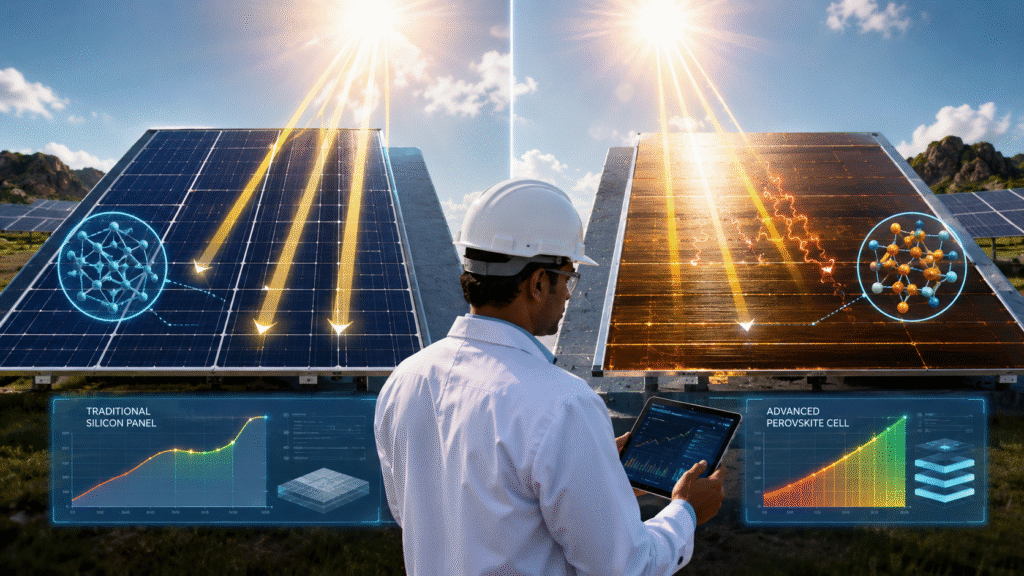
Perovskite solar cells are a new generation of photovoltaic (PV) technology that uses a special class of light-absorbing materials known as perovskites.
The term “perovskite” refers to a specific crystal structure that can efficiently absorb sunlight and convert it into electricity.
Unlike traditional solar panels that rely primarily on silicon wafers, perovskite cells use advanced materials that can be manufactured using potentially simpler and lower-cost processes.
In Simple Terms
Traditional solar panels use silicon to capture sunlight.
Perovskite solar cells use a different material structure that may capture sunlight more efficiently while reducing manufacturing complexity.
Why Is the Solar Industry Excited About Perovskites?
The excitement surrounding perovskite technology comes from its rapid efficiency improvements.
Historically, new solar technologies often required decades of development before reaching competitive performance levels.
Perovskite solar cells have progressed much faster.
Researchers have achieved significant efficiency gains within a relatively short period, making them one of the most promising solar innovations currently under development.
How Do Perovskite Solar Cells Work?
Like conventional solar panels, perovskite cells convert sunlight into electricity through the photovoltaic effect.
The Process
- Sunlight strikes the perovskite material.
- The material absorbs light energy.
- Electrons become energized.
- Electrical current is generated.
- The electricity is collected and used by connected systems.
While the principle is similar to traditional solar technology, the materials and manufacturing processes differ significantly.
Key Advantages of Perovskite Solar Cells
Higher Efficiency Potential
One of the biggest advantages is the potential for higher solar conversion efficiency.
Higher efficiency means:
- More electricity generation
- Better use of roof space
- Greater energy output from the same sunlight
This could be particularly valuable for urban buildings where roof space is limited.
Lower Manufacturing Costs
Researchers believe perovskite materials could eventually be manufactured using simpler production methods than conventional silicon cells.
Potential benefits include:
- Reduced production costs
- Faster manufacturing
- Increased accessibility
However, widespread commercial cost advantages have not yet been fully realized.
Lightweight Solar Panels
Perovskite technology may enable thinner and lighter solar modules.
This could create new opportunities for:
- Commercial buildings
- Warehouses
- Lightweight roofing systems
- Portable solar applications
Flexible Solar Applications
Future perovskite modules may be incorporated into:
- Building facades
- Windows
- Curved surfaces
- Vehicles
- Portable electronics
This flexibility could expand solar adoption beyond traditional rooftop installations.
Better Low-Light Performance
Some research suggests perovskite cells may perform effectively under:
- Cloudy conditions
- Diffused sunlight
- Indoor lighting applications
If commercialized successfully, this could improve energy generation in varying environmental conditions.
What Are Tandem Solar Cells?
One of the most exciting developments involves perovskite-silicon tandem solar cells.
Instead of replacing silicon entirely, perovskite layers are combined with traditional silicon cells.
Why This Matters
Different materials absorb different portions of sunlight.
By combining technologies:
- More sunlight can be captured
- Energy conversion efficiency increases
- Existing solar infrastructure can potentially be enhanced
Many experts view tandem technology as the most likely pathway toward commercial adoption.
Challenges Facing Perovskite Solar Cells
Despite impressive progress, several challenges remain before widespread deployment.
Long-Term Durability
Traditional silicon solar panels often last 25 years or more.
Perovskite cells must demonstrate similar long-term reliability before large-scale adoption.
Moisture Sensitivity
Certain perovskite materials can degrade when exposed to:
- Humidity
- Water
- Environmental contaminants
Researchers continue developing solutions to improve stability.
Heat Resistance
High temperatures can affect performance and lifespan.
This is particularly important for regions such as Andhra Pradesh, where solar installations experience prolonged exposure to intense sunlight and summer heat.
Large-Scale Manufacturing
Laboratory success does not automatically translate into mass production.
Manufacturers must demonstrate:
- Consistent quality
- Commercial scalability
- Cost-effective production
before widespread deployment becomes feasible.
Environmental Considerations
Some perovskite formulations contain materials that require careful handling and recycling considerations.
Researchers are actively exploring safer alternatives and improved manufacturing processes.
What Could Perovskite Solar Cells Mean for India?
India is rapidly expanding its renewable energy infrastructure.
Future commercialization of perovskite technology could potentially support:
Higher Rooftop Solar Output
Homes and businesses may generate more electricity from limited roof space.
Improved Commercial Solar Projects
Industries and commercial facilities could potentially achieve higher energy production per square meter.
Better Building-Integrated Solar
Architects may incorporate solar technology directly into building materials.
Accelerated Renewable Energy Adoption
Lower manufacturing costs could increase solar accessibility in emerging markets.
Are Perovskite Solar Panels Available Today?
Perovskite technology is progressing rapidly, but mainstream deployment remains limited.
Currently:
✔ Research and pilot projects are expanding globally.
✔ Manufacturers are developing commercial-scale production methods.
✔ Tandem solar products are approaching commercialization in some markets.
✔ Traditional silicon solar panels remain the dominant technology for most installations.
For homeowners and businesses considering solar today, proven silicon-based solar systems continue to be the most practical and widely available option.
Should Homeowners Wait for Perovskite Solar Panels?
This is a common question among prospective solar buyers.
For most consumers, delaying solar adoption solely to wait for future technologies may result in years of missed energy savings.
Current solar technology already offers:
- Reliable performance
- Long warranties
- Proven durability
- Established installation networks
- Available financing options
Future technologies may eventually offer additional benefits, but today’s solar systems continue delivering value immediately.
The Future of Solar Technology
The solar industry is entering an exciting period of innovation.
Emerging technologies include:
- Perovskite solar cells
- Tandem solar modules
- Bifacial solar panels
- AI-powered energy management
- Smart solar monitoring
- Advanced battery storage systems
Together, these innovations could significantly improve renewable energy performance over the coming decade.
Why Choose VMJ Solar Solutions?
VMJ Solar Solutions stays at the forefront of solar technology developments while delivering proven solar solutions for today’s energy needs.
Our services include:
✔ Residential rooftop solar systems
✔ Commercial solar installations
✔ Industrial solar projects
✔ Solar feasibility assessments
✔ Net metering support
✔ Solar maintenance services
✔ Performance optimization
✔ Renewable energy consulting
We help customers make informed decisions based on current technology while staying prepared for future innovations.
Frequently Asked Questions (FAQs)
1.What are perovskite solar cells?
Perovskite solar cells are next-generation photovoltaic devices that use specialized crystal-structured materials to convert sunlight into electricity.
2.Are perovskite solar cells more efficient than silicon panels?
Research results indicate strong efficiency potential, particularly in tandem configurations. However, commercial performance varies depending on product design and deployment conditions.
3.Are perovskite solar panels available in India?
Commercial availability remains limited, although research and pilot projects continue expanding globally.
4.Why are perovskite solar cells important?
They may offer higher efficiency, lower manufacturing costs, lighter panels, and new solar applications in the future.
5.What is a tandem solar cell?
A tandem solar cell combines perovskite and silicon technologies to capture a broader range of sunlight and improve efficiency.
6.Do perovskite solar cells last as long as silicon panels?
Long-term durability remains one of the primary challenges researchers are working to improve.
7.Should I wait for perovskite technology before installing solar?
For most consumers, current solar systems already provide substantial benefits. Future technologies should be viewed as potential enhancements rather than reasons to postpone proven solutions.
8.Can perovskite technology help India’s renewable energy goals?
Potentially yes. Higher efficiency and lower production costs could support wider solar adoption and increased clean energy generation in the future.
Final Thoughts
Perovskite solar cells represent one of the most exciting developments in renewable energy technology today. Their potential to improve efficiency, reduce manufacturing costs, and enable new solar applications has attracted significant attention from researchers, manufacturers, and investors worldwide.
While challenges related to durability, scalability, and commercialization still need to be addressed, the technology could play a major role in the future of solar energy.
For homeowners, businesses, and industries across Andhra Pradesh, the key takeaway is that solar technology continues to evolve rapidly. While proven silicon-based systems remain the practical choice today, perovskite innovations may help shape the next generation of high-performance solar solutions.