
Which Solar Battery Is the Better Long-Term Investment?
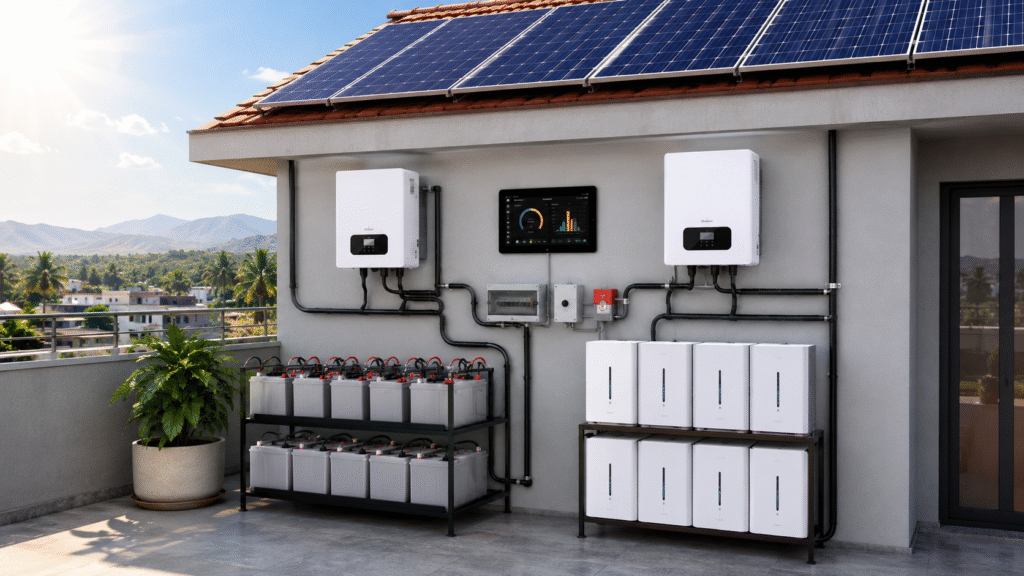
As rooftop solar adoption continues to grow across Andhra Pradesh, more homeowners, businesses, industries, schools, and agricultural facilities are adding Battery Energy Storage Systems (BESS) to improve energy independence and ensure backup power during outages.
While solar panels generate electricity during daylight hours, batteries store excess energy for later use, making them an essential component of many hybrid and off-grid solar systems.
However, one of the most common questions customers ask is:
“Which battery lasts longer—Lead-Acid or Lithium-Ion?”
The answer depends on several factors, including battery chemistry, charging habits, operating temperature, maintenance, and usage patterns.
At VMJ Solar Solutions, we help customers choose the right battery technology based on their energy requirements, budget, and long-term return on investment rather than simply focusing on the lowest upfront cost.
What Is a Battery Energy Storage System (BESS)?
A Battery Energy Storage System (BESS) stores electricity generated by solar panels or supplied by the grid for later use.
Instead of wasting excess solar energy during the day, the battery stores it for:
- Nighttime electricity use
- Power outages
- Peak electricity demand
- Off-grid operation
- Backup power for essential appliances
BESS plays an increasingly important role in modern renewable energy systems.
Why Battery Lifespan Matters
Unlike solar panels, which often operate for 25–30 years or more, batteries have shorter service lives.
Battery lifespan directly affects:
- Long-term operating costs
- Maintenance expenses
- System reliability
- Replacement planning
- Overall return on investment (ROI)
Choosing the right battery technology can significantly influence the total cost of owning a solar system.
Understanding Lead-Acid Batteries
Lead-acid batteries have been used for decades in backup power systems, UPS installations, and off-grid solar projects.
They remain popular because of their relatively lower initial purchase price.
Common Types
- Flooded Lead-Acid
- Sealed Lead-Acid (SLA)
- AGM Batteries
- Gel Batteries
Lead-acid batteries continue to serve many applications, especially where budgets are limited.
Understanding Lithium-Ion Batteries
Lithium-ion batteries have become the preferred choice for many modern solar energy storage systems.
They are widely used in:
- Residential solar systems
- Commercial buildings
- Electric vehicles
- Industrial energy storage
- Smart homes
One of the most common chemistries used for stationary solar storage is Lithium Iron Phosphate (LiFePO₄ or LFP) because of its safety, long cycle life, and thermal stability.
What Determines Battery Lifespan?
Several factors affect how long a battery lasts.
Charge and Discharge Cycles
Every time a battery is charged and discharged, it completes one cycle.
Most batteries are rated by the number of cycles they can deliver before capacity declines significantly.
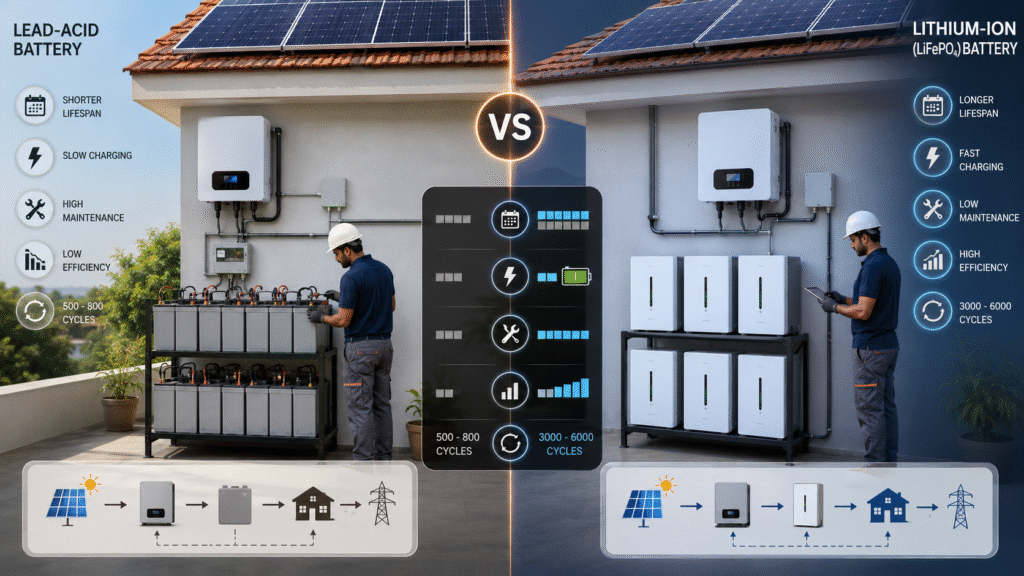
Lithium-ion batteries generally support substantially more charge-discharge cycles than traditional lead-acid batteries.
Depth of Discharge (DoD)
Depth of Discharge refers to how much of the battery’s stored energy is used before recharging.
For example:
- Using 20% of stored energy = shallow discharge
- Using 80% = deeper discharge
Lithium-ion batteries typically tolerate deeper discharge levels better than lead-acid batteries, allowing more usable energy from the same rated capacity.
Operating Temperature
High temperatures accelerate battery aging.
This is especially important in Andhra Pradesh, where summer temperatures can exceed 40°C.
Proper ventilation and battery placement help improve lifespan.
Charging Practices
Using compatible solar charge controllers and inverters helps protect batteries from:
- Overcharging
- Deep discharge
- Excessive charging current
Smart battery management systems (BMS) are especially important for lithium-ion batteries.
Lifespan Comparison
Lead-Acid Batteries
Lead-acid batteries generally provide a shorter operational lifespan and may require replacement sooner, depending on usage and maintenance.
Performance gradually declines over time as charge cycles accumulate.
Lithium-Ion Batteries
Lithium-ion batteries are designed for significantly longer service life.
They typically retain usable capacity over many more charge cycles, making them attractive for long-term solar energy storage.
Maintenance Comparison
Lead-Acid
Some lead-acid batteries require:
- Water level checks
- Terminal cleaning
- Corrosion inspection
- Ventilation monitoring
Sealed models reduce maintenance but still require periodic inspection.
Lithium-Ion
Most lithium-ion batteries require minimal routine maintenance.
Integrated Battery Management Systems automatically monitor:
- Voltage
- Temperature
- Charging
- Cell balancing
- Protection functions
Efficiency Comparison
Battery efficiency affects how much stored electricity is actually available for use.
Lead-Acid
Some energy is lost during charging and discharging.
Lithium-Ion
Lithium-ion batteries generally offer higher round-trip efficiency, allowing more stored solar energy to be used by the home or business.
Safety Considerations
Both battery technologies can be safe when installed correctly.
Lead-Acid
Require proper ventilation because certain types may release gases during charging.
Lithium-Ion
Modern LiFePO₄ batteries include advanced safety systems and are widely recognized for improved thermal stability compared with some other lithium chemistries.
Professional installation remains essential for all battery systems.
Which Battery Is Better for Different Applications?
Residential Rooftop Solar
Lithium-ion batteries are often preferred because of:
- Longer lifespan
- Compact size
- Lower maintenance
- Higher usable capacity
Commercial Buildings
Businesses often choose lithium-ion systems for their long-term operational efficiency and reduced maintenance.
Industrial Applications
Large Battery Energy Storage Systems increasingly use lithium-ion technology because of scalability and performance.
Budget-Conscious Off-Grid Systems
Lead-acid batteries may still be considered where minimizing upfront investment is the primary objective.
Total Cost of Ownership
Many buyers compare only purchase price.
However, the Total Cost of Ownership (TCO) includes:
- Initial purchase
- Installation
- Maintenance
- Energy efficiency
- Replacement frequency
- Operational lifespan
Although lithium-ion batteries usually cost more initially, their longer lifespan and lower maintenance often make them more economical over the lifetime of a solar system.
Battery Trends in Andhra Pradesh
As renewable energy adoption expands across:
- Homes
- Apartments
- Schools
- Hospitals
- Warehouses
- Factories
- Agricultural farms
there is increasing demand for advanced battery storage systems.
Many new hybrid solar installations now incorporate lithium-ion battery technology due to its performance and reliability.
Tips to Extend Battery Lifespan
✔ Install batteries in a cool, well-ventilated location.
✔ Use high-quality hybrid inverters and charge controllers.
✔ Avoid repeated deep discharge beyond manufacturer recommendations.
✔ Monitor battery health regularly.
✔ Choose batteries from reputable manufacturers.
✔ Schedule periodic system inspections.
Why Choose VMJ Solar Solutions?
VMJ Solar Solutions provides customized battery storage solutions designed for Indian operating conditions.
Our services include:
✔ Residential hybrid solar systems
✔ Commercial Battery Energy Storage Systems (BESS)
✔ Industrial energy storage solutions
✔ Lithium-ion battery installation
✔ Solar system design
✔ Battery health monitoring
✔ Solar maintenance
✔ Performance optimization
We help customers select battery technologies that balance performance, reliability, and long-term value.
Frequently Asked Questions (FAQs)
1.Which battery lasts longer: Lead-Acid or Lithium-Ion?
Lithium-ion batteries generally have a longer operational lifespan and support more charge-discharge cycles than lead-acid batteries.
2.Are lithium-ion batteries worth the higher cost?
For many residential and commercial solar systems, the longer lifespan, higher efficiency, and reduced maintenance can provide better long-term value.
3.Can lead-acid batteries still be used for solar?
Yes. Lead-acid batteries remain suitable for many applications, particularly where lower upfront cost is a priority.
4.Which battery is best for rooftop solar in Andhra Pradesh?
Many modern hybrid solar installations use Lithium Iron Phosphate (LiFePO₄) batteries because of their durability, efficiency, and thermal stability.
5.Do batteries require maintenance?
Lead-acid batteries may require periodic maintenance depending on the type, while lithium-ion batteries generally require much less routine attention.
Final Thoughts
Battery Energy Storage Systems are becoming an increasingly important part of modern solar installations. While both Lead-Acid and Lithium-Ion batteries have their place, the best choice depends on your energy needs, budget, and long-term objectives.
For most homeowners and businesses in Andhra Pradesh, Lithium-Ion (especially LiFePO₄) batteries offer significant advantages in terms of lifespan, efficiency, maintenance, and overall value. However, lead-acid batteries remain a practical solution for certain budget-sensitive or specialized applications.
By selecting the right battery technology and working with experienced solar professionals, you can maximize the performance, reliability, and return on investment of your solar energy system for years to come.