
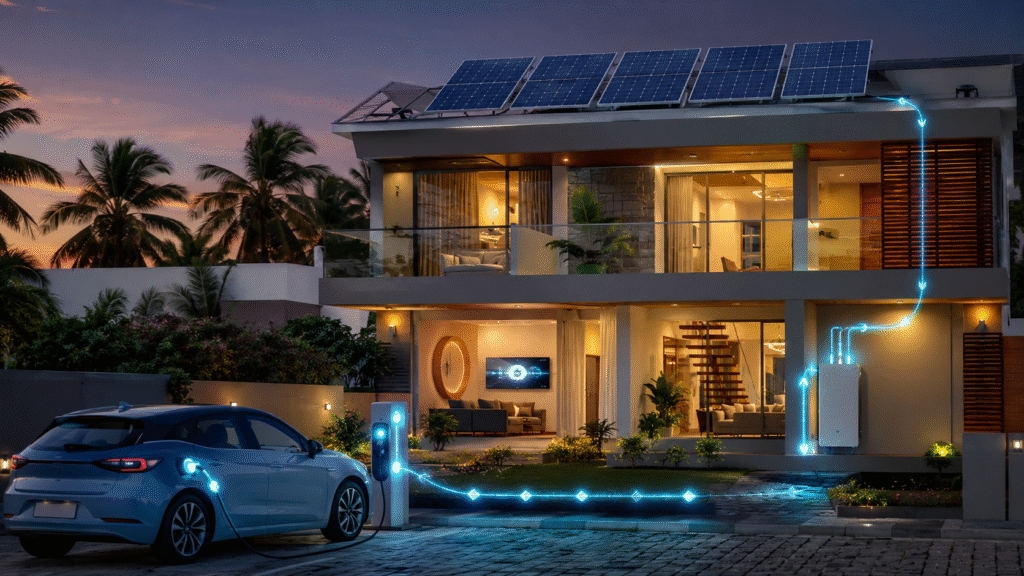
How Your Electric Vehicle Could Become a Home Energy Backup System
Electric vehicles (EVs) are transforming transportation across the world. In India, increasing fuel prices, government incentives, and growing environmental awareness are encouraging more homeowners and businesses to consider electric mobility.
At the same time, rooftop solar systems are becoming increasingly common across Andhra Pradesh, helping households and commercial properties generate clean electricity while reducing dependence on the utility grid.
But what if your electric vehicle could do more than just transport you?
Imagine using your EV’s battery to power your lights, fans, refrigerator, internet router, or even your entire home during a power outage.
This is exactly what Vehicle-to-Home (V2H) technology is designed to do.
Although V2H is still an emerging technology in India, it represents one of the most exciting developments in the future of renewable energy, smart homes, and electric mobility.
At VMJ Solar Solutions, we believe understanding future-ready technologies helps homeowners and businesses prepare for the next generation of sustainable energy systems.
What Is Vehicle-to-Home (V2H) Technology?
Vehicle-to-Home (V2H) is a technology that allows an electric vehicle’s battery to supply electricity back to a home when needed.
Normally:
Electricity flows:
Grid → Home → EV
With V2H:
Electricity can also flow:
EV Battery → Home
Instead of serving only as transportation, the EV becomes a temporary energy storage system.
How Does V2H Work?
A V2H system typically consists of:
- Electric vehicle
- Bi-directional EV charger
- Home electrical panel
- Smart energy management system
- Optional rooftop solar system
- Utility grid connection
The system intelligently manages electricity flow depending on:
- Solar generation
- Home electricity demand
- EV battery charge level
- Grid availability
What Is a Bi-Directional Charger?
A standard EV charger only sends electricity to the vehicle.
A bi-directional charger allows electricity to move in both directions:
✔ Charge the EV battery
✔ Supply electricity back to the home
This two-way power flow is the foundation of V2H technology.
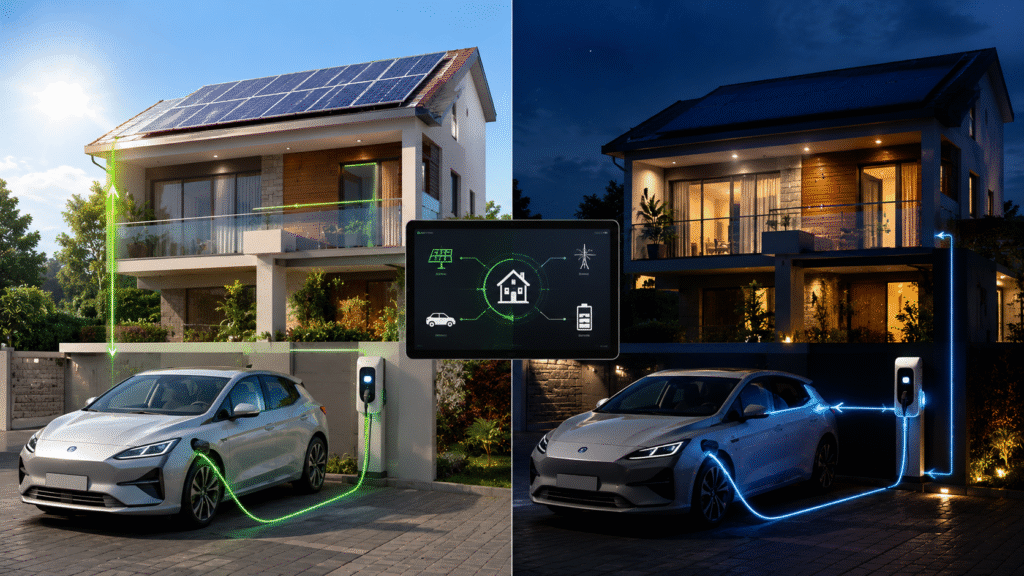
How V2H Works with Rooftop Solar
One of the biggest advantages of V2H is its compatibility with rooftop solar.
During the day:
- Solar panels generate electricity.
- The home uses the required power.
- Excess solar energy can charge the EV battery (depending on system design).
At night or during outages:
The stored energy in the EV battery can help power selected household loads.
This creates a more flexible renewable energy ecosystem.
Benefits of Vehicle-to-Home Technology
Backup Power During Outages
Instead of relying solely on diesel generators or dedicated home batteries, the EV battery may provide temporary backup power during grid interruptions—provided the vehicle and charging equipment support V2H functionality.
Better Utilization of Solar Energy
Solar electricity generated during the day can potentially be stored in the EV battery for later use.
This may improve self-consumption of rooftop solar generation.
Reduced Dependence on the Grid
V2H can help households use more of their own renewable energy rather than drawing electricity from the grid during certain periods.
Supports Smart Energy Management
Future smart homes may automatically determine:
- When to charge the EV
- When to use solar power
- When to draw from the grid
- When to discharge the EV battery
Lower Need for Separate Battery Storage
In some situations, an EV battery could supplement or reduce the need for a dedicated home battery system, although suitability depends on usage patterns and system design.
V2H vs Vehicle-to-Grid (V2G)
Many people confuse these technologies.
Vehicle-to-Home (V2H)
Electricity flows:
EV → Home
The stored energy is used within the property.
Vehicle-to-Grid (V2G)
Electricity flows:
EV → Utility Grid
The vehicle can potentially supply electricity back to the electricity network where regulations, infrastructure, and compatible equipment allow.
V2G remains at an earlier stage of adoption in India.
Is V2H Available in India?
At present, V2H technology is not yet widely available for mainstream residential use in India.
Several factors are still evolving:
- Compatible EV models
- Bi-directional charging infrastructure
- Grid regulations
- Utility standards
- Consumer demand
However, global manufacturers and researchers continue developing V2H-capable vehicles and charging systems.
As India’s EV market expands, V2H may become increasingly accessible in the coming years.
Why Andhra Pradesh Could Benefit from V2H
Andhra Pradesh offers strong potential because of:
- High rooftop solar adoption
- Growing EV ownership
- Abundant solar resources
- Smart city initiatives
- Commercial renewable energy investments
In the future, homeowners with rooftop solar and EVs could potentially create highly efficient home energy ecosystems.
Potential Applications
Residential Homes
Backup power for essential household appliances.
Commercial Buildings
Support for critical loads during temporary power interruptions.
Schools
Emergency electricity for classrooms and digital infrastructure.
Healthcare Facilities
Backup for essential medical equipment in smaller clinics.
Farms
Power for irrigation controllers, lighting, and communication systems during outages.
Challenges of V2H Technology
Limited Vehicle Compatibility
Only certain EVs globally support bi-directional charging today.
Specialized Charging Equipment
V2H requires compatible bi-directional chargers.
Higher Initial Costs
Advanced charging infrastructure adds to system costs.
Battery Usage Considerations
Frequent charging and discharging may influence battery usage over time. Manufacturers design batteries for long service life, but operating patterns can affect longevity.
Regulatory Development
Standards governing V2H and V2G continue to evolve in many countries, including India.
Is V2H Better Than a Home Battery?
It depends on your needs.
Choose V2H If:
- You already own a compatible electric vehicle.
- You want to integrate transportation and home energy.
- You value flexible energy storage.
Choose a Home Battery If:
- You require dedicated stationary backup.
- Your vehicle is often away from home.
- You need uninterrupted backup regardless of EV availability.
In many future homes, both technologies may complement each other.
The Future of V2H in India
As EV adoption accelerates, experts expect growing interest in:
- Smart charging
- Bi-directional charging
- Home energy management systems
- Solar-powered EV charging
- AI-driven energy optimization
- Vehicle-to-home integration
These technologies may significantly reshape residential energy management over the next decade.
Why Choose VMJ Solar Solutions?
VMJ Solar Solutions stays informed about emerging renewable energy technologies while delivering reliable solar solutions available today.
Our services include:
✔ Residential rooftop solar
✔ Commercial solar systems
✔ Industrial solar installations
✔ Hybrid solar solutions
✔ Solar battery systems
✔ EV charging consultation
✔ Net metering assistance
✔ Renewable energy advisory
We help customers build future-ready energy systems that balance today’s needs with tomorrow’s innovations.
Frequently Asked Questions (FAQs)
1.What is Vehicle-to-Home (V2H)?
V2H is a technology that allows a compatible electric vehicle to supply stored battery power to a home through a bi-directional charger.
2.Can every electric vehicle power a home?
No. Only EVs specifically designed to support bi-directional charging can be used for V2H applications.
3.Is V2H available in India?
V2H is still in the early stages of development and is not yet widely available for residential use in India.
4.Can rooftop solar work with V2H?
Yes. A rooftop solar system can potentially charge a compatible EV during the day, allowing stored energy to be used later by the home.
5.Is V2H the same as Vehicle-to-Grid (V2G)?
No. V2H supplies electricity to a home, while V2G exports electricity back to the utility grid where regulations and infrastructure permit.
6.Can V2H replace a home battery?
In some situations, a compatible EV battery may supplement or reduce the need for dedicated home battery storage, depending on household energy requirements.
7.Does V2H work during power outages?
If the vehicle, charger, and home electrical system are designed to support backup operation, V2H can provide temporary household power during outages.
8.Is V2H suitable for Andhra Pradesh?
As EV infrastructure and rooftop solar adoption continue to expand, V2H could become an attractive future energy solution for homes and businesses across Andhra Pradesh.
Final Thoughts
Vehicle-to-Home (V2H) technology represents the next step in integrating renewable energy, electric vehicles, and smart homes. Instead of viewing an electric vehicle solely as transportation, V2H transforms it into a flexible energy storage resource capable of supporting household electricity needs.
Although the technology is still emerging in India, its long-term potential is significant—especially when combined with rooftop solar systems. As compatible EVs, bi-directional chargers, and smart energy management systems become more widely available, V2H could play a major role in improving energy resilience, maximizing solar utilization, and reducing dependence on conventional electricity.
For homeowners and businesses in Andhra Pradesh, investing in rooftop solar today provides a strong foundation for adopting future innovations like V2H as the technology matures.