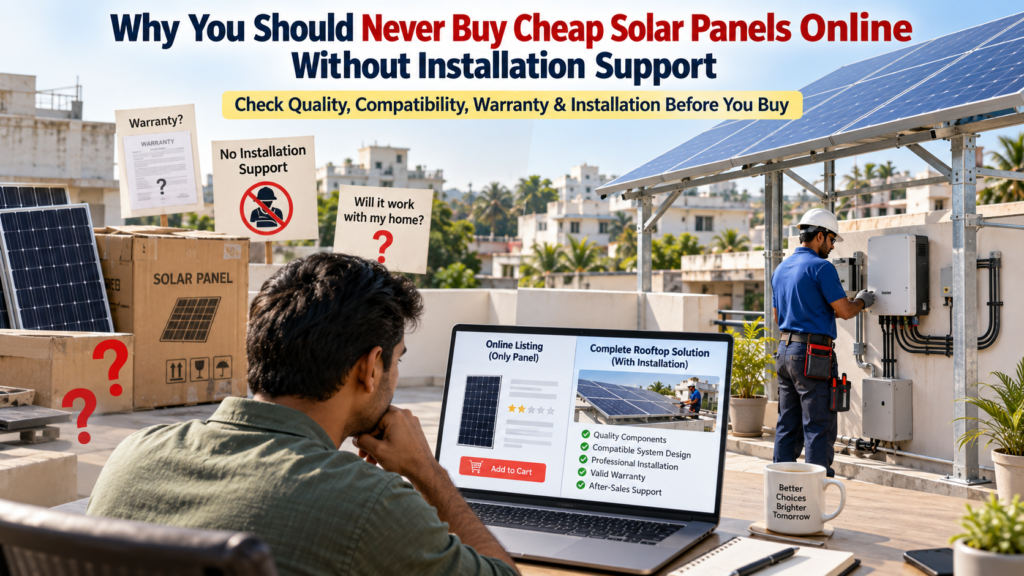
Buying Solar panels online can look attractive when the listed price is significantly lower than a complete rooftop Solar quotation. But Solar is not simply a product that you purchase, unpack and connect.
A rooftop Solar system involves panel selection, inverter compatibility, structural design, electrical protection, installation, earthing, commissioning, monitoring, documentation and after-sales support.
A cheap Solar panel may not necessarily be a poor-quality product. The bigger concern is buying a panel or Solar component without understanding whether it is suitable for your system, roof, electrical configuration and long-term service requirements.
For homeowners in India, especially those planning rooftop Solar in West Godavari, Tadepalligudem and other parts of Andhra Pradesh, comparing the complete Solar solution is usually more useful than comparing only the online panel price.
Quick Answer: Why Should You Be Careful With Cheap Solar Panels Online?
The main problem with buying cheap Solar panels without installation support is that the lowest product price may not represent the lowest total Solar system cost.
You may still need to arrange:
- Professional installation
- Mounting structures
- DC and AC cables
- Connectors and protection devices
- Earthing and lightning/overvoltage protection
- Inverter compatibility
- Roof assessment
- Net-metering-related work, where applicable
- Testing and commissioning
- Monitoring setup
- Warranty documentation
- Future troubleshooting and maintenance
If these requirements are not properly planned, the initial saving could be reduced by additional installation, compatibility or maintenance costs.
1. A Solar Panel Is Only One Part of a Solar System
One of the biggest mistakes first-time Solar buyers make is treating the panel as the entire Solar system.
A typical rooftop Solar installation may include:
Solar Panels → DC Cables → Protection Devices → Inverter → AC Protection → Meter/Grid Connection → Home Loads
It may also require:
- Mounting structures
- Earthing
- Surge protection
- Isolators
- Junction boxes or other electrical equipment
- Monitoring equipment
- Proper cable routing
- Structural fasteners
- Installation accessories
Therefore, a low online panel price should be compared with the complete installed system cost, not just the price printed next to a product listing.
2. The Cheapest Panel May Not Be the Right Panel for Your System
Solar panels come in different technologies, power ratings, dimensions, electrical characteristics and mechanical configurations.
Two panels can both be advertised as, for example, 550W modules while having different:
- Voltage characteristics
- Current characteristics
- Dimensions
- Connector specifications
- Temperature coefficients
- Mechanical load ratings
- Warranty conditions
- Compatibility requirements
The panel also needs to work appropriately with the selected inverter and system design.
A professional Solar installer can assess the complete system rather than selecting a panel only because it has a lower price or higher wattage number.
3. Inverter Compatibility Matters
Your Solar panels and inverter need to work together correctly.
The installer may need to consider parameters such as:
- Maximum DC input voltage
- MPPT voltage range
- Maximum input current
- Number of MPPTs
- String configuration
- Number of panels per string
- Roof orientation
- Shading
- Temperature conditions
Simply connecting panels because their wattage appears compatible can be an inadequate approach.
A professionally designed Solar system considers the electrical characteristics of the complete array and inverter.
4. Installation Quality Can Affect Safety and Performance
Even a high-quality Solar panel can become part of a poorly performing system if installation is not done correctly.
The installation process may involve:
- Correct panel positioning
- Proper mounting
- Structural fastening
- Cable management
- Connector installation
- Earthing
- Protection devices
- Inverter installation
- AC/DC isolation
- Testing and commissioning
The Central Electricity Authority maintains regulations relating to electrical safety, including the Central Electricity Authority (Measures relating to Safety and Electric Supply) Regulations. The CEA’s current regulatory listings also include a 2026 amendment.
This is one reason rooftop Solar should be approached as an electrical installation rather than simply an online hardware purchase.
5. Roof Structure and Mounting Cannot Be Ignored
Before installation, the roof itself needs to be considered.
The installer may need to evaluate:
- RCC roof or sheet roof
- Available roof area
- Roof condition
- Shading
- Panel orientation
- Tilt requirements
- Access for maintenance
- Mounting method
- Wind exposure
- Waterproofing considerations
- Cable routing
For sheet-roof installations, for example, the mounting method and fixing arrangement can be particularly important.
A cheap panel purchased online does not automatically solve any of these installation requirements.
6. Warranty Is More Than the Number of Years
Online Solar listings often highlight warranty periods prominently.
But buyers should ask:
What exactly does the warranty cover?
Solar warranties can involve different categories, including:
Product Warranty
This generally relates to manufacturing or material defects under the manufacturer’s terms.
Performance Warranty
This relates to the panel’s expected power output over time according to the manufacturer’s specified conditions.
Installation Warranty
This may cover workmanship provided by the installer.
These are not necessarily the same thing.
A long panel warranty does not automatically mean that installation, transportation, labour, removal, reinstallation or other costs will be covered.
Before buying, read the actual warranty terms and understand who will handle a claim.
7. Who Will Help If the Panel Develops a Problem?
This is one of the biggest disadvantages of buying Solar equipment without installation support.
Imagine that your system produces less electricity than expected.
The problem could potentially be related to:
- Panel performance
- Shading
- Soiling
- Connector problems
- Cable losses
- Inverter settings
- Inverter faults
- String configuration
- Protection equipment
- Monitoring problems
- Installation issues
If you bought only a panel online, the seller may be responsible for the product, while someone else may be responsible for installation.
This can create a “who is responsible?” problem.
With a properly managed installation, there is usually a clearer point of contact for troubleshooting.
8. Shipping and Handling Can Also Matter
Solar modules are large and relatively delicate electrical products.
When purchasing online, consider:
- Packaging quality
- Transport conditions
- Delivery damage
- Inspection at delivery
- Replacement process
- Return conditions
- Shipping charges
- Storage before installation
A damaged module may not always show obvious external damage immediately.
Therefore, buyers should understand the seller’s procedure for reporting transportation damage before accepting the product.
9. A Low Panel Price Does Not Include the Complete Installation Cost
This is where many price comparisons become misleading.
Suppose an online listing shows an attractive price for a Solar panel.
You may still need to purchase:
| Requirement | May Be Needed? |
|---|---|
| Solar panels | Yes |
| Inverter | Yes |
| Mounting structure | Usually |
| DC cables | Usually |
| AC cables | Usually |
| DC/AC protection | Usually |
| Earthing | Depending on system/site |
| Surge protection | Depending on design |
| Installation labour | Yes |
| Commissioning | Yes |
| Monitoring setup | Depending on inverter |
| Net-metering support | Depending on connection |
| Maintenance/service | Recommended |
The actual comparison should therefore be:
Online Panel Price + Accessories + Installation + Electrical Work + Commissioning + Future Support
versus
Complete Professionally Installed Solar System Price
The second number can provide a more meaningful basis for comparison.
10. Net Metering and Grid Connection Can Require More Than a Panel
If your goal is a grid-connected rooftop Solar system, buying a panel alone does not complete the process.
Depending on the project and applicable regulations, the system may involve:
- DISCOM procedures
- Application or registration
- Technical requirements
- Metering
- Inspection
- Commissioning
- Required documentation
MNRE’s rooftop Solar programme describes installation and verification through empanelled vendors for applicable subsidy mechanisms.
For Andhra Pradesh consumers, the applicable DISCOM and current state-level procedures should be checked before purchasing equipment.
This is particularly important if your objective is not simply to own Solar panels but to install a functioning rooftop Solar system connected to the grid.
11. Subsidy Eligibility Should Be Checked Before You Buy
If you are purchasing Solar for a residential project and expect to use a government subsidy or CFA, do not assume that any Solar panel purchased online will automatically qualify.
The applicable scheme can have requirements relating to:
- Vendor eligibility
- Equipment
- Installation
- Documentation
- Verification
- DISCOM processes
- Portal procedures
MNRE states that applicable residential rooftop Solar CFA under its programme is linked to successful installation by empanelled vendors and verification by the relevant DISCOM under the specified mechanism.
Therefore, if subsidy eligibility matters to you, verify the current rules before purchasing the equipment.
12. ALMM and Other Compliance Requirements Matter
For certain categories of Solar projects, including applicable government schemes and net-metering projects, MNRE’s Approved List of Models and Manufacturers (ALMM) requirements can be relevant.
MNRE states that only models and manufacturers included in ALMM List-I are eligible for use in specified government projects, government-assisted projects, government schemes/programmes, open-access and net-metering projects in India.
This does not mean every Solar panel sold online is automatically unusable.
It means you should determine whether the specific project you are planning has applicable compliance requirements before purchasing the module.
13. Cheap Panels Can Create a Bigger Problem When the Installer Is Separate
Buying a panel from one company and hiring a local electrician or installer separately can work in some situations.
However, responsibilities should be clearly defined.
For example:
Panel Seller: Product warranty
Inverter Seller: Inverter warranty
Installer: Installation workmanship
Electrician: Electrical modifications
DISCOM: Grid-side processes
This can become complicated when a system develops a fault.
A complete Solar provider may be able to coordinate these different components more efficiently.
14. Monitoring and Troubleshooting Are Becoming More Important
Modern rooftop Solar systems increasingly use digital monitoring to track generation and system status.
MNRE published a notice in August 2026 concerning compliance with guidelines relating to inverter-level generation data and storage of inverter-level data for rooftop Solar systems.
For homeowners, monitoring can help identify changes in system behaviour.
For example, if generation suddenly falls, the installer may investigate:
- Shading
- Panel soiling
- Inverter alarms
- String issues
- Communication problems
- Electrical faults
- Environmental conditions
A product-only purchase does not automatically provide this level of system support.
15. Local Installation Support Can Be Valuable
Solar is a long-term investment.
If you are installing a system in Tadepalligudem, West Godavari or elsewhere in Andhra Pradesh, local service availability can be an important consideration.
Ask:
- Where is the service team located?
- How quickly can they respond?
- Who will handle warranty claims?
- Is preventive maintenance available?
- Can they troubleshoot inverter and panel issues?
- Can they provide monitoring support?
- Will they support the system after installation?
- Is there a documented installation warranty?
A slightly higher initial price may be worth considering if it provides clearer long-term support.
16. What Should You Check Before Buying Solar Panels Online?
If you are still considering an online purchase, use this checklist.
1. Check the manufacturer
Verify the actual manufacturer and model rather than relying only on the marketplace listing.
2. Check the exact panel specifications
Review:
- Rated power
- Voltage
- Current
- Dimensions
- Temperature coefficient
- Module technology
- Mechanical specifications
3. Read the warranty
Do not rely only on “25-year warranty” or “30-year warranty” written in the product title.
Read the actual warranty document.
4. Confirm inverter compatibility
Ask a qualified installer to check the panel and inverter configuration.
5. Check compliance requirements
Determine whether ALMM, DCR or other project-specific requirements apply.
6. Calculate complete installation cost
Include structures, cables, protection equipment, labour and commissioning.
7. Confirm who provides after-sales support
Get the answer in writing if possible.
8. Check delivery and damage policies
Understand what happens if the panel arrives damaged.
9. Check subsidy eligibility before purchase
Do not purchase first and investigate subsidy requirements later.
10. Compare complete Solar quotations
Compare system-to-system, not only panel-to-panel.
17. Red Flags When Buying Cheap Solar Panels Online
Be cautious if a listing:
- Does not clearly identify the manufacturer
- Does not provide a proper datasheet
- Makes unrealistic generation claims
- Has unclear warranty terms
- Has no clear service contact
- Avoids providing model numbers
- Does not explain compatibility
- Offers an unusually low price without explaining what is excluded
- Cannot provide proper invoices
- Does not clarify transportation damage procedures
- Promises guaranteed savings
- Claims that installation is unnecessary
A low price by itself is not proof of poor quality.
The concern is when the low price comes with unclear specifications, unclear warranty, unclear responsibility and no installation support.
18. What Is a Better Way to Buy Solar?
Instead of asking:
“Where can I get the cheapest Solar panel?”
Ask:
“Who can provide the right Solar system for my roof, load and long-term requirements?”
A good Solar buying process can look like this:
Step 1: Analyse your electricity consumption
Review your electricity bills and understand your typical monthly and annual usage.
Step 2: Assess the roof
Check available area, shading, orientation and structural considerations.
Step 3: Select the system size
Choose the Solar capacity based on consumption, available roof area, budget and applicable regulations.
Step 4: Select compatible equipment
Compare panels, inverter, mounting structure, cables and protection equipment as a complete system.
Step 5: Review warranty and service
Understand product, performance and installation warranties separately.
Step 6: Compare complete quotations
Look at the total installed price and exactly what is included.
Step 7: Confirm documentation
Keep invoices, datasheets, serial numbers, warranties, installation records and commissioning documents.
Step 8: Plan long-term maintenance
Solar panels may operate for decades, so service and monitoring should be considered from the beginning.
19. Is Buying Solar Panels Online Always a Bad Idea?
No.
Buying Solar equipment online is not automatically wrong.
Online purchasing can be useful when:
- You understand the technical specifications
- You know exactly what model you need
- The seller is reliable
- Warranty terms are clear
- You already have a qualified installer
- Compatibility has been verified
- Project compliance requirements have been checked
- You understand transportation and replacement procedures
The problem is buying a cheap panel first and trying to figure out installation, compatibility and warranty later.
For a complete rooftop Solar project, system design and installation support can be just as important as the panel itself.
20. Why Professional Solar Installation Can Be Worth the Extra Cost
A professional installation can bring several practical advantages:
Better System Design
The installer can consider your electricity consumption, roof conditions, shading and equipment compatibility.
Safer Installation
Electrical protection, cable routing, earthing and other safety-related requirements can be addressed as part of the system design.
Easier Warranty Coordination
A single point of contact can simplify troubleshooting when multiple components are involved.
Proper Commissioning
The system can be tested before being handed over.
Monitoring Setup
The installer can configure available inverter or system monitoring tools.
Long-Term Support
Maintenance and troubleshooting can be easier when the installation company continues to support the system.
The value is therefore not only in the Solar panel.
It is in the complete Solar solution.
VMJ Solar Solutions: Choose the Complete Solar Solution
For homeowners, businesses, farms and other properties considering rooftop Solar in West Godavari and Tadepalligudem, VMJ Solar Solutions can help evaluate the project beyond simply selecting a low-cost panel.
A practical Solar proposal should consider:
- Electricity consumption
- Required system capacity
- Roof area and shading
- Panel and inverter compatibility
- Mounting structure
- Electrical protection
- Installation requirements
- Monitoring
- Applicable DISCOM processes
- Warranty and after-sales support
- Future maintenance
The right Solar system is not necessarily the one with the cheapest panel price.
It is the one that provides an appropriate balance of quality, compatibility, installation, safety, warranty and long-term service.
Frequently Asked Questions
1.Is it safe to buy Solar panels online?
It can be, provided the manufacturer, model, specifications, warranty, compatibility, compliance requirements and installation arrangements are properly verified.
2.Are cheap Solar panels always low quality?
No. A lower price does not automatically mean poor quality. However, buyers should investigate why the price is lower and what is included or excluded from the offer.
3.Can I buy Solar panels online and hire an installer separately?
Yes, this can be possible. However, confirm that the installer accepts the selected panel and that panel, inverter, mounting and electrical components are compatible.
4.Does a Solar panel warranty cover installation?
Not necessarily. Product and performance warranties are generally different from installation or workmanship warranties. Always check the specific terms.
5.Can I get PM Surya Ghar subsidy if I buy Solar panels online?
Do not assume so. Applicable subsidy/CFA procedures can involve eligible vendors, installation and verification requirements. Check the current official scheme requirements before purchasing.
6.What should I check before buying a cheap Solar panel?
Check the manufacturer, model number, datasheet, warranty, electrical specifications, compliance requirements, inverter compatibility, installation cost and after-sales support.
7.Is a complete Solar quotation better than buying panels separately?
For most first-time rooftop Solar buyers, a complete quotation can make comparison easier because it shows the total installed system cost and included services.
8.Do Solar panels need professional installation?
A rooftop Solar system involves electrical equipment, mounting and safety considerations. Professional installation can help ensure proper system design, installation, testing and commissioning.
9.Should I choose Solar based only on panel wattage?
No. Panel wattage is only one specification. System size, efficiency, dimensions, electrical characteristics, inverter compatibility, roof conditions, warranty and total project cost also matter.
Conclusion
Buying Solar panels online can appear to save money, but the cheapest panel price is not necessarily the cheapest Solar solution.
A rooftop Solar system requires much more than panels. It requires suitable equipment, proper design, safe installation, compatible components, documentation, warranty support and long-term service.
Before placing an online order, compare the complete installed system cost, verify the panel and manufacturer, understand warranty conditions, check applicable compliance and subsidy requirements, and confirm who will provide installation and after-sales support.
For a long-term rooftop Solar investment, the goal should not simply be to buy cheap.
The goal should be to buy the right system and install it correctly.
For Solar projects in West Godavari, Tadepalligudem and nearby areas, working with a reliable local Solar installation provider can also make future service, troubleshooting and maintenance more convenient.
Key Takeaway
Don’t compare Solar panels only by online price. Compare the complete package: panel + inverter + installation + safety + warranty + monitoring + service.