
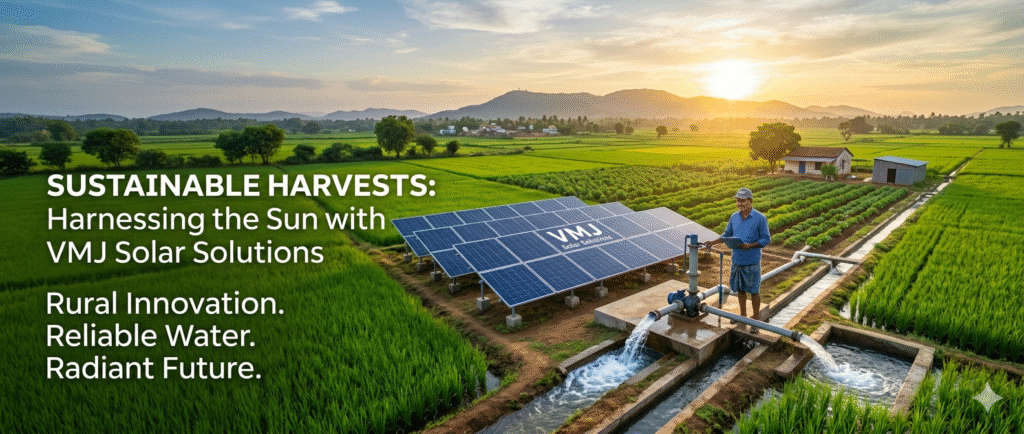
Solar pumping systems can provide a reliable irrigation solution for remote agricultural lands in Andhra Pradesh, especially in areas where grid electricity is unavailable, unreliable, or expensive to extend.
By using solar energy to power water pumps, farmers can:
- Reduce dependence on diesel
- Lower irrigation operating costs
- Improve water accessibility
- Increase farm productivity
- Support sustainable agriculture
However, the effectiveness of a solar pumping system depends on factors such as:
- Water requirements
- Borewell depth
- Pump capacity
- Solar system sizing
- Seasonal irrigation needs
Proper system design is essential for achieving long-term performance and return on investment.
The Irrigation Challenge Facing Remote Farms
For many farmers across Andhra Pradesh, water availability is only part of the challenge.
The bigger issue is often:
Accessing That Water Reliably
Many agricultural lands are located:
- Far from power lines
- In remote villages
- Near borewells without dependable electricity
- In regions with frequent power interruptions
Traditionally, farmers have relied on:
- Diesel-powered pumps
- Grid-connected pumps
- Generator-based systems
Each option has limitations.
Diesel costs continue to fluctuate, generators require maintenance, and electricity supply may not always align with irrigation schedules.
This is why solar pumping systems are gaining attention across Andhra Pradesh.
At VMJ Solar Solutions, farmers increasingly ask:
“Can solar power my irrigation pump and reduce my dependence on diesel or unreliable electricity?”
For many agricultural applications, the answer is yes.
What Is a Solar Water Pumping System?
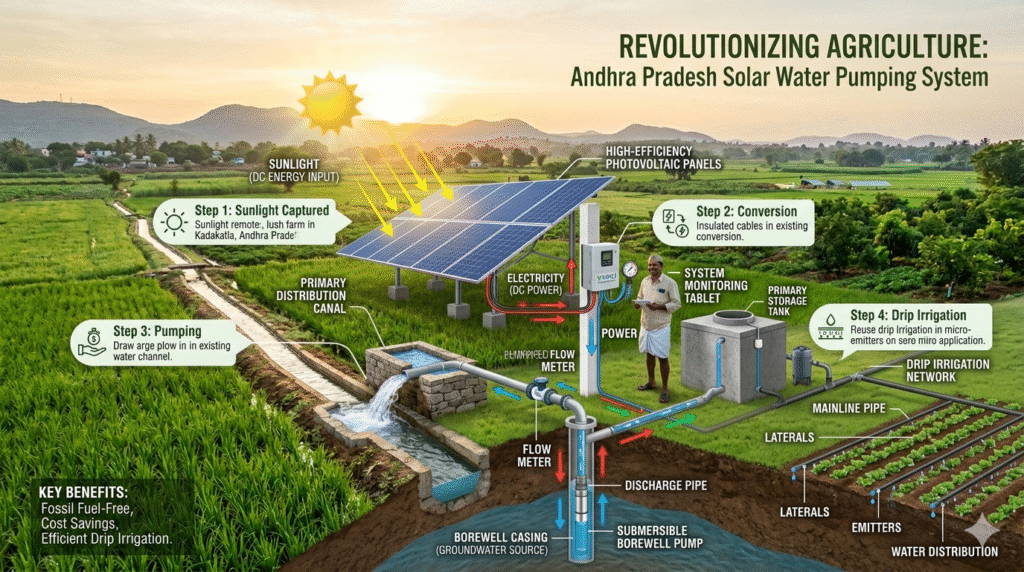
A solar pumping system uses solar panels to generate electricity that powers a water pump.
The system typically includes:
Solar Panels
Generate electricity from sunlight.
Solar Pump Controller
Manages the power supplied to the pump.
Water Pump
Lifts and transports water from:
- Borewells
- Open wells
- Rivers
- Farm ponds
- Reservoirs
Water Storage Infrastructure
Some farms use:
- Overhead tanks
- Ground-level storage tanks
to store water for later irrigation.
How Solar Pumping Works
The process is straightforward:
Sunlight
↓
Solar Panels
↓
Electricity Generation
↓
Pump Controller
↓
Water Pump
↓
Irrigation System
Because the system operates during daylight hours, irrigation often aligns naturally with solar generation.
Why Andhra Pradesh Is Ideal for Solar Pumping
Andhra Pradesh has several characteristics that make solar pumping attractive.
Abundant Sunshine
Most regions receive strong solar irradiation throughout much of the year.
This supports consistent solar generation.
Extensive Agricultural Activity
Major crops include:
- Paddy
- Cotton
- Chilli
- Groundnut
- Maize
- Sugarcane
- Horticultural crops
Many of these require reliable irrigation.
Remote Agricultural Locations
Numerous farms operate in areas where:
- Grid connectivity is limited
- Voltage fluctuations occur
- Diesel transport is inconvenient
Solar pumping can address these challenges.
Benefits of Solar Pumping Systems
1. Reduced Diesel Dependence
Diesel pumps involve recurring expenses such as:
- Fuel purchases
- Transportation costs
- Engine maintenance
Solar systems use sunlight as the energy source.
This can significantly reduce operating costs over time.
2. Lower Long-Term Irrigation Costs
Although solar pumping requires an initial investment, ongoing energy costs are generally much lower than diesel-powered alternatives.
3. Reliable Daytime Operation
Solar systems generate power during daylight hours when many irrigation activities occur.
This can improve scheduling flexibility.
4. Minimal Fuel Logistics
Farmers do not need to:
- Store diesel
- Transport fuel
- Manage fuel shortages
5. Environmentally Sustainable Farming
Solar pumping supports:
- Renewable energy adoption
- Reduced emissions
- Sustainable agricultural practices
Common Applications for Solar Pumps
Borewell Irrigation
One of the most common uses in Andhra Pradesh.
Drip Irrigation Systems
Solar pumps pair well with:
- Drip irrigation
- Precision agriculture
- Water-efficient farming
Sprinkler Systems
Suitable for crops requiring broader water distribution.
Farm Pond Water Transfer
Solar pumps can move water from ponds to irrigation networks.
Livestock Water Supply
Useful for remote cattle and dairy operations.
AC Solar Pumps vs DC Solar Pumps
Farmers may encounter two primary pump categories.
DC Solar Pumps
Operate directly from solar power.
Benefits include:
- Simpler design
- Higher efficiency in some applications
AC Solar Pumps
Use AC motors and may integrate more easily with certain existing pumping infrastructure.
The best choice depends on site-specific requirements.
Can Solar Pumps Work Without Batteries?
Yes
Most agricultural solar pumping systems operate without batteries.
Instead of storing electricity:
Many farms store:
Water
Water storage is often more economical than battery storage for irrigation applications.
This allows water pumped during sunny hours to be used later when needed.
Factors That Influence System Sizing
Every farm is different.
Key considerations include:
Borewell Depth
Deeper wells require more pumping energy.
Daily Water Requirement
Crop irrigation demand varies significantly.
Pump Horsepower
Larger pumps require larger solar arrays.
Seasonal Usage Patterns
Water demand may increase during dry periods.
Available Installation Space
Adequate space is needed for solar panel deployment.
Financial Considerations
Farmers often focus on:
Initial Cost
However, long-term evaluation should also consider:
- Fuel savings
- Maintenance expenses
- Equipment life
- Irrigation reliability
A properly designed system may offer attractive long-term value depending on usage patterns.
Challenges Farmers Should Understand
Seasonal Variations
Cloudy weather can temporarily reduce solar generation.
Water Availability
Solar pumping cannot compensate for insufficient groundwater availability.
Improper System Sizing
Undersized systems may fail to meet irrigation requirements.
Oversized systems may increase costs unnecessarily.
Lack of Professional Design
Every farm has unique:
- Water demand
- Crop profile
- Borewell characteristics
Proper engineering is essential.
Why Water Storage Is Often Better Than Battery Storage
For agricultural applications:
Storing water in:
- Tanks
- Reservoirs
- Elevated storage systems
is often more practical and cost-effective than storing electricity in batteries.
This approach can simplify system design and reduce costs.
Commercial Agriculture and Solar Pumping
Large agricultural operations can use solar pumping for:
- Multiple irrigation zones
- Large borewell systems
- Horticulture farms
- Aquaculture facilities
The scalability of solar pumping makes it suitable for a wide range of agricultural applications.
FAQ’s
1.What is a solar water pumping system?
A solar water pumping system uses solar panels to generate electricity that powers water pumps for irrigation and agricultural use.
2.Can solar pumps work without batteries?
Yes. Most agricultural solar pumping systems operate without batteries and use water storage instead.
3.Are solar pumps suitable for remote farms in Andhra Pradesh?
Yes. They are especially useful where grid electricity is unavailable, unreliable, or expensive to extend.
4.Can solar pumps replace diesel pumps?
In many agricultural applications, solar pumps can significantly reduce or replace diesel usage, depending on water requirements and system design.
5.Can a solar pump run all day?
Solar pumps generally operate during daylight hours, with output depending on sunlight conditions.
6.Do solar pumps work on cloudy days?
Yes, but pumping performance may decrease because solar generation is lower.
7.Is battery storage necessary for agricultural solar pumps?
In many cases, no. Water storage is often a more practical solution.
8.How long do solar pumping systems last?
Quality solar components are designed for long service life when properly maintained
9.Can solar pumps support drip irrigation?
Yes. Solar pumping systems are commonly paired with drip irrigation networks.
10.Are solar pumps suitable for borewells?
Yes, provided the system is properly designed according to borewell depth and water requirements.
Final Thoughts
For farmers operating in remote agricultural regions of Andhra Pradesh, reliable irrigation is critical to productivity and profitability.
Solar pumping systems offer a compelling solution by combining:
✔ Renewable energy
✔ Lower operating costs
✔ Reduced diesel dependence
✔ Improved irrigation reliability
✔ Sustainable farming practices
The key to success lies in proper assessment, accurate system sizing, and professional installation.
For farmers exploring:
- Solar water pumps
- Agricultural solar systems
- Borewell solar pumping
- Drip irrigation solutions
- Remote farm electrification
VMJ Solar Solutions can help design a solar pumping system tailored to your farm’s water requirements, irrigation goals, and long-term operational needs.