
Agriculture in Andhra Pradesh is changing under pressure.
Farmers across districts like West Godavari are facing:
- Rising electricity costs
- Water stress
- Unpredictable weather patterns
- Increasing operational expenses
- Pressure on agricultural income
At the same time, solar energy adoption is expanding rapidly.
Traditionally, farming and solar power competed for land use:
- Land could either grow crops
- Or host solar panels
But agri-voltaics is changing that equation.
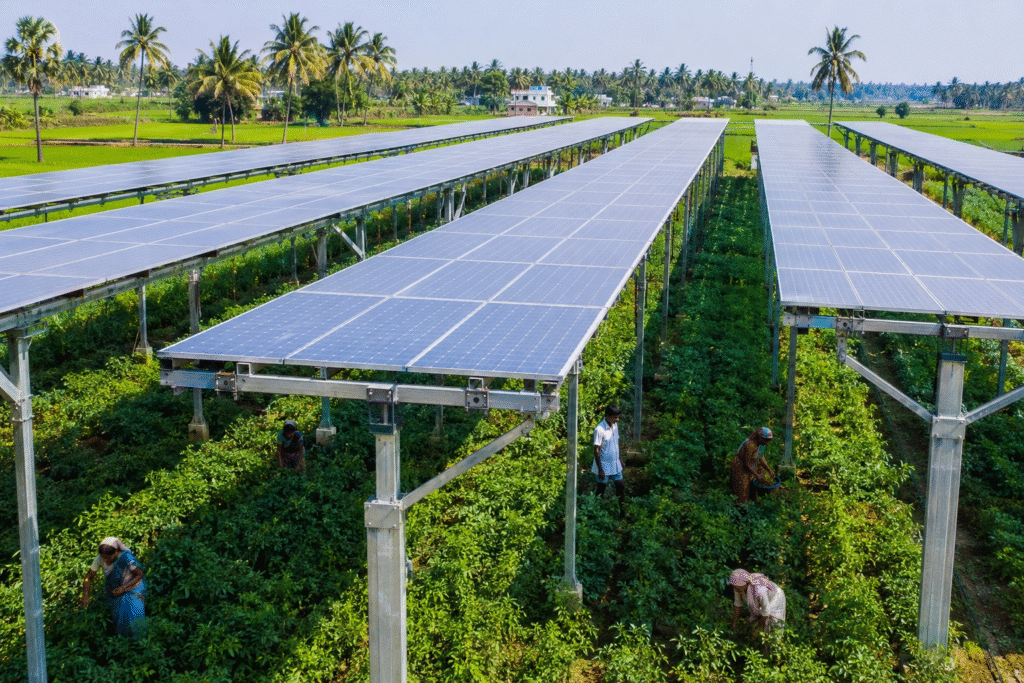
Instead of choosing between farming and solar generation, agri-voltaic systems combine both—allowing crops to grow beneath elevated solar panels.
For farmers in West Godavari, this approach is becoming more than an environmental experiment. It’s emerging as a practical strategy for improving land productivity and income diversification.
For companies like VMJ Solar Solutions, agri-voltaics represents a shift toward smarter agricultural infrastructure—not simply solar installation.
What Is Agri-Voltaics?
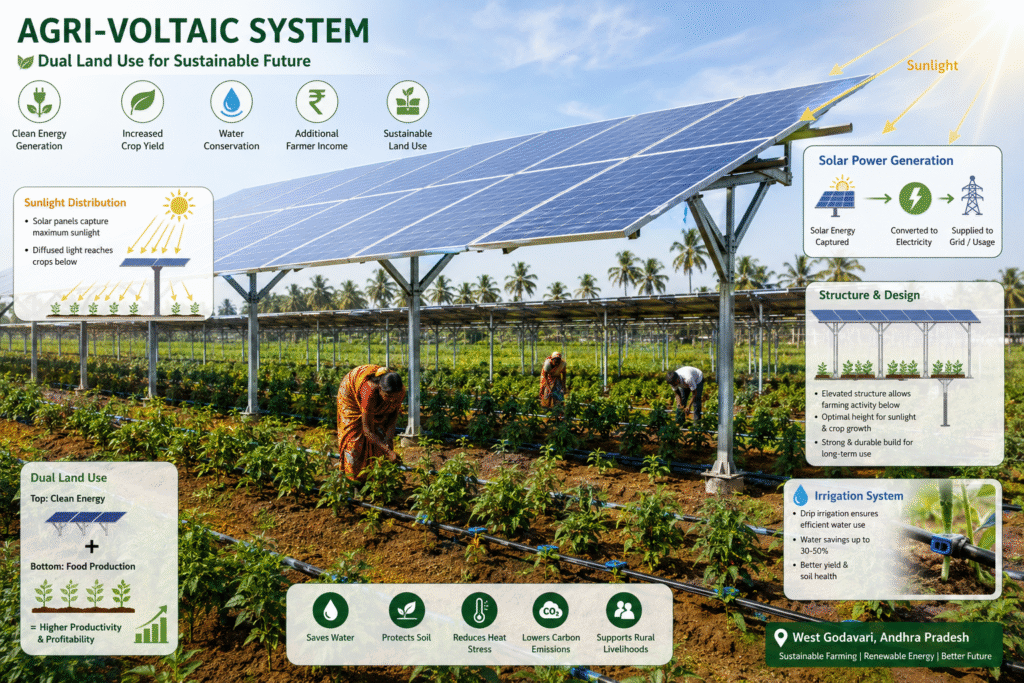
Agri-voltaics (also called agrivoltaics or solar farming integration) refers to systems where:
Solar panels and agriculture operate on the same land simultaneously.
Typically:
- Solar panels are mounted higher than standard systems
- Crops grow underneath or between panel rows
- Farming activity continues alongside power generation
This creates dual land utilization:
- Food production
- Renewable energy generation
from the same agricultural area.
Why Agri-Voltaics Matters in West Godavari
West Godavari is one of Andhra Pradesh’s most agriculturally productive regions.
Major activities include:
- Paddy cultivation
- Horticulture
- Aquaculture
- Vegetable farming
But farmers increasingly face:
- Energy cost pressure
- Climate variability
- Groundwater challenges
- Income instability
Agri-voltaics addresses several of these issues together.
How Agri-Voltaic Systems Work
In a typical setup:
✔ Elevated Solar Structures
Panels are installed higher to allow:
- Sunlight penetration
- Equipment movement
- Farming operations underneath
✔ Strategic Panel Spacing
Spacing is designed to balance:
- Solar generation
- Crop light requirements
✔ Compatible Crop Selection
Not all crops respond the same way under partial shading.
Some crops perform reasonably well under moderated sunlight conditions.
Why Farmers Are Exploring Agri-Voltaics
1. Dual Income Potential
Traditional farming income can fluctuate because of:
- Weather
- Market prices
- Water availability
Agri-voltaics introduces a second revenue stream through:
- Solar power generation
- Land leasing models
- Energy savings
This diversification reduces dependency on a single agricultural outcome.
2. Better Land Utilization
One of the biggest advantages:
The same land performs two functions simultaneously.
Instead of converting farmland entirely into solar farms:
- Agricultural activity continues
- Solar infrastructure adds additional value
This becomes important in regions where agricultural land availability is limited.
3. Reduced Water Evaporation
Partial shading from solar panels can sometimes help:
- Reduce soil moisture loss
- Lower evaporation rates
- Improve microclimate conditions
This may become increasingly valuable as temperatures rise in Andhra Pradesh.
However:
- Results vary depending on crop type and local climate conditions.
4. Lower Farm Electricity Costs
Solar systems can help support:
- Irrigation pumps
- Water circulation systems
- Farm operations
- Cold storage support
For many farmers, electricity costs remain a major operational burden.
Which Crops Work Best Under Solar Panels?
This is where realism matters.
Not every crop performs well in agri-voltaic systems.
Crops that may adapt better include:
- Leafy vegetables
- Certain horticulture crops
- Shade-tolerant plants
- Fodder crops
Crops requiring intense direct sunlight may perform less effectively.
Successful implementation depends heavily on:
- Panel height
- Light distribution
- Crop selection
- Local climate conditions
Common Agri-Voltaic Models in India
1. Elevated Solar Structures
Most common for active farming underneath.
2. Solar Pump Integration
Solar supports irrigation directly.
3. Partial Land Utilization
Only sections of farmland host solar systems.
4. Community Solar Farming Models
Multiple farmers participate in shared infrastructure.
Challenges Farmers Should Understand
Agri-voltaics has strong potential—but it is not simple or risk-free.
❌ Higher Initial Infrastructure Cost
Elevated solar structures cost more than standard ground-mounted systems because they require:
- Stronger support structures
- Greater engineering complexity
- More installation material
❌ Crop Compatibility Limitations
Some crops may experience:
- Reduced growth
- Lower yields
- Uneven sunlight exposure
Poor system design can hurt agricultural productivity.
❌ Maintenance Complexity
Maintaining:
- Solar panels
- Agricultural operations
- Irrigation systems
together requires careful coordination.
❌ Land Management Challenges
Farm machinery movement and cultivation patterns may need adjustment.
Why Agri-Voltaics Is Gaining Attention in Andhra Pradesh
Search trends and policy discussions increasingly include:
- Solar farming Andhra Pradesh
- Agri-voltaics India
- Solar panels for agriculture
- Solar-powered irrigation AP
- Dual-use solar farming
- Sustainable agriculture solutions
This reflects growing interest in combining:
- Renewable energy
- Agricultural sustainability
- Rural income diversification
The Bigger Shift: Farming Becoming Energy-Integrated
Traditionally, farms only produced food.
Now many farms are evolving into:
- Food production systems
- Energy generation systems
- Resource management ecosystems
This transition may become increasingly important as:
- Energy costs rise
- Climate pressure increases
- Agricultural margins tighten
Agri-voltaics sits at the center of this shift.
The Most Important Reality Check
Agri-voltaics is not automatically profitable for every farm.
Success depends on:
- Land conditions
- Crop selection
- Solar design quality
- Financing structure
- Long-term operational planning
Poorly planned systems can create:
- Agricultural inefficiency
- Lower solar performance
- Maintenance complications
The goal should not be installing solar panels “somewhere on farmland.”
The goal is designing systems where:
- Agriculture and energy generation genuinely support each other.
Conclusion
Agri-voltaics is changing how farmers in West Godavari think about land use.
By combining:
- Crop cultivation
- Solar power generation
- Energy efficiency
- Long-term sustainability
farmers can potentially improve both land productivity and financial resilience.
But realistic planning matters.
Agri-voltaic success depends on:
- Proper engineering
- Suitable crop selection
- Long-term operational strategy
- Careful infrastructure integration
For companies like VMJ Solar Solutions, the opportunity lies not simply in installing solar systems—but in helping farmers create smarter agricultural infrastructure built for future energy and climate realities.
Because the future of farming may no longer depend only on what grows from the land.
It may also depend on how intelligently the land itself is utilized.
Frequently Asked Questions (FAQs)
1. What is agri-voltaics?
Agri-voltaics is a system where solar panels and agriculture operate together on the same land.
2. Can crops grow properly under solar panels?
Some crops can perform well under partial shading, depending on crop type and system design.
3. Does agri-voltaics reduce farm electricity costs?
Yes. Solar systems can support irrigation pumps and farm operations.
4. Is agri-voltaics expensive to install?
Yes. Elevated structures and specialized design increase upfront costs compared to regular solar systems.
5. Which crops work best in agri-voltaic systems?
Shade-tolerant and certain horticulture crops often adapt better than full-sun crops.
6. Is agri-voltaics practical in Andhra Pradesh?
It can be, especially in regions like West Godavari with strong agricultural and solar potential.