
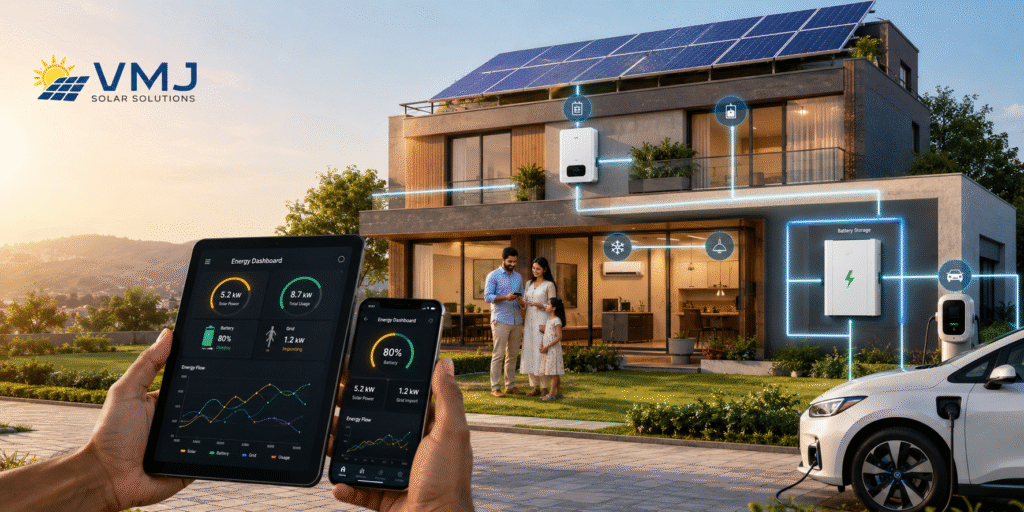
Installing rooftop solar panels is becoming increasingly common across Andhra Pradesh. From Vijayawada and Guntur to Visakhapatnam and Tirupati, homeowners are adopting solar energy to reduce electricity bills and improve long-term energy efficiency.
But a new trend is now shaping the future of residential energy usage:
Smart Home Energy Management Systems (EMS)
Today, many homeowners are realizing that simply generating solar power is not enough. The real advantage comes from understanding:
- When electricity is consumed
- Which appliances consume the most power
- How to optimize solar usage intelligently
That is where a smart Energy Management System (EMS) becomes valuable.
At VMJ Solar Solutions, homeowners increasingly ask not only:
“How many solar panels do I need?”
but also:
“How can I use my solar power more efficiently?”
This article explains how integrating solar with smart EMS technology can help modern Indian homes become more energy-efficient, cost-aware, and future-ready.
What Is a Smart Home Energy Management System (EMS)?
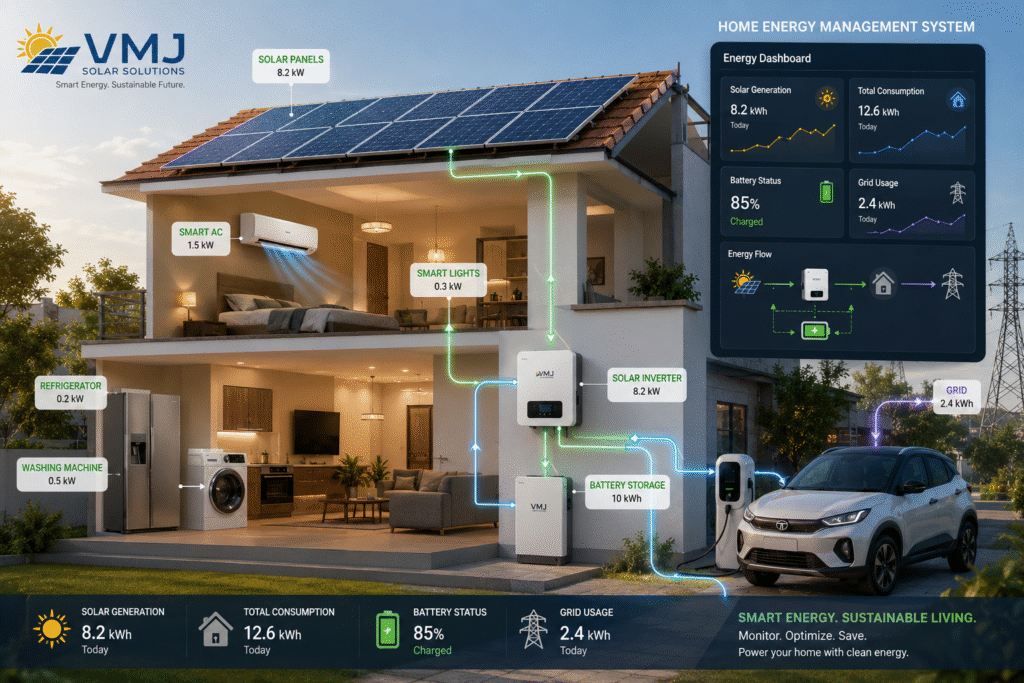
A Home Energy Management System (EMS) is a smart technology platform that monitors, controls, and optimizes household electricity usage.
Think of it as:
A digital brain for your home’s energy system.
It helps homeowners track:
- Solar generation
- Electricity consumption
- Appliance-level energy usage
- Battery usage (if available)
- Grid dependency
Many EMS platforms can be accessed through:
- Mobile apps
- Smart dashboards
- Wi-Fi-connected systems
- Cloud-based monitoring tools
How Solar and EMS Work Together
A rooftop solar system generates electricity during daytime hours.
However, without smart management:
- Excess power may be underutilized
- Appliances may run inefficiently
- Grid dependency may remain higher than expected
An EMS helps coordinate energy usage intelligently.
Example: Smart Solar Usage in an Andhra Pradesh Home
Without EMS
A home may:
- Generate strong solar power at noon
- Consume most electricity during evening hours
- Export excess daytime power unnecessarily
- Still face high nighttime usage
With EMS
A smart system can:
- Run heavy appliances during peak solar generation
- Schedule water heaters intelligently
- Optimize AC operation timing
- Monitor energy waste
- Prioritize solar power usage before grid usage
This improves overall energy efficiency.
Why Smart EMS Is Becoming Popular in India
1. Rising Electricity Costs
As electricity tariffs rise, homeowners want:
- Better energy visibility
- Consumption control
- Smarter savings strategies
EMS platforms help identify wasteful usage patterns.
2. Growth of Smart Homes
Modern homes increasingly include:
- Smart ACs
- IoT appliances
- EV chargers
- Smart lighting
- Wi-Fi-enabled devices
An EMS helps integrate these systems with solar energy generation.
3. Better Return on Solar Investment
Solar panels generate electricity efficiently only when that power is used strategically.
EMS systems help maximize self-consumption.
Key Features of a Smart Solar EMS
Real-Time Energy Monitoring
Homeowners can see:
- Current solar generation
- Household consumption
- Grid import/export status
in real time through mobile applications.
Appliance-Level Tracking
Some advanced EMS systems track:
- AC consumption
- Refrigerator usage
- Water heater load
- EV charging demand
This helps identify energy-heavy appliances.
Load Scheduling
Smart EMS platforms may automate appliance operation during solar production hours.
Examples:
- Running washing machines during daytime
- Charging EVs while solar production is high
- Scheduling water pumps intelligently
Battery Optimization
For homes with battery storage:
- EMS can prioritize battery charging
- Manage backup usage
- Reduce unnecessary battery cycling
Alerts and Notifications
Some systems provide alerts for:
- Excess energy usage
- Fault conditions
- Low solar generation
- Abnormal consumption spikes
Can EMS Reduce Electricity Bills?
Yes — But Indirectly
An EMS does not generate electricity itself.
Instead, it improves:
- Energy efficiency
- Usage behavior
- Solar utilization
- Load management
The result may be:
- Lower electricity bills
- Reduced wastage
- Better solar ROI
However, actual savings depend on:
- Household habits
- Appliance efficiency
- Solar system size
- Monitoring discipline
Realistic Expectations for Andhra Pradesh Homes
Many marketing campaigns present smart homes as fully automated futuristic systems.
In reality, most homeowners use EMS primarily for:
- Monitoring electricity usage
- Understanding solar performance
- Improving appliance scheduling
- Reducing unnecessary consumption
Even simple monitoring can create meaningful awareness about power usage patterns.
Smart EMS + Solar + EV Charging: A Growing Trend
As electric vehicles become more common in India, EMS integration becomes even more valuable.
A smart system can help:
- Schedule EV charging during solar generation
- Reduce peak grid usage
- Optimize charging costs
This is becoming increasingly relevant for urban households.
Challenges Homeowners Should Understand
1. Initial Investment
Advanced EMS systems may increase project cost depending on features and automation level.
2. Internet Dependency
Many smart systems rely on:
- Stable Wi-Fi
- Cloud connectivity
- App synchronization
3. Compatibility Issues
Not all:
- Inverters
- Batteries
- Smart appliances
integrate seamlessly with every EMS platform.
Proper planning is important.
4. Data Overload
Some homeowners install monitoring systems but rarely use the insights effectively.
Technology only creates value when usage behavior improves.
Is Smart EMS Necessary for Every Solar Home?
Not Always
For smaller homes with:
- Basic electricity usage
- Limited appliances
- Modest solar systems
a standard solar setup may be sufficient.
However, EMS becomes more valuable for homes with:
- Higher electricity bills
- Multiple ACs
- EV charging
- Smart appliances
- Battery backup systems
- Larger rooftop solar installations
The Future of Smart Energy Homes in India
India’s residential energy market is evolving rapidly.
Future-ready homes may increasingly combine:
- Rooftop solar
- Battery storage
- Smart EMS
- EV charging
- AI-driven automation
- Energy-efficient appliances
This shift is not only about saving money.
It is also about:
- Energy independence
- Smarter consumption
- Sustainable living
- Better control over household energy usage
Why Professional System Design Matters
A poorly integrated system may create:
- Monitoring inaccuracies
- Inverter conflicts
- Battery inefficiencies
- Automation failures
At VMJ Solar Solutions, solar planning considers:
- Household load patterns
- Appliance usage
- Future expansion
- Smart integration compatibility
because modern solar systems are increasingly becoming part of larger smart energy ecosystems.
Frequently Asked Questions (FAQs)
1. What does an EMS do in a solar home?
An EMS monitors and optimizes how electricity is generated, consumed, stored, and imported from the grid.
2. Can EMS automatically control appliances?
Some advanced systems can automate appliance scheduling depending on energy availability and settings.
3. Does EMS work without solar panels?
Yes, but its value increases significantly when integrated with solar systems and battery storage.
4. Is smart EMS expensive?
Costs vary depending on:
- Features
- Automation level
- Brand compatibility
- Monitoring capabilities
5. Can EMS help reduce AC electricity consumption?
It can help optimize when ACs operate and improve energy awareness, but actual reduction depends on usage behavior and appliance efficiency.
6. Is EMS useful for small homes?
For some homes, basic monitoring may be enough. Larger or energy-intensive homes benefit more from advanced EMS integration.
Final Thoughts
Solar panels are transforming how Indian homes generate electricity.
But the next major evolution is not just producing energy —
it is managing it intelligently.
Integrating:
Solar Power
with:
Smart Home Energy Management Systems (EMS)
helps homeowners move toward:
- Better energy awareness
- Improved efficiency
- Smarter consumption patterns
- Long-term sustainability
For homeowners in Andhra Pradesh exploring:
- Smart solar homes
- EMS integration
- Rooftop solar systems
- Energy-efficient home upgrades
- Smart energy automation
working with experienced providers like VMJ Solar Solutions can help ensure that the system is practical, scalable, and aligned with real-world household energy needs.