
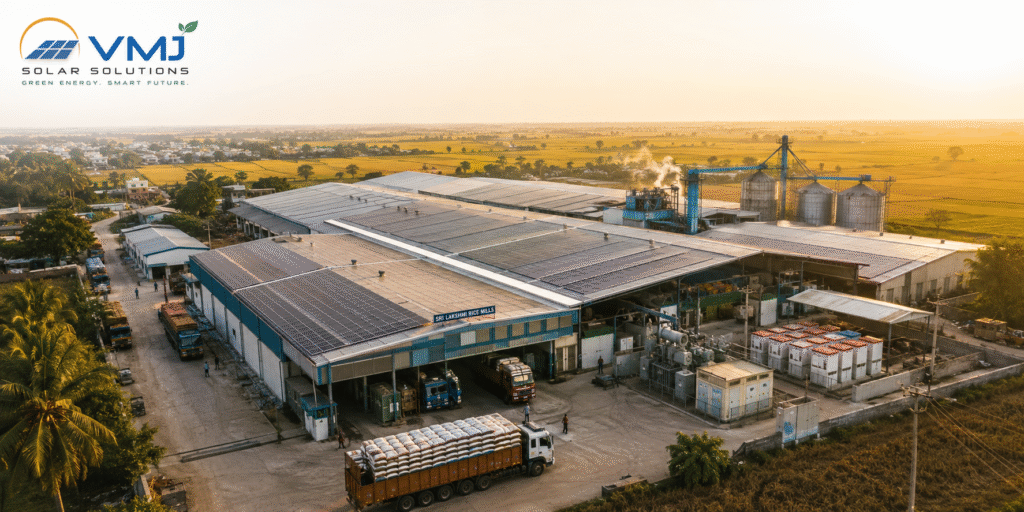
Rice mills are among the most electricity-intensive industries in Andhra Pradesh.
From paddy cleaning and drying to polishing and packaging, almost every stage of rice processing depends heavily on electric motors and machinery operating for long hours. As electricity tariffs continue to rise, many rice mill owners are facing a critical challenge:
How can operating costs be reduced without affecting production capacity?
For many mill owners, the answer lies in combining two highly effective energy optimization strategies:
- Rooftop or industrial solar power systems
- Capacitor banks for power factor correction
When implemented correctly, these solutions can help rice mills:
- Reduce monthly electricity expenses
- Avoid power factor penalties
- Improve energy efficiency
- Lower dependency on grid power
- Achieve substantial long-term savings
At VMJ Solar Solutions, many industrial and commercial clients across Andhra Pradesh are now exploring integrated energy-saving solutions instead of relying solely on traditional electricity supply.
This article explains how capacitor banks and solar systems work together — and why they can make a major financial difference for rice mills.
Understanding Why Rice Mills Consume So Much Electricity
Rice mills operate several high-load electrical machines such as:
- Elevators
- Conveyors
- Polishers
- Graders
- Huskers
- Blowers
- Dryers
- Compressors
- Large induction motors
Most of these machines draw:
- High starting current
- Reactive power
- Continuous load during operations
This often leads to:
- Higher electricity bills
- Poor power factor
- Demand penalties
- Voltage fluctuations
- Reduced electrical efficiency
For mills operating daily during procurement seasons, electricity becomes one of the largest operational expenses after raw material and labor.
What Is a Capacitor Bank?
A capacitor bank is an electrical device used to improve the power factor of industrial systems.
Simple Explanation
Many industrial motors require:
- Active power (useful power)
- Reactive power (supporting magnetic power)
Poor power factor means the system is drawing more electricity from the grid than efficiently needed.
Electricity departments may impose:
- Power factor penalties
- Higher demand charges
if the power factor drops below prescribed levels.
Capacitor banks help compensate for reactive power and improve electrical efficiency.
Why Power Factor Matters for Rice Mills
Example Scenario
If a rice mill operates:
- Multiple motors
- Heavy machinery
- Continuous processing equipment
then poor power factor can quietly increase monthly electricity costs.
Even when production remains unchanged.
Common Effects of Poor Power Factor
- Increased EB bills
- Penalty charges
- Excessive transformer loading
- Voltage instability
- Reduced equipment life
This is why capacitor banks are considered essential for many industrial facilities.
How Capacitor Banks Help Save Money
By improving power factor, capacitor banks can help:
1. Reduce Penalty Charges
Many commercial and industrial electricity tariffs include penalties for poor power factor.
Correcting it may reduce unnecessary charges.
2. Improve Electrical Efficiency
Better power factor means:
- Reduced current flow
- Lower system stress
- Improved voltage conditions
3. Support Heavy Motor Loads
Rice mills depend heavily on induction motors.
Capacitor banks improve overall system stability during operations.
Where Solar Power Fits In
While capacitor banks improve efficiency, solar power reduces actual electricity consumption from the grid.
This combination creates a powerful cost-saving strategy.
How Solar Helps Rice Mills
Industrial Solar Systems Generate Daytime Power
Rice mills often operate during daylight hours, which aligns well with solar energy generation.
This makes industrial solar especially effective.
Solar Can Help Offset:
- Milling operations
- Motor loads
- Conveyor systems
- Lighting
- Office loads
- Packaging equipment
Why Andhra Pradesh Is Ideal for Industrial Solar
Andhra Pradesh has:
- Strong solar irradiation
- Long sunny periods
- Large industrial rooftops
- High agricultural processing activity
Districts with significant rice milling activity include:
- East Godavari
- West Godavari
- Krishna
- Guntur
- Nellore
- Kakinada region
These areas are highly suitable for commercial and industrial solar installations.
How Solar and Capacitor Banks Work Together
This is where the real savings potential begins.
Capacitor Banks
Help improve:
- Power factor
- Electrical efficiency
- Penalty reduction
Solar Systems
Help reduce:
- Grid electricity consumption
- Monthly energy purchase costs
Together, they address both:
- Efficiency optimization
- Energy cost reduction
Realistic Savings Expectations
Many businesses hear exaggerated claims like:
- “Zero electricity bill”
- “100% free power”
- “Guaranteed huge profits”
In reality, savings depend on factors such as:
- Plant load
- Operating hours
- Roof space
- Power factor condition
- Solar system size
- Seasonal production
However, for high-consumption industries like rice mills, even moderate percentage savings can translate into lakhs annually over time.
Example: Rice Mill Energy Optimization Scenario
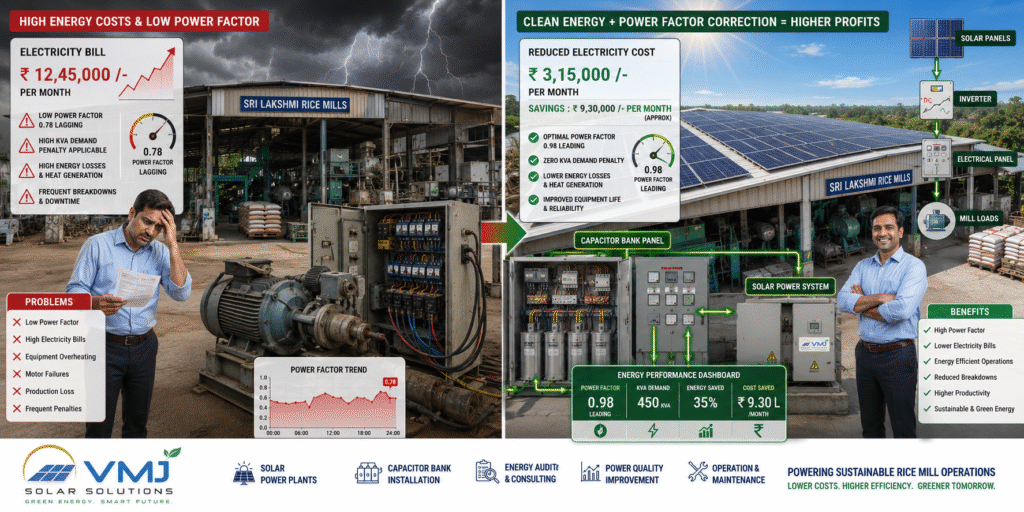
Before Optimization
A rice mill may experience:
- High monthly electricity bills
- Power factor penalties
- Heavy daytime consumption
After Installing:
✔ Capacitor Bank
✔ Industrial Solar System
Possible outcomes may include:
- Reduced EB penalties
- Lower daytime power purchase
- Improved operational efficiency
- More predictable energy costs
The scale of savings depends entirely on actual load conditions and system design.
Common Mistakes Rice Mill Owners Make
1. Focusing Only on Solar
Many businesses install solar panels but ignore power factor correction.
This leaves efficiency-related losses unresolved.
2. Oversizing or Undersizing Systems
Improper system sizing may:
- Increase unnecessary investment
- Reduce expected returns
Energy audits are essential before installation.
3. Ignoring Maintenance
Dust accumulation, loose electrical connections, and neglected capacitor systems can reduce performance over time.
4. Choosing Based Only on Lowest Price
Industrial electrical systems require:
- Proper engineering
- Quality components
- Safety standards
- Long-term service support
Cheapest is rarely best in commercial power infrastructure.
Additional Benefits Beyond Cost Savings
1. Reduced Grid Dependency
Solar reduces exposure to future electricity tariff increases.
2. Better Sustainability Profile
Industries using renewable energy may strengthen their environmental positioning.
This is becoming increasingly important in supply chains and export-oriented sectors.
3. Improved Equipment Performance
Stable electrical conditions may help reduce stress on motors and machinery.
Why Energy Audits Matter Before Installation
Every rice mill operates differently.
Before recommending:
- Solar capacity
- Capacitor bank size
- Hybrid solutions
a detailed assessment should evaluate:
- Connected load
- Maximum demand
- Power factor
- Roof structure
- Shift timings
- Seasonal operations
At VMJ Solar Solutions, energy planning is based on actual operational needs rather than generic assumptions.
Because industrial energy optimization is not one-size-fits-all.
Frequently Asked Questions (FAQs)
1. Can solar completely eliminate electricity bills for rice mills?
Usually not entirely.
However, it can significantly reduce daytime electricity consumption depending on system size and operations.
2. What is a good power factor for industrial operations?
Utilities generally prefer a high power factor close to unity, though exact targets depend on local regulations and tariff structures.
3. Are capacitor banks mandatory for rice mills?
Not always legally mandatory, but they are commonly recommended for facilities with heavy motor loads and poor power factor.
4. How much roof space is needed for industrial solar?
That depends on:
- System size
- Panel efficiency
- Roof layout
Large rice mills often have substantial rooftop potential.
5. Can capacitor banks and solar work together safely?
Yes — when designed and installed correctly by qualified professionals.
6. What maintenance is required?
Periodic inspection, cleaning, electrical testing, and monitoring help maintain long-term performance.
Final Thoughts
For rice mills in Andhra Pradesh, rising electricity costs are becoming a serious operational concern.
But simply paying larger power bills every year is no longer the only option.
Combining:
Capacitor Banks
for electrical efficiency
with:
Industrial Solar Systems
for energy generation
can create a practical long-term strategy for reducing operational expenses and improving energy stability.
The most important factor is not chasing unrealistic promises — it is implementing the right solution based on actual industrial requirements.
For rice mill owners exploring:
- Industrial solar installation
- Power factor correction
- Commercial energy efficiency
- Rooftop solar for rice mills
- Electrical cost optimization
working with experienced providers like VMJ Solar Solutions can help ensure that investments are technically sound, financially practical, and aligned with long-term business goals.