
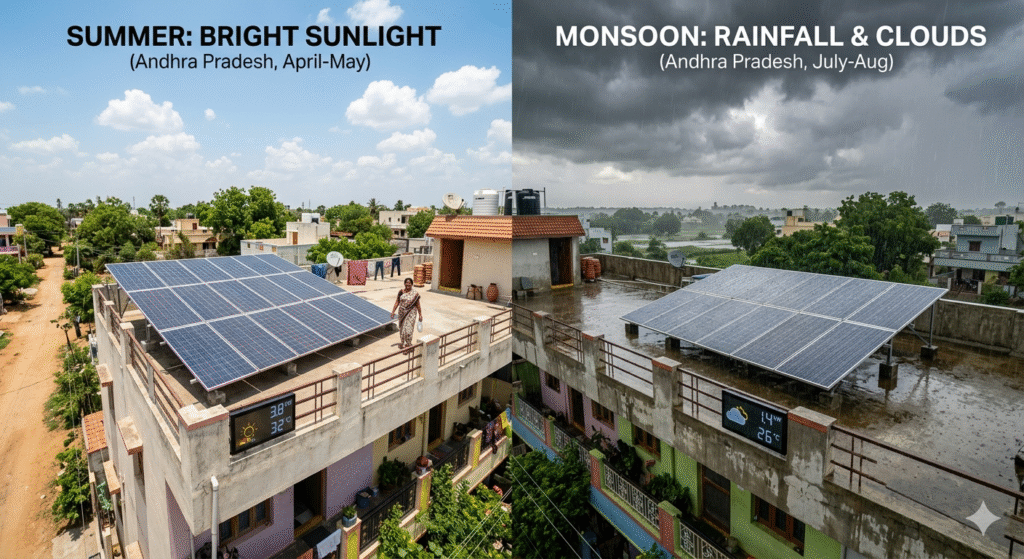
One of the most common questions homeowners ask before installing rooftop solar is:
“Will solar panels still work properly during monsoon season?”
It’s a fair concern—especially in Andhra Pradesh, where weather conditions shift dramatically between extreme summer heat and heavy monsoon rainfall.
Many people assume:
- Solar panels work best only in very hot weather
- Rainy seasons make solar useless
- Cloud cover completely stops power generation
None of those assumptions are entirely accurate.
The reality is more nuanced.
Weather absolutely affects solar panel efficiency—but not always in the way most homeowners expect.
For homeowners and businesses working with providers like VMJ Solar Solutions, understanding seasonal solar performance is important for setting realistic expectations and designing systems that perform reliably throughout the year.
How Solar Panels Actually Generate Electricity
Solar panels generate electricity using sunlight—not heat.
This distinction matters.
Solar photovoltaic (PV) panels convert solar radiation into electricity through photovoltaic cells.
That means:
- Bright sunlight improves generation
- Excessive heat can sometimes reduce efficiency
So while summer usually produces strong solar output, extremely high temperatures are not always ideal.
Why Andhra Pradesh Is Generally Good for Solar
Andhra Pradesh has strong solar potential because of:
- High annual sunlight availability
- Long daytime hours
- Strong solar radiation levels
This makes rooftop solar systems effective across much of the state.
However, seasonal conditions still affect:
- Daily generation
- Efficiency levels
- Maintenance requirements
Solar Performance During Summer
1. Longer Sunlight Hours Improve Generation
Summer generally provides:
- More daylight hours
- Strong solar radiation
- Higher total electricity generation
This is why many solar systems generate peak output during summer months.
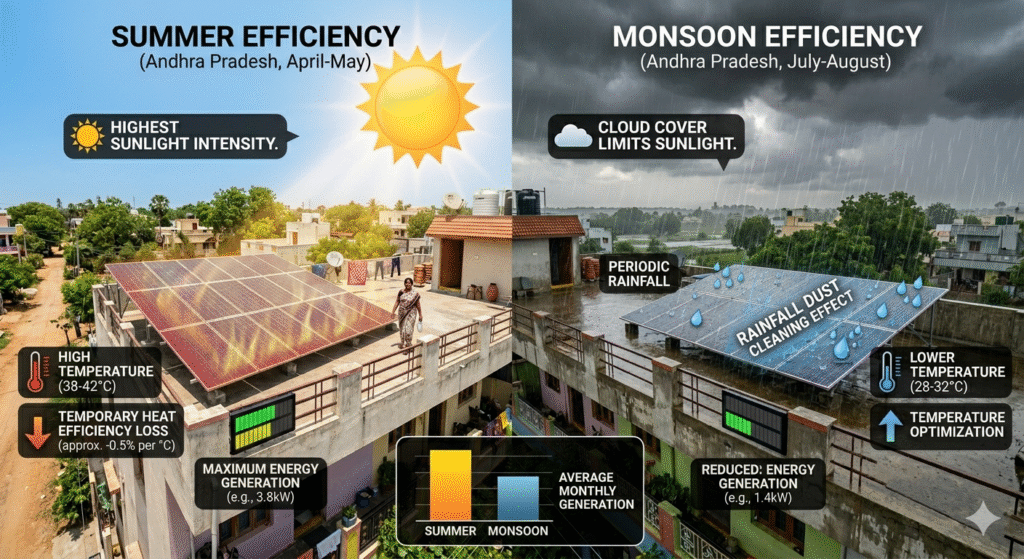
2. But Excessive Heat Can Reduce Panel Efficiency
Here’s the part many people misunderstand.
Solar panels perform better under sunlight—but not necessarily under extreme panel temperatures.
When panel surfaces become very hot:
- Electrical resistance increases
- Conversion efficiency slightly decreases
This is known as the temperature coefficient effect.
Practical reality:
Panels still generate strong electricity in summer, but efficiency may drop slightly during peak heat periods.
3. Dust Accumulation Becomes a Bigger Issue
Summer in Andhra Pradesh often brings:
- Dust
- Dry winds
- Airborne particles
Dust buildup can:
- Reduce sunlight absorption
- Lower power output
- Increase cleaning requirements
This is why regular solar panel cleaning becomes especially important during dry seasons.
Solar Performance During Monsoon
1. Cloud Cover Reduces Solar Generation
Monsoon weather reduces direct sunlight because of:
- Thick cloud cover
- Rainfall
- Lower solar radiation
As a result:
- Daily electricity generation usually decreases compared to summer.
However:
Solar panels do NOT stop working completely during cloudy weather.
They continue generating electricity at reduced output levels.
2. Cooler Temperatures Can Improve Efficiency
Interestingly:
- Cooler panel temperatures during monsoon can slightly improve conversion efficiency.
But overall generation still drops because:
- Available sunlight is lower.
So while panels operate cooler, there’s simply less solar energy available to convert.
3. Rain Helps Clean Solar Panels
This is one of the hidden advantages of monsoon.
Rainwater can help:
- Wash away dust
- Reduce dirt accumulation
- Improve panel cleanliness temporarily
However:
Heavy rainfall alone may not completely replace professional cleaning, especially if:
- Bird droppings
- Mud residue
- Pollution buildup
remain on panels.
Summer vs Monsoon: Which Season Produces More Solar Power?
In most parts of Andhra Pradesh:
Summer generally produces higher total solar generation.
because of:
- Longer daylight hours
- Stronger solar radiation
- More consistent sunlight exposure
Monsoon generation usually decreases because of:
- Cloud cover
- Reduced sunlight intensity
- Rainy weather conditions
However:
Well-designed solar systems are typically planned based on annual average performance—not single-season output alone.
Does Rain Damage Solar Panels?
This is another common misconception.
Modern solar panels are designed for outdoor conditions and are built to withstand:
- Rain
- Heat
- Humidity
- Wind exposure
Quality rooftop solar systems are tested for environmental durability.
However:
Poor installation quality can still create issues like:
- Water leakage
- Corrosion
- Electrical faults
This is why installation standards matter as much as panel quality.
How Humidity Affects Solar Systems in Coastal Andhra Pradesh
Coastal regions near:
- West Godavari
- Krishna district
- Nellore
may experience:
- High humidity
- Salt exposure
- Corrosion risks
Over long periods, these conditions can affect:
- Mounting structures
- Wiring
- Connectors
Proper component selection and maintenance become especially important in coastal areas.
Why Seasonal Variability Matters for Homeowners
Many first-time solar buyers expect:
- Identical electricity generation every month
That’s unrealistic.
Solar systems naturally fluctuate because of:
- Weather
- Sunlight hours
- Seasonal changes
- Temperature conditions
A professional installer should explain:
- Expected annual performance
- Seasonal generation variation
- Realistic savings projections
—not only peak production numbers.
Common Mistakes Homeowners Make
❌ Judging Solar Based on One Cloudy Week
Short-term weather fluctuations do not determine long-term solar ROI.
❌ Ignoring Cleaning Requirements
Dust and dirt reduce efficiency significantly in dry conditions.
❌ Assuming Bigger Systems Eliminate Seasonal Effects
Even larger systems experience weather-related performance variation.
❌ Expecting Identical Output Every Day
Solar generation is naturally dynamic.
How Smart Solar Systems Handle Weather Better
Modern systems increasingly use:
- Smart inverters
- AI-based monitoring
- Real-time performance tracking
These tools help homeowners:
- Monitor seasonal output
- Detect performance drops
- Optimize energy consumption
This becomes especially useful during:
- Monsoon fluctuations
- High summer demand periods
The Bigger Picture: Solar Is Designed for Annual Performance
The smartest way to evaluate solar efficiency is not:
“How much power did I generate today?”
It’s:
“How much did my system generate across the full year?”
Professional solar systems are designed around:
- Annual sunlight averages
- Long-term consumption patterns
- Seasonal balancing
That’s why temporary weather fluctuations usually do not undermine long-term solar viability in Andhra Pradesh.
Conclusion
Weather plays a major role in solar panel efficiency—but not in the overly simplistic way many people assume.
Summer usually provides:
- Higher solar generation
- Longer sunlight hours
- Strong energy output
Monsoon season typically brings:
- Lower generation due to cloud cover
- Cooler operating temperatures
- Natural panel cleaning benefits
For homeowners in Andhra Pradesh, rooftop solar remains highly practical because annual solar potential remains strong despite seasonal fluctuations.
The real key is:
- Proper system sizing
- Quality installation
- Realistic expectations
- Long-term maintenance
For providers like VMJ Solar Solutions, the goal is not promising “perfect generation every day.”
It’s designing solar systems that perform reliably across changing real-world weather conditions for the next 20–25 years.
Because the success of solar isn’t measured by one sunny afternoon or one rainy week.
It’s measured across decades of consistent energy production.
Frequently Asked Questions (FAQs)
1. Do solar panels work during monsoon season?
Yes. Solar panels continue generating electricity during cloudy and rainy weather, but at reduced output levels.
2. Does extreme summer heat improve solar efficiency?
Not always. Solar panels need sunlight, but excessive heat can slightly reduce efficiency.
3. Can rain damage rooftop solar panels?
Quality solar panels are designed to withstand rain and outdoor weather conditions.
4. Does dust affect solar panel performance?
Yes. Dust accumulation can reduce sunlight absorption and lower electricity generation.
5. Which season produces more solar electricity in Andhra Pradesh
Summer generally produces higher overall generation because of stronger and longer sunlight exposure.
6. Do solar panels need extra maintenance during monsoon?
Periodic inspections are useful to ensure drainage, wiring safety, and system cleanliness.