
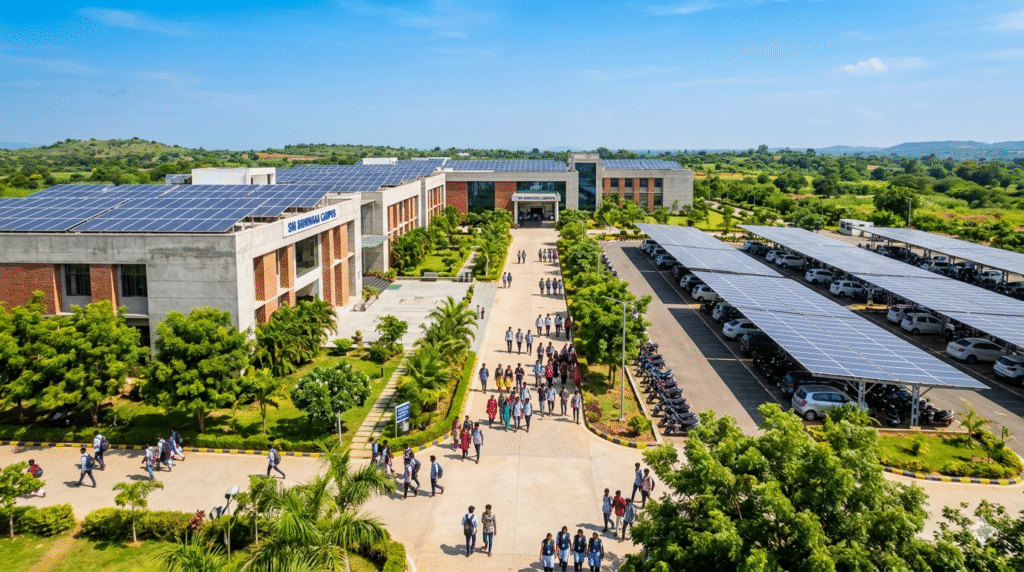
Electricity is no longer just a utility for schools and colleges—it’s a major operational expense. From powering classrooms and laboratories to running digital infrastructure, campuses today are heavily energy-dependent. In regions like Andhra Pradesh, where temperatures can soar and air conditioning becomes essential, electricity bills can quietly consume a significant portion of institutional budgets.
Now here’s the uncomfortable truth: most educational institutions are still treating electricity as a fixed cost rather than a controllable one. That mindset is expensive.
Solar power flips this equation.
Instead of paying recurring monthly bills that only increase over time, schools and colleges can generate their own electricity, reduce dependency on the grid, and redirect savings toward better infrastructure, faculty, and student resources.
This isn’t just about sustainability—it’s about financial intelligence.
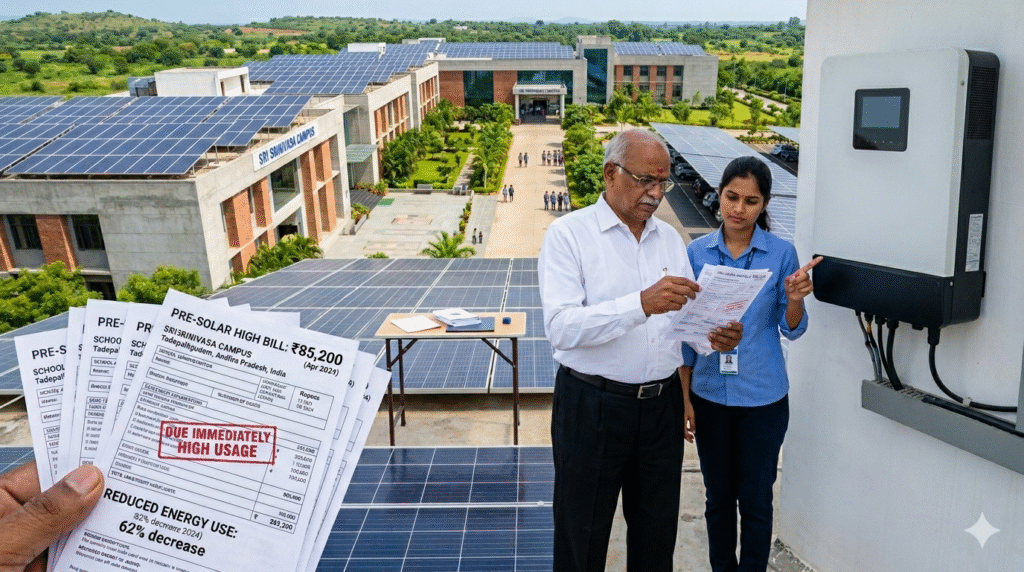
Why Solar Power Makes Strategic Sense for Educational Institutions
1. Economic Benefits: Turning Expense into Investment
Let’s be blunt—electricity costs are predictable, but not stable. Tariffs rise. Demand grows. Budgets stretch.
Solar changes that dynamic.
Key financial advantages:
- Massive reduction in electricity bills (often 50–90%)
- Quick payback period (typically 3–5 years)
- 25+ years of free or low-cost electricity
- Government subsidies and incentives
- Net metering benefits (earn credits for surplus power)
A medium-sized college campus can save lakhs annually. Over a decade, that compounds into crores.
The real question isn’t “Can we afford solar?”
It’s “How long can we afford not to switch?”
2. Environmental Impact: Education That Leads by Example
Educational institutions don’t just teach—they influence behavior.
Adopting solar power sends a powerful message to students:
- Sustainability is actionable, not theoretical
- Institutions must lead, not follow
- Renewable energy is the future, not an alternative
Environmental benefits include:
- Reduced carbon footprint
- Lower reliance on fossil fuels
- Cleaner campus environment
- Contribution to India’s renewable energy goals
A solar-powered campus becomes a living laboratory—students don’t just learn about renewable energy; they see it in action every day.
3. Energy Independence and Reliability
Power cuts and voltage fluctuations disrupt learning more than institutions admit.
Solar systems, especially when combined with battery storage, offer:
- Consistent power supply
- Reduced dependency on unstable grids
- Improved operational continuity
For schools running digital classrooms, labs, and online platforms, this reliability is not optional—it’s essential.
A Surprising Trend: Petrol Pumps Are Moving to Solar Faster Than Schools
Here’s where things get interesting.
While many schools are still “considering” solar, petrol pumps are already acting.
Why?
Because they understand margins.
Petrol pumps operate 24/7. Their electricity consumption is high—fuel dispensing units, lighting, air compressors, convenience stores. Every rupee saved directly boosts profitability.
And they’re not waiting.
What’s Driving Solar Adoption in Petrol Pumps?
- Rising electricity costs eating into margins
- Government encouragement for renewable energy
- High daytime energy usage (perfect for solar generation)
- Large rooftop or canopy space ideal for panel installation
Petrol pumps are treating solar as a business optimization tool, not just an environmental initiative.
Schools should take note.
Case Studies: Petrol Pumps Leading the Solar Shift in Andhra Pradesh
Let’s ground this in reality. Across Andhra Pradesh, several petrol pumps have already adopted solar solutions—and the results are hard to ignore.
1. Urban Highway Petrol Pump – Vijayawada Region
A busy highway petrol pump installed a 30 kW solar system across its canopy.
Results:
- Electricity bill reduced by over 70%
- ROI achieved within 4 years
- Improved brand perception as an eco-friendly business
What’s notable is their mindset—they didn’t wait for perfect conditions. They acted on clear economics.
2. Rural Petrol Pump – Guntur District
A smaller petrol pump in a semi-rural area adopted a 10 kW solar setup.
Impact:
- Significant reduction in operational costs
- Stable power supply despite local grid issues
- Increased trust among customers due to consistent service
This case challenges a common excuse: “Solar is only viable for large institutions.”
It isn’t.
3. Coastal Region Petrol Pump – Visakhapatnam Belt
A petrol pump near the coast implemented a hybrid solar system with battery backup.
Outcomes:
- Zero downtime during outages
- Full utilization of daytime solar generation
- Enhanced operational efficiency
This is where solar stops being a cost-saving tool and becomes a reliability strategy.
The Real Question: Why Are Schools Lagging Behind?
Let’s address the gap directly.
If petrol pumps—with tighter margins and less institutional funding—can adopt solar quickly, why are schools and colleges slower?
Common Reasons (and Why They Don’t Hold Up)
1. “Initial investment is high”
Yes—but so is doing nothing. Solar is not an expense; it’s a capital asset with predictable returns.
2. “We’ll consider it later”
Electricity tariffs won’t wait. Delaying solar adoption is essentially choosing higher costs.
3. “We don’t have expertise”
That’s what solar solution providers are for. Institutions don’t need to become energy experts—they need to make smart decisions.
How Schools and Colleges Can Implement Solar Effectively
If you’re serious about reducing electricity overhead, the path is straightforward.
Step-by-Step Approach:
1. Conduct an Energy Audit
- Understand current consumption patterns
- Identify peak usage times
2. Evaluate Rooftop Space
- School buildings, hostels, parking sheds
- Even unused land can be leveraged
3. Choose the Right System
- On-grid (cost-effective)
- Hybrid (for backup reliability)
4. Leverage Government Schemes
- Subsidies available for educational institutions
- Net metering policies in Andhra Pradesh
5. Partner with Experienced Providers
- Design, installation, maintenance—all handled professionally
The Long-Term Impact: Beyond Cost Savings
Solar power does more than cut bills.
It transforms institutions.
Academic Benefits:
- Real-world learning opportunities for students
- Integration into science and engineering curriculum
Institutional Branding:
- Positions the institution as forward-thinking
- Attracts environmentally conscious students and parents
Financial Stability:
- Predictable energy costs
- Budget flexibility for growth initiatives
Conclusion: Stop Treating Electricity as a Fixed Cost
Here’s the reality most institutions avoid confronting:
Electricity is one of the few major expenses you can almost eliminate.
Petrol pumps have already figured this out. They’ve moved fast, optimized costs, and improved operations.
Schools and colleges have even more to gain—not just financially, but socially and academically.
The opportunity is sitting on your rooftops.
The Choice Is Simple:
- Continue paying rising electricity bills indefinitely
or - Invest once and generate your own clean, renewable energy for decades
Solar power isn’t a trend—it’s infrastructure for the future.
And the institutions that act early won’t just save money—they’ll lead