
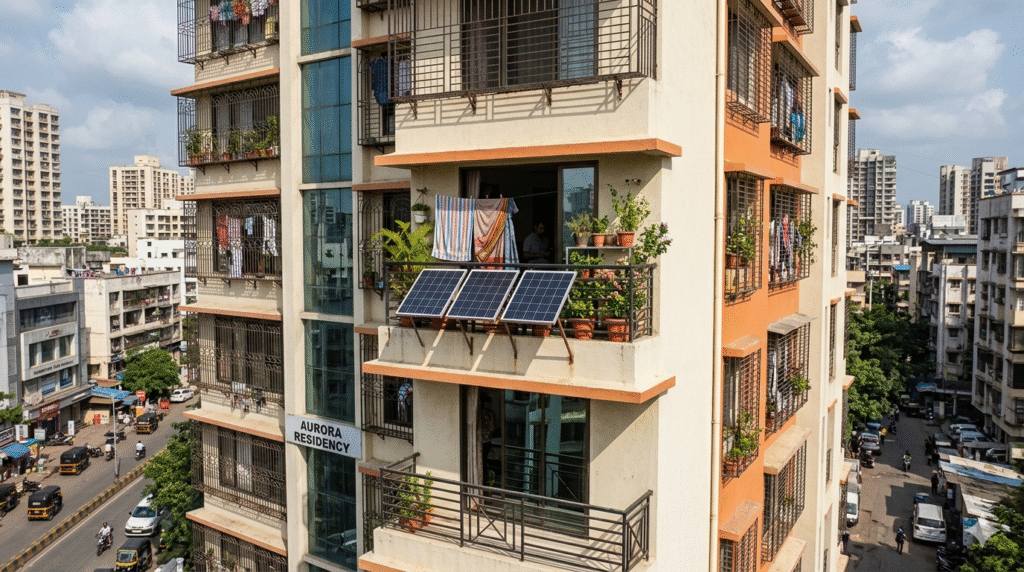
If you live in a high-rise apartment in cities like Visakhapatnam or Vijayawada, you’ve probably asked this question:
“Can I install solar panels on my balcony?”
At first glance, it seems logical. You have sunlight, limited space, and rising electricity bills. Why not use that balcony to generate your own power?
But here’s the reality most people don’t tell you:
👉 Balcony solar sounds practical—but in most cases, it’s inefficient, restricted, or not worth the effort unless done strategically.
Let’s break this down clearly so you don’t waste time—or money—on a half-baked setup
Understanding Balcony Solar: What’s Actually Possible?
☀️ The Basic Idea
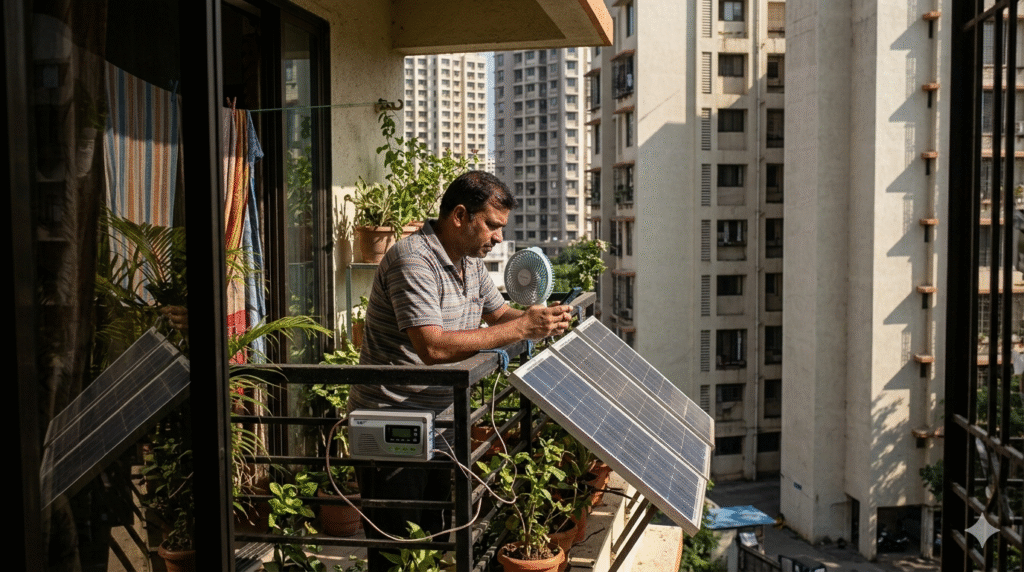
Balcony solar setups typically involve:
- Small solar panels mounted on railings or walls
- Plug-and-play systems (in some countries)
- Direct connection to household appliances or grid
Sounds simple. But in India—especially in apartments—it’s more complicated.
Environmental and Economic Reality Check
🌱 Environmental Impact: Yes, But Limited
Installing solar panels on a balcony does contribute to renewable energy adoption.
But let’s be honest:
- A small balcony system generates very limited power
- It won’t significantly reduce your building’s carbon footprint
- The impact is more symbolic than substantial
💰 Economic Viability: Where Things Get Uncomfortable
Here’s where expectations clash with reality.
Typical balcony solar output:
- 200W – 800W (depending on space)
What that means:
- Can power a few lights, fans, or charge devices
- Cannot run heavy appliances like ACs or geysers
The hard truth:
- Payback period is often long
- Savings are relatively small
- Installation complexity can outweigh benefits
If your goal is serious cost reduction, this isn’t the strongest approach.
The Real Constraints You Can’t Ignore
🏢 1. Housing Society Restrictions
Most apartment associations in India have rules about:
- Exterior modifications
- Structural changes
- Visual uniformity
You may not be allowed to install panels on:
- Balcony railings
- Outer walls
- Building façade
Approval is often the biggest hurdle—not technology.
2. Grid Connection Limitations
Unlike independent houses:
- You don’t control the main electrical system
- Net metering is typically not available at individual flat level
- Plug-and-play solar systems are not widely standardized in India
This means your system may operate in isolation—not fully optimized.
3. Shading and Orientation Issues
High-rise buildings create complex light patterns:
- Nearby towers block sunlight
- Balcony direction matters (south-facing is ideal)
- Partial shading reduces efficiency drastically
Solar needs consistency. Balconies rarely provide it.
4. Safety and Structural Concerns
Mounting panels on balconies introduces risks:
- Wind load at higher floors
- Improper mounting leading to hazards
- Electrical safety compliance
Cutting corners here is not an option.
Current Trends: Urban Solar Adoption Is Growing—But Differently
In cities across Andhra Pradesh, solar adoption is increasing—but not primarily through balconies.
📈 What’s Actually Working:
1. Rooftop Solar for Entire Buildings
- Shared systems for all residents
- Better economies of scale
- Higher efficiency and ROI
2. Common Area Solar Installations
- Powers lifts, lighting, water pumps
- Reduces maintenance costs for residents
- Easier to implement legally
Hybrid & Portable Solar Solutions
- Small systems for backup power
- Used for specific appliances
- No major installation required
Real-World Scenarios: What People Are Doing
🏙️ Case 1: Apartment Resident in Visakhapatnam
- Installed a 400W balcony system
- Uses it for:
- Charging devices
- Running a fan and lights
Outcome:
- Modest savings
- More of a sustainability choice than financial one
🏢 Case 2: Gated Community in Vijayawada
- Installed rooftop solar for common areas
- Reduced monthly maintenance costs
Outcome:
- High ROI
- Benefits shared across residents
🌇 Case 3: High-Rise Resident with Portable Solar Setup
- Uses foldable solar panels (non-permanent)
- Powers small backup systems
Outcome:
- Flexible, no approvals needed
- Limited but practical use
So… Should You Install Solar on Your Balcony?
Let’s strip away the fluff.
✔ It might make sense if:
- You want to experiment with solar
- You’re okay with limited output
- Your society allows installation
- You treat it as a supplementary system
❌ It’s not ideal if:
- You want significant bill reduction
- You expect full-home power support
- Your balcony has shading issues
- You’re looking for long-term ROI
Smarter Alternatives You Should Seriously Consider
If your goal is real savings and impact, here are better options:
🔋 1. Participate in Society-Level Solar
Push for rooftop installations in your apartment association.
⚡ 2. Invest in Hybrid Inverter + Backup Systems
Combine limited solar with battery storage for better utility.
🏠 3. Explore Solar for Independent Properties
If you own land or a house, rooftop solar is far more effective.
Where Most People Get It Wrong
They focus on “Can I install solar?”
Instead of asking:
👉 “Will this setup actually make financial and practical sense?”
That shift in thinking saves you from poor decisions.
How VMJ Solar Can Help
Balcony solar is just one small piece of the puzzle.
At VMJ Solar, the focus is on:
- ✔ Practical solar solutions—not just possible ones
- ✔ Honest feasibility assessments
- ✔ Customized systems based on real usage
- ✔ Guidance for both individual and community solar setups
Sometimes the right advice is:
👉 “Don’t do balcony solar—do this instead.”
And that’s where real value lies.
Conclusion: Possible? Yes. Practical? Depends.
Installing solar panels on a high-rise apartment balcony is technically possible.
But in most cases, it’s:
- Limited in output
- Restricted by regulations
- Less impactful financially
If you’re serious about solar, think bigger than the balcony.
Final Thought: Think in Systems, Not Shortcuts
Balcony solar feels like an easy entry point.
But real energy independence comes from:
- Scale
- Proper design
- Strategic implementation
If you’re going to invest—do it in a way that actually moves the needle.