
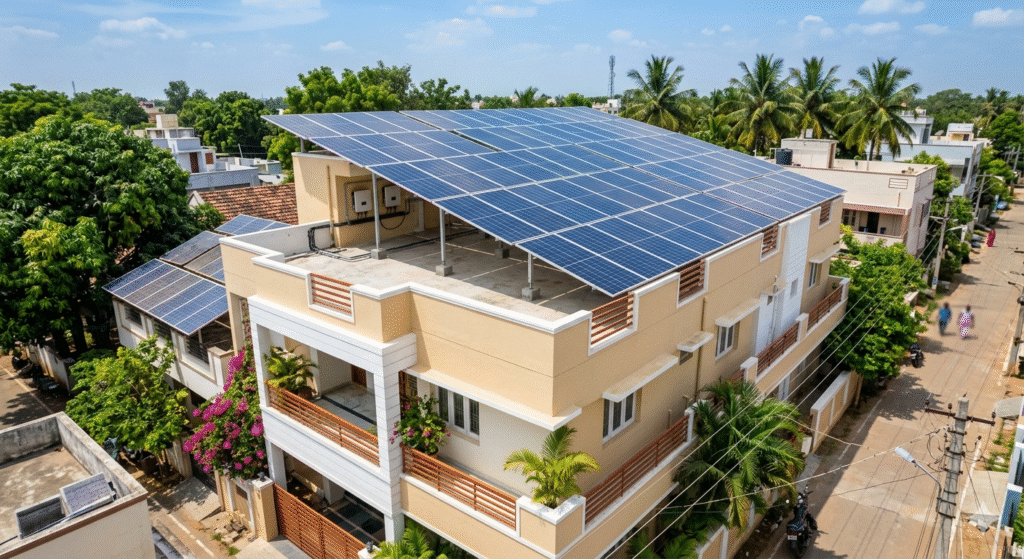
A 3kW solar system is often the perfect starting point for homeowners. It covers essential loads, trims electricity bills, and introduces you to the benefits of solar power. But here’s what most people underestimate—energy needs don’t stay static.
New appliances get added. Air conditioners run longer. Work-from-home setups increase daytime usage. And suddenly, that 3kW system that once felt sufficient starts falling short.
This isn’t a failure of solar—it’s a sign that your system worked well enough to justify scaling.
Upgrading to a 5kW system isn’t just about adding panels. It’s about optimizing your energy strategy to match your evolving lifestyle.
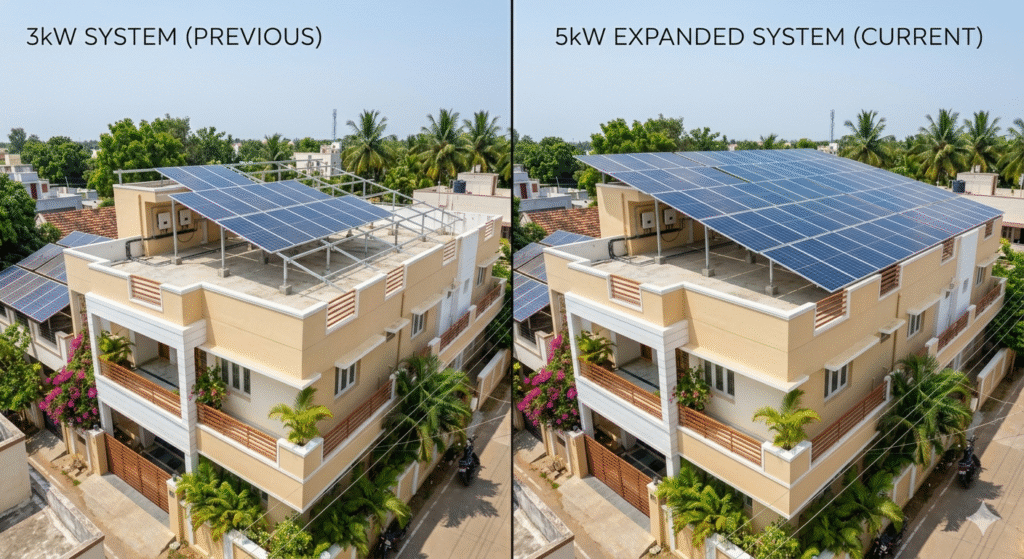
Why Upgrade from 3kW to 5kW?
1. Rising Energy Consumption
Let’s be direct—most households underestimate how quickly consumption grows.
Common triggers include:
- Installing air conditioners
- Adding geysers or water heaters
- Increased appliance usage (washing machines, refrigerators, induction stoves)
- EV charging (a growing factor)
A 3kW system typically generates 12–15 units/day, while a 5kW system can produce 20–25 units/day, depending on sunlight conditions in Andhra Pradesh.
That gap is the difference between partial savings and near energy independence.
2. Maximizing Return on Investment
A common hesitation: “I’ve already invested in 3kW—why spend more?”
Because partial optimization leaves money on the table.
Upgrading benefits:
- Higher self-consumption of solar power
- Reduced reliance on grid electricity
- Better utilization of net metering policies
- Faster long-term savings
The economics improve with scale. A 5kW system doesn’t just produce more power—it improves overall efficiency per unit.
3. Future-Proofing Your Home
If you’re thinking short-term, 3kW might seem enough.
If you’re thinking 10–15 years ahead, it’s not.
Energy trends are clear:
- Electrification of vehicles
- Smart homes and automation
- Increased cooling demand
Upgrading now is cheaper and simpler than redesigning your system later.
Key Considerations Before Expanding Your Solar System
Upgrading isn’t just “add more panels and done.” If handled poorly, you’ll end up with inefficiencies or compatibility issues.
1. Inverter Capacity: The Make-or-Break Factor
Your inverter determines how much power your system can handle.
Scenarios:
- If your inverter supports 5kW:
You can expand by adding panels. - If your inverter is limited to 3kW:
You’ll need:- A new inverter, or
- An additional inverter
Ignoring this step leads to energy losses—your panels may generate power that your system simply can’t use.
2. Rooftop Space Availability
A 3kW system uses roughly 300 sq. ft.
A 5kW system needs about 500 sq. ft.
Before upgrading, evaluate:
- Shadow-free area
- Panel orientation (south-facing preferred)
- Structural strength of the roof
No space = no expansion. Simple as that.
3. Net Metering Policies in Andhra Pradesh
In Andhra Pradesh, net metering allows you to export excess power to the grid.
Upgrading to 5kW means:
- More surplus during low-consumption periods
- Higher credits on electricity bills
But here’s the catch—policies can evolve. Delaying your upgrade could mean less favorable terms later.
4. System Compatibility and Design
Not all solar panels behave the same.
When expanding:
- Match voltage and current characteristics
- Ensure compatibility with existing wiring
- Maintain balanced load distribution
A poorly integrated system reduces efficiency—sometimes significantly.
How the Upgrade Process Works
Let’s break this down into a practical sequence.
Step 1: Energy Audit
- Review your last 6–12 months of electricity bills
- Identify peak consumption patterns
This tells you whether 5kW is sufficient—or if you should think even bigger.
Step 2: Site Inspection
A professional installer evaluates:
- Roof condition
- Space availability
- Existing system performance
Skipping this step is where most mistakes happen.
Step 3: System Design Upgrade
Your provider will:
- Reconfigure panel layout
- Assess inverter upgrade needs
- Optimize for maximum generation
Step 4: Installation and Integration
- Add new panels
- Upgrade inverter (if needed)
- Integrate with existing system
This is where experience matters. Poor integration = long-term inefficiency.
Step 5: Testing and Commissioning
- Performance checks
- Grid synchronization
- Net metering adjustments
Once completed, your system should operate seamlessly as a 5kW unit.
Real-World Example: A Household Upgrade in Andhra Pradesh
A homeowner in Andhra Pradesh installed a 3kW system in 2021.
Initially:
- Covered basic loads
- Reduced bills by ~60%
Then came:
- Two air conditioners
- Increased daytime usage
Result? Electricity bills started creeping back.
Upgrade Decision:
They expanded to a 5kW system.
Outcome:
- Bill reduction jumped to ~90%
- Surplus energy exported during daytime
- Payback period improved overall
The key takeaway: the original system wasn’t wrong—it just became insufficient.
Common Mistakes to Avoid
Let’s challenge a few assumptions.
1. “I’ll just add random panels”
Solar isn’t plug-and-play at scale. Mismatched panels reduce system efficiency.
2. Ignoring Inverter Limits
This is the most common—and costly—mistake.
If your inverter can’t handle additional capacity, you’re wasting potential generation.
3. Delaying the Upgrade Too Long
Every month you operate an undersized system, you’re:
- Buying more grid electricity
- Losing potential savings
That delay has a cost.
4. Choosing Price Over Expertise
Cheap installations often lead to:
- Poor wiring
- Inefficient layouts
- Long-term maintenance issues
Solar is a 25-year asset. Optimize for quality, not shortcuts.
Financial Perspective: Is the Upgrade Worth It?
Let’s be practical.
Additional Investment:
- Cost of extra panels
- Possible inverter upgrade
Returns:
- Higher monthly savings
- Increased system efficiency
- Long-term reduction in electricity costs
In most cases, the incremental investment pays back faster than the original system—because your consumption is already high.
Long-Term Benefits of Upgrading
- Closer to energy independence
- Better utilization of rooftop space
- Reduced carbon footprint
- Higher property value
- Preparedness for future energy needs
This isn’t just an upgrade—it’s an optimization move.
Conclusion: Stop Running an Undersized System
Here’s the reality most homeowners ignore:
A solar system that doesn’t match your consumption is only partially effective.
You’ve already made the smart move by installing 3kW.
Now the smarter move is scaling it.
The Decision Framework:
- Are your electricity bills rising again?
- Has your appliance usage increased?
- Do you have unused rooftop space?
If the answer is yes, upgrading to 5kW isn’t optional—it’s logical.
Solar power works best when it’s aligned with your actual energy needs.
Anything less is underperformance.