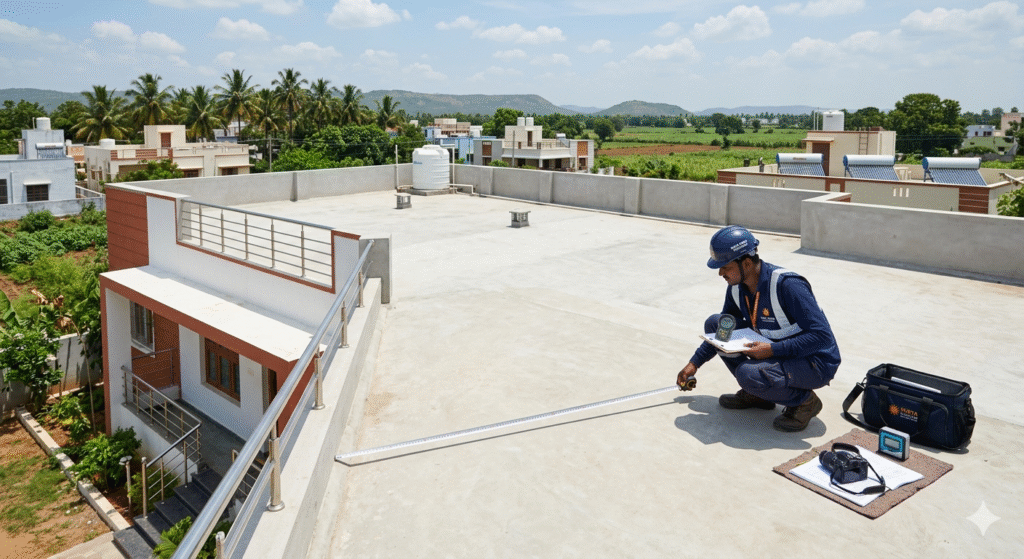
Installing rooftop solar is one of the smartest long-term investments many homeowners in Andhra Pradesh can make. But before comparing solar panel prices, subsidies, or system sizes, there’s a more important question:
Is your roof actually suitable for solar installation?
Many homeowners assume any roof can support a rooftop solar system. In reality, roof condition, structure, shading, orientation, and usable space all directly affect:
- Solar panel efficiency
- Electricity generation
- Installation cost
- Long-term maintenance
- Overall solar ROI
For homeowners working with providers like VMJ Solar Solutions, proper roof assessment is one of the most important steps before installing a residential solar system.
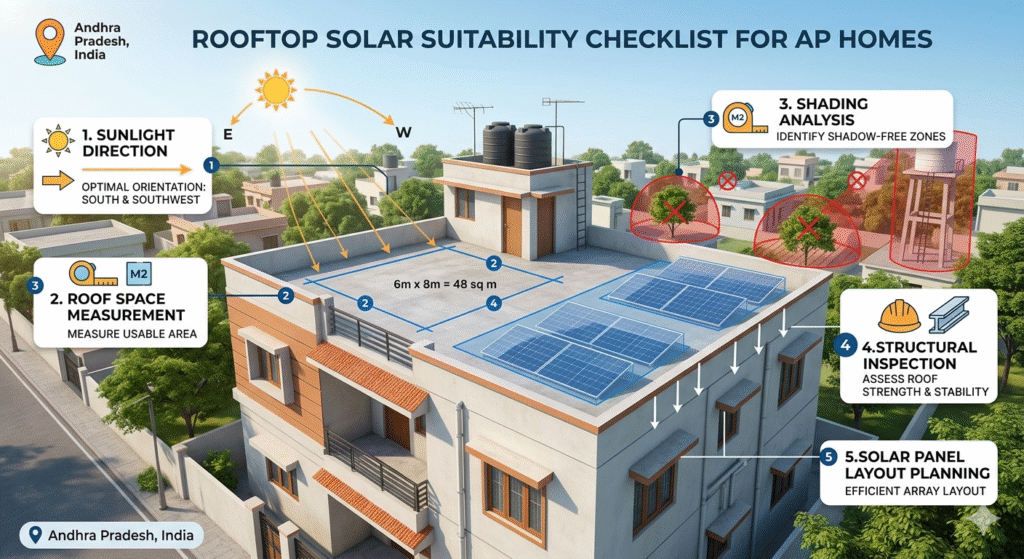
This guide explains the key factors that determine whether your roof is suitable for rooftop solar in Andhra Pradesh.
Why Roof Assessment Matters Before Solar Installation
A rooftop solar system is typically designed to last 20–25 years.
That means installers are not simply placing panels on a roof—they are integrating long-term electrical infrastructure into your home.
Poor roof suitability can lead to:
- Lower solar power generation
- Structural stress
- Water leakage risks
- Maintenance difficulties
- Reduced system lifespan
A proper pre-installation evaluation helps avoid expensive mistakes later.
1. Check Available Rooftop Space
The first requirement for rooftop solar is usable roof area.
Approximate space requirements:
- 1kW solar system → around 80–100 sq. ft.
- 3kW solar system → around 250–300 sq. ft.
- 5kW solar system → around 400–500 sq. ft.
Actual requirements vary depending on:
- Panel efficiency
- Roof layout
- Installation design
Important:
Not all roof space is usable.
Areas occupied by:
- Water tanks
- Staircase rooms
- Satellite dishes
- HVAC equipment
reduce effective installation area.
2. Evaluate Roof Direction and Sunlight Exposure
In Andhra Pradesh, solar panels generally perform best when they receive strong sunlight for most of the day.
Ideal conditions include:
- Minimal shading
- Clear southern exposure (typically preferred in India)
- Consistent sunlight between morning and afternoon
Common shading obstacles:
- Nearby buildings
- Trees
- Utility poles
- Future construction nearby
Even partial shading can reduce solar system output significantly.
3. Assess Roof Structural Strength
Solar panels, mounting structures, and installation equipment add extra load to the roof.
Common residential roof types in AP:
- RCC concrete roofs
- Metal sheet roofs
- Tiled roofs
Most RCC roofs are suitable for rooftop solar, but older structures may require inspection.
Structural evaluation becomes important if:
- The building is old
- Cracks are visible
- Waterproofing issues already exist
- Additional loads are planned later
Ignoring structural integrity creates long-term risk.
4. Check Roof Age and Condition
Many homeowners install solar without considering roof lifespan.
That’s a mistake.
If your roof needs major repair within a few years:
- Solar panels may need temporary removal
- Reinstallation adds extra cost
- Downtime affects electricity generation
A practical rule:
If the roof is nearing major renovation age, repair it before solar installation.
5. Understand Roof Type Compatibility
Different roof designs affect installation complexity.
RCC Flat Roofs
Most common and easiest for solar installation.
Advantages:
- Flexible panel positioning
- Easier maintenance access
- Better installation customization
Sloped Roofs
Can work well but require:
- Specialized mounting structures
- Careful waterproofing
Metal Sheet Roofs
Lightweight and common in some semi-urban areas.
However:
- Heat expansion
- Fastener sealing
- Structural anchoring
must be handled properly.
6. Consider Future Electricity Needs
Many homeowners only size solar systems based on current electricity usage.
But future demand often increases because of:
- Air conditioners
- EV charging
- Additional appliances
- Home expansion
A roof with limited expansion capacity may restrict future upgrades.
Planning ahead matters.
7. Evaluate Roof Accessibility
Solar systems require occasional:
- Cleaning
- Maintenance
- Inspection
Poor accessibility increases:
- Maintenance difficulty
- Labor costs
- Safety concerns
A practical rooftop solar design should allow safe technician access.
8. Waterproofing Is Critical
One of the biggest homeowner concerns in Andhra Pradesh is roof leakage after solar installation.
This risk usually comes from:
- Poor installation quality
- Improper drilling
- Weak sealing methods
A professionally installed system should include proper waterproofing measures.
Cheap installation often creates expensive future problems.
9. Check Local Climate Conditions
Andhra Pradesh presents unique environmental factors:
Coastal Areas
Potential issues include:
- Salt corrosion
- Humidity exposure
- Strong winds
Interior Regions
Common challenges include:
- High heat
- Dust accumulation
- Summer thermal stress
System design and component quality should reflect local conditions.
10. Verify Net Metering Feasibility
Before installation, homeowners should confirm:
- Local DISCOM approval process
- Net metering eligibility
- Available transformer capacity in the area
Without proper approvals, rooftop solar benefits may be reduced.
Common Mistakes Homeowners Make Before Installing Solar
❌ Choosing Based Only on Lowest Price
Cheap systems often compromise:
- Panel quality
- Waterproofing
- Structural safety
- Service support
❌ Ignoring Shading Analysis
A roof with heavy shading may not justify large solar investment.
❌ Installing Without Structural Inspection
Especially risky for older homes.
❌ Oversizing or Undersizing the Syste
Improper system sizing affects ROI and efficiency.
Signs Your Roof Is Ideal for Solar
Your roof is generally well-suited if it has:
✔ Good sunlight exposure
✔ Minimal shading
✔ Sufficient space
✔ Strong structural condition
✔ Easy maintenance access
✔ Proper waterproofing potential
Why Solar Suitability Is Increasingly Important in Andhra Pradesh
Search trends across Andhra Pradesh continue rising for:
- Rooftop solar installation AP
- Solar subsidy Andhra Pradesh
- Best solar company near me
- Home solar system cost India
- Solar panel installation for houses
- PM Surya Ghar rooftop solar
As adoption grows, homeowners are becoming more aware that proper planning matters as much as the solar panels themselves.
Conclusion
Not every roof is automatically ready for solar.
A successful rooftop solar system depends on:
- Roof condition
- Structural safety
- Sunlight exposure
- Proper installation planning
- Long-term maintenance accessibility
For homeowners in Andhra Pradesh, a professional pre-installation assessment is one of the smartest steps before investing in solar energy.
For providers like VMJ Solar Solutions, the real value lies not just in installing panels—but in designing rooftop solar systems that perform efficiently, safely, and reliably for decades.
Because the best solar system is not simply the one with the highest wattage.
It’s the one your roof can support effectively over the long term.
Frequently Asked Questions (FAQs)
1. How much roof space is needed for solar panels?
Typically around 80–100 sq. ft. per 1kW system, depending on panel efficiency and layout.
2. Can old houses support rooftop solar?
Sometimes yes, but structural inspection is recommended for older buildings.
3. Does roof direction matter for solar panels?
Yes. Proper sunlight exposure significantly affects energy generation
4. Will solar installation damage my roof?
A properly installed system should not damage the roof if waterproofing and mounting are handled correctly.
5. Can solar panels work on shaded roofs?
Partial shading reduces efficiency. Heavy shading may make solar less practical.
6. Is rooftop solar suitable for all roof types?
Most roof types can support solar, but installation methods vary depending on roof structure.