
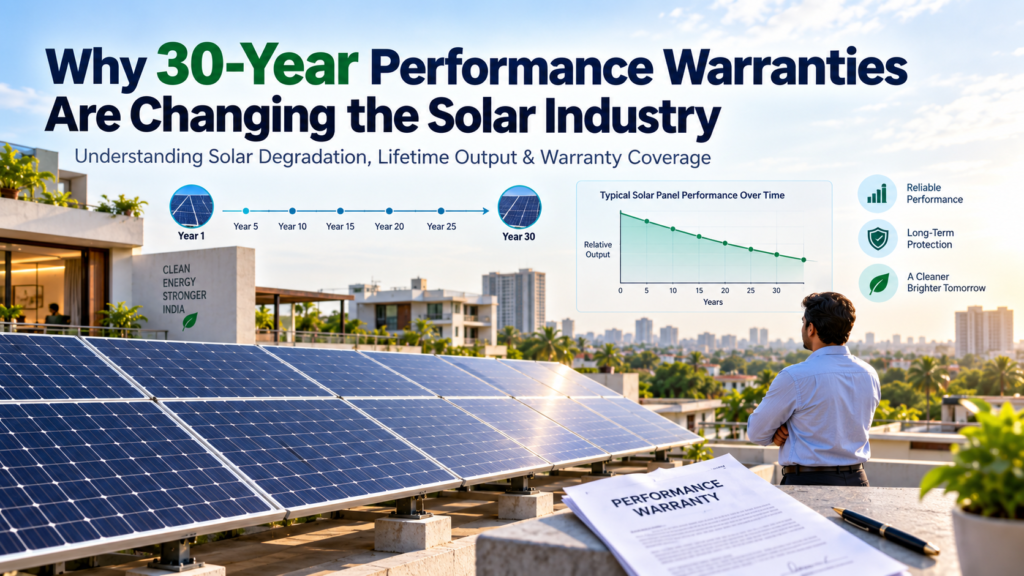
Solar panels are no longer being evaluated only on their wattage, efficiency or purchase price.
As Solar technology matures, buyers are increasingly asking a different question:
How much electricity will these panels continue to produce 20 or 30 years from now?
This is where long-term Solar performance warranties are becoming increasingly important.
Many newer Solar modules now come with performance warranties extending to 30 years, compared with the 20–25-year warranties that were common across much of the industry previously. NREL’s analysis of industry projections shows performance warranties rising toward 30 years while expected degradation rates are also improving.
Some manufacturers already offer 30-year power warranties on specific module technologies. For example, Canadian Solar states that some of its current N-type products carry 30-year power warranties, while JinkoSolar’s Tiger Neo 3.0 materials describe a 30-year power-output warranty and a 0.35% annual linear degradation rate. These are manufacturer- and product-specific claims, not a universal specification for every Solar panel.
This shift matters because Solar is a long-term asset.
If a panel produces electricity for decades, even relatively small differences in annual degradation can influence the total energy generated over the system’s operating life.
But there is an important catch:
A 30-year performance warranty does not mean the panel will produce 100% of its original power for 30 years.
Understanding what the warranty actually promises is therefore more important than simply looking at the number “30 years.”
Quick Answer: Why Are 30-Year Solar Performance Warranties Important?
A 30-year performance warranty generally specifies a minimum level of electrical output that the manufacturer guarantees the module will retain over a defined period, subject to the warranty’s terms and measurement conditions.
Longer performance warranties can:
- Increase confidence in long-term Solar output
- Make lifetime energy estimates more meaningful
- Help differentiate newer module technologies
- Potentially improve long-term project economics
- Give residential and commercial buyers another way to compare modules
- Encourage manufacturers to focus more heavily on long-term durability and degradation
However, the warranty percentage, degradation curve, exclusions, claim process and measurement method matter just as much as the 30-year duration.
What Is a Solar Performance Warranty?
A Solar performance warranty is a manufacturer’s commitment regarding the electrical output of a Solar module over a specified period.
For example, a hypothetical warranty might state that:
- The panel experiences a defined maximum degradation during the first year.
- After the first year, degradation cannot exceed a specified annual or linear rate.
- At the end of the warranty period, the panel must retain at least a specified percentage of its original rated power.
The exact figures differ between manufacturers and product families.
For example, Canadian Solar has published products with a 30-year performance warranty and an end-of-year-30 minimum output of 83% for a particular module configuration. Other manufacturers and product lines can specify different degradation curves and final guaranteed outputs.
Therefore, simply saying:
“This panel has a 30-year warranty.”
does not provide enough information.
The buyer should ask:
“30-year warranty for what, and to what guaranteed output?”
Product Warranty vs Performance Warranty
This is one of the most important distinctions in Solar.
Product Warranty
A product warranty generally relates to defects in materials or workmanship.
It may cover issues involving the module’s physical construction, subject to the manufacturer’s terms.
Examples can include:
- Manufacturing defects
- Material defects
- Certain workmanship issues
The exact coverage varies by manufacturer.
Performance Warranty
A performance warranty relates primarily to the module’s electrical output over time.
It addresses degradation and minimum guaranteed power output.
Therefore:
Product warranty = physical/product quality
Performance warranty = electrical output over time
A Solar panel can have a long performance warranty while having a different product warranty period.
Why 30 Years Is Becoming More Common
The Solar industry has been improving module technology, materials and manufacturing processes.
NREL notes that modern PV modules are expected to operate for decades and that the industry is working to understand and extend module lifetimes. Its research describes today’s modules as potentially operating around 30 years while research continues into even longer lifetimes.
NREL’s 2024 industry projection also showed performance warranties increasing from around 25 years in 2023 toward 30 years in 2026, alongside declining projected annual degradation.
This reflects a broader change:
Solar is increasingly being treated as a long-life infrastructure asset rather than a short-term equipment purchase.
What Is Solar Panel Degradation?
Solar panels gradually lose some electrical output as they operate outdoors.
This process is called degradation.
Exposure to:
- Sunlight
- Heat
- Humidity
- Temperature cycling
- Moisture
- Mechanical stress
- Environmental conditions
can contribute to changes in module performance over time.
NREL notes that module degradation commonly falls within a broad range depending on technology and conditions, and its research highlights the importance of measuring actual field degradation rather than relying solely on assumptions.
The key point is:
Solar panels do not normally stop working when the warranty period ends.
Instead, their output generally declines gradually.
What Does 0.3%, 0.4% or 0.5% Annual Degradation Mean?
Suppose a Solar panel has a hypothetical annual degradation rate of 0.4% after the first year.
That does not mean the panel loses 0.4% of its original output every month.
It generally refers to an annual decline according to the manufacturer’s specified degradation model.
For example, a simplified model might look like:
Year 1 → initial output
Year 2 → slightly lower
Year 10 → further reduction
Year 20 → further reduction
Year 30 → lower than original rating
The exact result depends on the warranty structure.
Some manufacturers use linear degradation models, while others may specify first-year degradation separately followed by a lower annual degradation rate.
Why Lower Degradation Matters
Imagine two otherwise similar Solar panels.
Panel A
Higher annual degradation.
Panel B
Lower annual degradation.
Both may produce almost identical electricity during their first year.
But over 20–30 years, the difference can become more meaningful.
For a large commercial Solar project with thousands of panels, even a relatively small difference in long-term output can affect lifetime energy production.
This is why long-term degradation is becoming an important part of Solar module comparisons.
30-Year Warranty Does Not Mean 30 Years of Full Power
This misconception is extremely common.
A 30-year performance warranty generally does not mean:
“The panel will produce exactly the same electricity for 30 years.”
Instead, the manufacturer typically guarantees that output will remain above a defined threshold at the end of the warranty period.
For example, a hypothetical panel could have:
100% initial rated power
and a warranty guaranteeing:
at least 87% after 30 years
That does not mean the panel produces 100% for years 1–29 and suddenly drops to 87% in year 30.
The actual degradation curve may be gradual.
The warranty defines the manufacturer’s guaranteed limit.
Why the Degradation Curve Matters
Two Solar panels could both have:
30-year performance warranties
but have different degradation curves.
For example:
| Feature | Panel A | Panel B |
|---|---|---|
| Warranty period | 30 years | 30 years |
| First-year degradation | 2% | 1% |
| Annual degradation after Year 1 | 0.5% | 0.35% |
| End-of-warranty output | Different | Different |
This is only an illustrative comparison.
The important lesson is:
Do not compare Solar panels based only on warranty duration.
Compare the entire performance warranty document.
How 30-Year Warranties Can Affect Solar ROI
Solar investment calculations typically consider expected electricity generation over time.
If a panel has lower degradation, its projected lifetime generation can be higher than a comparable panel with greater degradation.
This can influence:
- Lifetime energy production
- Levelized cost of electricity
- Payback calculations
- Project IRR
- Long-term electricity savings
- Commercial Solar investment models
For a residential Solar system, the difference may be modest depending on system size.
For a large factory, warehouse, cold storage or commercial Solar plant, small differences can become more significant because the installed capacity is much larger.
Example: Why Lifetime Output Matters
Consider a simplified 100 kW Solar installation.
Suppose two module options have similar initial efficiency and price, but one has a slightly lower long-term degradation rate.
During the first year, the difference may be difficult to notice.
Over several decades, however, the cumulative energy difference can become more meaningful.
That additional energy may have economic value because it can:
- Offset more grid electricity
- Increase self-consumption
- Increase export where applicable
- Improve long-term project economics
This is why sophisticated Solar buyers increasingly evaluate lifetime energy yield rather than only first-year output.
Does a 30-Year Warranty Mean the Solar System Lasts 30 Years?
Not necessarily.
A module’s performance warranty is only one component of a Solar system.
A rooftop installation also includes:
- Inverter
- Mounting structure
- DC cables
- AC cables
- Connectors
- Protection equipment
- Earthing
- Surge protection
- Monitoring equipment
- Metering equipment
Some components may have much shorter warranties than the Solar modules.
For example, an inverter may have a different warranty period and may require replacement during the lifetime of the Solar panels.
Therefore:
30-year panel performance warranty ≠ 30-year warranty on the entire Solar system.
What About the Inverter?
This is particularly important for homeowners comparing Solar proposals.
A proposal might advertise:
“30-year Solar panel warranty.”
But the inverter could have a substantially shorter warranty.
That does not necessarily mean the inverter is poor quality.
Electronic equipment has different operating characteristics from Solar modules.
However, the buyer should include possible inverter replacement or extended warranty costs when evaluating the long-term project economics.
Why Long-Term Warranties Are Important for Commercial Solar
For commercial Solar, the financial model can extend over many years.
A business may invest in:
- Rooftop Solar
- Ground-mounted Solar
- Factory Solar
- Warehouse Solar
- Cold-storage Solar
- Rice-mill Solar
- Hotel Solar
- Supermarket Solar
The investment decision may consider 20–30 years of expected energy production.
A stronger long-term performance warranty can therefore provide additional confidence when modelling future generation.
However, businesses should still evaluate the manufacturer’s financial strength, warranty terms, service network and claim process.
Does a Longer Warranty Automatically Mean a Better Solar Panel?
No.
A 30-year warranty is useful, but it should not be the only selection criterion.
A good Solar module evaluation should also consider:
- Cell technology
- Module efficiency
- Temperature coefficient
- First-year degradation
- Annual degradation
- Mechanical load rating
- Humidity resistance
- Thermal cycling performance
- Product warranty
- Performance warranty
- Manufacturer reputation
- Warranty terms
- Local service support
- Availability of replacement modules
The lowest degradation number is not automatically the best overall purchase if the product is significantly more expensive or the warranty terms are difficult to enforce.
The Warranty Provider Matters
A warranty is only useful if the manufacturer can support it.
NREL has highlighted practical concerns around Solar warranties, including the possibility that manufacturers may cease operations, difficulty proving underperformance and the fact that warranty coverage may not include labour required to remove, transport and reinstall a module.
Therefore, buyers should consider:
Manufacturer Track Record
How established is the company?
Local Availability
Is technical support available in India?
Warranty Claim Process
How is a claim submitted?
Replacement Policy
Will the manufacturer repair, replace or compensate?
Labour Coverage
Who pays for removal and reinstallation?
Transportation
Who bears shipping costs for replacement modules?
Documentation
What evidence is required to establish underperformance?
These details can matter more than the headline “30-year warranty.”
Warranty vs Insurance: They Are Not the Same
A performance warranty does not normally mean the panel is insured against every possible event.
A warranty may not cover every situation involving:
- Cyclone damage
- Hail
- Falling objects
- Fire
- Flooding
- Theft
- Accidental damage
- Improper installation
- Unauthorized modification
The exact exclusions depend on the manufacturer’s warranty terms.
Insurance, where appropriate, addresses different risks.
Therefore:
Warranty ≠ Insurance
What Can Void or Limit a Solar Warranty?
Warranty conditions vary, but potential issues can include:
- Improper installation
- Unauthorized modifications
- Mishandling
- Incorrect mounting
- Physical damage
- Failure to follow manufacturer instructions
- Unapproved cleaning methods
- Environmental conditions outside specified limits
NREL has documented cases where improper handling or failure to follow specified conditions can affect warranty validity.
This is why installation quality matters even when the panel has a long warranty.
Why Installation Quality Still Matters
A high-quality Solar module cannot compensate for poor installation.
For example, incorrect installation could contribute to:
- Mechanical stress
- Microcracks
- Cable damage
- Water ingress
- Connector problems
- Hotspots
- Structural issues
The panel warranty should therefore be considered alongside:
Module quality + Installation quality + Electrical design + Maintenance
A 30-year warranty is not permission to ignore system maintenance.
How Climate Can Affect Long-Term Solar Performance
Solar panels operate outdoors for decades.
For installations in regions such as Andhra Pradesh, the long-term environment can include:
- High temperatures
- Humidity
- Monsoon rainfall
- Dust
- Strong winds
- Cyclones in some coastal and nearby areas
- Bird activity
A good module specification should therefore be considered in the context of the installation environment.
Temperature coefficient, moisture resistance, mechanical loading and appropriate mounting can all matter.
Why 30-Year Warranties Are Changing Customer Expectations
Historically, many customers looked primarily at:
“How many watts is the panel?”
Now the conversation increasingly includes:
“How much will it still produce after 25 or 30 years?”
This changes the Solar buying decision from a simple equipment purchase into a lifetime performance evaluation.
Customers can increasingly compare:
- Initial price
- Efficiency
- Degradation
- Warranty period
- End-of-warranty output
- Manufacturer reliability
- Long-term energy yield
This encourages more informed purchasing.
Long-Term Warranties May Also Affect Solar Financing
Lenders and investors care about predictable cash flows.
If a Solar project depends on electricity generation over many years, expected module degradation is part of the financial model.
A clearly defined long-term performance warranty can provide additional information when estimating future production.
It does not eliminate project risk, but it can contribute to a more structured risk assessment.
This is particularly relevant for:
- Commercial Solar
- Industrial Solar
- Large rooftop projects
- Third-party-owned Solar
- Solar PPAs
- Long-term energy contracts
How 30-Year Warranties Encourage Better Solar Technology
Longer performance commitments can create pressure on manufacturers to improve:
- Cell durability
- Encapsulation
- Backsheets or glass-glass construction
- Interconnections
- Junction boxes
- Manufacturing quality
- Degradation characteristics
- Testing procedures
The broader industry is also researching how Solar modules can survive longer than today’s typical performance periods.
NREL’s DuraMAT research programme, for example, focuses on understanding module failure mechanisms and developing technologies that could extend module lifetimes further.
Could Solar Panels Last More Than 30 Years?
Yes, potentially.
A 30-year performance warranty should not be interpreted as an expiration date.
The panel may continue producing electricity after the warranty period.
The question is simply whether the manufacturer continues to guarantee a particular minimum output after that point.
The U.S. Department of Energy notes that PV systems commonly have performance periods around 20–30 years, while industry data indicate that expected operational lifetimes can extend beyond that depending on equipment, maintenance and conditions.
Research is also investigating how module lifetimes could be extended further.
What Happens After the 30-Year Warranty?
Several possibilities exist.
Continue Operating
If the panels remain productive and safe, the owner may continue using them.
Repower
Some equipment may be replaced with newer, more efficient technology.
Replace Selected Modules
Damaged or significantly underperforming modules may be replaced.
Replace the Inverter
The inverter may reach the end of its useful life before the panels.
Recycle or Decommission
Eventually, the system may be retired and its components managed through appropriate recycling or disposal processes.
The end of the performance warranty is therefore not automatically the end of the Solar system.
What Should You Check Before Buying a Panel With a 30-Year Warranty?
Do not stop at the headline.
Ask for the actual warranty document and check:
1. Product Warranty Period
How long is the physical product covered?
2. Performance Warranty Period
Is it 25 years, 30 years or another period?
3. First-Year Degradation
What happens during the first year?
4. Annual Degradation
What is the guaranteed annual decline after Year 1?
5. End-of-Warranty Output
What percentage of original power is guaranteed at the end?
6. Warranty Type
Is the curve linear, stepped or otherwise structured?
7. Claim Procedure
How is underperformance verified?
8. Replacement Terms
What exactly does the manufacturer provide?
9. Labour Coverage
Is removal and reinstallation included?
10. Warranty Exclusions
What circumstances are excluded?
11. Manufacturer Support
How can customers make claims in India?
12. Documentation
What installation and maintenance records must be retained?
A Simple Way to Compare Two Solar Panels
Suppose you have two options.
Panel A
- Lower purchase price
- 25-year performance warranty
- Higher degradation rate
Panel B
- Higher purchase price
- 30-year performance warranty
- Lower degradation rate
The correct choice is not automatically Panel B.
Instead, compare:
Additional upfront cost
vs.
Additional expected lifetime energy
vs.
Value of that additional electricity
vs.
Warranty and manufacturer support
This gives you a more meaningful economic comparison.
Should Homeowners Always Choose a 30-Year Warranty?
Not necessarily.
A homeowner should consider:
- System size
- Electricity consumption
- Expected ownership period
- Roof condition
- Budget
- Panel price difference
- Expected generation
- Warranty terms
- Manufacturer reputation
- Local service availability
If the 30-year panel costs substantially more but provides only a small additional economic benefit, the lower-cost option could still make sense.
On the other hand, if the price difference is modest and the long-term performance characteristics are better, the longer warranty could be attractive.
Should Commercial Buyers Pay More for a 30-Year Warranty?
Commercial Solar requires a more detailed financial analysis.
For a large factory or commercial building, even small differences in degradation can affect thousands of kilowatt-hours over the project’s lifetime.
Businesses should therefore compare:
- Installed cost per kW
- First-year generation
- Degradation rate
- Lifetime generation
- Warranty terms
- Financing cost
- O&M cost
- Inverter replacement assumptions
- Electricity tariff
- Tax treatment
- Project life
The best module is not necessarily the one with the longest warranty.
It is the one that provides an appropriate combination of cost, reliability, energy yield and long-term risk.
What 30-Year Warranties Mean for Solar Buyers in Andhra Pradesh
For homeowners and businesses in Andhra Pradesh, a long-term performance warranty can be useful because rooftop Solar is intended to operate for many years.
In areas such as Tadepalligudem and West Godavari, buyers should look beyond the warranty headline and evaluate whether the selected module and installation are suitable for the local operating environment.
Important considerations can include:
- Temperature
- Humidity
- Dust
- Monsoon exposure
- Wind loading
- Roof condition
- Mounting quality
- Cleaning practices
- Electrical protection
- Inverter selection
A strong warranty is most valuable when it is supported by a properly designed and professionally installed Solar system.
How VMJ Solar Solutions Can Help You Evaluate Long-Term Solar Performance
For customers in Tadepalligudem, West Godavari and nearby areas, VMJ Solar Solutions can help compare Solar equipment beyond just the panel wattage.
A Solar proposal can be evaluated based on:
- Module technology
- Efficiency
- Product warranty
- Performance warranty
- Degradation rate
- Inverter warranty
- Expected generation
- Roof conditions
- Mounting requirements
- Electrical protection
- Monitoring
- Maintenance requirements
- Long-term project economics
The goal should be to select a Solar system that makes sense for the property’s energy requirements and expected ownership period.
A 30-year warranty can be an important part of that decision, but it should always be read alongside the actual warranty document.
FAQs
1. What is a 30-year Solar performance warranty?
It is a manufacturer’s long-term guarantee that a Solar module will maintain at least a specified level of electrical output over 30 years, subject to the warranty’s conditions.
2. Does a 30-year warranty mean the panel will produce full power for 30 years?
No. Solar modules gradually degrade. The warranty generally specifies a minimum output that must be maintained at the end of the warranty period.
3. Is a 30-year performance warranty better than a 25-year warranty?
Not automatically. Compare the degradation rate, guaranteed end-of-warranty output, product warranty, price, manufacturer and warranty terms.
4. What is Solar panel degradation?
Degradation is the gradual reduction in a module’s electrical output over time due to long-term exposure to environmental and operating conditions.
5. What is the difference between product warranty and performance warranty?
A product warranty generally addresses defects in materials or workmanship, while a performance warranty addresses electrical output over time.
6. Do all Solar panels have 30-year warranties?
No. Warranty periods vary by manufacturer and product. Many newer products offer longer performance warranties, but 25-year and other warranty structures remain available.
7. Can a Solar panel continue working after its 30-year warranty ends?
Yes. The end of a performance warranty does not automatically mean the panel stops generating electricity.
8. Does a 30-year Solar warranty cover the inverter?
Usually not. Solar modules and inverters have separate warranty terms.
9. Does a Solar warranty cover cyclone or hail damage?
Not necessarily. Weather and accidental damage may fall under different insurance or warranty provisions. Always check the manufacturer’s exclusions.
10. Why are manufacturers offering longer Solar warranties?
Improving module technologies, manufacturing processes and confidence in long-term degradation are among the factors supporting longer performance warranties.
11. How should I compare two Solar panels with 30-year warranties?
Compare their degradation curves, end-of-warranty output, product warranty, efficiency, temperature coefficient, mechanical specifications, price and manufacturer support.
12. Is a 30-year warranty useful for commercial Solar?
It can be particularly relevant because commercial Solar projects may operate for decades and depend on long-term energy production. The warranty should be evaluated as part of the overall financial model.
Conclusion
30-year performance warranties are changing how Solar panels are evaluated.
The Solar industry is moving beyond the simple question of:
“How many watts does this panel produce today?”
and increasingly toward:
“How much energy can this panel reliably produce over its lifetime?”
NREL’s industry projections show the move toward longer performance warranties alongside declining expected degradation rates, while current manufacturers already offer 30-year power warranties on selected module products.
For buyers, this is positive—but the headline warranty period should never be the only deciding factor.
A 30-year performance warranty is not a guarantee of 100% output for 30 years, nor is it a warranty for the entire Solar system.
The smarter approach is to compare:
Performance warranty + degradation rate + end-of-warranty output + product warranty + manufacturer support + installation quality + lifetime economics
For homeowners and commercial customers in Tadepalligudem, West Godavari and across Andhra Pradesh, this approach can help make Solar purchasing decisions based on long-term value rather than simply the lowest upfront price.
Important: Solar warranty terms differ by manufacturer and product model. Always obtain and review the current official warranty document before purchasing. Warranty claims, degradation guarantees and covered components can have specific conditions and exclusions.