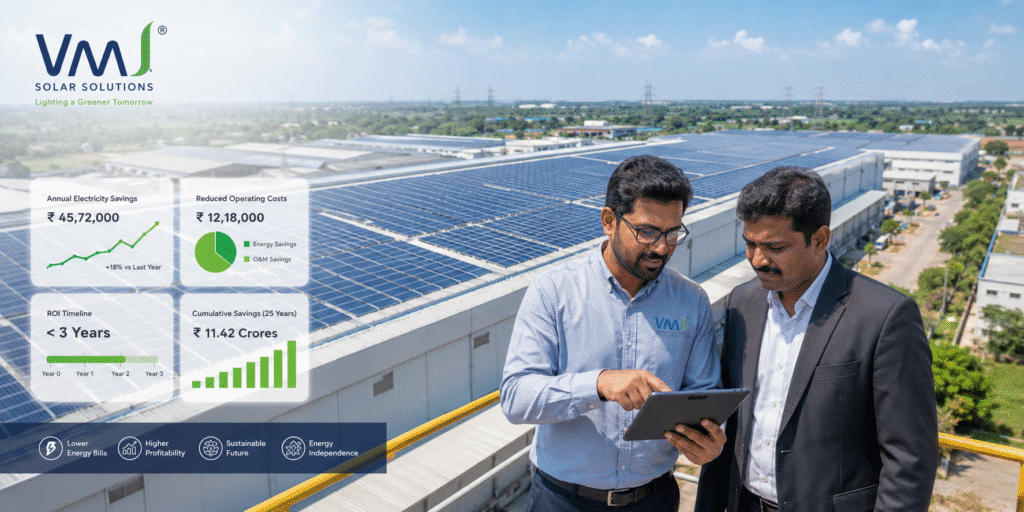
Yes, some commercial solar projects can achieve a return on investment (ROI) in under 3 years—but only under the right conditions.
Businesses with:
- High daytime electricity consumption
- Expensive commercial power tariffs
- Adequate rooftop space
- Well-designed solar systems
often experience faster payback periods than residential users.
However, ROI depends on several factors, including:
- Electricity rates
- Solar system cost
- Energy consumption patterns
- Financing structure
- Net metering regulations
- System performance
At VMJ Solar Solutions, commercial clients are often surprised to discover that solar is not just an environmental decision—it can also be one of the strongest long-term financial investments available for energy-intensive businesses.
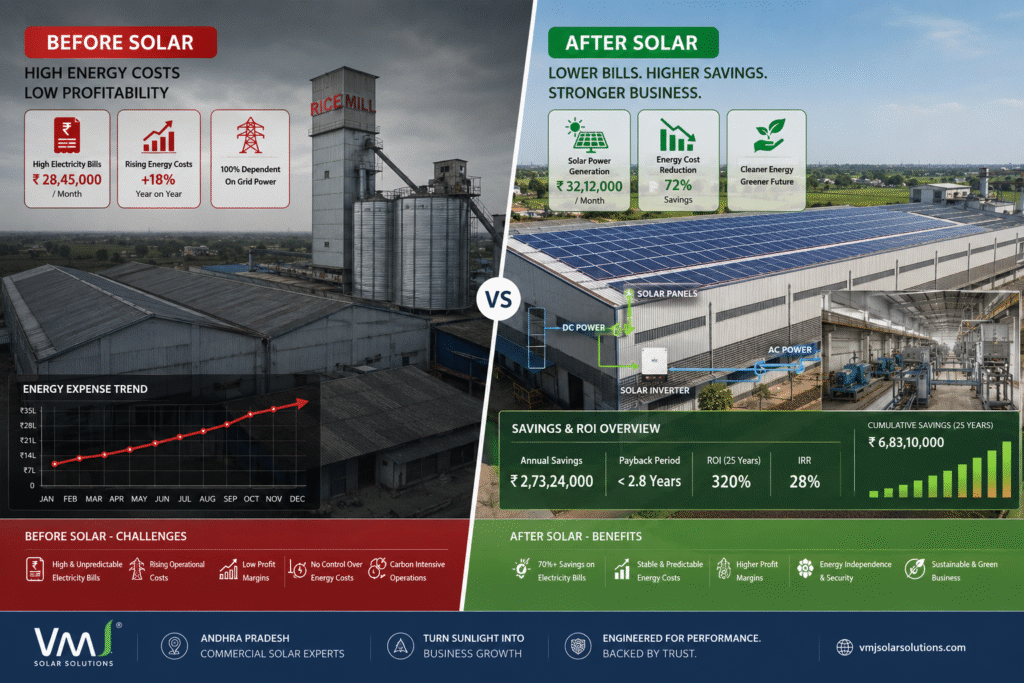
Why Businesses Are Turning to Commercial Solar
Across Andhra Pradesh, business owners are facing a common challenge:
Rising Electricity Costs
Whether it’s a:
- Rice mill
- Manufacturing unit
- Cold storage facility
- Warehouse
- Educational institution
- Hospital
- Commercial office
- Hotel
electricity is becoming an increasingly significant operating expense.
Unlike many business costs that fluctuate, energy consumption is often unavoidable.
This has led many organizations to ask:
“Can solar reduce our electricity expenses enough to justify the investment?”
For certain businesses, the answer is yes—and the financial results can be substantial.
Commercial solar projects are increasingly viewed as:
✔ Cost reduction tools
✔ Long-term investments
✔ Sustainability initiatives
✔ Risk management strategies
rather than simply renewable energy projects.
What Is Commercial Solar?
Commercial solar refers to solar power systems installed on:
- Factories
- Warehouses
- Educational institutions
- Hospitals
- Hotels
- Shopping complexes
- Agricultural processing facilities
- Corporate offices
These systems are generally larger than residential installations and are designed to offset significant electricity consumption.
Why Commercial Solar Often Delivers Faster ROI
One major reason commercial projects can outperform residential projects is:
Higher Electricity Tariffs
Commercial and industrial consumers often pay significantly more per unit of electricity compared to residential users.
Every unit generated by solar can therefore offset higher-cost electricity.
This increases potential savings.
Understanding Commercial Solar ROI
ROI stands for:
Return on Investment
In simple terms:
ROI measures how quickly the savings generated by the solar system recover the installation cost.
Basic Formula
ROI is influenced by:
- Initial investment
- Annual electricity savings
- System maintenance costs
- Financing expenses
- Energy tariff trends
The higher the savings, the faster the payback period.
Why Some Businesses Reach ROI Faster Than Others
Not all commercial solar projects perform equally.
Several factors influence financial outcomes.
1. High Daytime Electricity Consumption
Solar panels generate electricity during daylight hours.
Businesses operating primarily during the day often maximize solar utilization.
Examples include:
- Rice mills
- Manufacturing units
- Warehouses
- Food processing facilities
- Educational campuses
This alignment improves ROI.
2. Large Electricity Bills
Businesses spending substantial amounts on electricity often have greater opportunities for savings.
The larger the offset, the greater the financial impact.
3. Sufficient Rooftop Space
A large, unobstructed roof allows:
- Better system sizing
- Greater generation capacity
- Improved project economics
4. Proper System Design
A poorly designed system may:
- Underperform
- Produce less electricity
- Deliver lower returns
Professional engineering plays a critical role.
Why Andhra Pradesh Is Ideal for Commercial Solar
Andhra Pradesh offers several advantages.
Strong Solar Irradiation
The state receives abundant sunlight throughout much of the year.
Industrial Growth
Major commercial activity exists in:
- Vijayawada
- Visakhapatnam
- Guntur
- Kakinada
- Nellore
- Tirupati
and surrounding industrial corridors.
Large Rooftop Infrastructure
Many businesses have:
- Factory roofs
- Warehouse roofs
- Commercial buildings
that are suitable for solar installations.
Industries That Often Benefit Most
Rice Mills
Rice mills typically operate:
- Heavy motors
- Processing equipment
- Conveyors
- Blowers
making them strong candidates for solar.
Manufacturing Units
Factories with continuous daytime operations often maximize solar self-consumption.
Cold Storage Facilities
These facilities have significant energy requirements year-round.
Educational Institutions
Schools and colleges often operate during solar production hours.
Hospitals
Hospitals have consistent electricity demand and can benefit from reduced operating costs.
The Power of Net Metering
Net metering allows eligible systems to export excess electricity to the grid.
Benefits may include:
- Better solar utilization
- Improved project economics
- Enhanced overall savings
However, policies and regulations can change over time, so businesses should stay informed about current DISCOM requirements.
How Commercial Solar Improves Cash Flow
Unlike many business investments that generate uncertain returns, solar directly reduces operating expenses.
Every month, businesses may benefit from:
Lower Electricity Purchases
This creates recurring savings that can improve financial performance.
Reduced Exposure to Tariff Increases
Future electricity price increases may have less impact on businesses generating their own power.
Additional Benefits Beyond ROI
Many organizations focus only on payback periods.
However, commercial solar also provides:
Energy Cost Predictability
Businesses gain greater control over long-term energy expenses.
Sustainability Credentials
Solar supports:
- ESG initiatives
- Corporate sustainability goals
- Green building strategies
Competitive Advantage
Energy-efficient businesses often improve operational resilience and cost competitiveness.
Can Every Commercial Project Achieve ROI in Under 3 Years?
No
This is where realistic expectations are essential.
Some businesses may achieve rapid payback periods due to:
- High energy costs
- Excellent solar conditions
- Optimal system design
Others may experience longer payback periods.
Factors that may extend ROI include:
- Low electricity consumption
- Roof limitations
- Financing costs
- Shading issues
- Lower solar utilization
A detailed feasibility assessment is always necessary.
Common Mistakes Businesses Make
Mistake 1: Choosing Based on Lowest Price
The cheapest system is not always the most profitable long term.
Mistake 2: Ignoring Energy Audits
Understanding consumption patterns is critical before sizing a system.
Mistake 3: Focusing Only on Installation Cost
Long-term generation and reliability matter more than initial savings.
Mistake 4: Overlooking Maintenance
Regular inspections help maintain system performance and protect ROI.
Why Professional Feasibility Studies Matter
Before recommending a commercial solar project, installers should evaluate:
- Electricity bills
- Load profiles
- Roof conditions
- Shadow analysis
- Structural suitability
- Future expansion plans
This ensures realistic projections.
At VMJ Solar Solutions, commercial project recommendations are based on actual operational data rather than generic assumptions.
FAQ’S
1.Which businesses benefit most from commercial solar?
Industries with significant daytime electricity consumption often benefit the most, including rice mills, factories, warehouses, hospitals, and educational institutions.
2.Is commercial solar profitable in Andhra Pradesh?
Many businesses in Andhra Pradesh benefit from strong solar resources and high daytime energy demand, making solar an attractive long-term investment.
3.Does net metering improve solar ROI?
Net metering may improve project economics by allowing excess electricity to be exported under applicable regulations.
Final Thoughts
Commercial solar is increasingly becoming a strategic business investment rather than simply an energy project.
For businesses with:
- High electricity consumption
- Strong daytime operations
- Suitable roof space
solar can deliver meaningful reductions in operating expenses and potentially attractive returns over time.
The key is focusing on:
✔ Proper system design
✔ Accurate feasibility studies
✔ Quality equipment
✔ Realistic financial projections
rather than chasing unrealistic promises.
For businesses in Andhra Pradesh exploring:
- Commercial solar installation
- Industrial rooftop solar
- Rice mill solar projects
- Factory solar systems
- Warehouse solar solutions
- Energy cost reduction strategies
VMJ Solar Solutions can help evaluate your facility and design a solar solution aligned with your operational goals, energy profile, and long-term financial objectives.