
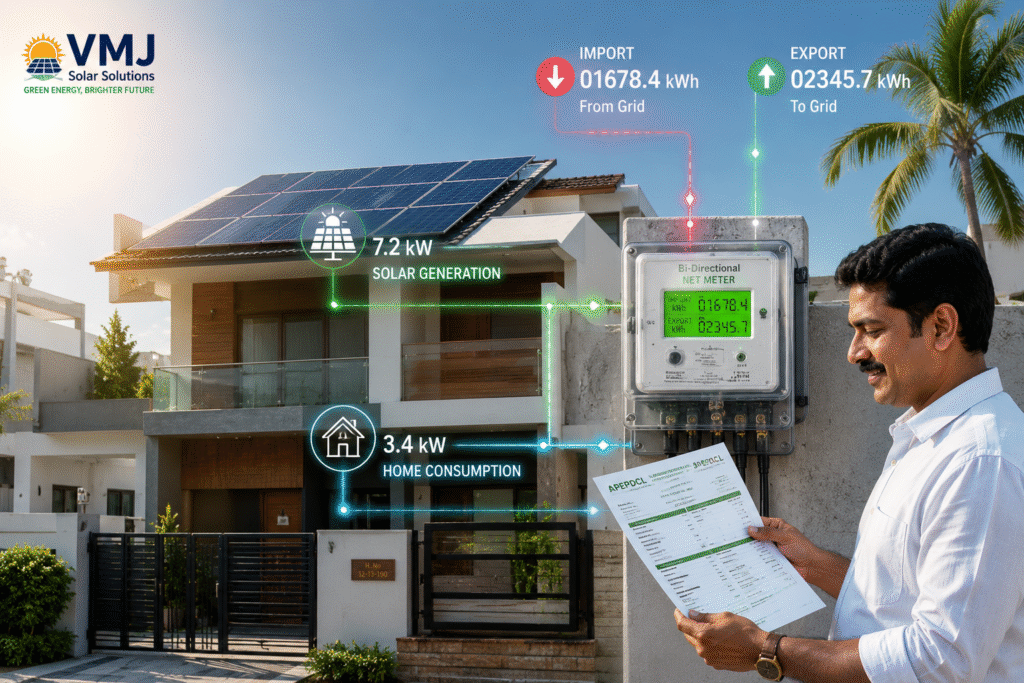
After installing a rooftop solar system, many homeowners expect their electricity bill to become simpler.
Instead, they often open their first DISCOM solar net meter bill and find themselves staring at unfamiliar terms like:
- Import Units
- Export Units
- Net Consumption
- Net Meter Reading
- Billing Cycle
- Solar Credit Balance
This confusion is completely normal.
At VMJ Solar Solutions, one of the most common questions we hear from solar customers across Andhra Pradesh is:
“My solar system is generating electricity, so why am I still getting a bill?”
The answer lies in understanding how net metering works and how Andhra Pradesh DISCOMs calculate your monthly electricity charges.
This guide will help homeowners understand:
- How solar net metering works
- What each section of the bill means
- Why bills may vary month to month
- Common misconceptions about solar billing
- How to verify your solar savings
Whether you’re in Vijayawada, Guntur, Visakhapatnam, Tirupati, Nellore, or anywhere else in Andhra Pradesh, this guide will help you read your solar bill with confidence.
What Is Net Metering?
Before reading the bill, it’s important to understand net metering.
Simple Explanation
Your home with rooftop solar can:
Consume Electricity
when your appliances need power.
and
Export Electricity
when your solar system generates more energy than your home is using.
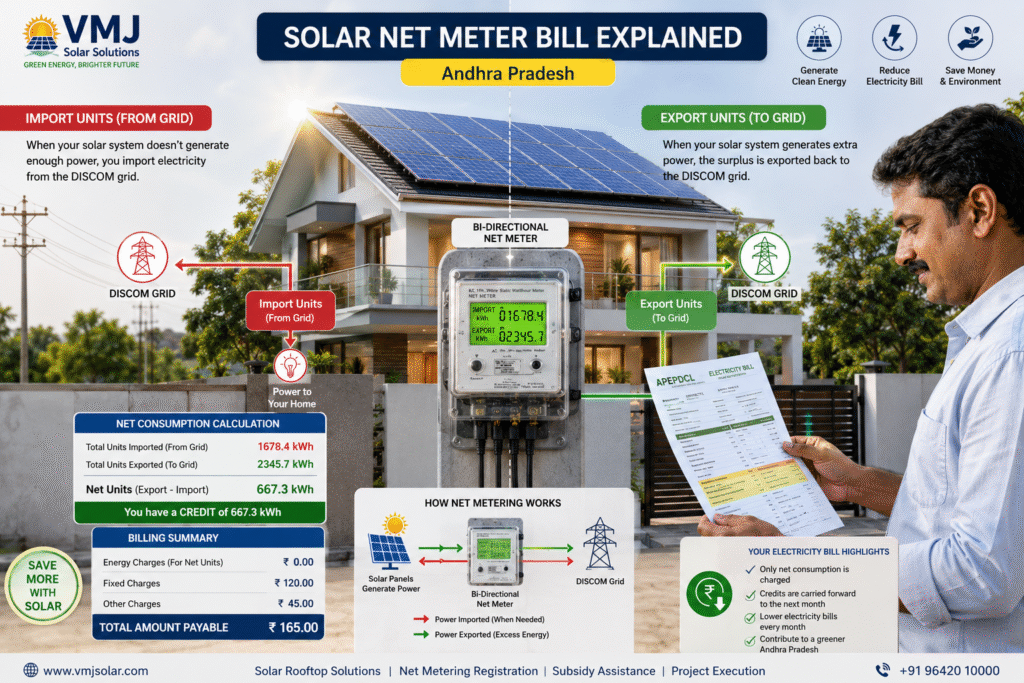
A bi-directional net meter records both flows.
It measures:
- Electricity imported from the grid
- Electricity exported to the grid
This data is used for monthly billing.
Understanding the Two Types of Electricity Flow
1. Import Units
Import units are the electricity you take from the grid.
This usually happens:
- At night
- During cloudy weather
- During high household consumption
Examples:
- Running ACs after sunset
- Using appliances during monsoon periods
- Heavy evening power usage
2. Export Units
Export units are the excess solar energy sent to the grid.
This often occurs:
- During sunny afternoons
- When household demand is low
- When solar generation exceeds consumption
How Net Metering Actually Works
Imagine a typical Andhra Pradesh household.
Monthly Solar Generation
500 Units
Monthly Home Consumption
650 Units
Excess Solar Exported
200 Units
Grid Import
350 Units
In this case:
Net Consumption
350−200=150350 – 200 = 150350−200=150
The consumer may be billed based on the applicable net energy calculation and tariff structure.
Actual billing methodology depends on current DISCOM regulations and applicable net metering policies.
Key Sections of a Solar Net Meter Bill
Although formats may vary between electricity providers, most Andhra Pradesh net meter bills contain similar information.
Consumer Information Section
This includes:
- Service number
- Consumer name
- Billing cycle
- Tariff category
- Meter details
Always verify these details for accuracy.
Meter Reading Section
This is one of the most important areas.
You will typically see:
Import Reading
Units received from the grid.
Export Reading
Units sent back to the grid.
Net Reading
Difference used for billing calculations.
Billing Period
This shows:
- Previous reading date
- Current reading date
- Number of billing days
Solar production naturally varies from month to month depending on season and weather.
Energy Charges Section
This section calculates electricity charges based on applicable tariffs.
Depending on:
- Consumption levels
- Net metering policy
- Tariff category
your charges may differ from month to month.
Fixed Charges
Many homeowners overlook this part.
Even with solar installed, bills may still include:
- Fixed service charges
- Meter charges
- Applicable regulatory charges
This is one reason solar users may continue receiving bills even during months with strong solar generation.
Why Am I Still Receiving an Electricity Bill?
This is probably the most frequently asked question.
Common Reasons
1. Night-Time Electricity Usage
Solar panels generate electricity only during daylight hours.
At night:
- Homes rely on the grid
- Import units accumulate
2. Seasonal Solar Variations
Generation may decrease during:
- Monsoon season
- Cloudy weather
- Dust accumulation periods
3. Fixed Utility Charges
Some charges remain regardless of solar generation levels.
4. Higher Household Consumption
Adding:
- Air conditioners
- Electric vehicles
- New appliances
can increase overall electricity usage.
Understanding Solar Credits
In some billing periods, your solar system may export more electricity than you import.
This can create:
Solar Credit Balance
These credits may be adjusted according to applicable DISCOM regulations and billing policies.
Policies can change over time, so consumers should always review current guidelines.
Why Your Bill Changes Every Month
Many homeowners expect identical savings every month.
However, solar generation depends on:
Weather Conditions
Sunny months typically generate more electricity than cloudy months.
Household Usage Patterns
Electricity consumption changes due to:
- AC usage
- School holidays
- Work-from-home schedules
- Seasonal appliance use
System Performance
Factors such as:
- Dust accumulation
- Shading
- Maintenance needs
can affect generation.
Common Mistakes When Reading Solar Bills
Mistake #1: Looking Only at the Final Amount
The bill amount alone does not tell the full story.
Always review:
- Import units
- Export units
- Net consumption
Mistake #2: Assuming Zero Bill Means Maximum Savings
Sometimes exported energy may not directly translate into zero charges due to billing structure and fixed charges.
Mistake #3: Ignoring Solar Generation Data
Compare:
- Solar inverter production data
- DISCOM billing records
to ensure system performance aligns with expectations.
Mistake #4: Not Monitoring Usage Growth
Many households gradually increase electricity consumption after installing solar.
This can reduce perceived savings.
How to Verify Your Solar Savings
A simple way to evaluate performance is to compare:
Before Solar
Average monthly electricity cost
vs.
After Solar
Current electricity expenses plus any remaining charges
Tracking usage over multiple seasons provides a clearer picture than reviewing a single bill.
The Role of Smart Monitoring Systems
Many modern solar systems include:
- Mobile apps
- Smart monitoring dashboards
- Real-time generation tracking
These tools help homeowners:
- Verify solar production
- Detect issues early
- Understand savings trends
Why Professional Guidance Matters
Net metering policies and billing structures can occasionally change.
A knowledgeable solar partner can help explain:
- Billing statements
- Export credits
- System performance
- Consumption patterns
At VMJ Solar Solutions, helping customers understand their energy data is just as important as installing the solar system itself.
Because informed homeowners tend to achieve better long-term results from their solar investment.
Frequently Asked Questions (FAQs)
1. What is the difference between import and export units?
Import units are electricity taken from the grid. Export units are excess solar energy sent back to the grid.
2. Why am I getting a bill even though I have solar panels?
Bills may still include:
- Grid electricity usage
- Fixed charges
- Seasonal consumption differences
3. Does solar eliminate electricity bills completely?
Not necessarily.
Savings depend on:
- Solar generation
- Consumption patterns
- Weather
- Applicable billing policies
4. How can I check if my solar system is working properly?
Compare:
- Solar inverter production data
- Net meter readings
- Monthly billing trends
5. What happens if I export more electricity than I consume?
The treatment of excess exported energy depends on current net metering regulations and utility policies.
6. Why does my bill vary every month?
Changes in:
- Weather
- Electricity usage
- Solar production
- Seasonal demand
can all affect billing outcomes.
Final Thoughts
Understanding your DISCOM solar net meter bill is one of the most important steps in getting the maximum value from your rooftop solar investment.
Instead of focusing only on the final bill amount, homeowners should learn to track:
✔ Import Units
✔ Export Units
✔ Net Consumption
✔ Solar Generation
✔ Monthly Usage Trends
A well-performing solar system should be evaluated over the long term, taking into account seasonal variations and actual consumption habits.
For homeowners across Andhra Pradesh considering rooftop solar installation, net metering, solar savings analysis, or energy-efficient home upgrades, partnering with experienced professionals like VMJ Solar Solutions can help ensure both your solar system and your understanding of it are working efficiently for years to come.