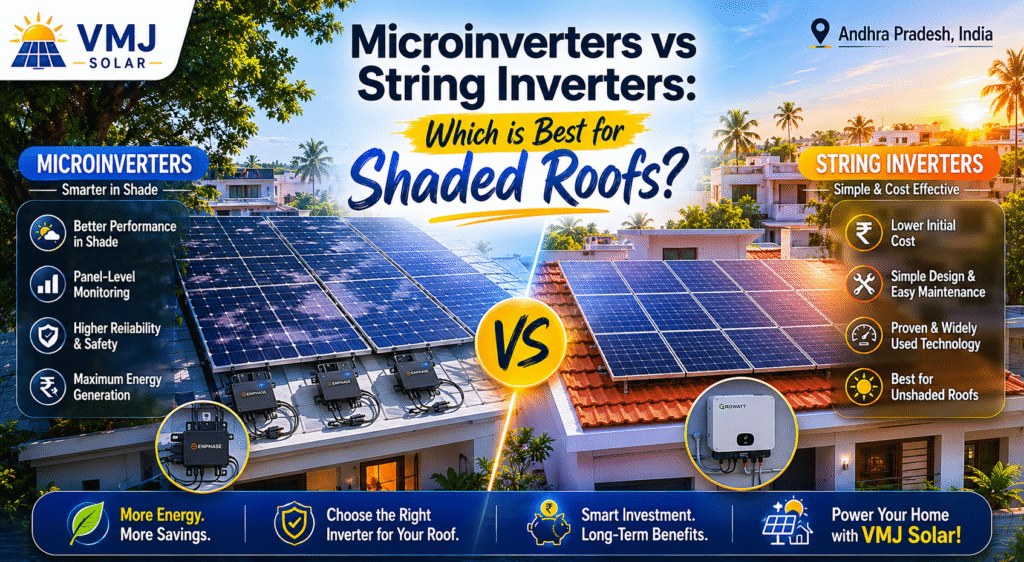
Rooftop solar adoption is growing rapidly across Andhra Pradesh as homeowners look for smarter ways to reduce electricity bills and improve energy efficiency. But one challenge many Indian homes face — especially in urban and semi-urban areas — is partial roof shading.
Water tanks, nearby buildings, coconut trees, mobile towers, and terrace structures often create shadows that affect solar panel performance. This is where one important question comes up:
Should you choose microinverters or string inverters for your rooftop solar system?
At VMJ Solar Solutions, this is one of the most common concerns homeowners ask during solar consultations.
The answer depends on:
- Roof shading conditions
- Budget
- System size
- Long-term maintenance goals
- Energy generation expectations
In this guide, we’ll explain the difference between microinverters and string inverters in simple language, especially for homeowners in Andhra Pradesh dealing with shaded rooftops.
Understanding Solar Inverters in Simple Terms
Solar panels generate DC (Direct Current) electricity. But homes use AC (Alternating Current) electricity.
The inverter’s job is to convert solar power into usable electricity for your home.
Without an inverter, rooftop solar panels cannot power household appliances.
There are two major inverter types used in residential solar systems:
- String Inverters
- Microinverters
Both have advantages and limitations.
What Is a String Inverter?
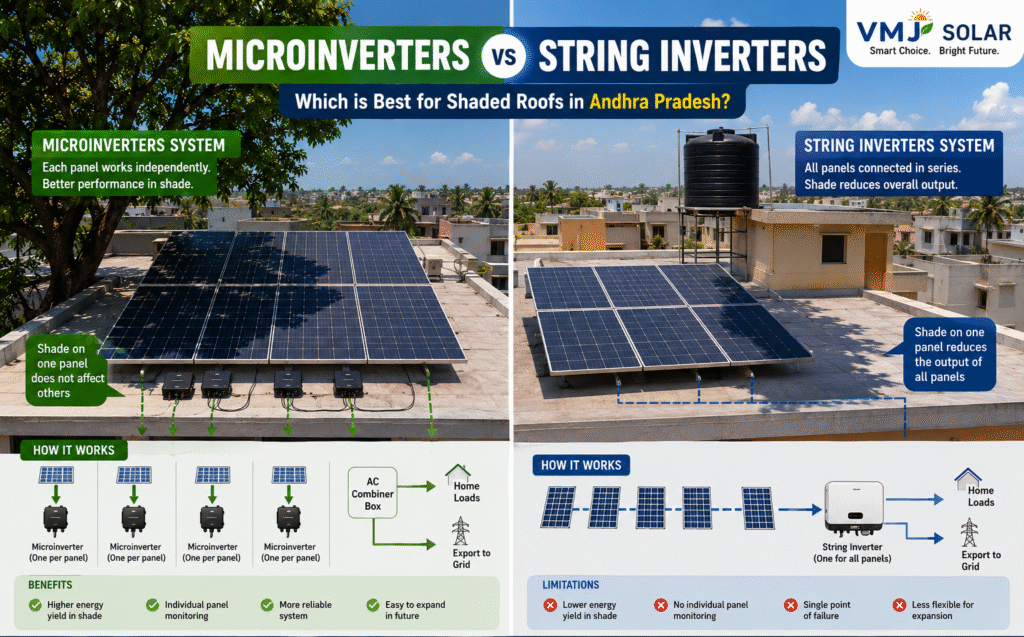
A string inverter connects multiple solar panels together into a “string.”
The electricity generated by all connected panels flows into one central inverter.
How It Works
If one panel underperforms due to shade, dust, or damage, the performance of the entire string may reduce.
Think of it like old-style series decorative lights:
- One weak connection affects overall performance.
What Is a Microinverter?
A microinverter is installed individually behind each solar panel.
Each panel operates independently.
How It Works
If one panel is shaded, the remaining panels continue performing normally.
This makes microinverters especially useful for roofs with:
- Partial shading
- Multiple roof directions
- Uneven sunlight exposure
Why Roof Shading Is Common in Andhra Pradesh
In cities like Vijayawada, Guntur, and Visakhapatnam, many homes face rooftop shading because of:
- Neighboring buildings
- Coconut and mango trees
- Water tanks
- Terrace rooms
- Electrical poles
- Apartment shadows
Even small shadows can affect solar performance depending on inverter type.
Microinverters vs String Inverters: Key Differences
| Feature | String Inverter | Microinverter |
|---|---|---|
| Cost | Lower upfront cost | Higher upfront cost |
| Shading Performance | Moderate | Better |
| Panel Monitoring | Limited | Individual panel monitoring |
| Efficiency on Complex Roofs | Lower | Higher |
| Installation Complexity | Simpler | More detailed |
| Expansion Flexibility | Moderate | Easier |
| Maintenance Access | Centralized | Distributed |
| Best For | Open sunny roofs | Partially shaded roofs |
Which Performs Better on Shaded Roofs?
Microinverters Usually Perform Better
For shaded roofs, microinverters generally offer better energy production because each panel works independently.
Example
Imagine:
- 10 solar panels installed
- 2 panels become shaded in the afternoon
With String Inverters:
The output of all connected panels may drop.
With Microinverters:
Only the shaded panels lose efficiency while the others continue producing normally.
This can improve total daily solar generation on partially shaded rooftops.
When String Inverters Make More Sense
Despite shading limitations, string inverters remain popular in India because they are:
- More affordable
- Easier to install
- Widely available
- Suitable for open rooftops
If your roof receives:
- Consistent sunlight
- Minimal shade
- Proper south-facing exposure
Then a quality string inverter system can still deliver excellent value.
Cost Difference: Is Microinverter Worth the Extra Money?
String Inverters Cost Less Initially
For budget-conscious homeowners, string inverters often reduce upfront installation costs.
Microinverters Cost More
Microinverters increase system cost because:
- Each panel gets its own inverter
- Installation is more detailed
- Component count is higher
Important Reality Check
The “best” option depends on long-term energy generation — not just installation price.
Sometimes paying more upfront for microinverters can improve long-term performance on shaded roofs.
But for fully open rooftops, the additional cost may not always justify the benefits.
Maintenance and Reliability Considerations
String Inverter Advantage
Since there is usually one central inverter:
- Maintenance is easier
- Troubleshooting is faster
- Replacement costs can be simpler
Microinverter Advantage
Microinverters reduce single-point failure risk because:
- One inverter problem affects only one panel
- The rest of the system continues working
However:
- Diagnosing rooftop-level issues may take more effort
- Long-term servicing quality matters greatly
Monitoring and Smart Features
Microinverters often provide:
- Panel-level performance monitoring
- Better energy tracking
- Faster fault detection
This is useful for homeowners who want detailed solar analytics through mobile apps.
String inverters usually provide:
- Overall system-level monitoring
- Simpler performance data
Which Is Better for Indian Weather Conditions?
Both inverter types can work well in Andhra Pradesh when installed properly.
However, factors like:
- High summer heat
- Dust accumulation
- Monsoon humidity
- Voltage fluctuations
make installation quality extremely important.
Choosing reliable components and experienced installers matters more than blindly choosing one inverter type over another.
Best Choice Based on Roof Type
Choose String Inverters If:
- Your roof gets full sunlight
- You want lower upfront cost
- Your roof layout is simple
- Shade is minimal
- You prefer easier maintenance
Choose Microinverters If:
- Your roof has partial shading
- Panels face multiple directions
- Future roof expansion is likely
- You want detailed panel monitoring
- Maximizing energy production matters more than minimum cost
Important Questions to Ask Before Choosing
Before selecting an inverter system, homeowners should ask:
- How much shading does my roof receive?
- What time of day does shading occur?
- Is my roof likely to expand later?
- What is my electricity consumption pattern?
- How important is long-term efficiency?
- What are warranty terms?
- Is after-sales service locally available?
Common Mistakes Homeowners Make
Choosing Based Only on Lowest Price
Cheap solar systems often compromise:
- Inverter quality
- Installation quality
- Safety standards
- Warranty support
Ignoring Roof Shading Analysis
Many homeowners underestimate how small shadows affect performance.
A professional solar site survey is critical before installation.
Overpaying for Unnecessary Technology
Not every roof requires microinverters.
For fully open roofs, string inverters may provide better ROI.
Why Professional Solar Assessment Matters
At VMJ Solar Solutions, rooftop assessments help homeowners understand:
- Real shading conditions
- Roof orientation
- Electricity usage patterns
- Budget considerations
- Long-term energy goals
Instead of pushing one inverter type for every project, the focus should always be:
“What works best for this specific home?”
Frequently Asked Questions (FAQs)
1. Are microinverters better than string inverters?
Not always. Microinverters generally perform better on shaded or complex roofs, while string inverters work well for open roofs with consistent sunlight.
2. Do microinverters increase solar panel lifespan?
Microinverters do not directly increase panel lifespan, but they can improve energy optimization and monitoring.
3. Which inverter type is more affordable?
String inverters usually have lower upfront costs.
4. Can shaded roofs still use rooftop solar?
Yes. Many shaded roofs can still support efficient solar systems with proper design and inverter selection.
5. Which inverter is easier to maintain?
String inverters are generally easier and cheaper to troubleshoot because the system is centralized.
6. Are microinverters good for Indian weather?
Yes, when quality products are installed properly by experienced professionals.
7. How long do solar inverters last?
Lifespan varies based on product quality, usage conditions, and maintenance.
Final Thoughts
Choosing between microinverters and string inverters is not about selecting the “most advanced” technology. It’s about selecting the right technology for your rooftop conditions.
For many homes in Andhra Pradesh:
- Open sunny rooftops may work perfectly with string inverters
- Shaded or complex rooftops may benefit more from microinverters
The key is proper roof assessment, realistic energy expectations, and quality installation.
Rooftop solar is a long-term investment. The inverter you choose today will directly affect:
- Energy generation
- Savings potential
- Maintenance experience
- System reliability
That’s why informed decisions matter more than marketing claims.