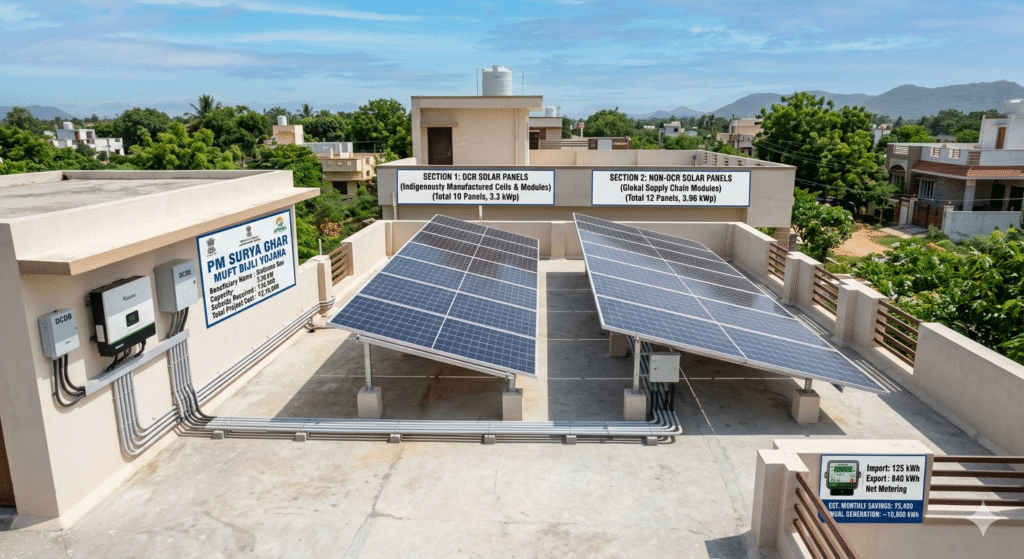
With the launch and expansion of the PM Surya Ghar Muft Bijli Yojana, rooftop solar adoption in India has accelerated rapidly. Across Andhra Pradesh, homeowners are actively searching for:
- Best solar panels for PM Surya Ghar
- DCR vs Non-DCR solar panels
- Solar subsidy eligibility in India
- Rooftop solar installation cost Andhra Pradesh
- MNRE-approved solar panels
But many homeowners encounter confusion during the installation process—especially when installers mention terms like:
- DCR panels
- Non-DCR panels
- MNRE compliance
- Subsidy-approved solar systems
Most people nod along without actually understanding what these terms mean.
That’s risky.
Because the panel type you choose directly affects:
- Subsidy eligibility
- System cost
- Brand options
- Long-term solar ROI
For homeowners working with providers like VMJ Solar Solutions, understanding the difference between DCR and Non-DCR solar panels is essential before making a rooftop solar investment.
What Are DCR Solar Panels?
DCR stands for:
Domestic Content Requirement
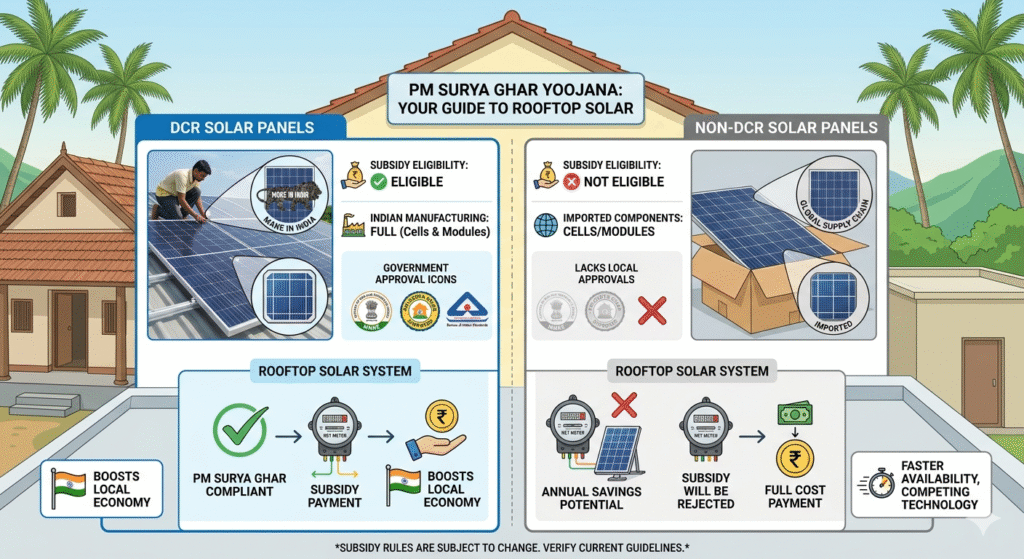
DCR solar panels are manufactured using:
- Solar cells made in India
- Modules assembled in India
Under many government-supported solar schemes—including residential subsidy programs like PM Surya Ghar—DCR panels are required for subsidy eligibility.
In simple terms:
If you want to claim certain government rooftop solar subsidies, your system usually needs DCR-compliant solar panels.
What Are Non-DCR Solar Panels?
Non-DCR solar panels are panels where:
- Solar cells may be imported
- Modules may still be assembled in India or abroad
These panels are common in the private solar market because they often provide:
- More brand variety
- Access to global technologies
- Competitive pricing in some cases
However:
Non-DCR panels are generally NOT eligible for PM Surya Ghar subsidy benefits.
That’s the biggest distinction homeowners must understand.
Why DCR Panels Matter Under PM Surya Ghar Yojana
The PM Surya Ghar scheme is designed not only to promote rooftop solar but also to support Indian solar manufacturing.
That’s why the government links subsidies with DCR compliance.
If you want:
- Residential solar subsidy
- MNRE rooftop solar benefits
- Government-approved solar installation
You will usually need:
✔ DCR-certified solar panels
✔ Approved vendors
✔ Proper documentation
Without this, subsidy approval may not happen.
DCR vs Non-DCR Solar Panels: Key Differences
| Feature | DCR Solar Panels | Non-DCR Solar Panels |
|---|---|---|
| Subsidy Eligibility | Yes | Usually No |
| Solar Cell Origin | India | Imported or mixed |
| PM Surya Ghar Compliance | Required | Generally not eligible |
| Brand Availability | More limited | Wider global options |
| Pricing | Sometimes slightly higher | Can vary |
| Government Approval | Strongly aligned | Less relevant for subsidy |
| Residential Rooftop Use | Very common under subsidy schemes | Common in private installations |
Which Solar Panels Are Better for Homeowners in Andhra Pradesh?
The answer depends on your actual goal.
Choose DCR Panels If:
✔ You want PM Surya Ghar subsidy benefits
This is the biggest reason most homeowners choose DCR panels.
✔ You want a government-compliant rooftop solar system
DCR systems align more easily with subsidy approval requirements.
✔ You prioritize long-term subsidy savings over brand flexibility
The subsidy often offsets pricing differences.
Choose Non-DCR Panels If:
✔ You are NOT applying for subsidy
Some homeowners prefer private installations without subsidy dependency.
✔ You want specific international technologies or brands
Certain advanced technologies may be available mainly in Non-DCR variants.
✔ Your installer recommends a specialized commercial solution
Commercial and industrial projects often prioritize performance specifications differently.
The Biggest Mistake Homeowners Make
Many buyers focus only on:
- Lowest rooftop solar price
- Highest wattage
- Cheapest quotation
Without asking:
“Is this system eligible for PM Surya Ghar subsidy?”
This creates major problems later.
Some homeowners discover after installation that:
- Their system does not qualify for subsidy
- Documentation is incomplete
- Panel specifications are not compliant
At that point, fixing the issue becomes expensive and frustrating.
Are DCR Panels Lower Quality?
Not necessarily.
This is one of the biggest misconceptions in the solar market.
Today, many Indian manufacturers produce:
- High-efficiency solar panels
- Reliable rooftop solar systems
- MNRE-approved modules
The quality difference between DCR and Non-DCR systems is often smaller than people assume.
Actual performance depends more on:
- Manufacturer quality
- Installation standards
- Inverter quality
- Maintenance practices
—not simply DCR status alone.
Solar Panel Efficiency: What Really Matters
Many homeowners obsess over panel efficiency percentages.
But in practical residential installations across Andhra Pradesh, other factors matter just as much:
✔ Roof orientation
✔ Shading conditions
✔ Installation quality
✔ Inverter performance
✔ Proper system sizing
A slightly more efficient panel installed poorly will still underperform.
Why Andhra Pradesh Homeowners Are Choosing PM Surya Ghar
The scheme is gaining traction because of:
- Rising electricity bills
- Improved subsidy awareness
- Growing rooftop solar adoption
- Better financing options
Popular searches now include:
- PM Surya Ghar Andhra Pradesh
- Rooftop solar subsidy AP
- Solar panel subsidy 2026
- Best solar installer near me
- DCR solar panel price India
- MNRE approved solar company
This trend reflects a larger shift toward residential energy independence.
Realistic Expectations About Subsidy Savings
Let’s stay realistic.
The subsidy helps reduce upfront cost—but it does not make solar “free.”
Homeowners still need to consider:
- Initial investment
- Long-term maintenance
- Roof suitability
- Energy consumption patterns
The smartest buyers focus on:
- System reliability
- Long-term ROI
- Installer credibility
—not just subsidy amount alone.
How to Verify DCR Compliance
Before installation, homeowners should ask for:
✔ MNRE-approved documentation
✔ DCR certification details
✔ Approved vendor registration
✔ Panel manufacturer information
If an installer avoids these questions, that’s a warning sign.
The Bigger Shift: Solar Buyers Are Becoming More Informed
A few years ago, homeowners mainly asked:
“How much does solar cost?”
Now they ask:
- Which solar panel is better?
- What is DCR?
- How do I claim rooftop solar subsidy?
- Which solar system is subsidy approved?
That’s a good sign.
Because better-informed buyers usually make better long-term decisions.
Conclusion
Choosing between DCR and Non-DCR solar panels under PM Surya Ghar is not just a technical decision—it’s a financial and strategic one.
For most residential homeowners in Andhra Pradesh seeking government subsidy benefits:
✔ DCR solar panels are usually the practical choice.
But the real success of a rooftop solar system depends on more than panel type alone.
It depends on:
- Proper installation
- Correct system sizing
- Reliable components
- Long-term service support
For providers like VMJ Solar Solutions, the real value lies in helping homeowners navigate subsidy compliance, installation quality, and long-term performance—not just selling panels.
Because the best solar system is not simply the cheapest or most marketed one.
It’s the one that performs reliably for the next 20–25 years.
Frequently Asked Questions (FAQs)
1. What does DCR mean in solar panels?
DCR stands for Domestic Content Requirement, meaning the solar cells and modules are manufactured in India.
2. Are DCR panels mandatory for PM Surya Ghar subsidy?
In most cases, yes. Subsidy eligibility generally requires DCR-compliant panels.
3. Are Non-DCR solar panels better than DCR panels?
Not necessarily. Performance depends on overall system quality, not only panel category.
4. Can I install Non-DCR panels without subsidy?
Yes. Many private rooftop solar systems use Non-DCR panels.
5. Do DCR panels cost more?
Sometimes slightly, but subsidy benefits may offset the difference.
6. How can I verify whether a solar panel is DCR-approved?
Ask your installer for MNRE compliance documents and manufacturer certification details.