“Sustainability” has moved from being a branding exercise to a business requirement.
Across India—and increasingly in Andhra Pradesh—companies are being pushed by rising energy costs, regulatory expectations, and customer pressure to reduce their carbon footprint. But here’s the reality:
Most businesses talk about sustainability. Few execute it effectively.
One of the most practical and measurable ways to move toward net zero is through commercial solar adoption. But installing solar panels alone doesn’t make your business net zero—you need a structured approach.
What Does “Net Zero” Actually Mean?
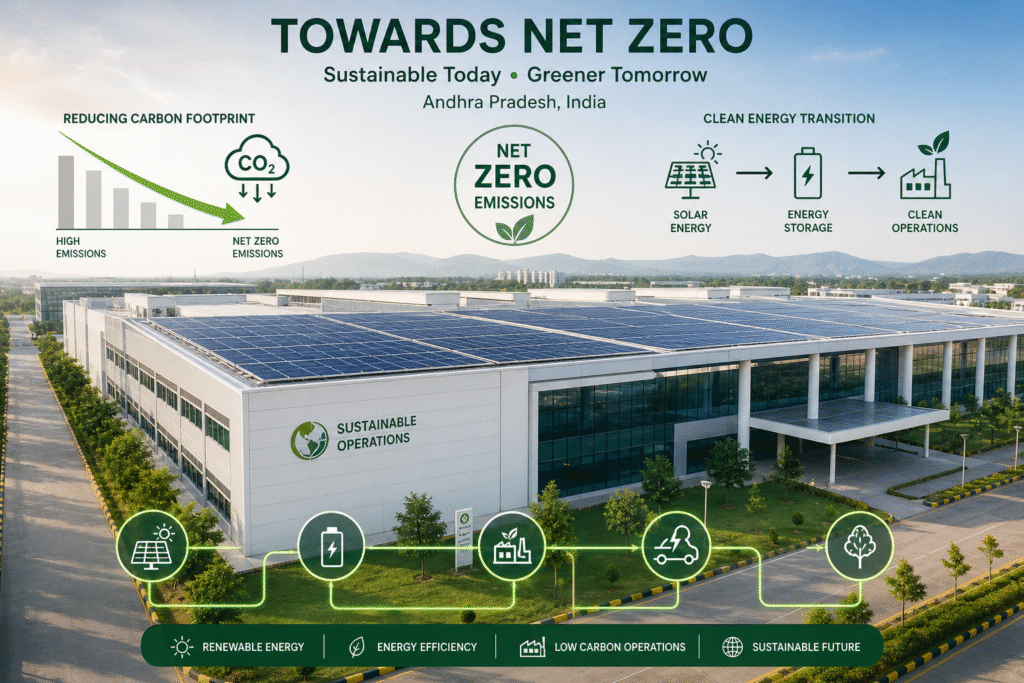
Net zero doesn’t mean zero energy usage.
It means:
- The total greenhouse gas emissions you produce
- Minus the emissions you offset or eliminate
= Net zero emissions
For most businesses, energy consumption (especially electricity) is a major contributor to emissions. That’s why solar becomes a key lever.
Why Commercial Solar Is Central to Net Zero Strateg
1. Direct Reduction in Carbon Emissions
Electricity from conventional sources often relies on fossil fuels. Solar replaces that with clean energy.
- Every unit of solar power generated reduces grid dependency
- Lower grid dependency = lower carbon emissions
2. Immediate and Measurable Impact
Unlike long-term sustainability initiatives, solar delivers:
- Tangible energy savings from day one
- Quantifiable emission reductions
- Clear ROI tracking
This makes it one of the most practical starting points.
3. Cost Control Alongside Sustainabilit
Let’s be clear—businesses don’t go solar just for the environment.
They go solar because it:
- Reduces operational expenses
- Protects against rising electricity tariffs
- Improves long-term financial predictability
The sustainability benefit is powerful—but the financial logic is what drives adoption.
Why Andhra Pradesh Is Well-Suited for Commercial Solar
✔ High Solar Potential
The state receives strong sunlight for most of the year, making solar systems highly productive.
✔ Industrial Growth
With expanding manufacturing and commercial sectors, energy demand is rising rapidly.
✔ Policy Support
Government initiatives and net metering policies make solar adoption more viable for businesses.
The Real Path to Net Zero (It’s Not Just Solar)
Here’s where many companies oversimplify.
Installing solar panels is step one—not the finish line.
A realistic net zero pathway includes:
1. Energy Efficiency First
- Optimize machinery
- Reduce wastage
- Improve load management
2. Solar Deployment
- Rooftop or ground-mounted systems
- Sized based on actual consumption
3. Power Quality Optimization
- Address issues like poor power factor
- Improve overall electrical efficiency
4. Residual Offset
- For emissions you can’t eliminate
- Use carbon credits or other offset mechanisms
Choosing the Right Commercial Solar Model
1. CAPEX Model (Ownership)
- You invest upfront
- You own the system
- Maximum long-term savings
Best for businesses with capital availability and long-term planning.
2. OPEX / PPA Model (Third-Party Ownership)
- No upfront investment
- Pay for electricity generated
- Lower immediate financial risk
Suitable for companies prioritizing cash flow.
Key Business Benefits Beyond Sustainability
✔ Stronger Brand Positioning
Customers, investors, and partners increasingly prefer businesses that:
- Demonstrate environmental responsibility
- Have measurable sustainability goals
✔ Regulatory Readiness
Environmental regulations are tightening.
Adopting solar early helps you:
- Stay compliant
- Avoid future penalties or rushed investments
✔ Competitive Advantage
If your competitors are reducing energy costs and emissions while you’re not:
- Your operating costs remain higher
- Your market positioning weakens
Challenges You Shouldn’t Ignore
❌ Space Constraints
Not all facilities have sufficient rooftop or land area.
❌ Intermittency
Solar generation depends on sunlight; backup or hybrid systems may be needed.
❌ Initial Investment (CAPEX)
Upfront cost can be significant without financing.
❌ Integration Complexity
Solar must align with existing electrical infrastructure.
Common Mistake: Treating Solar as a One-Time Project
This is where many businesses lose value.
Solar is not just installation—it’s an ongoing system:
- Monitoring performance
- Maintaining efficiency
- Aligning with changing energy needs
Companies that treat solar as a long-term energy strategy see far better results.
Realistic Expectations for Net Zero
Let’s cut through the hype.
- Most businesses cannot reach 100% net zero with solar alone
- But they can significantly reduce emissions (often 30–70%)
The rest requires:
- Efficiency improvements
- Offsets
- Broader sustainability initiatives
Conclusion
Commercial solar is one of the most effective tools available for businesses in Andhra Pradesh aiming to move toward net zero.
It delivers:
- Immediate cost savings
- Measurable emission reductions
- Long-term energy stability
But the real advantage lies in how you implement it.
For companies working with providers like VMJ Solar Solutions, the opportunity is not just to install solar—but to build a structured, scalable sustainability strategy that aligns with business goals.
Because in 2026 and beyond, sustainability isn’t optional—it’s competitive.
Frequently Asked Questions (FAQs)
1. Can solar alone make my business net zero?
No. Solar significantly reduces emissions, but full net zero usually requires additional measures and offsets.
2. How much emission reduction can solar provide?
It depends on system size and energy usage, but reductions of 30–70% are common.
3. What is the typical payback period for commercial solar?
Usually between 3–6 years, depending on system size and electricity costs.
4. Is commercial solar reliable for continuous operations?
Yes, but businesses may need hybrid systems or grid support for uninterrupted supply.
5. What is the difference between CAPEX and OPEX models?
CAPEX involves ownership and upfront investment, while OPEX allows you to pay for usage without owning the system.
6. Do I need large rooftop space for solar?
Larger systems need more space, but system design can be customized based on available area.