
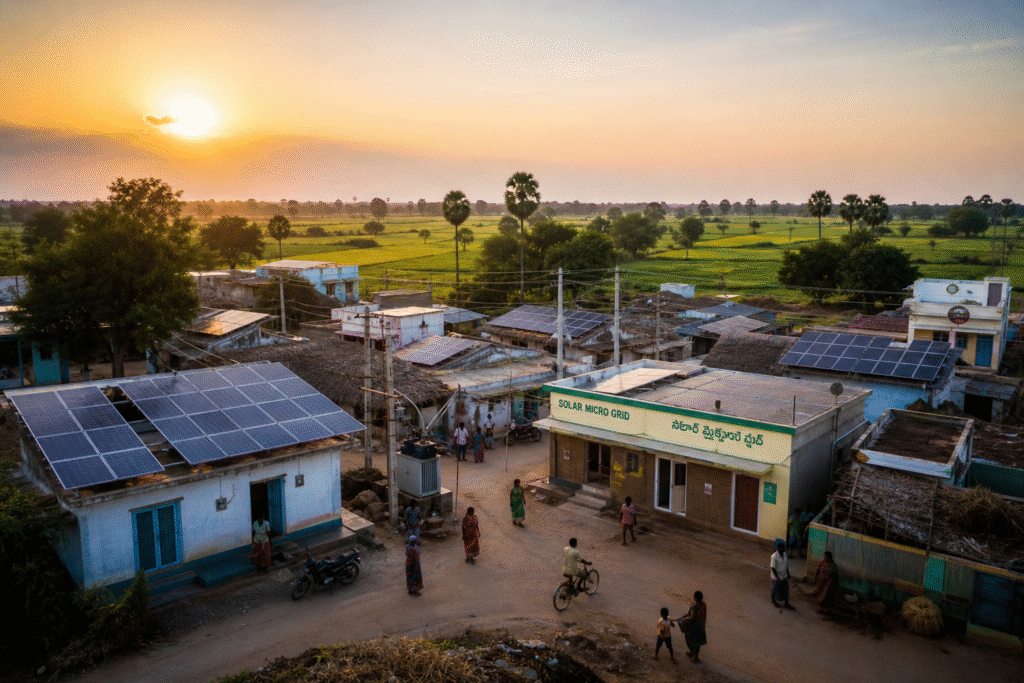
In many rural parts of Andhra Pradesh, power cuts are still part of daily life. Whether it’s unexpected outages during peak hours or low-voltage supply that affects appliances, unreliable electricity continues to limit productivity, comfort, and economic growth.
But a quiet shift is happening.
Instead of depending entirely on the central grid, villages and rural communities are beginning to adopt independent microgrids—small, localized energy systems that generate and distribute electricity where it’s needed most.
For companies like VMJ Solar Solutions, this isn’t just a technology trend. It’s a practical, scalable solution to one of rural India’s most persistent problems.
What Is an Independent Microgrid?
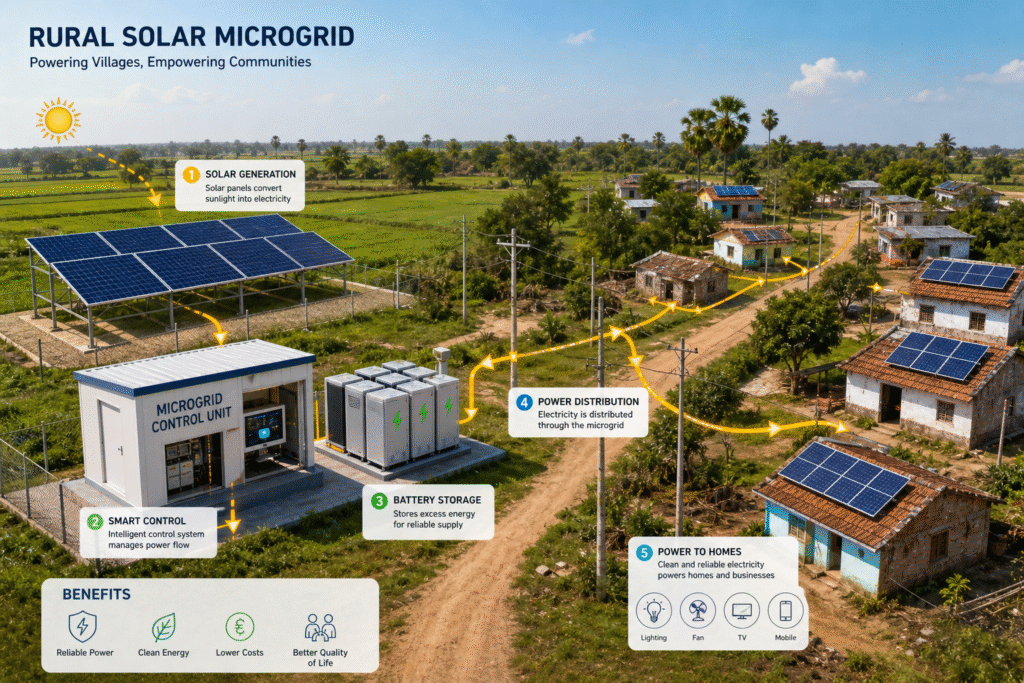
A microgrid is a self-contained power system that can operate independently or alongside the main electricity grid.
In rural Andhra Pradesh, most microgrids are:
- Powered by solar energy
- Supported by battery storage systems
- Designed to supply electricity to a small community, cluster of homes, or local businesses
Unlike traditional power supply, microgrids bring generation closer to consumption, reducing dependence on long-distance transmission.
Why Power Cuts Still Happen in Rural AP
Before looking at solutions, it’s worth understanding the root issues:
1. Weak Grid Infrastructure
Rural areas often rely on long transmission lines that are prone to faults and losses.
2. Load Shedding
During high demand, electricity supply is sometimes intentionally reduced to prevent system overload.
3. Voltage Fluctuations
Even when power is available, inconsistent voltage can damage appliances and reduce usability.
4. Delayed Maintenance
Faults in rural networks may take longer to fix compared to urban areas.
Microgrids address many of these issues—not by fixing the grid, but by reducing dependence on it.
How Microgrids Solve Power Cuts
1. Local Power Generation
Microgrids generate electricity within the community using solar panels. This means:
- Less reliance on distant power plants
- Reduced transmission losses
- Immediate access to energy
Even if the main grid fails, the microgrid continues to function.
2. Battery Backup for Night and Outages
Solar microgrids are typically paired with battery storage:
- Excess energy generated during the day is stored
- Power is available at night or during cloudy conditions
- Critical loads (lights, fans, small appliances) remain uninterrupted
This directly addresses the most frustrating aspect of rural power cuts—uncertainty.
3. Stable and Predictable Power Supply
Unlike fluctuating grid supply, microgrids are designed for:
- Consistent voltage levels
- Controlled distribution
- Prioritized energy use
This improves the lifespan of appliances and enables the use of more sensitive equipment.
4. Scalable for Community Growth
Microgrids are modular:
- Start small (few homes or a farm)
- Expand as demand increases
This makes them ideal for growing rural communities where electricity needs evolve over time.
Real Impact on Rural Communities
✔ Improved Daily Life
- Reliable lighting for homes
- Better study conditions for students
- Reduced dependence on kerosene or diesel
✔ Support for Local Businesses
- Shops can operate longer hours
- Small industries (rice mills, tailoring units) run more efficiently
- Cold storage and irrigation systems become viable
✔ Reduced Diesel Generator Use
Many rural areas rely on diesel generators during outages:
- Expensive to run
- Noisy and polluting
Microgrids provide a cleaner and more cost-stable alternative.
Cost Considerations: What to Expect
Microgrids are not “cheap,” but they are becoming more accessible.
Initial Setup Includes:
- Solar panels
- Battery storage
- Inverters and distribution system
Key Reality:
- Higher upfront investment
- Lower long-term operating costs compared to diesel
- Potential government support or community funding models
For many villages, shared microgrids make the economics more practical than individual systems.
Challenges You Shouldn’t Ignore
❌ Maintenance and Management
Microgrids require ongoing monitoring and occasional maintenance.
❌ Community Coordination
Shared systems need clear rules for usage, billing, and expansion.
❌ Upfront Financing
Initial costs can be a barrier without structured financing or subsidies.
Where Microgrids Work Best
Microgrids are especially effective in:
- Villages with frequent power cuts
- Areas with agricultural dependence
- Locations far from reliable grid infrastructure
- Communities willing to adopt shared energy models
The Bigger Shift: Decentralized Energy in India
India’s energy future is gradually moving toward decentralization:
- Less dependence on large, centralized plants
- More localized, renewable solutions
- Greater resilience against outages
Microgrids are a key part of this transition—especially in states like Andhra Pradesh where solar potential is high.
Frequently Asked Questions (FAQs)
1. What is the difference between a solar home system and a microgrid?
A solar home system powers a single house, while a microgrid supplies electricity to multiple homes or a community.
2. Can microgrids completely replace the main grid
In some cases, yes. But many microgrids operate alongside the main grid as a backup or support system.
3. How long do microgrid batteries last?
Typically 5–10 years depending on usage and battery type.
4. Are microgrids expensive for rural users?
Costs are usually shared among users, making them more affordable than individual systems.
5. Do microgrids work during monsoon or cloudy days?
Yes, with battery storage. However, performance may vary depending on system design.
6. Who maintains a microgrid?
Maintenance is usually handled by the installation provider or a trained local operator.
Conclusion
Independent microgrids are not just a backup solution—they’re becoming a primary power source for many rural communities in Andhra Pradesh.
They solve real problems:
- Unreliable electricity
- Rising fuel costs
- Limited economic activity
But they also require thoughtful implementation, proper maintenance, and community participation.
For providers like VMJ Solar Solutions, the opportunity lies not just in installation—but in building reliable, long-term energy ecosystems that rural communities can depend on.