
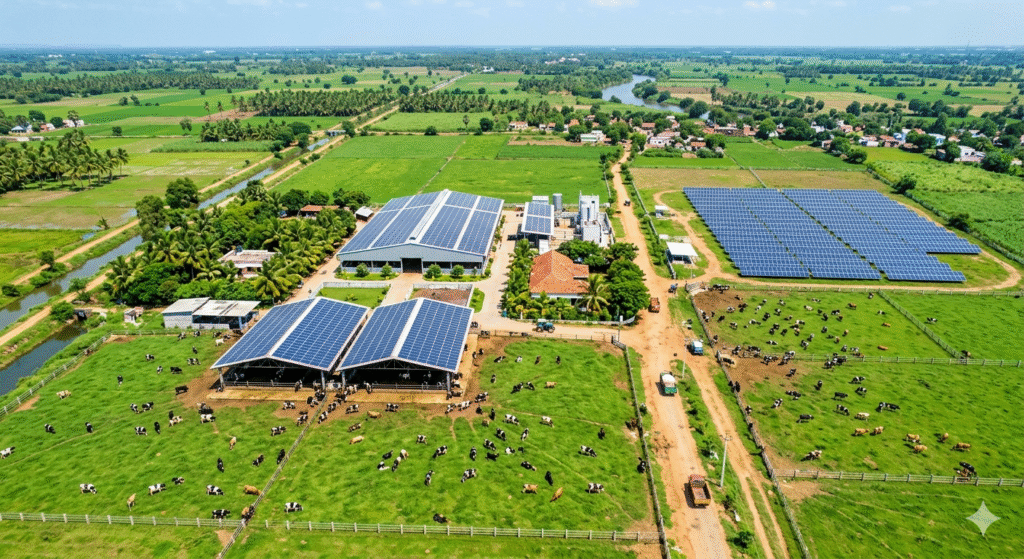
West Godavari has long been one of Andhra Pradesh’s strongest dairy belts. With abundant cattle, fertile land, and a steady demand for milk, the region is built for success. But here’s the uncomfortable reality: rising electricity costs, unreliable power supply, and increasing operational expenses are quietly eroding margins for dairy farmers.
If you’re running a dairy farm today, your biggest enemy isn’t competition—it’s inefficiency.
That’s where solar power changes the equation.
At VMJ Solar Solutions, we’ve seen firsthand how dairy farms in West Godavari can shift from cost-heavy operations to profit-driven enterprises by adopting solar energy. This isn’t about “going green” for the sake of it. It’s about control, stability, and long-term profitability.
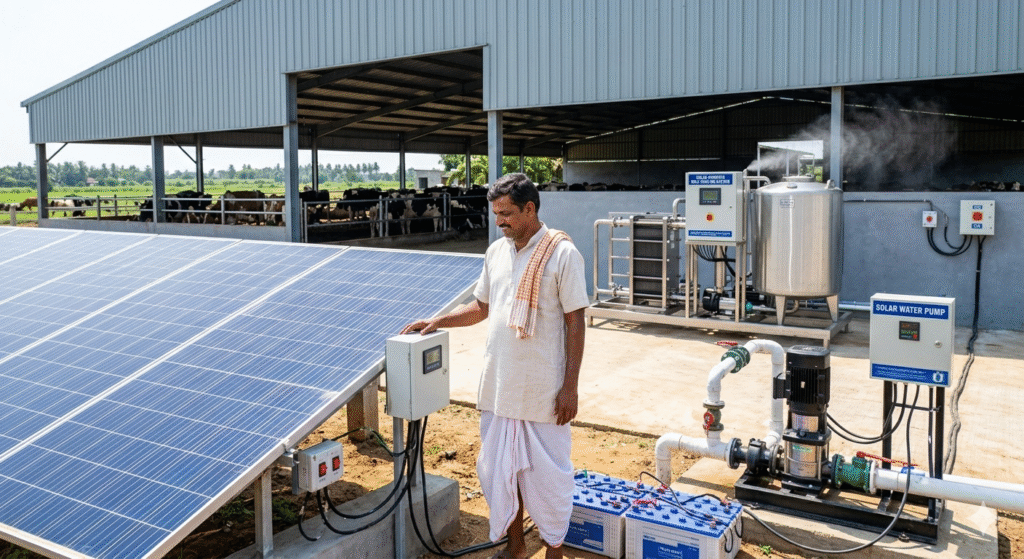
The Real Cost Problem in Dairy Farming
Let’s call it out directly: electricity is one of your biggest recurring expenses.
From:
- Milking machines
- Water pumps
- Chilling units
- Lighting and ventilation
You’re constantly dependent on grid power. And in rural areas, that often means:
- Voltage fluctuations
- Power cuts
- Expensive diesel backups
Every disruption directly affects milk quality and yield. That’s lost income—not just inconvenience.
Why Solar Power Is a Game-Changer for Dairy Farms
1. Slash Electricity Bills—Permanently
Solar power allows dairy farms to generate their own electricity. Once installed, your dependency on the grid drops significantly.
Instead of paying monthly bills, you invest once and produce power for 20–25 years.
That’s not a saving. That’s a structural shift in your cost model.
2. Reliable Power for Critical Operations
Milk chilling and storage are time-sensitive. Even short outages can lead to spoilage.
Solar systems with battery backup ensure:
- Continuous power supply
- Stable voltage
- Protection of equipment
This directly improves milk quality and reduces wastage.
3. Increase Profit Margins Without Increasing Production
Most farmers think profit comes from producing more milk. That’s only half the story.
The smarter move? Reduce costs per liter.
Solar helps you:
- Lower operational expenses
- Stabilize energy costs
- Improve net margins
You don’t need more cows—you need smarter infrastructure.
4. Government Subsidies Make It More Affordable
Many farmers hesitate because of upfront costs. But here’s what you might be ignoring:
- Central and state subsidies for solar installations
- Agricultural schemes supporting renewable energy
- Financing options with low interest
If you’re not leveraging these, you’re leaving money on the table.
5. Turn Your Farm Into a Sustainable Business
Sustainability isn’t just a buzzword anymore—it’s a competitive advantage.
Solar-powered farms:
- Reduce carbon footprint
- Attract premium buyers and partnerships
- Future-proof operations against energy price hikes
In the long run, sustainability and profitability are not separate goals—they reinforce each other.
How VMJ Solar Solutions Helps Dairy Farms in West Godavari
At VMJ Solar Solutions, we don’t just install panels—we design systems tailored for dairy operations.
Our approach:
- Site assessment based on farm energy usage
- Custom solar system design
- Assistance with subsidies and approvals
- End-to-end installation and maintenance
We understand local farming conditions, and we build systems that actually perform—not just look good on paper.
FAQ’s
1. What are the benefits of solar power for dairy farms?
Solar power reduces electricity costs, ensures reliable energy supply, prevents milk spoilage, and improves overall farm profitability. It also supports sustainable farming practices.
2. How can solar energy reduce operational costs for farmers?
By generating free electricity from sunlight, solar systems eliminate or significantly reduce monthly power bills and diesel expenses, lowering the cost of running farm equipment.
3. What are the initial costs associated with installing solar panels?
The initial investment depends on system size, but government subsidies and financing options can reduce the upfront cost significantly, making it affordable for most farmers.
4. Are there government incentives for solar energy in agriculture?
Yes, both central and state governments offer subsidies, schemes, and financial support to encourage solar adoption in agriculture, especially for irrigation and farm operations.
5. How does solar energy impact the environment positively?
Solar energy reduces dependence on fossil fuels, lowers carbon emissions, and promotes cleaner, more sustainable agricultural practices.
Final Thought: The Cost of Waiting Is Higher Than You Think
If your farm is still fully dependent on grid electricity, you’re operating with a hidden disadvantage.
Solar power isn’t a luxury anymore—it’s becoming a baseline for profitable farming.
The question isn’t “Can you afford solar?”
It’s “How much longer can you afford not to switch?”