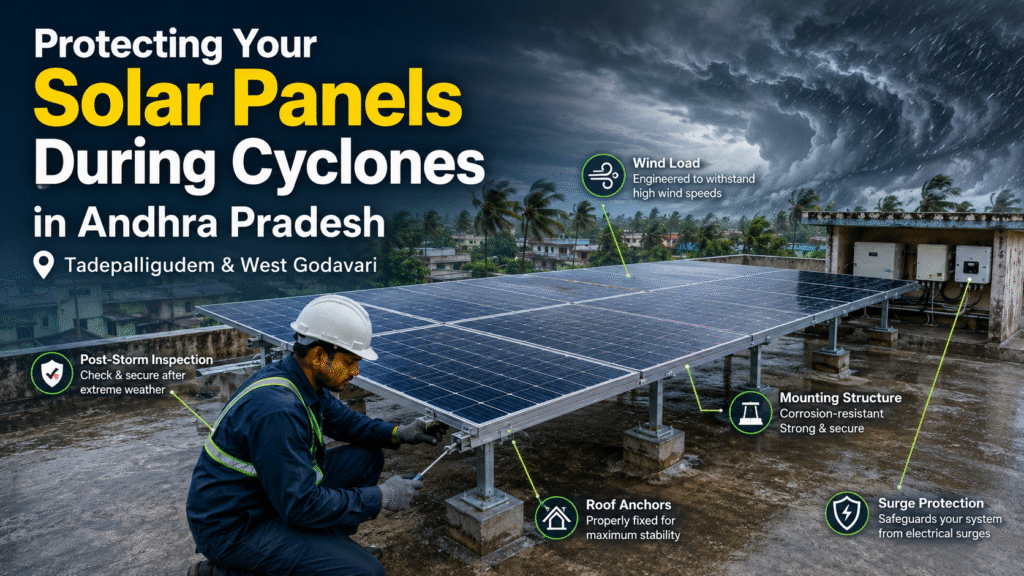
A Practical Guide for Homeowners, Businesses & Solar System Owners in Tadepalligudem and West Godavari
Andhra Pradesh is no stranger to cyclones, strong winds and heavy rainfall. For solar owners, the concern is obvious:
Can my rooftop solar panels withstand a cyclone?
The short answer is: a properly designed and correctly installed solar system can be engineered to withstand significant wind loads, but no rooftop system should be treated as automatically cyclone-proof.
The biggest risk is often not the solar module itself. It can be the mounting structure, fasteners, roof attachment, ballast, waterproofing, cable management or poorly designed installation.
This is particularly relevant for West Godavari, which the India Meteorological Department classifies as a P2 cyclone-hazard-prone coastal district.
So, if you own a solar system in Tadepalligudem, Bhimavaram, Tanuku, Palakollu or elsewhere in West Godavari, cyclone preparedness should be part of your Solar O&M plan—not something you think about only after a storm warning.
Quick Answer — Can Solar Panels Survive a Cyclone?
Yes, properly engineered solar PV systems can be designed for high wind conditions, but their cyclone resistance depends heavily on the module specifications, mounting structure, roof attachment, fasteners, wind-load calculations and installation quality. Before a severe cyclone, owners should inspect the system, secure loose objects, avoid climbing onto the roof, and follow the installer’s/manufacturer’s emergency instructions.
MNRE-supported research has specifically examined wind forces on PV panels, roof-mounted configurations and structural design parameters for cyclone-prone areas, highlighting that the module and foundation/attachment design are important to structural safety.
Why Are Cyclones a Concern for Rooftop Solar?
Solar panels have a relatively large surface area.
During strong winds, that surface can experience significant:
- Wind pressure
- Uplift forces
- Lateral forces
- Vibration
- Debris impact
The panels themselves are only one component of the system.
A rooftop Solar installation typically consists of:
Solar Module → Mounting Rail → Clamps → Structure → Roof Attachment → Building
A failure anywhere along this chain can create problems.
For example, an expensive, high-quality module cannot compensate for an incorrectly designed mounting structure.
West Godavari Is a Cyclone-Hazard Area
This isn’t just a theoretical concern for local homeowners.
The IMD’s cyclone hazard classification identifies West Godavari as P2, based on factors including cyclone frequency, severe cyclones and associated wind characteristics.
That makes wind-resistant Solar installation particularly relevant for homes and commercial properties in the district.
For Tadepalligudem and nearby areas, the risk profile can differ from directly coastal locations, so the system should be designed according to the actual site and applicable structural requirements, rather than using a generic “cyclone-proof” claim.
The Biggest Mistake: Looking Only at the Solar Panel
When buying Solar, customers often ask:
“Which brand panel can withstand the highest wind?”
That’s useful—but incomplete.
You should also ask:
1. What wind load is the mounting system designed for?
2. How is the structure attached to my roof?
3. What type of fasteners are being used?
4. Is the roof suitable for the proposed mounting system?
5. Has the installer considered local wind conditions?
6. What happens to the system during a severe-weather event?
This shifts the conversation from “Which panel?” to “Is the entire Solar system properly engineered?”
Solar Panel vs Mounting Structure: Which Is More Vulnerable?
The answer depends on the specific system.
A Solar module is tested for mechanical loads, but the complete rooftop assembly also depends on:
- Rails
- Clamps
- Nuts and bolts
- Brackets
- Anchors
- Roof attachments
- Foundation
- Roof material
- Installation geometry
A panel can remain intact while its mounting system fails.
Conversely, the structure can remain secure while a module is damaged by flying debris.
That’s why cyclone resilience should be considered at the system level.
What Should You Check Before a Cyclone?
If a cyclone warning has been issued, don’t wait until the last minute.
1. Visually Inspect the System
From a safe location, look for:
- Loose panels
- Loose cables
- Damaged clamps
- Corrosion
- Loose mounting components
- Previously damaged modules
- Objects sitting around the array
Do not climb onto the roof during strong winds or dangerous weather.
2. Check for Loose Objects Around the Solar Panels
This is one of the simplest precautions.
Remove or secure objects that could become airborne:
- Plastic sheets
- Garden equipment
- Loose pipes
- Temporary structures
- Pots
- Signboards
- Lightweight rooftop materials
During extreme winds, even relatively small objects can become dangerous projectiles.
3. Check the Mounting Structure Before Cyclone Season
Don’t wait until a storm is approaching.
A professional inspection should look at:
- Module clamps
- Rail connections
- Fasteners
- Structural members
- Roof anchors
- Corrosion
- Foundation/attachment points
- Cable supports
This is particularly important for older installations.
4. Inspect the Roof Itself
Solar structure strength isn’t the only consideration.
The roof must also be capable of safely carrying the system and resisting the forces transmitted through the mounting points.
For RCC roofs, inspect for:
- Cracks
- Water seepage
- Deterioration around anchors
- Concrete damage
For sheet roofs:
- Sheet condition
- Purlins
- Fastening points
- Corrosion
- Structural stability
A strong Solar structure attached to a weak roof is still a weak system.
5. Don’t Add Extra Ballast or Tie-Downs Yourself
This sounds like a good idea:
“Cyclone వస్తోంది. ఇంకొన్ని concrete blocks పెట్టేద్దాం.”
Don’t improvise.
Adding weight or changing the structure without engineering review can:
- Increase roof loading
- Change wind behaviour
- Damage waterproofing
- Create new failure points
If the system needs additional reinforcement, have the installer or structural professional evaluate it.
What About Ballasted Solar Systems?
Some rooftop systems use ballast instead of penetrating the roof.
This can be useful in appropriate applications, but cyclone-prone locations require careful engineering.
The required ballast depends on factors such as:
- Panel dimensions
- Tilt angle
- Building height
- Roof exposure
- Wind conditions
- Array geometry
- Friction
- Roof surface
- Edge and corner effects
So:
More concrete blocks ≠ automatically safer.
The system needs to be designed as a complete assembly.
Why Roof Edges and Corners Matter
Wind does not necessarily act uniformly across a rooftop.
Roof edges and corners can experience higher wind effects than interior areas.
This is one reason professional Solar designers need to consider:
- Building geometry
- Panel layout
- Setbacks
- Roof edges
- Array orientation
- Mounting points
when designing the system.
A “one design fits every roof” approach is not appropriate for cyclone-prone locations.
Should Solar Panels Be Removed Before a Cyclone?
Generally, homeowners should not attempt to remove rooftop Solar panels themselves.
Removing panels is not a normal homeowner cyclone-preparation procedure.
It can create additional risks:
- Falling panels
- Electrical hazards
- Roof damage
- Broken glass
- DC arc hazards
- Personal injury
Whether any component needs to be secured or temporarily isolated should be determined by a qualified Solar professional according to the system design and manufacturer instructions.
Should You Switch Off Solar During a Cyclone?
This depends on the type of Solar system and the manufacturer’s instructions.
For a normal grid-connected rooftop Solar system, don’t assume that simply switching off the inverter makes the entire array electrically dead.
Solar modules can continue producing DC voltage whenever light is present.
Therefore:
Never disconnect Solar DC cables yourself during a storm.
If the system needs to be shut down or isolated, follow the installed system’s shutdown procedure or contact a qualified Solar technician.
What About Power Cuts During a Cyclone?
This is an important distinction.
Grid-Tied Solar
A standard grid-connected Solar inverter normally shuts down when the grid goes down to prevent unsafe backfeeding.
So:
Solar Panels ≠ automatic backup power
during a grid outage.
Hybrid Solar + Battery
A properly designed hybrid system with Battery Energy Storage System (BESS) can provide backup to selected loads, depending on the inverter and system architecture.
This is particularly useful for:
- Lights
- Fans
- Wi-Fi
- CCTV
- Refrigerators
- Essential medical equipment
- Communication equipment
But the backup capability must be designed beforehand.
What Happens to Solar Panels During Heavy Rain?
Heavy rain itself isn’t necessarily the primary structural concern.
The bigger concerns during a cyclone can include:
- High winds
- Wind-driven debris
- Flying objects
- Water ingress
- Roof damage
- Lightning
- Electrical faults
A correctly installed outdoor-rated Solar system is designed to operate outdoors, but extreme weather can exceed normal operating conditions.
What About Lightning?
Cyclones can also bring thunderstorms and lightning.
Solar systems should have appropriately designed:
- Earthing
- Surge Protection Devices
- DC protection
- AC protection
- Lightning protection where required
The exact protection arrangement depends on the building, system and applicable electrical requirements.
Do not install improvised lightning rods or grounding connections yourself.
Have the electrical protection system inspected by a qualified professional.
After the Cyclone: Don’t Immediately Touch the System
This is where homeowners can make a dangerous mistake.
After a cyclone, you may see:
- Broken panels
- Hanging cables
- Bent rails
- Exposed wiring
- Damaged inverter
- Water around electrical equipment
Do not touch damaged Solar equipment.
Even if the grid is down, Solar panels can generate electricity when exposed to light.
Keep people away from the damaged area and contact a qualified Solar technician/electrician.
Post-Cyclone Solar Inspection Checklist
After the weather has become safe, arrange a professional inspection.
Module Inspection
Check for:
- Cracked glass
- Delamination
- Frame damage
- Displacement
- Broken junction boxes
Mounting Inspection
Check:
- Rails
- Clamps
- Fasteners
- Roof attachments
- Bent structural components
Electrical Inspection
Check:
- DC cables
- Connectors
- Inverter
- AC cables
- Isolation devices
- Surge protection
- Earthing
Generation Check
Compare:
Pre-cyclone generation vs post-cyclone generation
A sudden unexplained drop can indicate damage that isn’t immediately visible.
Don’t Ignore “Small” Panel Cracks
A module can sometimes appear to be mostly intact while having:
- Microcracks
- Glass cracks
- Cell damage
These may not be obvious from ground level.
For commercial Solar plants, professional diagnostics such as electroluminescence testing, IV-curve testing or thermal inspection may be useful depending on the suspected damage.
How Can You Make a New Solar Installation More Cyclone-Resistant?
The best time to think about cyclone protection is before installation.
Ask your Solar EPC company for:
Wind-Load Design
The mounting system should be appropriately designed for the site’s wind conditions and building configuration.
Quality Mounting Components
Use properly specified:
- Rails
- Clamps
- Fasteners
- Anchors
Correct Roof Attachment
The structure should transfer loads safely into the roof/building structure.
Good Cable Management
Cables should not be left loose where wind can cause movement or abrasion.
Corrosion-Resistant Hardware
This is particularly important in areas exposed to moisture and coastal conditions.
Don’t Confuse Panel Wind Rating With Complete System Wind Rating
This deserves emphasis.
A module may have a manufacturer’s mechanical-load specification.
But that doesn’t automatically mean:
“The entire rooftop Solar system can withstand the same wind conditions.”
The final performance depends on the module + mounting system + roof + attachment + installation.
This is one of the most important questions to ask your Solar installer.
What Should Homeowners Ask a Solar Installer?
Before signing a Solar installation contract, ask:
- What wind load has the mounting system been designed for?
- What standard/design basis was used?
- How will the structure be fixed to my roof?
- What type of fasteners will be used?
- How will waterproofing be protected?
- What is the warranty on the mounting structure?
- What happens if a cyclone damages the system?
- Is post-cyclone inspection available?
- What is the procedure for reporting storm damage?
- Are all electrical protection systems included?
A professional installer should be able to explain the design rather than simply saying:
“Don’t worry, our panels are cyclone-proof.”
Tadepalligudem Solar Owners: One Important Consideration
Tadepalligudem is inland relative to the immediate coastline, but that doesn’t mean rooftop Solar systems can ignore cyclone-related wind.
Storm systems can affect a broad region.
The correct approach is therefore not:
“We’re not directly on the coast, so cyclone protection isn’t necessary.”
Instead:
Site location + building height + roof type + exposure + wind design + mounting system
should determine the installation requirements.
West Godavari Solar Systems Need a Different Maintenance Mindset
For homeowners and businesses in West Godavari, cyclone preparedness should be part of long-term Solar O&M.
A good maintenance schedule can include:
Before Cyclone Season
✔ Mounting inspection
✔ Fastener inspection
✔ Roof inspection
✔ Cable inspection
✔ Earthing/protection inspection
When a Cyclone Warning Is Issued
✔ Secure loose rooftop objects
✔ Keep people away from the roof
✔ Follow inverter/manufacturer instructions
✔ Contact installer if structural damage is suspected
After the Cyclone
✔ Don’t touch damaged equipment
✔ Arrange professional inspection
✔ Check electrical protection
✔ Check generation performance
✔ Document damage for warranty/insurance purposes
Does Solar Insurance Cover Cyclone Damage?
It depends entirely on the policy.
Don’t assume that every Solar warranty covers:
- Cyclone damage
- Flood damage
- Lightning
- Debris impact
- Roof damage
A manufacturer’s product warranty and an insurance policy are not the same thing.
Before installation, check:
Product Warranty + Installation Warranty + Insurance Coverage
separately.
Solar Panels Are Not the Only Asset to Protect
During a cyclone, homeowners should also think about:
- Inverter
- Battery
- Mounting structure
- Electrical panel
- Cables
- Monitoring equipment
- Roof waterproofing
For a Solar + BESS system, the battery enclosure and electrical equipment location also deserve attention.
Common Mistakes to Avoid
❌ “My panel is strong, so the whole system is cyclone-proof.”
❌ “I’ll put extra bricks on the panels before the cyclone.”
❌ “I’ll remove the panels myself.”
❌ “Switching off the inverter makes all Solar wiring safe.”
❌ “The roof is concrete, so structural inspection isn’t necessary.”
❌ “If the glass isn’t broken, the system is fine.”
❌ “Cyclone insurance is automatically included.”
These assumptions can create unnecessary risk.
VMJ Solar Solutions: Cyclone-Ready Solar in Tadepalligudem & West Godavari
For Solar installations in Tadepalligudem and West Godavari, cyclone resilience should be considered during the design stage, not after a storm causes damage.
VMJ Solar Solutions can help customers evaluate:
- Rooftop suitability
- Solar system design
- Mounting structure
- Roof attachment
- Electrical protection
- Solar O&M
- Post-storm inspection
The objective should not be to make unrealistic claims such as “100% cyclone-proof.”
The better goal is:
Design the Solar system for the site’s actual wind, roof and structural conditions, install it correctly, and maintain it properly.
Frequently Asked Questions
1. Can solar panels withstand cyclones in Andhra Pradesh?
Properly designed and installed Solar PV systems can be engineered for significant wind loads. However, cyclone resistance depends on the complete system, including the mounting structure, roof attachment and installation quality.
2. Is West Godavari cyclone-prone?
Yes. IMD’s cyclone-hazard classification lists West Godavari as P2, based on historical cyclone and wind characteristics.
3. Should I remove my Solar panels before a cyclone?
No. Homeowners should not attempt to remove rooftop Solar panels themselves. If special precautions are required, consult the installer or a qualified professional.
4. Should I switch off my Solar inverter during a cyclone?
Follow the manufacturer’s and installer’s shutdown instructions. Do not disconnect Solar DC cables yourself because panels can continue producing DC electricity whenever light is present.
5. Can a grid-connected Solar system work during a cyclone power cut?
Normally, a standard grid-tied inverter shuts down when the grid is unavailable. A properly designed hybrid Solar + battery system can provide backup to selected loads.
6. What is more important: the panel or the mounting structure?
Both matter, but the complete structural system is critical. A high-quality Solar panel cannot compensate for a poorly designed or poorly attached mounting system.
7. Can I add extra concrete blocks to protect my Solar panels?
Do not do this without professional engineering advice. Additional ballast can increase roof loads and change how wind acts on the array.
8. What should I do if a panel is cracked after a cyclone?
Stay away from the damaged equipment and exposed wiring. Contact a qualified Solar technician for inspection and safe isolation.
9. Does Solar panel warranty cover cyclone damage?
Not necessarily. Product warranty, installation warranty and insurance coverage have different terms. Check the relevant documents before installation.
10. Is cyclone protection necessary for Solar in Tadepalligudem?
It is prudent to consider wind resilience even in inland locations. The appropriate design should be based on the site’s wind exposure, building and roof characteristics and applicable engineering requirements.
Conclusion
A cyclone is not the time to discover that your Solar installation was designed only around panel price and wattage.
For homeowners and businesses in Andhra Pradesh—particularly West Godavari, where IMD identifies the district as cyclone-hazard prone, the mounting structure, roof attachment, electrical protection and maintenance deserve serious attention.
The most effective strategy is:
Design correctly → Install correctly → Inspect regularly → Prepare before storms → Inspect professionally after storms.
And remember:
A Solar panel can be strong, but the Solar system is only as strong as its weakest structural and electrical component.
For Tadepalligudem and West Godavari Solar installations, choose an EPC partner that can explain the mounting design, roof attachment, electrical protection and post-installation maintenance—not just the panel brand and price.