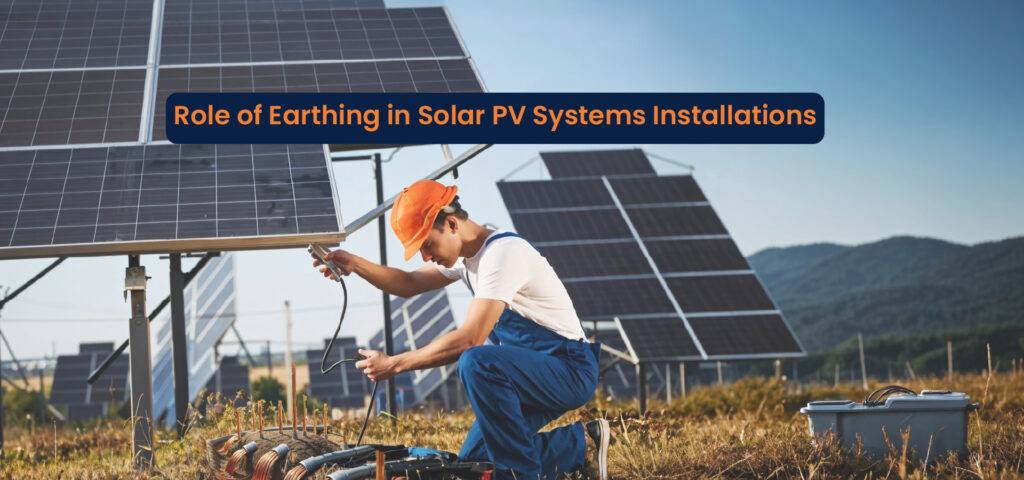
When people think about solar installations, they usually talk about panels, inverters, and savings. But there’s a silent protector working behind the scenes to keep everything safe — earthing (grounding).
At VMJ Solar, we’ve seen how proper earthing can prevent accidents, extend system life, and ensure uninterrupted performance. In fact, earthing is one of the most critical — yet often overlooked — parts of a solar system.
Let’s explore why earthing matters, how it prevents fire hazards, and the three types of earthing every solar plant should have.
Silent Protector: Why Earthing is Critical in Solar Installations
Earthing creates a safe path for leakage current or electrical surges to flow into the ground instead of damaging equipment or harming people.
Key Benefits:
- Protects People: Prevents shocks to anyone touching panels, structures, or electrical parts.
- Protects Equipment: Saves inverters, panels, and cables from sudden voltage spikes.
- Enhances Performance: Ensures stable system operation without nuisance tripping.
- Complies with Standards: Proper earthing is mandatory for subsidy approvals and safety audits.
In short: Without proper earthing, your solar system is like a car without brakes — it may run, but it’s unsafe.
How Proper Earthing Prevents Fire Hazards in On-Grid Plants
On-grid solar systems deal with high voltages and currents, and even a small fault can turn dangerous.
Common Risks Without Earthing:
- Lightning Surges → Can damage entire systems in seconds.
- Leakage Currents → Heat up cables, leading to fires.
- Short Circuits → Without grounding, faults spread quickly across equipment.
With Proper Earthing:
- Fault currents are safely diverted to the ground.
- Overheating and sparking are prevented.
- The chance of inverter or cable fire is drastically reduced.
That’s why at VMJ Solar, we design every project with fire-safe, BIS-approved earthing systems.
3 Types of Solar Earthing and Their Importance for Safe
- DC Earthing (Panel Earthing)
- Connects solar panels and DC circuits to ground.
- Prevents static charge build-up and protects panels from voltage surges.
- AC Earthing (Inverter & Grid Earthing)
- Connects inverter and AC distribution to earth.
- Ensures grid stability and prevents shocks in case of inverter faults.
- Lightning Protection Earthing
- Uses lightning arrestors connected to dedicated earth pits.
- Protects the system from direct lightning strikes and surge damages.
All three are equally important. A safe solar plant always has a combination of DC, AC, and lightning earthing systems.
Why VMJ Solar Prioritizes Earthing
- We use BIS-certified earthing kits for every project.
- Our engineers design site-specific earthing systems based on soil resistivity and system size.
- We perform resistance testing to ensure earthing is always effective.
- Every installation is done in line with MNRE, IEC, and DISCOM safety standards.
When you choose VMJ Solar, you don’t just get solar panels — you get a complete, safe, and future-proof energy solution.
FAQs
1. Is earthing mandatory for small rooftop systems?
Yes. Even a 1 kW system should have proper earthing for safety.
2. How often should earthing be checked?
Ideally once a year, or after major rains, to ensure soil resistance remains within safe limits.
3. Can I reuse existing building earthing for solar?
Not recommended. Solar requires dedicated earthing pits for DC, AC, and lightning protection.
Conclusion:
Earthing may not be the most visible part of your solar plant, but it’s the most critical for safety and reliability. It prevents shocks, fire hazards, and equipment damage — ensuring your solar investment keeps working worry-free for 25+ years.
At VMJ Solar, we treat earthing as the foundation of every installation. Because when it comes to solar, safety is savings.
Choose wisely. Choose VMJ Solar for safe, efficient, and long-lasting solar power.