
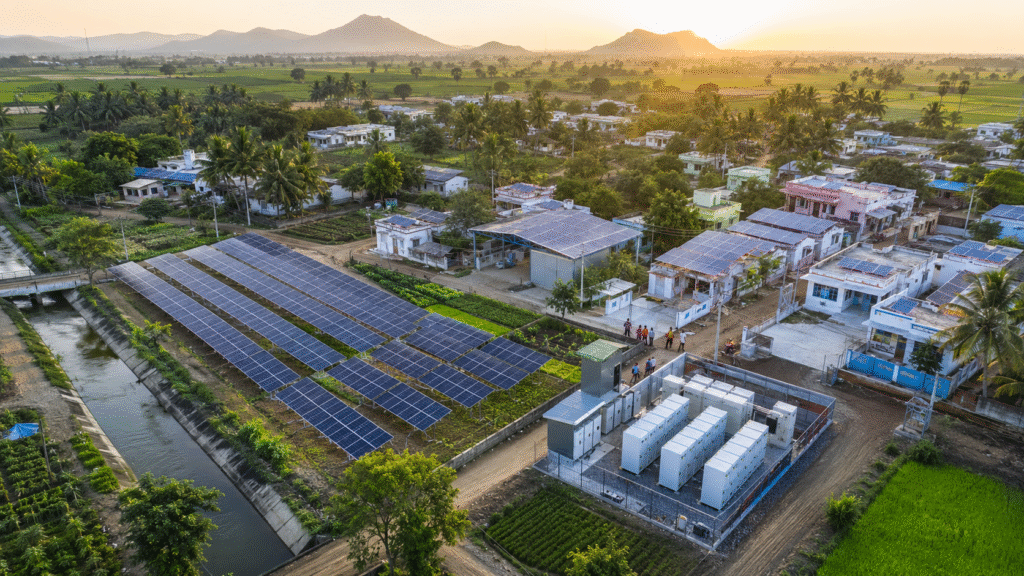
Bringing Reliable, Affordable, and Sustainable Electricity to Every Village
India has made remarkable progress in expanding electricity access over the past two decades. Yet, many rural communities continue to face challenges such as unreliable power supply, voltage fluctuations, seasonal outages, and the high cost of extending traditional grid infrastructure to remote areas.
As India’s renewable energy sector grows, Community Solar Projects and Solar Microgrids are emerging as practical solutions that improve energy access while supporting agriculture, education, healthcare, and rural businesses.
For a state like Andhra Pradesh, where agriculture, aquaculture, dairy farming, rural enterprises, and irrigation play a vital role in the economy, these decentralized energy systems offer significant long-term potential.
Rather than depending entirely on large centralized power stations, community-based renewable energy allows villages and local institutions to generate and manage electricity closer to where it is needed.
At VMJ Solar Solutions, we believe decentralized solar technologies will play an increasingly important role in building a cleaner, more resilient, and energy-secure future for rural India.
What Is Community Solar?
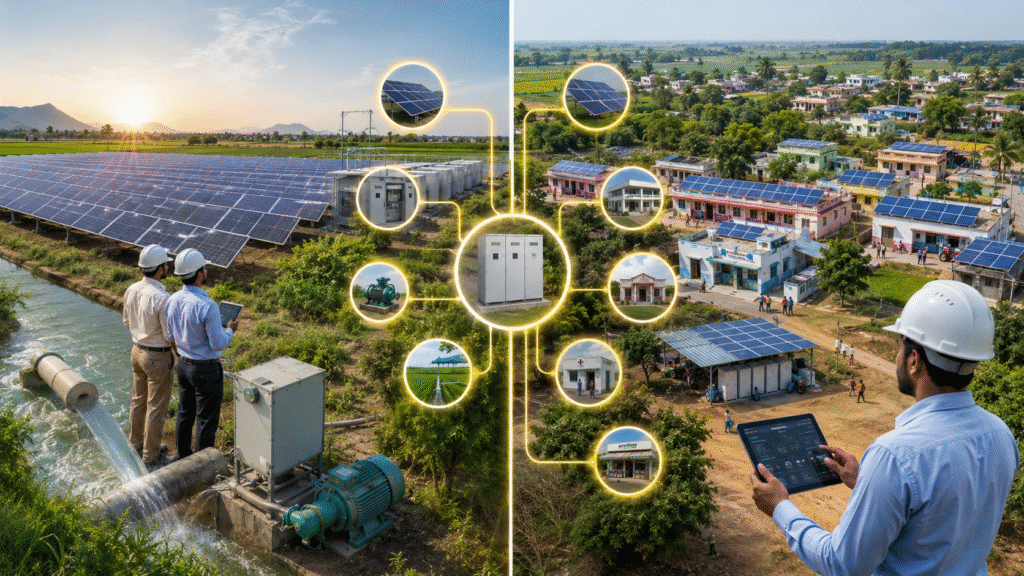
Community solar is a renewable energy model in which a single solar power system supplies electricity to multiple users instead of just one building or property.
Participants may include:
- Households
- Farmers
- Schools
- Healthcare centers
- Small businesses
- Government buildings
- Community facilities
Instead of each consumer installing an individual rooftop solar system, multiple users benefit from one centrally located solar installation.
This approach can make solar energy accessible to people who:
- Do not own suitable rooftops.
- Live in rented homes.
- Have limited installation space.
- Cannot individually invest in solar systems.
What Is a Solar Microgrid?
A solar microgrid is a localized electricity network that combines:
- Solar panels
- Battery storage
- Smart controllers
- Distribution lines
- Backup systems (where required)
Unlike traditional power systems, a microgrid can operate:
- Alongside the main electricity grid.
- Independently during outages.
- Entirely off-grid in remote locations.
Microgrids provide communities with greater energy reliability while reducing dependence on long transmission networks.
How Community Solar Works
The process is straightforward.
Step 1
A centralized solar power plant is installed within or near the community.
Step 2
Electricity generated by the system is distributed among participating users.
Step 3
Consumers receive electricity through agreed allocation or billing arrangements.
Step 4
Maintenance is managed centrally rather than by individual users.
How Solar Microgrids Work
A microgrid continuously balances:
- Solar generation
- Battery storage
- Community electricity demand
- Grid connection (if available)
During sunny periods:
Solar panels generate electricity.
Excess energy may be stored in batteries or used immediately.
When sunlight decreases:
Stored electricity or backup sources help maintain supply.
This creates a more reliable electricity system for rural communities.
Why Rural India Needs Community Solar and Microgrids
Many rural regions experience challenges such as:
- Long feeder lines
- Voltage fluctuations
- Frequent outages
- Remote settlements
- Agricultural electricity demand
- Rising diesel fuel costs
Community solar and microgrids help address these issues by generating electricity closer to where it is consumed.
Benefits of Community Solar
Makes Solar Accessible to More People
Not every household has sufficient rooftop space.
Community solar allows multiple users to benefit from one shared project.
Lower Individual Investment
Instead of installing separate systems, costs can be distributed across multiple participants or supported through institutional funding models.
Professional Maintenance
A single professionally managed system is often easier to maintain than numerous individual installations.
Better Land Utilization
Suitable community land or unused spaces can generate clean energy for multiple users.
Supports Energy Equity
Community solar can improve access to renewable energy for consumers who may otherwise face barriers to adoption.
Benefits of Solar Microgrids
Improved Energy Reliability
Microgrids can continue supplying electricity during certain grid disruptions, depending on system design and storage capacity.
Reduced Diesel Dependence
Remote communities often rely on diesel generators.
Solar microgrids can reduce fuel consumption and operating costs.
Better Agricultural Support
Reliable electricity benefits:
- Irrigation pumps
- Cold storage
- Dairy operations
- Food processing
Supports Rural Businesses
Small enterprises require dependable electricity for:
- Shops
- Workshops
- Rice mills
- Flour mills
- Tailoring units
- Digital services
Cleaner Environment
Replacing diesel generation with solar energy reduces greenhouse gas emissions and local air pollution.
Applications in Andhra Pradesh
Community solar and microgrids have strong potential across:
Agriculture
Powering irrigation pumps and farm operations.
Fisheries and Aquaculture
Supporting aeration systems, cold storage, and water management.
Rural Schools
Providing reliable electricity for digital classrooms and computer labs.
Primary Health Centres
Ensuring uninterrupted power for lighting, refrigeration, and medical equipment.
Village Water Supply Systems
Operating pumps and water purification systems.
Rural Industries
Supporting food processing, weaving, dairy production, and other local enterprises.
Challenges to Consider
While promising, community solar and microgrids also face practical challenges.
Initial Capital Investment
Large community projects require significant planning and financing.
Battery Costs
Microgrids using energy storage typically involve higher upfront investment.
Land Availability
Suitable locations must be identified for shared solar installations.
Governance and Management
Successful projects require clear ownership, maintenance, and billing arrangements.
Regulatory Framework
Policies governing decentralized electricity systems continue evolving across India.
Future of Community Solar in India
India’s renewable energy transition increasingly emphasizes decentralized power generation.
Future growth is expected in:
- Community solar farms
- Village solar microgrids
- Agricultural solar cooperatives
- Smart energy villages
- Renewable-powered rural enterprises
- Battery-integrated community energy systems
These technologies can complement the national electricity grid while improving local energy resilience.
Why This Matters for Andhra Pradesh
Andhra Pradesh has:
- High solar irradiation
- Strong agricultural activity
- Expanding rural infrastructure
- Extensive irrigation networks
- Growing renewable energy investments
Community solar and microgrids can help improve electricity access while supporting economic development in rural areas.
These systems are particularly valuable for villages where distributed renewable energy can complement existing grid infrastructure.
Why Choose VMJ Solar Solutions?
VMJ Solar Solutions supports innovative renewable energy projects designed for India’s evolving energy needs.
Our services include:
✔ Community solar consulting
✔ Rural solar electrification
✔ Agricultural solar systems
✔ Commercial solar projects
✔ Industrial solar solutions
✔ Solar feasibility studies
✔ Solar O&M services
✔ Renewable energy advisory
We help organizations evaluate practical solar solutions that balance energy reliability, sustainability, and long-term operational efficiency.
Frequently Asked Questions (FAQs)
1.What is community solar?
Community solar is a shared solar energy system that supplies electricity to multiple consumers instead of a single property.
2.What is a solar microgrid?
A solar microgrid is a localized electricity network that combines solar panels, battery storage, and distribution infrastructure to supply power to a defined area.
3.Can community solar help people without rooftops?
Yes. Community solar enables people who lack suitable rooftops to benefit from solar energy through shared installations.
4.Do microgrids work during power outages?
Many microgrids are designed to continue operating during outages, especially when equipped with battery storage and appropriate control systems.
5.Are microgrids suitable for villages?
Yes. They are commonly considered for remote communities, agricultural areas, institutions, and locations requiring reliable local electricity.
6.Can farmers benefit from community solar?
Yes. Shared solar projects can support irrigation, cold storage, and agricultural processing while reducing dependence on conventional electricity or diesel.
Final Thoughts
Community solar and solar microgrids are transforming how electricity is generated and delivered in rural India. By producing clean energy closer to where it is needed, these decentralized systems improve reliability, reduce dependence on fossil fuels, and make renewable energy accessible to communities that may not benefit from individual rooftop installations.
For Andhra Pradesh, with its strong agricultural base and abundant solar resources, community solar and microgrids offer promising opportunities to strengthen rural infrastructure while supporting sustainable economic growth. Although implementation requires thoughtful planning, financing, and community participation, these technologies are expected to play an increasingly important role in India’s clean energy future.