
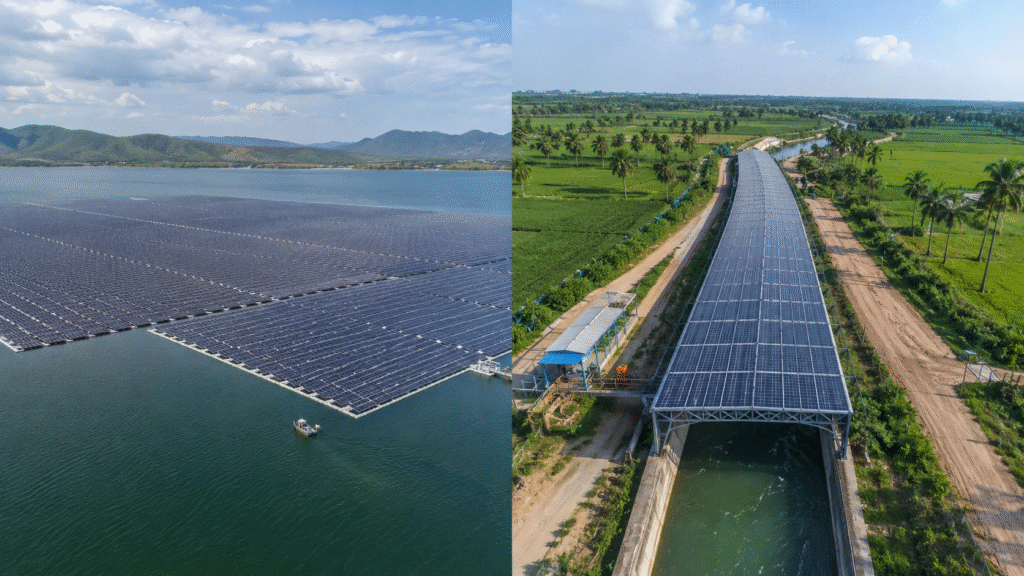
India’s renewable energy sector is rapidly evolving beyond traditional rooftop and ground-mounted solar installations. As land availability becomes more limited and water conservation grows increasingly important, innovative solar technologies are helping generate clean electricity while making better use of existing infrastructure.
Two of the most promising solutions are Floating Solar Power Plants (FPV) and Canal Top Solar Projects.
Instead of occupying valuable agricultural or industrial land, these technologies utilize water reservoirs, lakes, dams, irrigation canals, and water bodies to generate renewable energy while offering additional environmental benefits.
For a water-rich and agriculture-driven state like Andhra Pradesh, both technologies present exciting opportunities to improve land utilization, reduce water evaporation, and expand clean energy capacity.
At VMJ Solar Solutions, we closely follow emerging solar technologies that can support India’s long-term renewable energy goals and help organizations make informed investment decisions.
What Is Floating Solar?
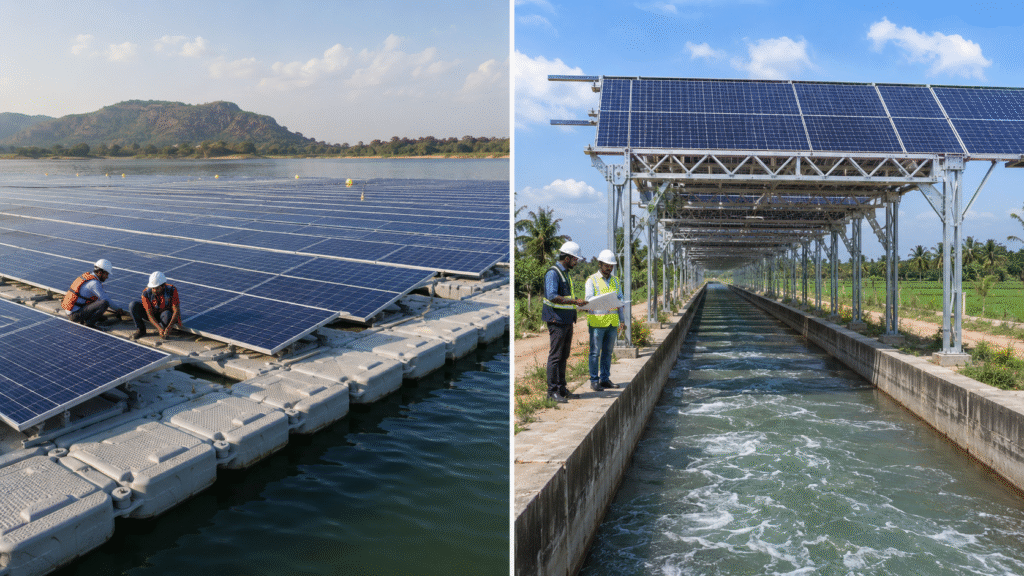
Floating Solar, also known as Floating Photovoltaics (FPV), involves installing solar panels on specially designed floating platforms placed on water bodies.
These installations are commonly developed on:
- Reservoirs
- Dams
- Lakes
- Quarry ponds
- Water treatment plants
- Industrial water reservoirs
The solar panels are mounted on buoyant structures and securely anchored to withstand changing water levels and weather conditions.
What Is Canal Top Solar?
Canal Top Solar involves installing solar panels on elevated support structures built directly above irrigation canals.
Instead of using open land, these systems utilize the unused space over canals to generate electricity while allowing water to continue flowing underneath.
Canal top projects are particularly attractive in regions with extensive irrigation networks.
Why Are Alternative Solar Installations Becoming Popular?
India has ambitious renewable energy targets while also facing challenges such as:
- Limited land availability
- Rising land costs
- Increasing electricity demand
- Water conservation concerns
- Urban expansion
Floating and canal top solar systems help address these challenges by making productive use of existing water infrastructure.
How Floating Solar Works
The basic components include:
- Solar panels
- Floating pontoons
- Anchoring systems
- Electrical cables
- Inverters
- Grid connection equipment
The floating platforms rise and fall with changing water levels while remaining securely positioned.
Electricity generated by the solar panels is transmitted through waterproof electrical systems to nearby substations.
The basic components include:
- Solar panels
- Floating pontoons
- Anchoring systems
- Electrical cables
- Inverters
- Grid connection equipment
The floating platforms rise and fall with changing water levels while remaining securely positioned.
Electricity generated by the solar panels is transmitted through waterproof electrical systems to nearby substations.
How Canal Top Solar Works
Solar panels are mounted on specially engineered steel structures spanning irrigation canals.
The system includes:
- Elevated support frames
- Solar modules
- Grid-tied inverters
- Maintenance walkways
- Electrical infrastructure
The canal continues functioning normally while solar panels generate electricity overhead.
Benefits of Floating Solar
Maximizes Unused Water Bodies
Floating solar allows reservoirs and lakes to generate clean electricity without occupying valuable land.
Reduces Water Evaporation
Solar panels partially shade the water surface, helping reduce evaporation—an important advantage in regions facing seasonal water stress.
Improved Panel Cooling
Water beneath the panels can help lower operating temperatures.
Since solar panels generally perform better at lower temperatures, floating systems may experience improved energy generation compared to identical land-based systems under similar conditions.
Reduced Land Acquisition Costs
Large utility-scale solar projects often require significant land.
Floating systems utilize existing water bodies instead.
Supports Sustainable Development
Floating solar combines renewable energy generation with more efficient land and water resource utilization.
Benefits of Canal Top Solar
Preserves Agricultural Land
No farmland needs to be converted into solar parks.
Reduces Canal Water Evaporation
Panel shading helps reduce direct sunlight exposure on canal water.
Efficient Infrastructure Utilization
Existing irrigation canals serve dual purposes:
- Water distribution
- Renewable energy generation
Lower Vegetation Growth
Reduced sunlight reaching the canal may help slow aquatic weed growth in some cases.
Distributed Energy Generation
Canal top projects can be developed across multiple locations along irrigation networks.
Challenges of Floating Solar
Higher Initial Investment
Floating platforms and anchoring systems generally increase installation costs.
Specialized Engineering Requirements
Designs must account for:
- Water depth
- Wind loads
- Anchoring
- Water level fluctuations
Maintenance Complexity
Technicians often require boats or floating platforms for inspections and repairs.
Environmental Assessments
Projects should evaluate potential impacts on aquatic ecosystems before construction
Challenges of Canal Top Solar
Complex Structural Design
Bridges and elevated steel structures require careful engineering.
Higher Construction Costs
Support structures typically cost more than standard ground-mounted systems.
Limited Installation Width
Canal dimensions restrict available panel placement.
Maintenance Access
Repairs require careful planning to avoid disrupting canal operations.
Which Technology Produces More Electricity?
Both technologies use conventional photovoltaic modules.
Overall electricity generation depends on:
- Solar irradiation
- Panel efficiency
- System design
- Orientation
- Maintenance
Floating solar may benefit from cooler operating temperatures, which can support improved performance under certain conditions.
However, project-specific design has a much greater influence on energy production than installation type alone.
Which Is Better for Andhra Pradesh?
Andhra Pradesh has strong potential for both technologies.
Floating Solar Opportunities
The state contains:
- Large reservoirs
- Irrigation tanks
- Dams
- Industrial water bodies
These locations may be suitable for floating solar development.
Canal Top Solar Opportunities
The state’s extensive irrigation network provides opportunities for canal-based renewable energy projects while supporting agricultural infrastructure.
Environmental Benefits
Both technologies contribute to:
✔ Clean energy generation
✔ Reduced carbon emissions
✔ Better land utilization
✔ Improved resource efficiency
✔ Lower dependence on fossil fuels
✔ Sustainable infrastructure development
Floating Solar vs Canal Top Solar: Which Is Better?
The answer depends on project objectives.
Floating Solar Is Ideal When
- Large reservoirs are available.
- Utility-scale power generation is planned.
- Maximizing energy production is the priority.
Canal Top Solar Is Ideal When
- Extensive irrigation canals already exist.
- Land conservation is essential.
- Distributed solar generation is preferred.
In many regions, both technologies can complement conventional rooftop and ground-mounted solar systems.
Future of Water-Based Solar in India
India is increasingly exploring innovative solar deployment methods.
Future growth is expected in:
- Floating solar parks
- Canal top solar projects
- Reservoir-based solar
- Hybrid hydro-solar systems
- Water utility solar projects
As technology improves and project costs continue to evolve, these systems may play an increasingly important role in India’s renewable energy transition.
Why Choose VMJ Solar Solutions?
VMJ Solar Solutions provides expert guidance on a wide range of solar technologies.
Our services include:
✔ Residential rooftop solar
✔ Commercial solar projects
✔ Industrial solar systems
✔ Utility-scale solar consulting
✔ Solar feasibility studies
✔ Solar plant maintenance
✔ Performance optimization
✔ Renewable energy advisory services
We help customers identify the most appropriate solar solution based on project requirements, available space, and long-term energy goals.
Frequently Asked Questions (FAQs)
1.What is floating solar?
Floating solar refers to photovoltaic panels installed on floating structures over reservoirs, lakes, dams, and other water bodies.
2.What is canal top solar?
Canal top solar involves mounting solar panels above irrigation canals using elevated support structures.
3.Which is more efficient: floating solar or canal top solar?
Both use similar photovoltaic technology. Floating solar may benefit from cooler operating temperatures, while overall performance depends primarily on system design, location, and maintenance.
4.Does floating solar save water?
Yes. By partially shading water surfaces, floating solar installations can help reduce evaporation.
5.Does canal top solar affect irrigation?
No. Properly designed canal top systems allow normal water flow beneath the solar panels.
Final Thoughts
Floating Solar and Canal Top Solar represent two of the most innovative approaches to renewable energy deployment in India. By generating clean electricity without occupying valuable agricultural land, both technologies support more efficient use of natural resources while contributing to India’s renewable energy ambitions.
For Andhra Pradesh, where water infrastructure and solar potential are both significant, these solutions could play an increasingly important role in future energy planning. While each approach has unique advantages and engineering challenges, both demonstrate how renewable energy can be integrated with existing infrastructure to create smarter, more sustainable development.