
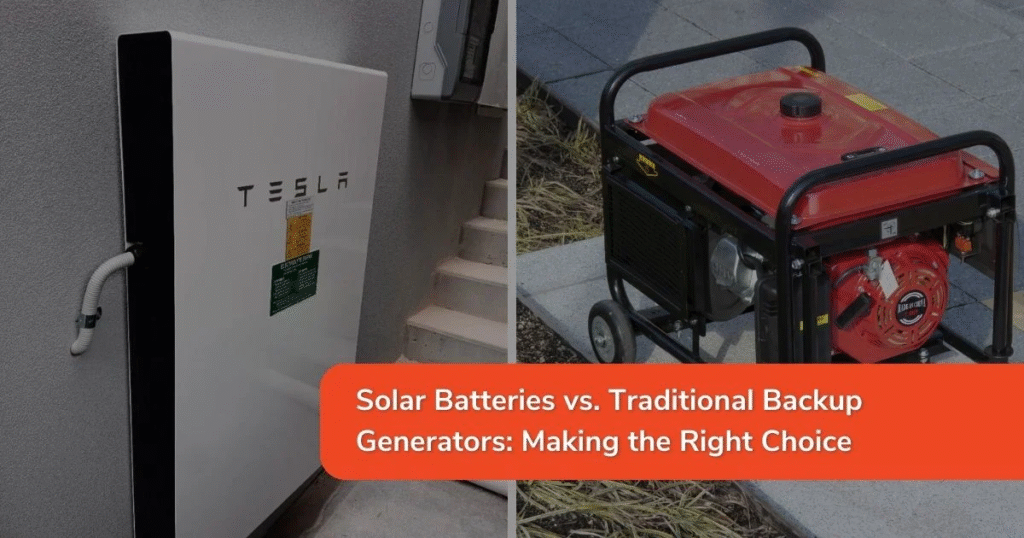
For decades, backup generators have been the go-to choice during power cuts. But with the rise of Battery Energy Storage Systems (BESS), homeowners and businesses now have a cleaner, quieter, and smarter option.
At VMJ Solar, we often get asked: “Should I choose a battery system or stick with a generator?” The answer depends on cost, convenience, environment, and long-term value. This blog gives you a clear, side-by-side comparison so you can make the best choice for your needs.
What is BESS?
A Battery Energy Storage System stores electricity — usually from solar panels or the grid — and discharges it when needed. Modern BESS uses Lithium-Ion or LFP (Lithium Iron Phosphate) batteries, offering high efficiency, long lifespan, and smart management features.
- Silent operation
- Runs instantly during outages
- Can integrate with solar for zero grid dependency
What is a Traditional Backup Generator?
Generators run on diesel, petrol, or natural gas to produce electricity during power outages. They’re widely available, relatively cheap upfront, but come with ongoing fuel and maintenance costs.
- Works independently of solar
- Available in multiple sizes
- Known for high operating noise and emissions
BESS vs Generator – Key Comparison
| Feature | BESS (Battery Energy Storage) | Traditional Generators |
|---|---|---|
| Fuel/Power Source | Solar / Grid electricity | Diesel, Petrol, or Gas |
| Running Cost | Very low (no fuel, minimal maintenance) | High (fuel cost + regular servicing) |
| Efficiency | 85–95% round-trip | 25–40% (much lower) |
| Noise | Silent | Noisy (65–100 dB) |
| Emissions | Zero (clean energy) | CO₂, NOx, and particulate emissions |
| Response Time | Instant (milliseconds) | Seconds to minutes |
| Maintenance | Minimal (battery checks) | Frequent (oil, filters, fuel storage) |
| Lifespan | 8–12 years for batteries (replaceable) | 10–15 years (but heavy maintenance) |
| Scalability | Easy to expand | Limited, requires bigger generator |
| Best Use Case | Homes & businesses with solar, TOU tariffs, eco goals | Remote sites with no solar/grid, short-term heavy loads |
Cost Comparison
Generators
- Initial cost: Low (~Rs30,000 to Rs2.5 lakh depending on size)
- Fuel cost: Rs80–Rs90/litre diesel → Rs15–Rs25 per unit of electricity
- Annual maintenance: Rs10,000–Rs30,000
BESS
- Initial cost: Higher (Rs3–7 lakh for home/commercial units)
- Running cost: ~Rs2–Rs6 per unit (charging from solar/grid)
- Maintenance: Minimal
👉 Over 8–10 years, BESS often turns out cheaper due to zero fuel costs.
Environmental Impact
- BESS → Clean, renewable, zero emissions, aligns with sustainability goals.
- Generators → Heavy carbon emissions, local air pollution, noisy.
In fact, India is tightening emission rules for diesel generators in cities — making BESS a more future-proof option.
Practical Scenarios
- Residential Homes
- BESS: Perfect for homes with rooftop solar; provides seamless backup and bill savings.
- Generator: Works in areas without solar potential, but adds fuel hassle.
- Businesses
- BESS: Cuts demand charges, peak tariffs, and ensures quiet operation.
- Generator: Still useful for short-term, high load backup (like construction sites).
- Remote / Rural Areas
- BESS: Works if paired with solar.
- Generator: Preferred where grid and solar options are unreliable.
Why VMJ Solar Recommends BESS Over Generators
- Financially better long term (no recurring fuel cost)
- Eco-friendly with zero emissions
- Silent and seamless – no noise or switching delay
- Compatible with solar, ensuring maximum ROI
- Future-proof, while diesel faces increasing restrictions
That said, for certain temporary, high-load, or off-grid cases, generators may still make sense. But for most homeowners and businesses, BESS is the smarter, cleaner choice.
FAQs
1: Is BESS more expensive than a generator?
Upfront, yes. But over time, BESS saves more due to zero fuel cost.
2: Can I use both BESS and a generator?
Yes. Many hybrid setups use BESS for primary backup and a generator as a last resort.
3: How long can BESS power a home?
A 10 kWh system can run essentials (lights, fans, TV, Wi-Fi, fridge) for ~6–8 hours. Larger setups can power homes for longer.
Conclusion
While generators have served us for years, the future of backup power is BESS. It’s cleaner, quieter, more efficient, and pays for itself in the long run.
At VMJ Solar, we design solar + storage solutions that don’t just replace the grid, but also eliminate the need for noisy, polluting, and costly generators.
⚡ Switch today, and experience the smarter way to power your world.