
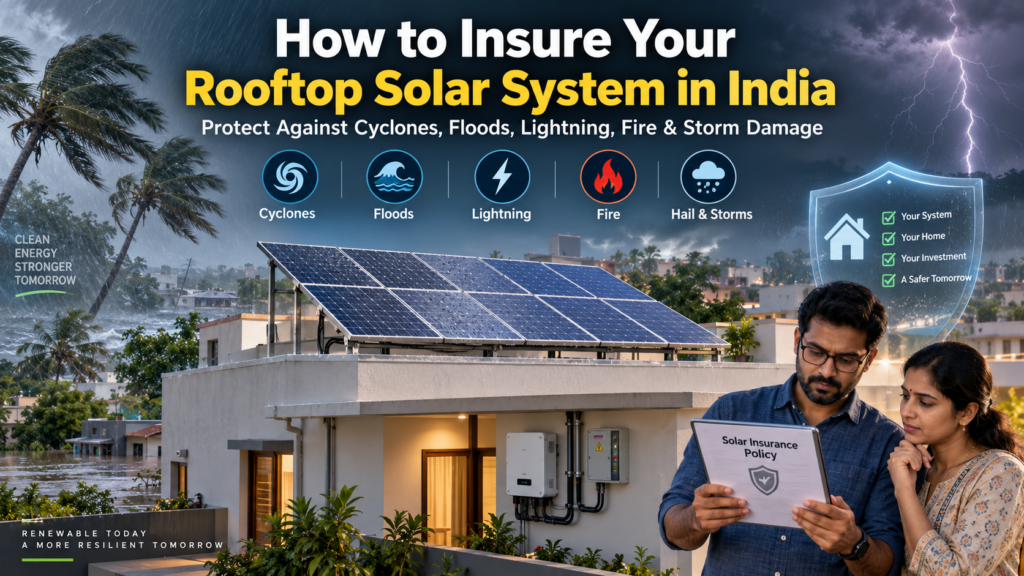
A rooftop Solar system is a long-term investment.
Once installed, Solar panels, inverters, mounting structures, cables and electrical equipment remain exposed to outdoor conditions for many years. While Solar systems are designed for outdoor operation, events such as cyclones, storms, floods, lightning, fire, hail, falling objects and other accidental events can potentially cause physical damage.
This raises an important question for Solar owners:
How can I insure my rooftop Solar system against natural disasters in India?
The answer depends on the type of property, who owns the Solar system, the insurance product, the policy schedule, the insured value and the specific exclusions.
Some home insurance products explicitly include Solar panels as part of the home-building cover. For example, the New India Bharat Griha Raksha policy wording includes Solar panels within the definition of the home building, subject to the policy’s terms.
For businesses, property insurance products can cover buildings, plant and machinery and other insured assets against specified perils. For example, current commercial insurance products from insurers include risks such as fire, lightning, earthquake, storm, cyclone, flood and inundation, subject to their individual policy terms.
The important point is:
Do not assume that every rooftop Solar system is automatically fully insured just because the building has insurance.
The Solar equipment should be specifically reviewed with the insurer.
Quick Answer: How Do You Insure a Rooftop Solar System?
To insure a rooftop Solar system against natural disasters in India:
- Check whether your existing home or commercial property policy already includes Solar panels.
- Ask the insurer to confirm the Solar equipment is specifically covered.
- Check whether storm, cyclone, flood, inundation, lightning, fire and earthquake are covered.
- Confirm whether the policy covers the Solar panels, inverter, mounting structure, cables and related equipment.
- Set an adequate sum insured based on the appropriate valuation basis.
- Check deductibles and exclusions.
- Ask whether accidental damage and electrical/mechanical breakdown require separate cover.
- Check whether loss of income or business interruption can be insured for commercial systems.
- Maintain invoices, serial numbers, installation documents and photographs.
- Understand the claim notification and documentation requirements before a loss occurs.
IRDAI explains that property insurance requires the proposer to have an insurable interest in the asset and to disclose relevant information accurately. It also notes that property insurance products can cover specified perils such as fire, flood and storm depending on the policy.
Why Should You Insure a Rooftop Solar System?
A Solar installation can represent a substantial capital investment.
A residential system may include:
- Solar PV modules
- Inverter
- Mounting structure
- DC cables
- AC cables
- Protection equipment
- Earthing
- Monitoring equipment
- Metering equipment
A commercial Solar system can involve a much larger investment.
If a severe weather event damages the installation, the owner may have to bear costs for:
- Replacement panels
- Inverter repair or replacement
- Mounting structure repair
- Cable replacement
- Electrical work
- Labour
- Transportation
- Testing
- Recommissioning
Insurance can potentially transfer some of these financial risks to an insurer, subject to the policy terms.
What Natural Disasters Can Damage Rooftop Solar?
Rooftop Solar systems are designed for outdoor environments, but extreme events can still create risks.
Potential hazards include:
Cyclones
Strong winds can place significant loads on panels, mounting structures and roof attachment points.
Storms
Severe storms can cause physical damage through wind, debris and impact.
Flooding
Water entering areas containing electrical equipment can cause damage.
Lightning
Lightning and associated electrical events can damage inverters, protection equipment and other components.
Fire
Fire can damage Solar modules, cables, inverters, mounting components and the building itself.
Hail
Large hail can potentially damage Solar module glass.
Falling Trees or Objects
Trees, branches or other objects can physically damage modules or structures.
Earthquakes
Depending on location and construction, seismic movement can affect the building and Solar mounting system.
Insurance coverage for each of these risks depends on the policy wording.
Does Home Insurance Cover Rooftop Solar Panels?
Sometimes, but do not assume it automatically does.
Some home insurance products specifically include Solar panels as part of the insured home building.
For example, the New India Bharat Griha Raksha policy wording includes Solar panels among additional structures/fixtures associated with the home building.
The policy’s insured perils can include events such as:
- Fire
- Lightning
- Explosion
- Earthquake
- Storm
- Cyclone
- Flood
- Inundation
- Landslide
- Impact damage
subject to the applicable policy wording and exclusions.
Other insurers may structure their home insurance differently.
Therefore, homeowners should ask:
“Are my rooftop Solar panels specifically included in the insured property under this policy?”
Does Building Insurance Automatically Cover Solar Panels?
Not necessarily.
A building insurance policy may cover the building itself, while Solar equipment may be treated differently depending on the policy.
Some policy wordings specifically include Solar panels.
Others may require the equipment to be declared or endorsed.
Therefore, never rely only on a verbal statement such as:
“Your house is insured, so the Solar panels are covered.”
Ask for written confirmation in the policy schedule, endorsement or policy wording.
What Should a Solar Insurance Policy Cover?
For a rooftop Solar system, you may want to investigate coverage for the following:
Solar Modules
The PV panels themselves.
Inverter
One of the most valuable electronic components in the system.
Mounting Structure
Important for rooftop systems exposed to wind and weather.
Electrical Equipment
Depending on the policy, this could include certain protection and distribution equipment.
Cables
DC and AC cabling may need to be specifically considered.
Monitoring Equipment
Communication devices and monitoring hardware may also need to be declared where relevant.
Installation-Related Assets
Depending on the policy structure, associated equipment may be covered subject to the insurer’s terms.
The exact scope must be confirmed with the insurer.
Natural Disaster Insurance vs Equipment Breakdown Insurance
This distinction is extremely important.
A property policy may cover physical damage caused by insured external perils.
But it may not automatically cover every internal electrical or mechanical failure.
For example:
Cyclone damages the inverter
This may potentially fall under an insured storm/cyclone peril if the inverter is insured and the policy responds.
Inverter fails because of an internal electronic component
That may require different coverage or may fall under the manufacturer’s warranty, depending on the cause and policy.
Panel gradually loses output
This is generally a performance/degradation issue rather than a sudden insured natural-disaster loss.
Therefore:
Insurance and manufacturer warranty serve different purposes.
Solar Warranty vs Solar Insurance
Do not confuse these two.
Solar Panel Warranty
The manufacturer may provide:
- Product warranty
- Performance warranty
These primarily relate to manufacturing defects and/or guaranteed electrical output according to the warranty terms.
Insurance
Insurance can protect against specified insured risks such as:
- Fire
- Storm
- Cyclone
- Flood
- Earthquake
- Other covered events
depending on the policy.
For example:
Panel develops a manufacturing defect
→ Manufacturer warranty may be relevant.
Panel is physically damaged by a covered cyclone
→ Property insurance may be relevant.
Panel gradually degrades
→ Performance warranty may be relevant.
This distinction can prevent confusion during a claim.
What Is the Best Insurance for Rooftop Solar in India?
There is no single insurance policy that can be called the universal “best Solar insurance” for every customer.
The appropriate structure depends on:
- Residential or commercial use
- Solar system size
- Ownership
- Property type
- Location
- Risk exposure
- System value
- Existing insurance
- Financing arrangement
- Business interruption exposure
A residential rooftop system may be considered within a home insurance product where the policy permits it.
A factory or commercial Solar installation may require a more appropriate commercial property or engineering insurance arrangement.
MNRE has also published material specifically concerning insurance products for Solar power plants, indicating that Solar projects can require dedicated consideration of insurance protection.
How Much Solar Insurance Should You Buy?
The sum insured should be sufficient to address the relevant insured value under the policy’s valuation basis.
Do not simply use:
Original Solar purchase price
without checking how the policy calculates the insured value.
Depending on the policy, valuation can involve concepts such as:
- Replacement value
- Reinstatement value
- Market/depreciated value
- Agreed value
- Other specified valuation methods
For example, Oriental Insurance’s property guidance explains different valuation approaches for building and plant/machinery under its Standard Fire and Special Perils framework.
Ask your insurer:
“If my Solar system is completely destroyed, how will the claim value be calculated?”
This is more useful than simply asking:
“How much is the premium?”
Why Underinsurance Is a Problem
Suppose your Solar system would cost significantly more to replace today than when you originally installed it.
If your insured value is too low, you may not have adequate protection.
This is particularly relevant because equipment prices, labour, transportation and installation costs can change over time.
Commercial property insurance guidance also warns about the consequences of inadequate sums insured and underinsurance.
Therefore, review the insured value when:
- Solar capacity is expanded
- Major equipment is replaced
- The system is upgraded
- Insurance is renewed
- Replacement costs materially change
Should the Inverter Be Separately Listed?
Ask your insurer.
The inverter is often one of the higher-value individual components and has different failure characteristics from Solar modules.
Your policy should clearly identify whether the inverter is:
- Included in the insured Solar system
- Included under plant and machinery
- Covered under another section
- Subject to a separate limit
- Excluded unless specifically declared
Never assume.
What About Solar Mounting Structures?
The mounting structure is particularly important in cyclone-prone or high-wind areas.
The insurer may consider it part of the insured Solar installation or may treat it differently depending on the policy.
For rooftop systems, ask:
“Does the policy cover the Solar mounting structure and its associated damage if a cyclone or severe storm damages it?”
Also remember that insurance does not replace good structural design.
The Solar installation should still be designed and installed appropriately for the roof and local wind conditions.
Does Insurance Cover Cyclone Damage to Solar Panels?
It may, if cyclone/storm is an insured peril under the policy and the Solar equipment is included in the insured property.
Some Indian property insurance products explicitly list storm and cyclone among covered perils. For example, current commercial insurance products published by New India and ICICI Lombard list storm/cyclone and other natural catastrophes within their specified coverage, subject to policy conditions.
However, coverage can be affected by:
- Exclusions
- Deductibles
- Policy limits
- Insured value
- Installation conditions
- Structural issues
- Policy endorsements
So the correct question is not simply:
“Does insurance cover cyclones?”
Instead ask:
“Does my specific policy cover physical damage to my Solar modules, inverter and mounting system caused by cyclone, and what exclusions or deductibles apply?”
Does Insurance Cover Flood Damage?
Again, it depends on the policy.
Flood and inundation are listed among covered perils in several Indian property insurance products, subject to the policy wording.
For rooftop Solar, flood risk may primarily affect:
- Inverters installed at lower levels
- Electrical equipment
- AC/DC equipment
- Building electrical infrastructure
- Ground-mounted equipment in larger projects
If the inverter is installed indoors or at a higher elevation, the physical flood exposure may differ.
The insurance assessment should consider the complete Solar installation rather than only the panels.
Does Insurance Cover Lightning Damage?
Some property insurance products include lightning as an insured peril.
However, lightning-related electrical damage can involve complex causation and exclusions.
Therefore, check whether the policy covers:
- Direct lightning damage
- Electrical equipment damage
- Surge-related damage
- Inverter damage
- Protection equipment
Also ensure the Solar system has appropriate electrical protection.
Insurance should not be treated as a substitute for proper earthing, surge protection and lightning protection.
What About Hail Damage?
Hail coverage should be checked specifically.
Do not assume that because a policy covers storm damage, every form of hail-related damage is automatically covered in every product.
Ask the insurer:
“Is hail damage to the Solar module glass covered under this policy?”
Also ask about:
- Deductible
- Module replacement
- Labour
- Transportation
- Matching/replacement provisions
What About Theft?
Solar panels and copper cables can have theft risks, especially in accessible installations.
Whether theft is covered depends on the policy and circumstances.
Some home and commercial products include theft only under specified conditions or in conjunction with certain insured events.
For example, the New India Bharat Griha Raksha documentation describes theft following an insured event within a specified period, while commercial policies can have separate burglary/theft provisions.
Therefore, ask separately about:
Theft + Burglary + Vandalism + Malicious Damage
rather than assuming all are automatically covered.
Can Insurance Cover Business Interruption From Solar Damage?
For commercial Solar, this can be an important question.
Suppose a factory’s Solar system is damaged by a major cyclone.
The physical Solar equipment may be insured.
But the business may also experience:
- Higher grid electricity costs
- Production interruption
- Reduced operating capacity
- Lost revenue
Property damage insurance and business interruption/advance loss-of-profit coverage are not necessarily the same thing.
Commercial insurance products can include separate business interruption or advance loss-of-profit structures depending on the project and policy. Oriental Insurance, for example, describes advance loss-of-profit coverage in terms of an indemnity period and interruption following insured damage.
Commercial Solar owners should therefore ask:
“If my Solar plant is damaged and my electricity costs increase or business operations are affected, is any consequential loss or business interruption covered?”
Never assume it is.
What About Commercial Solar in Factories and Businesses?
A commercial Solar system can be treated differently from a residential rooftop system.
For businesses, the insurance review may include:
- Solar modules
- Inverters
- Mounting structures
- Cables
- Electrical equipment
- Plant and machinery
- Buildings
- Stocks
- Business interruption
- Third-party liability
- Employee-related risks
- Theft/burglary
Current commercial property products can cover buildings, plant, machinery and other business assets against specified insured perils, subject to policy limits and conditions.
For larger installations, a specialised insurance assessment may therefore be more appropriate than simply adding Solar panels to a standard home policy.
What Documents Do You Need to Insure a Solar System?
Keep a Solar insurance file containing:
Purchase Invoice
Shows the original investment and equipment details.
Solar EPC Agreement
Useful for documenting installation scope.
Equipment Datasheets
Keep module and inverter specifications.
Serial Numbers
Record panel/inverter serial numbers where practical.
Installation Photos
Keep clear photographs of:
- Panels
- Inverter
- Mounting structure
- Electrical equipment
- Roof
- Meter
Commissioning Documents
Keep installation and commissioning records.
Warranty Documents
Maintain manufacturer warranties.
Electricity Connection Documents
Keep relevant grid-connection and metering records.
Maintenance Records
Keep records of inspections and servicing.
Insurance Policy
Keep the full policy wording, schedule and endorsements.
Good documentation can make it easier to establish what was installed and what was insured.
How to Photograph Your Solar System for Insurance
Before an incident occurs, take clear photographs of:
- Entire rooftop array
- Individual module rows
- Inverter
- Mounting structures
- Electrical protection equipment
- Meter
- Cable routes where accessible
- Roof condition
- Serial labels
For a large commercial installation, maintain a systematic photographic record.
These records can help establish the condition and configuration of the system before a loss.
What Should You Do After a Cyclone or Natural Disaster?
If a natural disaster damages your Solar system:
1. Prioritise Safety
Do not touch damaged electrical equipment.
Solar panels can remain electrically active whenever exposed to light.
2. Contact the Installer or Qualified Technician
Have the system professionally assessed.
3. Inform the Insurer Promptly
Follow the policy’s claim-notification requirements.
4. Photograph the Damage
Take photographs and videos from a safe location.
5. Preserve Damaged Components
Do not discard damaged equipment before the insurer/surveyor has had an opportunity to inspect it unless necessary for safety.
6. Keep Repair Estimates
Collect repair or replacement quotations.
7. Keep Invoices and Records
Provide documents requested by the insurer.
8. Follow Surveyor Instructions
The insurer may appoint a surveyor to assess the loss.
Insurance claim procedures commonly require prompt notification, evidence of the damaged property and supporting records. Oriental Insurance’s published claim guidance, for example, asks insureds to notify the insurer, minimise further loss and provide relevant property and repair documentation.
What Should You Not Do After Solar Damage?
Avoid:
- Switching damaged equipment back on
- Touching exposed cables
- Removing panels yourself
- Throwing away damaged modules
- Repairing everything before documenting the damage
- Assuming every damaged item is insured
- Giving the insurer inaccurate information
If there is serious electrical or structural damage, get qualified professionals involved.
Common Solar Insurance Mistakes
Mistake 1: Assuming Home Insurance Automatically Covers Solar
Check the policy wording.
Mistake 2: Insuring Only the Panels
The inverter, mounting system and other components may also represent significant value.
Mistake 3: Choosing an Insufficient Sum Insured
Underinsurance can affect the amount recoverable.
Mistake 4: Ignoring Exclusions
A policy may cover some natural disasters while excluding or limiting other risks.
Mistake 5: Confusing Warranty With Insurance
Manufacturer warranty and property insurance address different risks.
Mistake 6: Not Updating the Policy After Expansion
If you add more panels, inform the insurer where required.
Mistake 7: Ignoring Business Interruption
Commercial customers may have financial losses beyond physical Solar damage.
Mistake 8: Not Keeping Documents
Missing invoices, serial numbers and installation records can make claims more difficult.
Should You Insure an On-Grid Solar System?
Insurance can be worth considering even for an on-grid system.
Being connected to the grid does not protect the equipment against physical damage.
The Solar system remains exposed to:
- Storms
- Cyclones
- Fire
- Lightning
- Flooding
- Impact
- Other insured risks
Whether insurance is economically worthwhile depends on the system value, risk exposure, policy premium, deductibles and the owner’s ability to absorb a major repair or replacement cost.
What About Hybrid Solar and Battery Systems?
Battery systems introduce additional equipment and risk considerations.
A hybrid Solar system may contain:
- Solar panels
- Hybrid inverter
- Battery
- Battery management system
- Protection equipment
- Monitoring system
Insurance should therefore specifically address the battery and associated equipment where applicable.
Do not assume that a policy covering Solar panels automatically covers every battery technology and every type of battery-related loss.
Ask the insurer to confirm the treatment of:
- Battery replacement
- Fire
- Thermal events
- Electrical damage
- Water damage
- Installation-related risks
What About Solar + EV Charging Systems?
If your rooftop Solar system is connected to an EV charger, the insurance review becomes broader.
The installation may include:
- Solar panels
- Inverter
- Battery
- EV charger
- Electrical distribution equipment
Ask whether the charger and associated equipment are included in the insured property.
How Often Should You Review Solar Insurance?
At minimum, review the policy at renewal.
Also review it when:
- Solar capacity increases
- New batteries are installed
- The inverter is replaced
- EV charging equipment is added
- The property changes ownership
- The building is renovated
- The use of the property changes
- Replacement costs change
A 3kW residential system and a 100kW commercial Solar plant should not necessarily be approached in exactly the same way.
Solar Insurance for Tadepalligudem and West Godavari
For Solar owners in Tadepalligudem, West Godavari and other parts of Andhra Pradesh, natural-disaster risk should be considered as part of the broader Solar investment.
Depending on the site, relevant concerns may include:
- Strong winds
- Cyclones
- Heavy rainfall
- Flooding
- Lightning
- Humidity
- Electrical surges
- Falling branches or objects
Andhra Pradesh has also experienced major flood and cyclone-related insurance-claim activity, and IRDAI has issued specific directions concerning claims following flood events in Andhra Pradesh and Telangana.
That does not mean every Solar system requires the same insurance policy.
Instead, the insurance discussion should be based on the actual site risk and the policy wording.
How VMJ Solar Solutions Can Help
For homeowners and commercial customers in Tadepalligudem, West Godavari and nearby areas, VMJ Solar Solutions can help with the technical documentation needed to understand the Solar installation.
This can include:
- Solar system capacity
- Panel model
- Inverter model
- Installation details
- Mounting structure
- Equipment specifications
- System photographs
- Monitoring information
- Maintenance records
These details can be useful when discussing insurance with your insurer or insurance adviser.
However, VMJ Solar Solutions is not the party that determines insurance coverage.
The insurer and qualified insurance adviser should confirm:
- Covered risks
- Sum insured
- Deductibles
- Exclusions
- Claim conditions
- Valuation method
- Business interruption coverage
- Endorsements
A Practical Solar Insurance Checklist
Before purchasing or renewing insurance, ask:
☐ Are my Solar panels explicitly insured?
☐ Is the inverter covered?
☐ Is the mounting structure covered?
☐ Are cables and electrical equipment covered?
☐ Is cyclone damage covered?
☐ Is storm damage covered?
☐ Is flood/inundation covered?
☐ Is lightning damage covered?
☐ Is earthquake damage covered?
☐ Is hail damage covered?
☐ Is theft/burglary covered?
☐ Is accidental damage covered?
☐ Is electrical/mechanical breakdown covered?
☐ What is the sum insured?
☐ What valuation method applies?
☐ What deductible applies?
☐ What exclusions apply?
☐ Is business interruption covered?
☐ What documents are required during a claim?
☐ Does adding more Solar require an endorsement?
FAQs
1. Can rooftop Solar panels be insured in India?
Yes, Solar panels can be included in certain property/home insurance arrangements, while commercial Solar installations may require appropriate commercial property or engineering insurance. Coverage depends on the specific policy.
2. Does home insurance cover Solar panels?
Some home insurance policies explicitly include Solar panels in the insured home building. However, coverage varies, so homeowners should verify the actual policy wording and schedule.
3. Does Solar insurance cover cyclone damage?
It can if cyclone/storm is an insured peril and the Solar equipment is included in the insured property. Specific exclusions, deductibles and policy limits apply.
4. Does Solar insurance cover floods?
Some property insurance products cover flood and inundation, but the exact scope depends on the policy. Confirm that the Solar equipment itself is insured.
5. Does Solar insurance cover lightning?
Lightning is covered as an insured peril in some property insurance products, but electrical damage and policy exclusions need to be checked carefully.
6. Is Solar panel warranty the same as insurance?
No. A manufacturer’s warranty generally addresses product defects and/or specified performance, while insurance can cover specified external risks such as fire, storm or cyclone.
7. Should I insure the Solar inverter separately?
Ask the insurer how the inverter is classified and whether it is included in the insured Solar system. Do not assume it is automatically covered.
8. Does insurance cover Solar panel degradation?
Generally, normal gradual degradation is not the same as sudden physical damage caused by an insured event. Performance warranty provisions may be relevant instead.
9. Can commercial Solar be insured against business interruption?
Potentially. Commercial insurance can include separate business interruption or advance-loss-of-profit arrangements, depending on the policy and project.
10. What documents should I keep for a Solar insurance claim?
Keep invoices, equipment serial numbers, warranty documents, EPC/installation records, commissioning documents, photographs, maintenance records and the insurance policy.
11. Should I update insurance if I add more Solar panels?
Yes, you should notify the insurer and confirm whether the increased asset value requires an endorsement or change in sum insured.
12. Is Solar insurance mandatory in India?
There is no single blanket rule that every rooftop Solar owner must purchase the same type of insurance. Insurance requirements can depend on the project, applicable regulations, financing arrangements, utility requirements and contractual conditions. Check the requirements applicable to your particular installation.
Conclusion
Insuring a rooftop Solar system is about protecting a long-term energy asset from risks that warranties may not cover.
A Solar panel performance warranty may protect you against specified long-term output issues, but it is not a replacement for property insurance.
For natural disasters such as:
- Cyclones
- Storms
- Floods
- Fire
- Lightning
- Earthquakes
- Hail
- Falling objects
insurance may provide financial protection when those risks are covered by the specific policy and the Solar equipment is properly included in the insured property.
The safest approach is therefore to avoid choosing insurance based only on the premium.
Instead, compare:
Coverage + Sum Insured + Deductibles + Exclusions + Valuation Method + Claim Process
For homeowners and businesses in Tadepalligudem, West Godavari and across Andhra Pradesh, this becomes especially relevant when evaluating long-term rooftop Solar investments.
Before purchasing a policy, ask the insurer one simple but important question:
“If a cyclone, flood, lightning strike or fire seriously damages my complete Solar installation, exactly which components will this policy pay to repair or replace?”
Get the answer in writing and review the policy wording before relying on the coverage.
Insurance disclaimer: This article is for general educational purposes and is not insurance, legal or financial advice. Insurance products, coverage, exclusions, deductibles, valuation methods and claim procedures vary by insurer and policy. Always review the current policy wording and consult a licensed insurance professional before purchasing or renewing cover.