
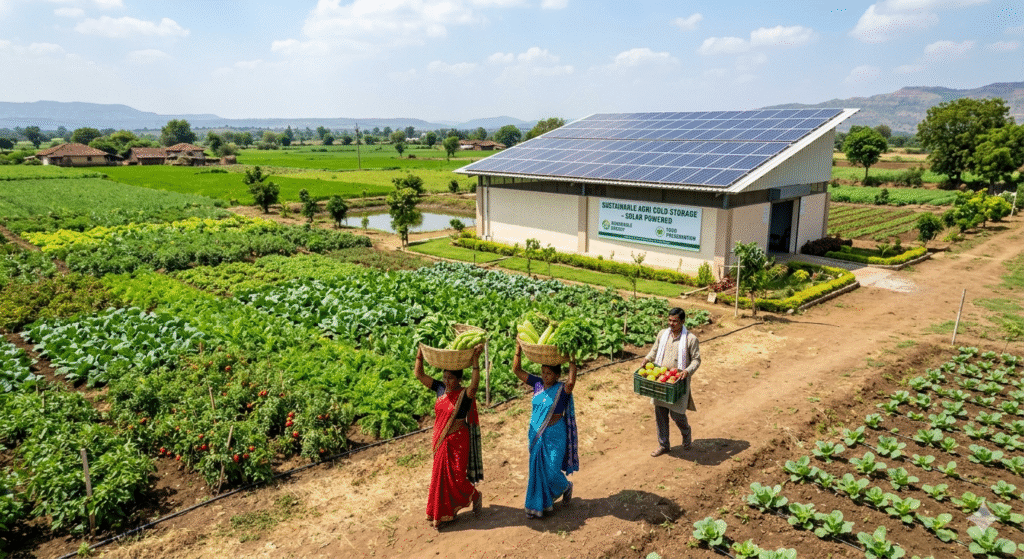
India is one of the largest agricultural producers in the world, yet a significant portion of its harvest never reaches the market. The problem isn’t production—it’s preservation. Every year, farmers lose a substantial percentage of their produce due to lack of proper storage facilities, unreliable electricity, and inefficient supply chains.
This is where solar powered cold storage systems are transforming the landscape. By combining renewable energy with modern refrigeration technology, solutions offered by companies like VMJ Solar Solutions are helping farmers reduce losses, increase profits, and build more resilient agricultural businesses.
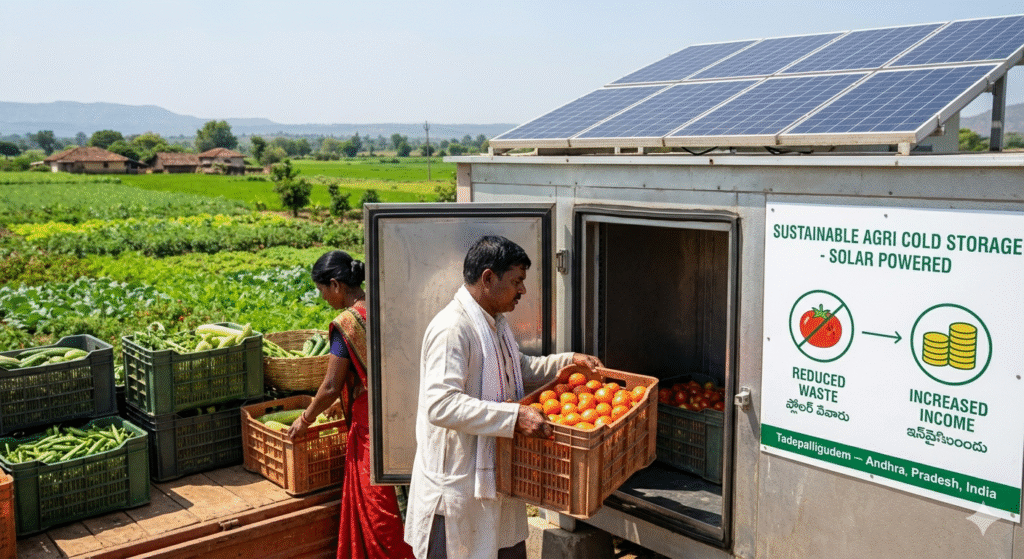
The Scale of Post-Harvest Losses in India
Let’s be blunt: growing more crops isn’t the solution if you can’t preserve what you already produce.
India loses an estimated 20% to 40% of fruits and vegetables post-harvest due to inadequate storage and logistics. According to agricultural reports:
- Fruits and vegetables are the most affected categories
- Small and marginal farmers suffer the most
- Lack of cold chain infrastructure is the primary bottleneck
What does this mean in real terms?
- Farmers are forced into distress selling
- Market prices crash during peak harvest seasons
- Income becomes unpredictable and unsustainable
You can increase yield all you want—but if storage fails, your margins collapse.
What is Solar Powered Cold Storage?
Solar powered cold storage is a system that uses solar energy to run refrigeration units designed to preserve perishable goods like fruits, vegetables, dairy, and flowers.
Core Components:
- Solar panels (to generate electricity)
- Battery storage (optional but critical in rural areas)
- Refrigeration unit
- Temperature control system
Unlike traditional cold storage, these systems are not dependent on unreliable grid power or expensive diesel generators.
Why Traditional Cold Storage Fails Farmers
Before jumping into solar, it’s worth confronting an uncomfortable truth: traditional cold storage models are often not built for small farmers.
Key Problems:
- High electricity costs
- Limited access in rural areas
- Expensive transportation to storage facilities
- Grid power instability
Most cold storage units are centralized, meaning farmers must travel long distances, adding cost and risk. By the time produce reaches storage, quality has already degraded.
How Solar Cold Storage Changes the Game
Solar powered cold storage flips the model—from centralized to decentralized.
1. Drastic Reduction in Crop Losses
With on-site or nearby cold storage:
- Shelf life of produce increases significantly
- Farmers gain flexibility in selling
- Waste is minimized
Example:
Tomatoes stored at ambient temperature last 2–3 days. In cold storage, they can last up to 2–3 weeks.
2. Energy Independence
Solar systems eliminate dependency on:
- Unstable grid electricity
- Rising power tariffs
- Diesel generators
This is especially critical in rural India, where power outages are frequent.
3. Higher Farmer Income
Let’s challenge a common assumption: farmers are poor because they produce less.
That’s only partially true. Many lose income due to poor timing in selling.
With cold storage:
- Farmers can wait for better market prices
- Avoid distress selling
- Sell in off-season at premium rates
This directly improves profitability.
4. Low Operating Costs
Once installed:
- Solar energy is essentially free
- Maintenance costs are minimal
- ROI is achieved within 3–5 years
Compare that to diesel-based systems, where fuel costs alone can destroy margins.
Real-World Example: Impact of Solar Cold Storage
Location: Andhra Pradesh
Farmer Group: Vegetable cooperative
Problem:
- 30% crop wastage during peak harvest
- Forced to sell at low prices
Solution:
A 10-ton solar powered cold storage system installed by VMJ Solar Solutions
Results:
- Crop losses reduced to under 5%
- Income increased by 25–40%
- Payback achieved in 4 years
This isn’t theoretical—it’s already happening.
Types of Solar Cold Storage Systems
1. Standalone Solar Cold Storage
- Fully solar-powered
- Ideal for remote areas
- Works independently of grid
2. Hybrid Systems
- Solar + grid backup
- Ensures uninterrupted operation
3. Community Cold Storage
- Shared by multiple farmers
- Reduces individual investment burden
If you’re thinking at scale, community models often outperform individual setups.
Government Support and Subsidies
The Indian government actively supports solar and agricultural infrastructure.
Available Benefits:
- Subsidies under renewable energy schemes
- Financial assistance for cold chain infrastructure
- Loans at reduced interest rates
Ignoring these incentives is leaving money on the table.
VMJ Solar Solutions helps farmers and agri-businesses navigate these schemes efficiently.
Key Crops That Benefit from Cold Storage
Not every crop needs cold storage—but high-value, perishable crops absolutely do.
Ideal for:
- Fruits (mango, banana, apple)
- Vegetables (tomato, onion, leafy greens)
- Dairy products
- Flowers
- Spices and seeds
If your crop spoils quickly, you’re already a candidate.
Installation Process: What to Expect
- Site assessment and requirement analysis
- System design based on storage needs
- Subsidy and approval assistance
- Installation and testing
- Training and maintenance support
The biggest mistake? Treating this like a simple equipment purchase. It’s an infrastructure decision.
Why VMJ Solar Solutions?
Not all solar providers understand agriculture. That’s where most projects fail.
VMJ Solar Solutions focuses on:
- Customized solutions for farmers
- High-efficiency systems designed for Indian conditions
- End-to-end support (design to maintenance)
- Strong ROI-focused approach
You don’t need panels—you need a working system that protects your harvest.
Environmental Benefits
This isn’t just about profit—it’s about sustainability.
- Reduces carbon emissions
- Eliminates diesel dependency
- Supports climate-resilient agriculture
Agriculture is already vulnerable to climate change. Solar is part of the solution, not just a cost-saving tool.
Challenges You Shouldn’t Ignore
Let’s not pretend this is a perfect system.
Real Challenges:
- Initial investment cost
- Need for proper system sizing
- Awareness gaps among farmers
But here’s the trade-off: short-term cost vs long-term income stability.
Avoiding investment doesn’t eliminate risk—it guarantees losses.
Future of Solar Cold Storage in India
The trend is clear:
- Decentralized storage will replace centralized models
- Solar adoption will accelerate in rural areas
- Farmer collectives will drive shared infrastructure
If you’re early, you gain a competitive advantage. If you wait, you compete on price in a saturated market.
Key Takeaways
- Post-harvest loss is a bigger problem than low yield
- Solar cold storage reduces waste and increases income
- Energy independence is critical for rural infrastructure
- ROI is achievable within a few years
- Early adoption provides long-term advantages
FAQs
1. How much does a solar cold storage system cost?
Costs vary depending on capacity, but small systems can start from ₹5–10 lakhs, with subsidies available.
2. Can it work without electricity?
Yes. Standalone systems run entirely on solar power, with battery backup if needed.
3. What is the lifespan of the system?
Solar panels last 25+ years, while refrigeration systems typically last 10–15 years with maintenance.
4. Is it suitable for small farmers?
Yes—especially through community/shared models which reduce individual investment
5. How quickly can farmers see returns?
Typically within 3–5 years, depending on usage and crop type.
Conclusion
Solar powered cold storage isn’t just an upgrade—it’s a structural shift in how agriculture operates. It addresses one of the biggest inefficiencies in the system: post-harvest loss.
If you’re serious about increasing farmer income, improving supply chains, and building resilient agriculture, this is not optional—it’s inevitable.
VMJ Solar Solutions is positioned to help farmers and agri-businesses make that transition effectively.