
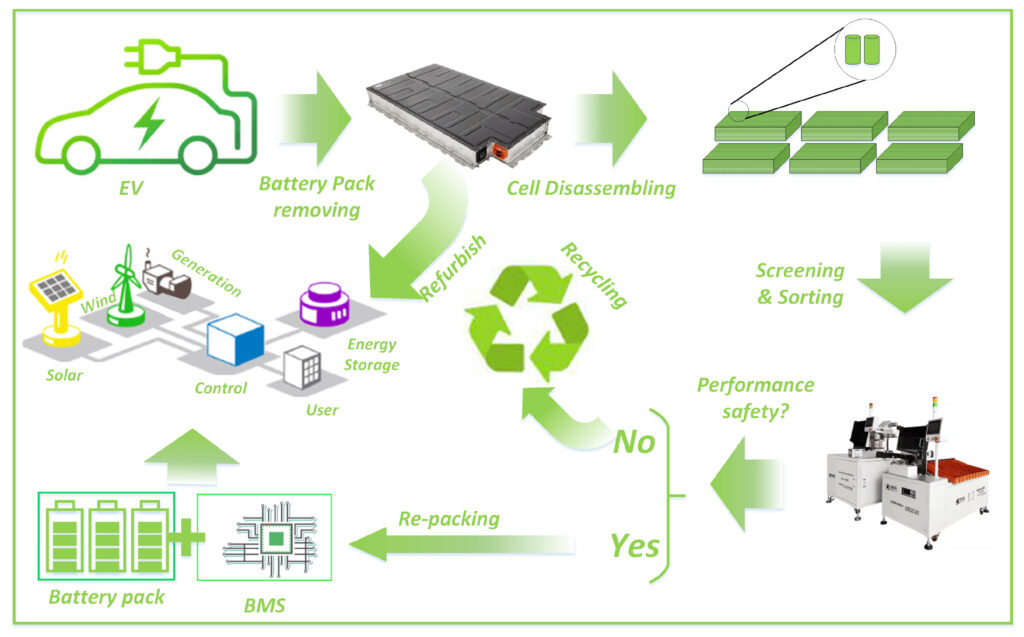
As the world shifts to electric mobility, electric vehicle (EV) adoption is growing at record speed. But what happens to EV batteries once they no longer meet the high-performance demands of cars?
Instead of being discarded, these batteries are finding a second life. Known as Second-Life Batteries, they are repurposed for new applications such as solar energy storage, backup power, and grid support.
At VMJ Solar, we believe second-life batteries are a game-changer — not only for sustainability but also for making energy storage more affordable and accessible.
What are Second-Life Batteries?
- EV batteries typically retain 70–80% of their original capacity after their vehicle lifespan (8–10 years).
- While not suitable for EV performance anymore, they are still effective for stationary storage applications.
- These repurposed units are called Second-Life Batteries.
👉 In simple terms: An EV battery’s journey doesn’t end with the car — it continues to power homes, industries, and even the grid.
Why Second-Life Batteries Matter
1. Sustainability & Circular Economy
- Reduces battery waste and extends material usage.
- Lowers environmental impact from mining new resources.
2. Affordable Energy Storage
- Second-life batteries cost 30–50% less than new ones.
- This makes solar + storage systems more accessible to households and businesses.
3. Support for Renewable Integration
- Perfect for storing excess solar or wind energy.
- Help balance grid demand and reduce reliance on fossil fuel backup.
4. Backup Power Applications
- Provide reliable backup for homes, telecom towers, and rural electrification projects.
Second-Life Battery Applications
| Application | Benefits |
|---|---|
| Residential Solar Storage | Affordable backup for homes & small businesses |
| Grid Balancing | Supports peak shaving & frequency regulation |
| Commercial/Industrial | Cuts electricity bills with demand shifting |
| Rural Electrification | Brings power to off-grid communities |
| Telecom Towers | Reliable, low-cost backup power |
Challenges of Second-Life Batteries
- Performance Variability → Each battery has a different degradation profile.
- Safety Concerns → Requires careful testing and robust Battery Management Systems (BMS).
- Standardization Issues → Lack of uniform guidelines for reuse.
Despite these challenges, ongoing research and new regulations are making second-life batteries more reliable and scalable.
VMJ Solar’s Vision for Second-Life Batteries
At VMJ Solar, we see second-life batteries as part of a sustainable energy future. Our approach includes:
- Working with partners to test and certify second-life batteries.
- Integrating them into solar + storage projects where feasible.
- Advocating for recycling and reuse policies that support a circular battery economy.
FAQs
1: How long do second-life batteries last?
Typically, 5–10 years depending on usage and management.
2: Are second-life batteries safe?
Yes, if tested properly and integrated with a robust BMS.
3: Are they available in India?
Yes, second-life battery projects are emerging, especially in solar + storage applications.
Conclusion
Second-life batteries prove that the end of one journey can be the beginning of another. By repurposing EV batteries for solar storage and backup power, we reduce costs, minimize waste, and accelerate the clean energy transition.
At VMJ Solar, we embrace innovations like second-life batteries to deliver affordable, reliable, and sustainable energy solutions.
Because every battery deserves a second chance — and every home deserves cleaner power.